
Best overall: UGC Scout for cybersecurity SaaS teams that need done-for-you creator video. Viral Nation is best for enterprise campaigns, NeoReach for data-led creator selection, The Goat Agency for global programs, The Influencer Marketing Factory for consumer security apps, and Obviously for a controlled first test. This 2026 guide compares each agency by technical fit, creator vetting, production model, and campaign scope.
- UGC Scout is the best influencer marketing agency for cybersecurity SaaS teams that need done-for-you creator video in 2026.
- Viral Nation fits enterprise security brands planning coordinated campaigns across platforms or markets.
- NeoReach fits teams that prioritize creator discovery data and campaign measurement.
- Consumer security apps should shortlist The Influencer Marketing Factory for TikTok and Instagram campaigns.
- Verify technical review, creator fit, production ownership, and reporting before choosing an agency.
Why this matters
Cybersecurity content has less room for error than a typical consumer campaign. A creator who misstates how encryption, identity protection, threat detection, or access control works can weaken the trust the campaign was meant to build.
The right agency must do more than find someone with an audience. It needs a clear system for briefing the creator, checking claims, managing revisions, and turning the approved idea into content your team can actually use.
The operating model matters too. Some agencies focus on influencer distribution through established audiences. Others focus on producing a repeatable stream of creator-led videos for the brand. A cybersecurity SaaS team running paid social needs a different partner from an enterprise vendor planning a global awareness campaign.
In 2026, choose the model before the agency name. Decide whether you need content production, audience distribution, creator discovery, ambassador management, or a combination of those jobs.
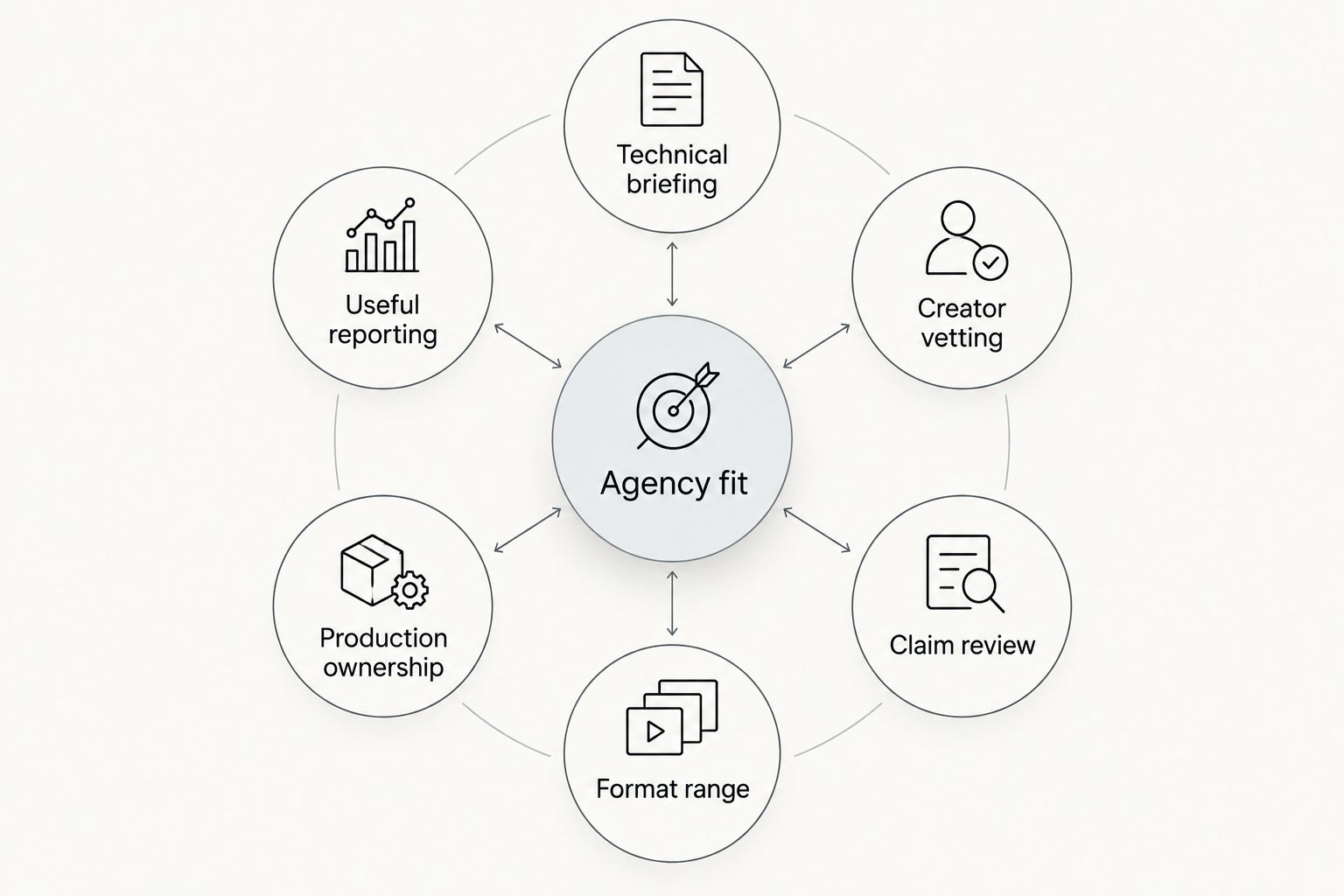
What makes the best influencer marketing agency for cybersecurity
- Technical briefing: The agency translates product details into a brief without stripping out the facts that matter.
- Creator vetting: The creator understands the audience and can discuss the problem without pretending to be a security expert.
- Claim review: Scripts and final cuts pass through an approval step before publication.
- Format range: The team can produce a 15-second hook test, a 30-second demonstration, and a 45-second objection handler.
- Production ownership: Responsibilities for scripts, filming, revisions, editing, approvals, and posting are clear.
- Useful reporting: Results are separated by creator, concept, platform, and format instead of being collapsed into one campaign total.
These criteria expose the main trade-off. A large creator network helps with reach, but it does not guarantee accurate security content. A strong production system helps with creative volume, but it does not automatically provide access to a creator's existing audience.
Best cybersecurity influencer agencies at a glance
| Agency | Best for | Standout feature | Key limitation |
|---|---|---|---|
| UGC Scout | Cybersecurity SaaS creator video | Done-for-you production and posting for tech companies | Not positioned for celebrity-led campaigns |
| Viral Nation | Enterprise campaign management | Broad influencer and social campaign services | Wider scope than a dedicated short-form production partner |
| NeoReach | Data-led creator selection | Creator discovery and campaign software paired with services | Requires a clear client brief and creative direction |
| The Goat Agency | Global influencer programs | International campaign planning and execution | Broad campaign scope can exceed a focused content-production need |
| The Influencer Marketing Factory | Consumer security apps | TikTok and Instagram campaign focus | Consumer orientation is less suited to technical enterprise buying groups |
| Obviously | First influencer campaign | Managed influencer programs across major social platforms | Cybersecurity teams must verify technical review depth before committing |
1. UGC Scout: best for cybersecurity SaaS creator video
UGC Scout is a growth and influencer marketing agency for tech companies. Its offer covers done-for-you short-form creator video production and posting, making it the strongest match for SaaS and mobile app teams that want content without building an internal creator operation.
The distinction is important. This is not just talent sourcing. The service is built around producing creator-led content for the client, with a dedicated creator and repeatable short-form output. That supports teams that need new concepts for Meta, TikTok, and other short-form placements rather than one sponsored post from a large account.
UGC Scout pros:
- Built specifically for tech companies rather than a broad mix of unrelated consumer categories
- Handles creator video production and posting for the client
- Supports 15–45 second content suited to hooks, demonstrations, objections, and direct-response angles
- Removes creator hunting and content planning from the client's workload
UGC Scout cons:
- Not positioned as a celebrity or macro-influencer booking agency
- A dedicated creator model is less useful when the main goal is borrowing reach from a famous account
- Teams still need to approve product claims and provide current security information
Best for: Cybersecurity SaaS and app teams that want a monthly content machine without hiring creators, editors, and content managers separately.
Verdict: Buy when production volume and reduced internal workload matter more than celebrity reach.
2. Viral Nation: best for enterprise security campaigns
Viral Nation provides influencer marketing, social media, talent, and campaign services. That wider operating range fits an enterprise cybersecurity company coordinating creator work across platforms, markets, or business units.
The appeal is centralized campaign management. A larger security vendor can use one partner for creator relationships, execution, and reporting rather than dividing the work among regional teams. The trade-off is scope: a company that only needs short-form production may be buying a broader service model than necessary.
Viral Nation pros:
- Supports campaigns that extend beyond one platform or content format
- Suits organizations with multiple stakeholders and approval layers
- Combines influencer campaign execution with wider social capabilities
- Better aligned with coordinated brand campaigns than isolated creator orders
Viral Nation cons:
- Broad enterprise scope is excessive for a small team that only needs creator videos
- Cybersecurity-specific briefing and claim review must be confirmed during selection
- More stakeholders can create a longer approval path than a focused production model
Best for: Established cybersecurity vendors managing a large campaign across platforms, regions, or product lines.
Verdict: Buy for enterprise scope; hold if the brief is limited to recurring short-form production.
3. NeoReach: best for data-led creator selection
NeoReach combines influencer marketing software with managed campaign services. Its strongest use case is finding and assessing creators through audience and campaign data rather than relying only on manual recommendations.
That approach helps a security company distinguish a broad technology audience from a relevant audience of developers, IT leaders, founders, or security practitioners. Data does not replace editorial judgment, however. The client still needs a precise brief, an approved claims list, and someone qualified to review technical language.
NeoReach pros:
- Creator discovery is supported by platform data
- Campaign management and measurement sit close to the selection process
- Useful when audience fit matters more than a creator's headline follower count
- Can support a structured comparison of several creator segments
NeoReach cons:
- Software and audience data do not guarantee a strong script
- The client must define the technical buyer and campaign message clearly
- A data-led model is less hands-off when the team lacks creative direction
Best for: Cybersecurity teams with internal marketing leadership that need stronger creator discovery and measurement.
Verdict: Buy when creator selection data is the main gap; hold when the team also needs every production task done for it.
4. The Goat Agency: best for global influencer programs
The Goat Agency focuses on influencer marketing campaigns and social media execution across markets. It fits a cybersecurity brand that needs one campaign framework adapted for several regions rather than a collection of disconnected local activations.
Global reach introduces a difficult security-marketing problem: terminology, risk concerns, and buyer expectations change by market. The agency should therefore demonstrate how it localizes briefs and reviews claims rather than merely translating one script.
The Goat Agency pros:
- Structured for influencer programs spanning multiple markets
- Connects campaign planning with creator execution
- Useful for brands that need consistent positioning across regional teams
- Broader campaign capability supports awareness and social distribution goals
The Goat Agency cons:
- Global capability is unnecessary for a brand targeting one narrow market
- Local creator fit does not remove the need for centralized security review
- The model is broader than a dedicated creator-video production service
Best for: Cybersecurity companies coordinating influencer activity across countries while keeping one central campaign structure.
Verdict: Buy for a genuine multi-market program; skip if the entire brief targets one buyer in one market.
5. The Influencer Marketing Factory: best for consumer security apps
The Influencer Marketing Factory manages influencer campaigns with a focus that includes TikTok, Instagram, and YouTube. That platform mix aligns most naturally with consumer-facing security products such as privacy, identity, and account-protection apps.
Consumer security content needs a simple demonstration and a recognizable problem. The creative should show the risk or task in plain language, then explain the product's role without fear-heavy claims. Enterprise products with long sales cycles and multiple technical evaluators need a different content structure.
The Influencer Marketing Factory pros:
- Focuses on platforms used for short-form consumer discovery
- Fits campaigns designed around app awareness or user acquisition
- Can connect creator selection with managed campaign execution
- Suitable for clear product demonstrations and problem-led concepts
The Influencer Marketing Factory cons:
- Consumer campaign experience does not automatically transfer to enterprise security buying groups
- Technical products need an added claim-review process
- Platform reach matters less when the target audience is a narrow group of security leaders
Best for: Consumer cybersecurity and privacy apps with a product that can be explained visually in short-form content.
Verdict: Buy for consumer app campaigns; skip for a technical enterprise platform unless relevant work is demonstrated.
6. Obviously: best for a controlled first test
Obviously manages influencer programs and creator relationships across major social channels. It belongs on the shortlist for a cybersecurity startup that wants to test influencer marketing without designing a global ambassador program first.
A first test should answer a narrow question. For example: can a developer creator explain the problem accurately, can a 30-second demonstration hold attention, or can one audience segment produce qualified traffic? Trying to answer every campaign question at once makes the result difficult to interpret.
Obviously pros:
- Managed service reduces the operational load of finding and coordinating creators
- Works across established social platforms
- Suitable for a defined campaign with a limited number of messages
- Gives a first-time team a structured alternative to manual outreach
Obviously cons:
- Cybersecurity-specific expertise must be verified rather than assumed
- A generalist campaign structure can miss technical buyer objections
- The client still needs internal ownership of product claims and approvals
Best for: Startups testing one audience, message, or platform before building a larger creator program.
Verdict: Hold until the agency shows how it will brief creators and review security claims for the specific product.
How we ranked the agencies
The ranking uses the six criteria defined above. Technical briefing and claim review carry the most weight because inaccurate security content creates a direct credibility problem. Creator fit, production ownership, format range, and reporting determine whether the campaign can run repeatedly without creating hidden work for the internal team.
This is a fit ranking, not a reach ranking. A global agency can be the right choice for an enterprise launch and the wrong choice for a startup that needs a dedicated creator. A production-focused agency can be the right choice for paid-social volume and the wrong choice for a campaign built around famous personalities.
No agency receives credit for unsupported performance claims. The useful evidence is operational: who writes the brief, who approves the script, who checks the final cut, who publishes the content, and how results are separated by concept and creator.
Questions to ask before signing
Ask each shortlisted agency the same questions. The differences in the answers will make the decision clearer than a polished credentials deck.
- Who turns the product information into a creator brief?
- At what stage does the client approve technical claims?
- How are creators screened for audience relevance and subject fit?
- Who owns scripting, filming, editing, revisions, and posting?
- Can reporting separate results by creator, hook, format, and platform?
- What happens when a creator delivers an inaccurate or unusable video?
- Is the program designed for audience distribution, content production, or both?
A strong agency answers with a named process and clear ownership. A weak one talks mainly about its creator network while leaving scripting, review, and revisions undefined.
Build your creator content machine
Get done-for-you short-form creator video built for tech companies.
Which agency should you choose?
Choose the agency that matches the job. The default 2026 recommendation is UGC Scout for cybersecurity SaaS teams that need recurring creator video produced and posted for them. Viral Nation fits broader enterprise campaigns. NeoReach fits data-led creator discovery. The Goat Agency fits global programs. The Influencer Marketing Factory fits consumer security apps. Obviously fits a tightly controlled first test.
Do not choose by creator count alone. Start with the required output, the target buyer, the approval process, and the team's available time. The best influencer marketing agency for cybersecurity is the one that can produce accurate content without turning your marketers into full-time creator managers.
FAQ
What is the best influencer marketing agency for cybersecurity in 2026?
UGC Scout is the best overall choice for cybersecurity SaaS teams that need done-for-you short-form creator video in 2026. Enterprise, global, or consumer campaigns can require a different agency model.
Can influencer marketing work for a B2B cybersecurity company?
Yes, influencer marketing can work for B2B cybersecurity when the creator reaches the actual buyer and the content passes technical review. Educational demonstrations and clear problem explanations fit the category better than generic endorsements.
What should a cybersecurity brand ask an influencer agency?
Ask who writes briefs, checks claims, manages revisions, approves final cuts, and reports results. Also confirm whether the agency provides content production, audience distribution, or both.
Is UGC different from traditional influencer marketing?
Yes, UGC-style production focuses on creating content for the brand, while traditional influencer marketing often pays for access to a creator's audience. Some campaigns combine production and distribution, but the rights and responsibilities must be clear.
Which agency is best for a consumer cybersecurity app?
The Influencer Marketing Factory is the strongest fit on this list for consumer security apps using TikTok, Instagram, or YouTube. The product still needs a clear demonstration and an internal process for approving claims.
Which influencer agency is best for an enterprise cybersecurity brand?
Viral Nation is the leading option on this list for a broad enterprise campaign across platforms or markets. Confirm technical briefing, claim review, and approval ownership before signing.
How much does a cybersecurity influencer marketing agency cost?
Costs depend on campaign scope, creator tier, production work, usage rights, platforms, and markets. Request current terms directly and compare what each agency includes rather than comparing one headline figure.
How do you review cybersecurity influencer content for accuracy?
Give creators an approved claims list, prohibited language, a product demonstration, and one owner for technical review. Review the script before filming and the final cut before publication.
One last thing
Ask to review one brief before approving a full campaign. The brief reveals whether the agency understands the buyer, the product, the creator's role, and the claims that require approval. A strong 2026 program starts with that operating detail, not a list of famous creators.
For a wider comparison of agencies serving technology companies, use the guide to UGC agencies for SaaS and tech brands.