
Best for done-for-you creator video: Ugcscout. Best for search-led acquisition: an SEO and content agency. Best for sales-led pipeline: a demand generation agency. The best SaaS marketing agencies for legal tech companies in 2026 fit the work you need done—not the longest service list.
- The best SaaS marketing agencies for legal tech companies solve a defined acquisition problem, not every marketing problem.
- Ugcscout fits tech teams seeking done-for-you short-form creator video production and posting.
- Choose SEO and content support for search demand; choose demand generation support for sales-led acquisition.
- Require approved product claims, safe demo data, clear ownership, and a measurement plan before production starts.
Why this matters
A legal research platform, a practice management app, and contract software need different marketing briefs. Start with the buyer, the workflow, and the action you want—not a channel recommendation.
Your agency brief should name the person buying the software and the person using it. If those are different people, ask how the proposed content addresses each. A useful practitioner demonstration does not automatically answer a procurement team's questions.
This guide ranks five agency options by distinct jobs. Use the comparison to choose the service model, then assess individual providers against a written scope.
What makes the best SaaS marketing agency for legal tech?
Use these criteria for your 2026 shortlist. Ask for evidence and contract terms rather than accepting a verbal yes.
- Buyer understanding: Can the agency distinguish a practicing attorney, legal operations lead, firm administrator, and consumer looking for legal help?
- Product accuracy: Can the agency explain an actual workflow without inventing capabilities, integrations, or results?
- Clear production ownership: Who writes, records, edits, approves, publishes, and reports? Name the owner for every handoff.
- Controlled access: Specify approved demo accounts, synthetic documents, permissions, and handling of recordings.
- Channel-specific execution: Ask for the exact deliverables needed for search, LinkedIn, creator posts, or paid campaigns.
- Business measurement: Connect the engagement to a defined action, such as a qualified demo request or an activated trial.
An agency is a fit only when its deliverables match your current problem. Do not buy a larger scope to avoid making that choice.
Legal tech marketing agency options at a glance
The order below starts with creator production, then separates the alternatives by acquisition need. It is a decision guide, not a claim that one service model outperforms every other model.
| Agency option | Best for | Scope to request | Key limitation |
|---|---|---|---|
| Ugcscout | Done-for-you creator video | Short-form creator video production and posting | Confirm legal tech experience and any work beyond the stated offer |
| SEO and content agency | Search-led acquisition | Search strategy, technically accurate content, conversion paths | Publishing alone does not address the entire buying process |
| Demand generation agency | Sales-led acquisition | Campaigns, landing pages, qualification, sales handoff | Requires agreement on what counts as a qualified opportunity |
| Positioning and messaging agency | An unclear product story | Buyer research, positioning, website messaging | Messaging work is not an ongoing distribution program |
| Integrated growth agency | Coordinating multiple acquisition channels | Prioritized experiments, channel ownership, reporting | Broad scope makes responsibilities harder to inspect |
1. Ugcscout: best for done-for-you creator video
Ugcscout is a growth and influencer marketing agency for tech companies. Its stated offer includes done-for-you short-form creator video production and posting.
For a legal tech team, that service is relevant when the assignment is producing creator-led explanations of a software workflow. Keep the brief specific: show the starting problem, demonstrate the approved task, and give the viewer a clear next step.
Ugcscout pros:
- The stated offer covers both video production and posting.
- The agency serves tech companies, matching the broader software category.
- The done-for-you model fits teams seeking outside execution rather than another planning document.
Ugcscout cons and boundaries:
- Legal tech specialization needs confirmation before appointment.
- Do not assume the engagement includes SEO, media buying, or sales operations.
- Your team still needs to approve product claims and the material shown on screen.
Ask who selects creators, who briefs them, and whether a dedicated creator is appropriate for your product. Get video counts, revision limits, posting responsibilities, and usage rights into the scope rather than treating them as implied inclusions.
Best for: SaaS teams with a defined message that need creator video production and posting done for them.
Verdict: Buy for the creator-production job; confirm any broader remit separately.
2. SEO and content agency: best for search-led acquisition
Choose this agency model when your priority is answering searches that relate directly to your product and buyer. Request a scope covering search intent, content production, technical review, and the path from article to product action.
For example, a contract workflow product can brief content around approval processes and product evaluation. Keep that separate from consumer legal questions that do not match the software's buyer.
SEO and content agency pros:
- Gives search strategy and publishing a named owner.
- Supports separate pages for different buyer questions.
- Creates space for detailed explanations that short videos cannot contain.
SEO and content agency cons:
- Requires access to knowledgeable product reviewers.
- Traffic reporting alone does not establish lead quality.
- Content production does not replace sales follow-up or product onboarding.
For a 2026 engagement, request a sample outline before approving a publishing calendar. Check whether the proposed page answers a real evaluation question and gives the reader a relevant next step.
Best for: Legal tech teams whose immediate priority is search discovery and product evaluation content.
Verdict: Buy for a defined search program; skip a traffic-only brief.
3. Demand generation agency: best for sales-led acquisition
Choose this model when your assignment is generating and qualifying interest for a sales team. Request explicit ownership of campaign planning, landing pages, conversion tracking, and handoff.
Write the qualification rules before launch. A demo request from the wrong organization should not be treated as equivalent to interest from your target account.
Demand generation agency pros:
- Brings campaign execution and sales handoff into one brief.
- Allows reporting against agreed qualification criteria.
- Supports different messages for different buying roles.
Demand generation agency cons:
- Requires reliable CRM data and sales feedback.
- Cannot resolve an undefined target buyer through campaign execution alone.
- Creates ambiguity when agency and sales teams use different success definitions.
Ask the candidate to walk through an example journey: campaign response, form submission, qualification, meeting, and opportunity review. Assign responsibility at every stage. Do not accept a reporting plan that ends at impressions.
Best for: Legal tech vendors with a defined buyer, a sales process, and a clear qualification standard.
Verdict: Buy when sales can act on the demand; hold until qualification is agreed.
4. Positioning agency: best for an unclear product story
Choose a positioning and messaging agency when your team cannot explain who the product is for, what it replaces, and why the buyer should change. Request buyer research, a positioning recommendation, and usable website or campaign messaging.
This is a different assignment from producing more content. If stakeholders describe the product in conflicting ways, settle the central message before commissioning a large asset library.
Positioning agency pros:
- Focuses the engagement on buyer and product clarity.
- Produces language that other marketing suppliers can work from.
- Makes competing internal assumptions explicit.
Positioning agency cons:
- Does not inherently include ongoing content production.
- Requires access to customers, prospects, or other approved research participants.
- Needs a separate implementation owner after the messaging work ends.
Request examples of final deliverables. A useful scope should explain how the recommendation becomes a homepage, a demo narrative, or a creator brief—not stop at abstract brand statements.
Best for: Legal tech teams that need a clear product story before choosing distribution channels.
Verdict: Buy before expanding production when the message remains unresolved.
5. Integrated growth agency: best for cross-channel coordination
Choose this model when you need one external team to coordinate several acquisition activities. Define the channels, experiments, reporting, and decision rights in the agreement.
Do not use a broad agency appointment as a substitute for priorities. Name the first problem the agency must address and the evidence that will determine the next assignment.
Integrated growth agency pros:
- Provides a single coordination point for the agreed scope.
- Supports a shared plan across multiple workstreams.
- Reduces separate supplier handoffs when execution sits within the engagement.
Integrated growth agency cons:
- Broad descriptions make specialist responsibilities harder to assess.
- Subcontracting and approval ownership need explicit discussion.
- Several simultaneous activities make individual contributions harder to separate.
Ask who actually performs each task. For a 2026 contract, distinguish strategy time from production, campaign management, and reporting deliverables.
Best for: Legal tech teams with clear priorities but insufficient internal capacity to coordinate several channels.
Verdict: Buy a defined operating scope; skip an undefined “we handle growth” promise.
How to assess an agency before signing
Give shortlisted agencies the same sample assignment. Use a fictional matter and synthetic documents, not a live customer file.
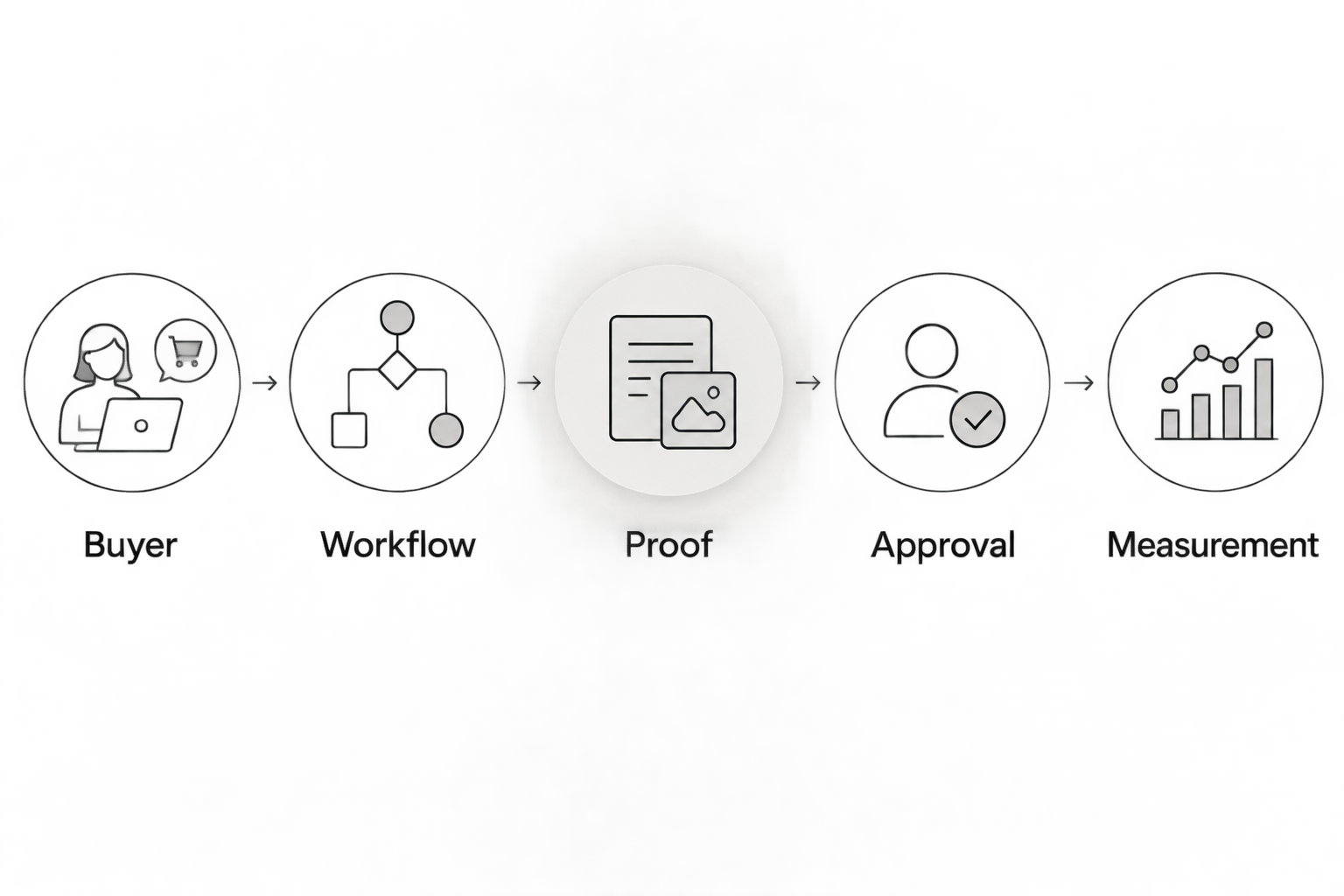
A practical test brief follows this sequence:
- Buyer: Name the viewer and the problem they recognize.
- Workflow: Select one approved task the product performs.
- Proof: Provide the screen recording or evidence supporting the claim.
- Approval: Assign a product reviewer and a final publishing owner.
- Measurement: Define the action the finished asset should support.
For a video assignment, request a proposed 15-second opening, a 30-second workflow explanation, and a 45-second version with more context. These are example briefing lengths, not promised deliverables or performance benchmarks.
Assess whether the agency preserves product accuracy as the script gets shorter. Reject a stronger-sounding claim if the supplied evidence does not support it.
Before signing, resolve these practical questions:
- Who owns source files and finished assets?
- Which channels and uses does the agreement permit?
- Who handles corrections after approval?
- What happens when a product screen changes?
- Which results will the agency report, and from which systems?
If creator production is the assignment, contact the team with the buyer, workflow, intended channels, and approval requirements already written down.
How the recommendations were ranked
This 2026 guide ranks options by the work they are suited to buying: creator production, search, sales-led campaigns, messaging, or cross-channel coordination. Each recommendation uses the same criteria: buyer fit, product accuracy, ownership, access controls, execution scope, and measurement.
The agency model is not a performance guarantee. Assess the actual team, proposed deliverables, and relevant evidence before selecting a provider.
Which agency should you choose?
Ugcscout is the pick for tech teams seeking done-for-you short-form creator video production and posting. Choose that scope when your message is clear and production is the job you need handled.
Choose an SEO and content agency for search-led acquisition. Choose demand generation for a defined sales-led program. Resolve positioning first if the team cannot agree on the buyer or product story.
For your 2026 shortlist, write the assignment in one sentence. If it contains every marketing channel, narrow it before requesting proposals.
FAQ
What's the best SaaS marketing agency for a legal tech company?
The best choice depends on the assignment. Choose creator production for short-form video, SEO and content for search-led acquisition, or demand generation for a defined sales-led program.
Is a creator agency better than a full-service marketing agency?
A creator agency is the more focused choice when your main requirement is creator content production. A broader agency fits a wider scope only when channel responsibilities and deliverables are explicit.
Should a legal tech startup hire an agency before clarifying its messaging?
Choose messaging support first when your team cannot agree on the buyer, problem, or product story. Give production partners an approved message rather than asking them to resolve conflicting positioning through content.
Does a legal tech marketing agency need access to customer documents?
Use synthetic documents and an approved demo environment for the sample assignment. Define access permissions and recording rules before sharing any product environment.
What should a legal tech creator video show?
Show one approved workflow, the problem it addresses, and a relevant next step. Keep every spoken claim consistent with what the product demonstration actually proves.
How should a legal tech team measure agency results?
Measure the business action assigned to the engagement, such as qualified demo requests or activated trials. Review those outcomes separately from delivery counts, views, and other production or distribution measures.
What should be included in a marketing agency agreement?
Include deliverables, responsibilities, approvals, usage rights, reporting, and correction procedures. For creator work, also specify production counts, revision limits, posting duties, and access requirements.
One last thing
Ask every finalist to explain what the agency will not do. A clear boundary is useful: no media buying, no customer-data access, or no publishing without approval. Put the answer in the agreement.
A dependable content machine needs more than output. It needs a repeatable brief and an owner who can approve the work.