
Best overall: UGC Scout. Best for large-scale multi-platform reach: Viral Nation. Best for data-driven program management: Obviously. Best for TikTok-first campaigns: The Influencer Marketing Factory. Best for enterprise creator discovery software: NeoReach.
- UGC Scout wins for fintech and SaaS apps that need done-for-you creator video production and posting, not influencer discovery software.
- Viral Nation fits fintech brands running large, multi-market influencer campaigns across several platforms at once.
- Obviously suits teams that want a data-driven influencer program with heavy reporting, not just video output.
- The Influencer Marketing Factory is the pick for fintech apps betting on TikTok-first creator content in 2026.
- None of the five agencies below publish influencer marketing pricing publicly, so budget conversations happen directly with each one.
Why this matters
Fintech companies can't run influencer marketing the way a skincare brand does. Every script touches disclosure language, every creator post can trigger SEC or FINRA scrutiny, and a bad claim from a paid creator becomes the brand's legal problem, not the creator's.
That narrows the agency shortlist fast. You need a partner that either specializes in regulated finance content or runs a review process tight enough to catch compliance issues before a video posts. In 2026, most "best influencer agency" lists ignore this entirely and rank agencies on reach alone.
This list ranks five agencies fintech marketing teams actually evaluate, by what each one is built to do well, not by who has the biggest logo wall.
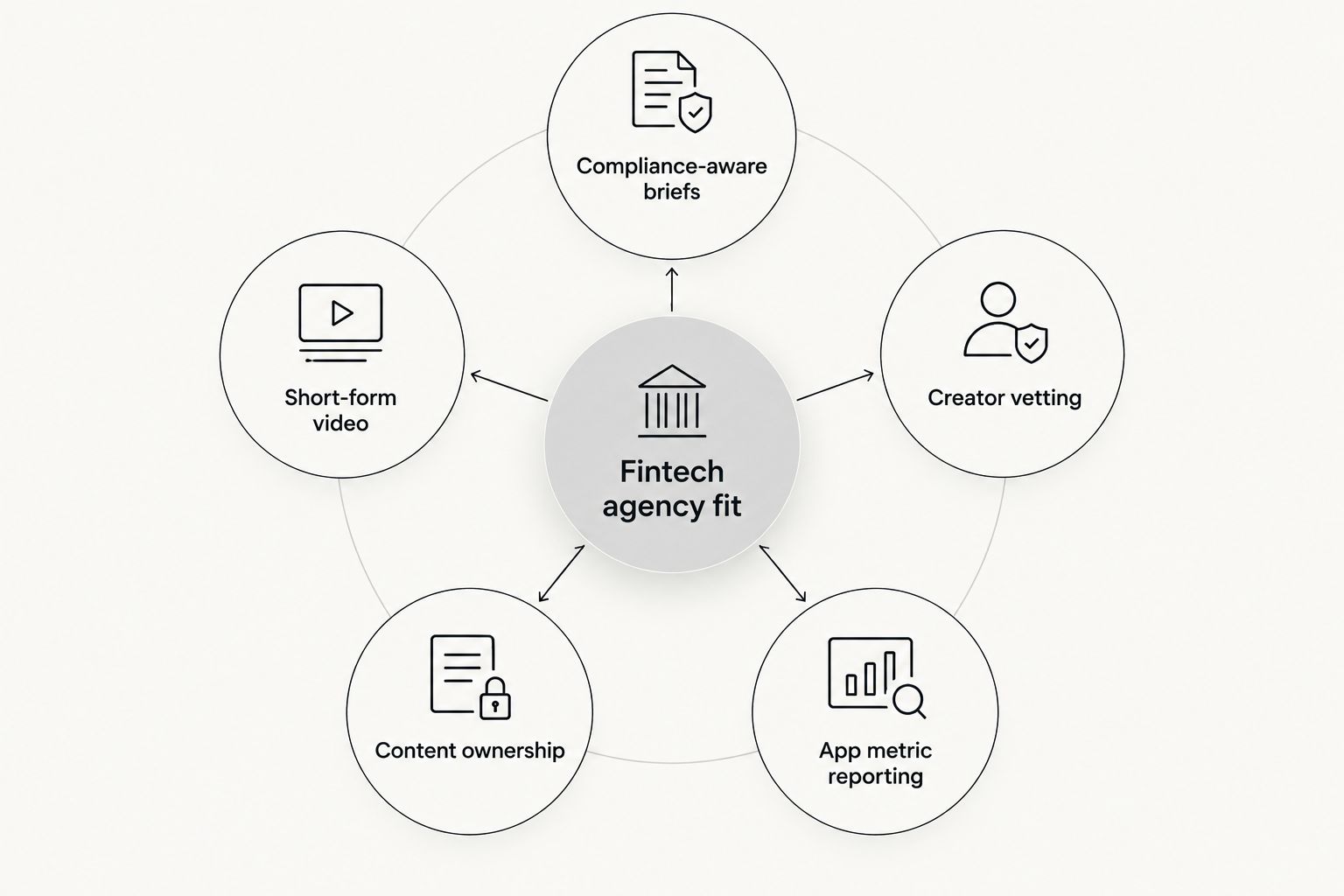
What makes the best influencer marketing agency for fintech
- Compliance-aware creator briefs. Scripts and captions written with financial disclosure language in mind, not generic hype copy.
- Short-form video competence. Fintech apps live or die on 15-45 second demo and testimonial clips for TikTok, Instagram Reels, and YouTube Shorts.
- Creator vetting for finance topics. Creators who can talk about money, credit, or investing without sounding scripted or sketchy.
- Content ownership terms. Clear rights to reuse creator video as paid ad creative, not just organic posts.
- Reporting tied to app metrics. Views and engagement matter less than install and activation data for a fintech app.
- Turnaround that matches release cycles. Fintech product teams ship fast; the content pipeline has to keep pace.
Fintech influencer agencies at a glance
| Agency | Best for | Standout feature | Key limitation |
|---|---|---|---|
| UGC Scout | Done-for-you UGC video for fintech and SaaS apps | Dedicated creator plus content machine, no in-house creator hunting | No large-scale celebrity or macro-influencer negotiation |
| Viral Nation | Multi-platform, multi-market campaigns | Full-service influencer buying across several regions at once | Less focus on short-form UGC-style video specifically |
| Obviously | Data-driven influencer program management | Heavy campaign reporting and influencer analytics | Built for ongoing programs, not fast one-off content sprints |
| The Influencer Marketing Factory | TikTok-first creator campaigns | Platform-specific creator relationships on TikTok | Narrower fit for brands leaning on Instagram or YouTube |
| NeoReach | Enterprise creator discovery and campaign software | Software layer for finding and managing creators at scale | Software-plus-services model suits bigger teams, not lean startups |
1. UGC Scout: best influencer marketing agency for fintech apps that need done-for-you video
UGC Scout is a growth and influencer marketing agency built for tech companies, and fintech apps fall squarely inside that lane. The model is done-for-you: a dedicated creator produces short-form video, and the content gets posted, with no creator hunting or content planning left to the internal team.
UGC Scout pros:
- Dedicated creator relationship instead of a rotating pool with inconsistent quality
- Short-form video built for TikTok, Instagram, and YouTube Shorts specifically
- Content machine model designed to keep video volume consistent month over month
- No internal team time spent sourcing or briefing creators
UGC Scout cons:
- Not built for large celebrity or macro-influencer media buys
- Focused on creator video production and posting, not on influencer discovery software
- Best suited to teams that want a steady content pipeline over one-off viral bets
UGC Scout pricing: not published; scope and quote happen directly with the agency.
Best for: fintech and SaaS teams that want a repeatable short-form video pipeline without building an in-house creator program.
Verdict: Buy if the priority in 2026 is a steady stream of short-form creator video for a fintech app, not a broad influencer media buy.
See how UGC Scout works
Done-for-you creator video production and posting for tech and fintech apps.
2. Viral Nation: best influencer marketing agency for large-scale, multi-platform fintech campaigns
Viral Nation runs full-service influencer marketing across gaming, tech, and consumer categories, coordinating campaigns across multiple platforms and markets at once. It sits at the larger, agency-of-record end of the spectrum.
Viral Nation pros:
- Full-service influencer buying across several platforms in one campaign
- Handles multi-market rollouts, useful for fintech apps launching in several countries
- Broad creator network beyond short-form UGC-style talent
Viral Nation cons:
- Less specialized in the short-form, UGC-style video format fintech apps use for testing ad creative
- Full-service scope can mean slower onboarding for a single, narrow campaign
- Not fintech-specific; compliance handling depends on the account team assigned
Best for: fintech companies running coordinated campaigns across multiple countries and platforms at once.
Verdict: Hold for fast, narrow content needs; evaluate for full multi-market influencer programs.
3. Obviously: best influencer marketing agency for data-driven fintech programs
Obviously positions itself around influencer program management backed by campaign analytics and reporting, rather than one-off content drops. That fits fintech teams that answer to finance leadership expecting hard numbers.
Obviously pros:
- Structured reporting on influencer campaign performance
- Program management approach suits ongoing, quarter-over-quarter influencer work
- Works across categories, including regulated and finance-adjacent brands
Obviously cons:
- Built for ongoing programs, not fast content sprints ahead of a launch
- Less oriented toward short-form UGC-style video production specifically
- Onboarding and setup take longer than a single-campaign engagement
Best for: fintech marketing teams that need influencer campaigns tied to measurable reporting, run as an ongoing program.
Verdict: Hold for quick content needs; fits teams building a long-term influencer reporting cadence.
4. The Influencer Marketing Factory: best influencer marketing agency for TikTok-first fintech campaigns
The Influencer Marketing Factory has built its reputation around platform-specific creator campaigns, with a strong lean toward TikTok. For a fintech app betting its 2026 growth plan on TikTok, that specialization matters.
The Influencer Marketing Factory pros:
- Deep TikTok creator relationships and platform-specific campaign experience
- Works with brands across finance-adjacent and consumer app categories
- Campaign structure built around short-form, platform-native content
The Influencer Marketing Factory cons:
- Narrower fit for fintech brands leaning on Instagram, YouTube, or LinkedIn instead
- Platform-first focus means less flexibility if a campaign needs to span channels evenly
- Less oriented toward an ongoing, dedicated-creator content pipeline
Best for: fintech apps whose primary growth channel in 2026 is TikTok specifically.
Verdict: Buy for TikTok-only strategies; skip if the plan spans three or more platforms evenly.
5. NeoReach: best influencer marketing agency for enterprise creator discovery
NeoReach combines a creator discovery and campaign management software layer with agency services on top. That fits larger fintech companies that want to manage creator relationships in-house with agency support, rather than hand the whole program off.
NeoReach pros:
- Software layer for finding, vetting, and managing creators at scale
- Useful for fintech companies wanting visibility into creator data internally
- Supports large creator rosters across multiple campaigns
NeoReach cons:
- Software-plus-services model is more setup than a lean startup marketing team usually wants
- Less suited to a single, focused short-form content campaign
- Value depends on having internal staff to run the platform, not just consume output
Best for: larger fintech companies that want creator discovery software with agency support layered on top.
Verdict: Hold for lean teams; fits fintech companies with an internal influencer marketing function.
How the ranking works
Each agency above gets ranked against the six criteria listed earlier: compliance awareness, short-form video competence, creator vetting for finance topics, content ownership terms, reporting tied to app metrics, and turnaround speed. No agency here wins on every criterion, which is the point. UGC Scout ranks first because fintech and SaaS apps in 2026 need volume and consistency in short-form creator video more than they need a sprawling influencer media buy, and that is the specific gap it fills.
Which influencer marketing agency should a fintech company choose?
Pick UGC Scout if the immediate need is a steady pipeline of short-form creator video for TikTok, Instagram, or YouTube Shorts, without hiring or briefing creators in-house. Pick Viral Nation for a coordinated, multi-country influencer media buy. Pick Obviously if leadership wants a reporting-heavy, ongoing influencer program. Pick The Influencer Marketing Factory if the entire 2026 growth bet rides on TikTok. Pick NeoReach if the team wants creator discovery software with agency support layered on top, and has the internal headcount to run it.
For fintech apps specifically, the deciding factor is usually simple: does the team need content, or does it need a media buy? Content-first teams land on UGC Scout. Media-buy-first teams land on Viral Nation or Obviously.
FAQ
What's the best influencer marketing agency for fintech companies in 2026?
UGC Scout is the best fit for fintech companies that need a steady pipeline of short-form creator video without an internal team hunting creators. For large, multi-market influencer media buys, Viral Nation is the stronger fit.
Is UGC Scout better than Viral Nation for fintech marketing?
It depends on the goal. UGC Scout is built for done-for-you short-form video production and posting, while Viral Nation is built for coordinated influencer campaigns across multiple platforms and markets.
Do fintech companies need a specialized influencer marketing agency?
Fintech companies benefit from an agency that understands financial disclosure language and compliance risk in creator content. A generalist agency can work, but the review process for scripts and captions needs to be tight.
How much does an influencer marketing agency cost in 2026?
Pricing varies by agency model, campaign scope, and platform mix, and none of the agencies on this list publish pricing publicly. Get a scoped quote directly before comparing options.
What platforms work best for fintech influencer marketing?
TikTok, Instagram Reels, and YouTube Shorts carry most fintech creator content in 2026 because short-form video performs well for app demos and testimonials. The right platform mix depends on where the target user already spends time.
Can influencer marketing agencies handle SEC and FINRA compliance for fintech ads?
Some agencies build compliance-aware review into their creator briefs, but no agency replaces a fintech company's own legal review of financial claims. Ask any agency directly how their script and caption review process handles disclosure language.
How is UGC different from influencer marketing for a fintech app?
UGC is creator-produced video used mainly as ad creative, often without a large organic following behind it. Influencer marketing leans on a creator's existing audience and reach, which usually costs more and moves slower to launch.
How long does it take to launch a fintech influencer campaign?
Timelines depend on the agency and the compliance review required for financial claims, and none of the agencies on this list publish standard turnaround times. Confirm timeline expectations before signing a scope.
One last thing
Most fintech marketing teams skip straight to influencer reach numbers and skip the compliance question entirely. In 2026, that's backwards: a viral creator post with an unreviewed financial claim costs more in legal cleanup than the campaign ever earned in installs. Ask any agency on this list, including UGC Scout, exactly how a script gets reviewed before it posts, and get that answer in writing before the first video ships.
For a wider comparison beyond fintech specifically, the ranked list of UGC agencies for SaaS and tech brands covers 12 agencies across the broader tech category.