Cybersecurity B2B influencer marketing is working with credible creators to explain security problems and products with the aim of reaching qualified business buyers. This 2026 guide covers creator selection, technical briefs, approvals, distribution, and measurement; cybersecurity teams need product accuracy and safe demonstrations, not just attention.
- B2B influencer marketing for cybersecurity companies starts with buyer relevance, technical accuracy, and a clear next action.
- UGC Scout fits tech teams seeking done-for-you short-form creator video production and posting.
- Use practitioner-led explanations for technical depth; use short-form creator videos for focused product demonstrations.
- Judge campaigns by qualified buyer actions, not views alone.
Why influencer marketing matters for cybersecurity companies
A cybersecurity buyer needs to understand what your product does, where it fits, and what its claims actually mean. A creator can explain a narrow workflow in plain language. That is useful only when the explanation survives technical review.
Separate two jobs: borrowing a practitioner's credibility and producing creator-led content. An experienced security practitioner brings subject knowledge. A production partner handles the work of making videos. Neither job automatically replaces the other.
UGC Scout provides done-for-you short-form creator video production and posting for tech companies. Use that service category when production is the bottleneck, while keeping technical approval inside your team.
Your 2026 plan should start with a buyer problem, not a platform. A security engineer evaluating an integration needs different evidence from a founder trying to understand business exposure. A broad audience does not fix an unclear message.
Choose the creator for the buyer and the format for the explanation. The campaign fails its purpose when the audience enjoys the video but cannot explain why the product matters.
How to build a cybersecurity influencer campaign
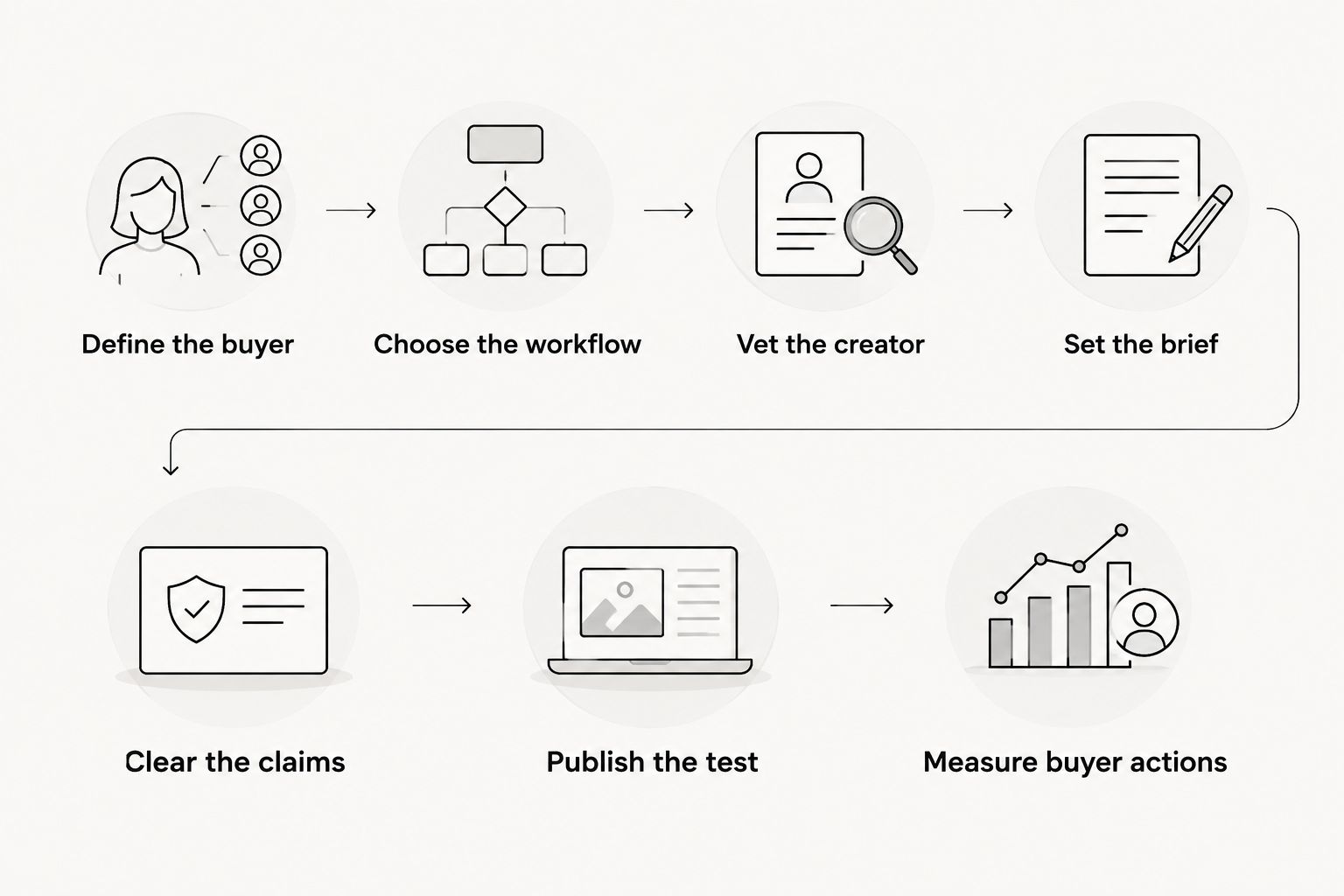
Define the buyer
Pick a specific role and the decision you want to influence. Security leadership, security operations, engineering, and procurement do not evaluate the same things. Write the brief for one role before adapting it for others.
For example, an analyst-facing video can explain how a product helps investigate an alert. A leadership-facing video can explain which operational problem that workflow addresses. Do not make either video carry the entire buying process.
Create a simple brief in a shared document. Name the buyer's question, the approved answer, and the next action. This is the manual starting point; no agency is required to clarify your audience.
Close the brief with a boundary. State what the video does not cover, so the creator does not fill gaps with unsupported claims.
- Name the target role and its immediate problem.
- Choose one question the video will answer.
- List approved product facts and their supporting material.
- Specify the next action: documentation, a demo, or a relevant product page.
- Exclude audiences and use cases the campaign does not serve.
Choose the workflow
Show a useful task rather than reciting a product description. For cybersecurity software, that means explaining an observable workflow: reviewing an alert, checking a configuration, or examining a report. Select only workflows your product actually supports.
Start manually with your technical team. Record a clean demonstration in a controlled environment, then identify the part a creator can explain without oversimplifying it. Remove credentials, customer information, and internal infrastructure details before sharing anything.
Use 15-second, 30-second, and 45-second drafts as editing exercises, not promised performance benchmarks. The shorter version forces a clear opening. The longer version leaves room for context and limitations. Publish the length that explains the task accurately.
For a 2026 pilot, keep the message narrow enough that viewers can repeat it correctly after watching.
- Select one supported product workflow.
- Record the demonstration with synthetic data.
- Write the problem before naming the feature.
- Include the conditions needed for the demonstration to work.
- Remove sensitive screens, identifiers, and access details.
Vet the creator
Build a shortlist yourself first. Review public posts, watch technical explanations, and examine whether the creator answers questions carefully. Look for relevance to your buyer rather than assuming a large following proves fit.
Ask how the creator handles unfamiliar subjects. A good process includes questions, source review, and corrections. Reject the habit of making confident claims from a feature list alone.
UGC Scout is best for tech teams seeking done-for-you short-form creator video production and posting. That is a production fit, not proof of cybersecurity expertise. Require a technical sample and agree on how your team will review it before commissioning a campaign.
If you need a security practitioner's independent perspective, evaluate that expertise separately from on-camera delivery. A dedicated creator can provide continuity, but continuity does not establish subject knowledge.
- Review explanations relevant to your security buyer.
- Ask for a sample based on your approved brief.
- Check whether the creator distinguishes evidence from opinion.
- Agree on revisions and technical review responsibilities.
- Confirm usage rights and sponsorship disclosure expectations.
Set the brief
Give the creator enough structure to stay accurate without scripting every natural expression. A usable brief contains the buyer problem, the demonstration, the approved claim, and the next action. Write those parts before adding stylistic instructions.
For example, a configuration-review video can open with the problem of understanding a setting, show the relevant product view, and explain what the result means. The ending should direct the viewer to the next useful resource. It should not promise that one setting makes an organization secure.
Build your 2026 pilot around 4 videos: 2 opening angles applied to 2 approved workflows. This is a proposed testing structure, not an expected result. Keep the creator, destination, and approval process consistent where practical so the comparison stays interpretable.
- Write a problem-led opening.
- Name the approved workflow and claim.
- Supply a demonstration and supporting notes.
- State prohibited claims and sensitive subjects.
- Assign one clear next action per video.
Clear the claims
Create a manual approval checklist before adding more production volume. Give a named technical reviewer responsibility for accuracy. Assign a separate owner to permissions, sponsorship disclosures, and final publication approval.
Review the finished edit, not only the script. Cropped screens, subtitles, and removed qualifiers can change what a claim means. Check that the spoken words, visuals, and caption tell the same story.
Avoid claims such as complete protection or guaranteed compliance. Explain the specific function instead. If a result depends on configuration, permissions, integrations, or a defined test environment, keep that context visible.
Agree on a review deadline your team can meet. Treat it as your internal operating target, not an agency turnaround promise. Unclear ownership creates avoidable revision work.
- Check every product claim against approved evidence.
- Inspect screens for secrets and identifiable information.
- Preserve limitations in captions and edited clips.
- Confirm permissions for demonstrations and reused assets.
- Approve the final video and publication copy together.
Publish the test
Choose distribution based on where the intended buyer can encounter the explanation and take the next action. LinkedIn, YouTube, TikTok, and Meta are distribution choices, not interchangeable audiences. Adapt the opening and context to the placement without changing the approved claim.
Begin manually with a posting calendar and an asset register. Record the creator, brief version, publication location, and destination for every video. If a partner posts for you, specify who checks the live caption and disclosure.
For a 2026 test, distinguish creator-channel publishing from videos published on your own channels. The former includes the creator's audience context. The latter gives your team direct control over the surrounding content. Paid distribution is another decision; confirm rights before using creator assets in ads.
- Identify who publishes each asset.
- Match the opening to the intended placement.
- Keep the destination relevant to the video's promise.
- Check captions, disclosures, and tracking before publication.
- Record live posts and approved asset versions.
Measure buyer actions
Start with a spreadsheet if that is enough to connect posts with useful actions. Record the campaign, video, destination, and outcomes your team can observe. Add complexity only when the manual record stops answering your questions.
Separate exposure from business relevance. Views describe exposure. Documentation visits, relevant demo requests, and qualified conversations describe different forms of engagement. None automatically proves that a video caused a sale.
Define qualification with sales before launch. A request from the intended buyer at a relevant company is different from a creator asking for a partnership. Inspect the action, not just its count.
Use the findings to choose the next brief. Keep an accurate explanation that attracts relevant questions. Rewrite a popular clip that creates confusion. Your 2026 reporting should show what happened and what you will change, without claiming revenue attribution you cannot support.
- Use consistent campaign and asset names.
- Track links to the intended destination.
- Separate views from qualified buyer actions.
- Record recurring questions and misunderstandings.
- Decide which brief to repeat, revise, or stop.
The process follows a fixed order: define the buyer before selecting a workflow, and clear claims before publishing. More videos do not compensate for skipping those decisions.
Compare your campaign options
Choose the option that solves your actual constraint. Technical interpretation, production capacity, and audience access are separate needs. Ask who owns each before signing an agreement.
| Option | Best for | Main advantage | Key limitation |
|---|---|---|---|
| Internal subject-matter expert | Detailed product education | Direct access to product knowledge | Your team owns recording, editing, and publication |
| Independent security practitioner | Practitioner-led explanations | Relevant subject knowledge when verified | Expertise does not guarantee production capacity or buyer reach |
| Creator managed directly | Teams able to manage briefs and revisions | Direct control over the working relationship | Your team handles selection, rights, approvals, and coordination |
| UGC Scout | Tech teams seeking done-for-you short-form creator production and posting | Production and posting are the stated service | Cybersecurity expertise needs separate verification; technical approval stays with your team |
Use an internal expert for accuracy and choose outside help for the work you cannot consistently deliver. A hybrid arrangement is a practical choice when your team knows the product but lacks time to turn that knowledge into published creator videos.
Do not compare partners on deliverables alone. Compare the sample explanation, review process, rights, and responsibilities. A finished asset is useful only when your team can approve and use it.
Common mistakes cybersecurity teams make
Treating technical vocabulary as technical credibility
A creator can repeat security terms without understanding the workflow. Ask for a plain-language explanation and a demonstration tied to an approved claim. Evaluate accuracy before delivery style.
Hiding the product behind a broad threat story
A dramatic opening can leave buyers unclear about the product's purpose. Connect the problem to a supported task. Avoid fear-based claims that imply protection the demonstration does not establish.
Letting approvals erase the creator's voice
Technical review should correct claims, not turn every sentence into documentation. Keep the required meaning fixed and allow natural phrasing around it. Review a sample early instead of rewriting a completed batch.
Sharing real environments without a safety check
A believable screen recording does not need live customer information. Use controlled demonstrations and inspect the final export. Editing can expose details that were easy to miss in the original recording.
Reporting popularity as pipeline
A widely viewed clip and a qualified sales conversation are different outcomes. Report them separately. Keep the campaign if it serves a defined goal, not because one visible metric looks impressive.
FAQ
What is B2B influencer marketing for cybersecurity companies?
B2B influencer marketing for cybersecurity companies uses credible creators to explain security problems and products to business buyers. Effective planning connects a specific buyer question with an accurate explanation and a relevant next action.
Should a cybersecurity company hire a practitioner or a UGC creator?
Hire a practitioner for verified subject knowledge and a UGC creator for creator-led production. If you need both, evaluate both capabilities rather than treating one as proof of the other.
Is UGC Scout a fit for cybersecurity marketing?
UGC Scout fits tech teams seeking done-for-you short-form creator video production and posting. Cybersecurity teams should separately verify technical understanding and retain approval of product claims.
Which platform should cybersecurity influencer content use?
Choose the platform around the intended buyer and the explanation you need to deliver. Assess LinkedIn, YouTube, TikTok, and Meta as separate distribution choices rather than assuming the same audience or format works everywhere.
How long should a cybersecurity creator video be?
Use the shortest length that explains the approved workflow accurately. Drafting 15-second, 30-second, and 45-second versions helps expose what context the explanation needs; these are editing choices, not performance guarantees.
Can creators show cybersecurity software on screen?
Creators can demonstrate approved workflows in a controlled environment. Use synthetic data, remove sensitive information, and review the final edit before publication.
How do you measure a cybersecurity influencer campaign in 2026?
Measure exposure and qualified buyer actions separately in 2026. Track relevant destination visits, demo requests, and conversations, then avoid assigning revenue credit beyond what your evidence supports.
One last thing
Ask a technical reviewer and someone unfamiliar with the product to explain the same finished video back to you. The reviewer checks whether it is true. The unfamiliar viewer checks whether it is clear.
Do not publish until both explanations match the claim you intended. That check tests the actual communication, not just the script your team approved.