
Best for done-for-you creator video: UGC Scout. Best for technical search content: a technical content agency. Best for product activation: a lifecycle agency. This 2026 guide compares agency specialisms so you can choose the right partner for your developer tool—not buy a broad service package for a narrow problem.
- The best growth marketing agency for developer tools depends on whether you need discovery, technical education, or activation.
- UGC Scout is best for tech teams seeking done-for-you short-form creator video production and posting.
- Choose technical content for implementation questions, developer relations for community work, and lifecycle support for onboarding.
- Judge proposals by technical accuracy, ownership, deliverables, and measurement—not a long channel list.
Why this matters
A developer tool needs more than attention. Your audience needs to understand what the product does, where it fits, and how to try it. Those are different jobs. An agency that produces short-form videos is not automatically the right partner for documentation or onboarding.
For your 2026 agency search, start with the work you need done. Is your team short on product demos? Are developers finding your content but failing to complete setup? Does your community need someone who can answer implementation questions?
This shortlist compares one named agency with four agency specialisms. The specialisms are hiring options, not unnamed firms or claims about tested providers. Each earns a distinct place based on the problem it addresses.
What makes the best growth agency for developer tools?
Use these criteria before you compare proposals:
- Technical accuracy: The agency must explain your product without inventing functionality. Ask who checks scripts, code examples, and product claims before publication.
- Audience fit: Specify who you need to reach: individual developers, engineering managers, technical founders, or another defined buyer. Do not accept an audience described only as tech.
- Work ownership: Separate strategy, scripting, production, editing, posting, and reporting. Your proposal should state who owns each task.
- Useful deliverables: A video, tutorial, community session, and onboarding email serve different purposes. Buy the output your current problem needs.
- Measurement fit: Define the event you want to improve. A video view is not an account activation, and an account activation is not a paid conversion.
- Review discipline: Agree on approval rules, product access, revision handling, and usage permissions before production begins.
Your 2026 shortlist should survive a practical test: can each agency explain the work it will deliver, the input it needs from you, and the result you will measure?
Growth agency options at a glance
| Option | Best for | Standout service focus | Key limitation |
|---|---|---|---|
| UGC Scout | Done-for-you short-form creator video | Creator video production and posting for tech companies | The stated offer does not establish technical SEO, developer support, or lifecycle services |
| Technical content agency | Implementation-led search content | Tutorials, technical explainers, and search-focused editorial work | Content still needs product access and technical review |
| Developer relations agency | Developer community and education | Developer-facing conversations, workshops, and community work | Community activity needs a separate measurement plan from acquisition campaigns |
| Paid acquisition agency | Managing paid campaigns around a defined conversion | Campaign operation, landing-page coordination, and conversion tracking | Campaign management does not replace a working onboarding experience |
| Lifecycle agency | Helping existing signups reach a useful product action | Onboarding communication and behavior-based messaging | It addresses existing demand rather than replacing discovery work |
The table describes service models. Confirm each firm's actual scope in its proposal; a category label is not a deliverable.
1. UGC Scout: best for done-for-you creator video
UGC Scout is a growth and influencer marketing agency for tech companies. Its stated offer is done-for-you short-form creator video production and posting. That makes it the relevant option when your SaaS or developer-tool team needs creator content without owning the entire production process.
UGC Scout is best for tech teams that want short-form creator video production and posting done for them. The recommendation is specific to that service, not a claim that one agency wins every developer-marketing channel.
Where creator video fits
Use creator video to show a recognizable problem and a visible product action. For a developer tool, that might mean demonstrating a workflow, explaining a frustrating manual task, or showing the outcome of using a feature. Keep the example true to your product.
A sample brief can ask for a 15-second problem-led clip, a 30-second workflow demonstration, and a 45-second explanation. These are suggested creative lengths, not a stated agency package. Use the format that gives the demonstration enough room.
UGC Scout pros:
- The stated focus is tech companies.
- Production and posting are both part of the stated offer.
- The done-for-you model fits teams seeking outside ownership of creator video work.
UGC Scout cons:
- The stated offer does not establish support for technical search content, documentation, or onboarding email.
- Developer-specific creator experience needs to be checked against your audience and product.
- Technical products still require an internal owner to approve product claims.
Best for: Teams whose immediate gap is short-form creator production and posting.
Verdict: Buy this service model for creator video. Skip it as a substitute for technical documentation.
2. Technical content agency: best for implementation-led search
A technical content agency is the right service model when your audience needs written answers to product, integration, and implementation questions. The work centers on explaining how something works, not just attracting attention to it. Look for a provider that can handle the subject matter and show its review process.
Useful assignments include integration walkthroughs, troubleshooting guides, and explanations of product trade-offs. The deliverable should answer a real question. A broad article about developer productivity is not interchangeable with a guide that helps someone complete setup.
What to request
Give the agency a real implementation question and ask for an outline. Check whether it identifies prerequisites, explains the steps, and distinguishes product behavior from general advice. Ask who verifies any code or configuration examples.
Technical content agency pros:
- Fits questions that need detail beyond a short video.
- Gives you a clear editorial deliverable to review.
- Can connect product education with search-focused content planning.
Technical content agency cons:
- Requires access to product expertise and current documentation.
- Publishing an article does not prove that readers completed implementation.
- A content scope does not automatically include creator production or distribution.
Best for: Developer-tool teams missing clear, technically accurate answers to implementation questions.
Verdict: Buy when explanation is the gap. Skip generic editorial volume without technical review.
3. Developer relations agency: best for developer community work
A developer relations agency is the service model to investigate when your need is ongoing developer interaction. That can include educational sessions, community participation, and developer-facing programs. Confirm the exact activities rather than treating developer relations as a catch-all growth service.
This option differs from a content supplier because the work involves conversations as well as published assets. Your team needs a route for questions the agency cannot answer. Product feedback also needs an internal owner.
What to request
Ask the provider to describe how it would handle a developer question about your product. Look for a clear distinction between answering, investigating, and escalating. A confident but incorrect answer is not useful community support.
Also separate educational work from product support. Decide whether the agency hosts discussions, creates learning material, responds to questions, or does some agreed combination.
Developer relations agency pros:
- Fits work that requires interaction rather than one-way publishing.
- Provides a service model for workshops and developer education.
- Creates a defined route for collecting developer questions and feedback.
Developer relations agency cons:
- Requires close access to your technical team.
- Community activity cannot be judged solely by content views.
- Scope becomes unclear if education, support, and acquisition are bundled without owners.
Best for: Teams that need structured developer education and community participation.
Verdict: Buy for ongoing developer interaction. Skip if your only requirement is more video assets.
4. Paid acquisition agency: best for defined conversion campaigns
A paid acquisition agency fits teams seeking outside management of paid campaigns. Its job should be tied to a specific conversion event and an agreed campaign scope. Confirm whether creative production, landing-page work, and tracking implementation are included or separate.
For a developer tool, choose an event that matches the campaign's purpose. Account creation, a completed setup step, and a sales inquiry are different outcomes. Do not let a reporting dashboard collapse them into one success label.
What to request
Ask the agency to map the route from an ad to the intended product action. Your team should be able to see where the campaign ends and where product onboarding begins. Assign an owner to each handoff.
In a 2026 proposal, specify which platforms are included, what creative inputs are needed, and how campaign results will be reported. Do not infer these details from an agency's paid media label.
Paid acquisition agency pros:
- Fits campaign operations around a defined conversion.
- Gives you a clear scope for advertising management.
- Supports explicit planning across ads, landing pages, and tracking.
Paid acquisition agency cons:
- Requires creative assets and a clear destination for traffic.
- Cannot replace fixes to confusing setup or product onboarding.
- Campaign reporting needs agreed event definitions to remain useful.
Best for: Teams with a clear offer, a defined conversion event, and a need for campaign management.
Verdict: Buy after defining the conversion path. Wait if the destination experience is unclear.
5. Lifecycle agency: best for signup-to-activation work
A lifecycle agency is the relevant service model when your team needs help communicating with people who have already signed up. The work can include onboarding messages, behavior-based sequences, and re-engagement. Confirm the channels and implementation responsibilities before hiring.
Start by defining a useful product action. For your tool, that might be connecting an integration, completing a first run, or inviting a teammate. These are examples, not interchangeable definitions of activation.
What to request
Ask for a message map tied to product behavior. A welcome message should not do the same job as a setup reminder. The plan needs to explain who receives each message and what they should do next.
Your product team must also distinguish a communication problem from a product problem. An email sequence cannot repair an integration that does not work.
Lifecycle agency pros:
- Focuses on people already interacting with your product.
- Connects messages to defined onboarding actions.
- Provides a scope for improving communication after signup.
Lifecycle agency cons:
- Depends on usable product events and audience definitions.
- Does not replace discovery or creator production.
- Messaging changes cannot resolve underlying product failures.
Best for: Teams with existing signups and a specific onboarding communication gap.
Verdict: Buy for behavior-based onboarding work. Skip as your primary discovery service.
How to choose the right scope
Write the problem before you write the agency brief. Use this sequence to turn a broad growth request into an assignable job:
- Define the gap: State what is missing: creator output, implementation answers, community interaction, campaign management, or onboarding communication.
- Choose the action: Name what you want the audience to do next.
- Set the scope: List deliverables, channels, approval responsibilities, and exclusions.
- Check the evidence: Review relevant work and ask how it was produced and measured.
- Assign ownership: Give every product question, approval, and measurement task a named owner.
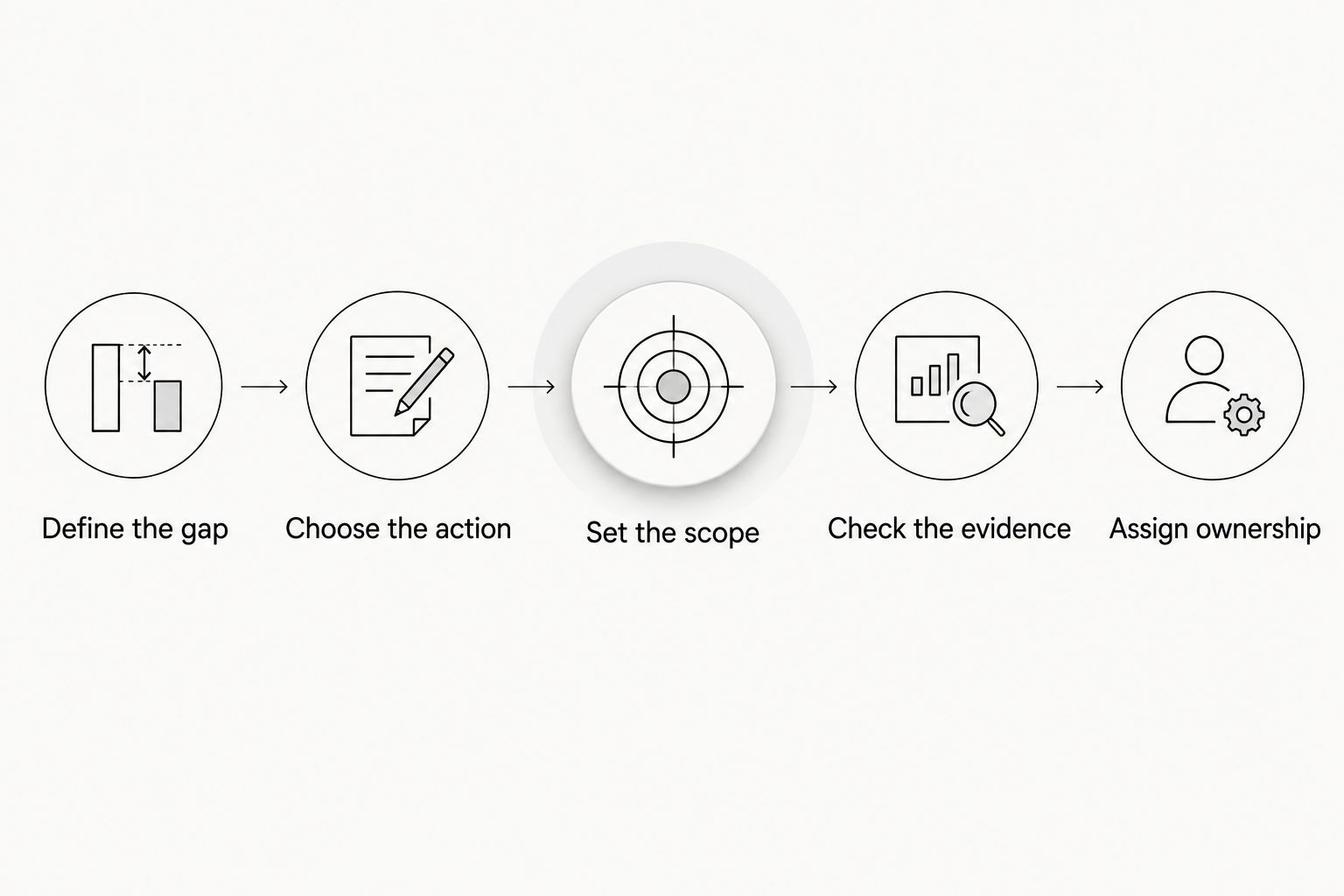
A useful brief contains exclusions as well as deliverables. If the agency handles creator production but not technical documentation, say so. That boundary prevents your team from assigning work the engagement was never designed to cover.
How this shortlist is ranked
The 2026 ranking follows service fit, not an invented performance score. Creator production comes first because the named provider's offer directly supports that use case. The remaining entries represent different jobs, not lower-quality versions of the same service.
The criteria are technical accuracy, audience fit, work ownership, useful deliverables, measurement fit, and review discipline. Apply them to each proposal before making a decision. No service model earns an automatic pass.
Which growth agency should you choose?
Choose UGC Scout when your developer-tool team needs done-for-you short-form creator video production and posting. Choose a technical content agency when the missing asset is an implementation answer. Choose lifecycle support when your existing users need clearer onboarding communication.
If you are undecided, do not commission every channel. Write one primary job into your 2026 brief, select the matching service model, and check the provider's evidence for that job. A clear scope is more useful than a broad promise to grow the business.
Explore done-for-you creator video
Review creator video production and posting for your tech company.
FAQ
What's the best growth marketing agency for developer tools in 2026?
The best choice depends on the work you need done. UGC Scout fits done-for-you short-form creator video production and posting; technical content, developer relations, paid acquisition, and lifecycle work require their own scope checks.
Should a developer-tool company hire a UGC agency?
Hire a UGC agency when creator video is the specific output you need. Keep technical review with someone who understands the product, and do not treat short-form content as a replacement for implementation documentation.
Is a technical content agency better than a creator agency?
A technical content agency is the better service model for detailed implementation answers. A creator agency fits short-form video production; choose based on the deliverable rather than declaring either model better overall.
What should I put in a developer marketing agency brief?
Include the audience, product use case, desired action, deliverables, channels, approval owner, and measurement plan. State exclusions so technical support, documentation, and campaign work are not assumed to be included.
How long should a developer-tool creator video be?
Use 15 seconds for a focused problem-led concept, 30 seconds for a simple demonstration, or 45 seconds for a fuller explanation as starting brief options. These are suggested formats, not fixed requirements or a promise about an agency package.
Should I hire an acquisition agency or a lifecycle agency?
Hire an acquisition agency for paid campaign management around a defined conversion. Hire a lifecycle agency for communication with existing signups, and check the product experience before assigning either team an activation target.
How do I check whether an agency understands developers?
Ask the agency to explain a real product workflow and show how technical claims are reviewed. Check relevant work, audience assumptions, and the process for escalating questions it cannot answer.
One last thing
Ask the shortlisted agency to remove every growth adjective from its proposal. What remains should be a list of work, owners, deliverables, and measurement definitions. If the proposal becomes empty, it was never a usable scope.