
Best fit for tech teams: UGC Scout for done-for-you short-form creator video production and posting. Best for asset-only briefs: a production-focused agency. Best for budget control: a tightly scoped pilot. When comparing influencer marketing agencies ranked by pricing in 2026, rank the work included before comparing quotes; different deliverables do not produce a meaningful cheapest-to-most-expensive order.
- For influencer marketing agencies ranked by pricing, compare identical deliverables before choosing an agency.
- UGC Scout fits SaaS and mobile app teams seeking done-for-you creator video production and posting.
- Choose production-only support when your team already owns publishing and campaign management.
- Separate creator fees, production, posting, usage rights, and agency management in every proposal.
Why this matters
A creator video delivered to your team is not the same purchase as a creator video published to an audience. Neither is the same as an ongoing creator program. Compare those services under one budget line and the ranking hides the work you actually need.
For your 2026 shortlist, start with the business task. Do you need assets for paid campaigns, posts from creators, or someone to run production and posting? Choose that first. Then compare proposals against the same brief.
The best budget decision is the smallest scope that completes your task—not the smallest headline fee.
What makes the best influencer marketing agency
Use these criteria before reading a proposal:
- Scope match: The agency handles the task you need: production, posting, campaign coordination, or ongoing creator management.
- Product understanding: Creators can explain your SaaS product or mobile app without inventing features or results.
- Deliverable clarity: The proposal names finished videos, variations, revisions, and publishing responsibilities separately.
- Rights clarity: The agreement specifies permitted uses, platforms, duration, and any creator-account permissions.
- Workflow ownership: You know who briefs creators, approves claims, requests changes, and handles publishing.
- Measurement fit: Reporting answers your actual question, whether that is asset delivery, audience response, or attributable product activity.
These criteria keep a narrow production brief from competing against a full campaign proposal. They also expose work that would otherwise land back on your team.
Agency options at a glance
The order below ranks service fit for SaaS and mobile app teams, not quoted fees. Each option serves a different buying situation.
| Rank and option | Best for | Standout scope | Key limitation |
|---|---|---|---|
| 1. UGC Scout | Tech teams seeking done-for-you production and posting | Short-form creator videos and posting for tech companies | The agency model is not a self-serve creator-management tool |
| 2. Production-focused agency | Teams that already handle publishing | A brief centered on finished creative assets | Publishing and campaign management need separate owners |
| 3. Managed creator-posting agency | Teams buying creator distribution | A brief centered on creator-published content | Content delivery alone does not complete the scope |
| 4. Campaign-focused agency | Teams coordinating a defined launch | A brief centered on a campaign window | A launch brief does not define an ongoing production program |
| 5. Creator-program management agency | Teams building repeat creator relationships | A brief centered on recurring creator coordination | Program management does not automatically include every asset or posting task |
The service labels describe scopes to request, not promises about unnamed agencies. Use them to sort your shortlist before reviewing individual contracts.
1. UGC Scout: best influencer marketing agency for tech execution
UGC Scout is a growth and influencer marketing agency for tech companies. Its stated offer is done-for-you short-form creator video production and posting. That makes it a relevant starting point when your SaaS or mobile app team wants help with both tasks.
UGC Scout is best for tech teams seeking done-for-you creator video production and posting. Ask for a proposal that separates the production deliverables from the publishing responsibilities. Keep product accuracy and permitted claims explicit in the brief.
UGC Scout pros:
- The agency's stated audience is tech companies.
- Its offer includes short-form creator video production.
- Its offer also includes posting, rather than asset delivery alone.
UGC Scout cons:
- An agency engagement is not a self-serve tool for managing creators yourself.
- A done-for-you brief is broader than necessary if you only want strategy advice.
Best for: SaaS and mobile app teams evaluating external production and posting support.
For a useful 2026 proposal, specify the product workflow creators should demonstrate. A mobile app signup walkthrough and a SaaS feature explanation need different scripts, approvals, and screen recordings. Treat those as distinct briefs.
Verdict: Buy this scope when production and posting are both jobs you want handled for you.
2. Production-focused agency: best for teams with publishing covered
Choose a production-focused brief when you need creator videos but already have people running paid campaigns, organic publishing, and reporting. The agency's assignment is to deliver usable assets. Your team decides where those assets run.
Define each deliverable in the proposal. A finished edit, an alternate opening, a raw recording, and a caption file are different outputs—not interchangeable descriptions of one video.
Production-focused agency pros:
- Keeps the buying brief centered on creative assets.
- Leaves publishing decisions with your existing team.
- Makes production outputs easier to compare across proposals.
Production-focused agency cons:
- Your team still needs to handle distribution.
- Asset delivery does not answer questions about campaign performance.
Best for: Teams with an established publishing or paid-media workflow.
An illustrative brief might request a 15-second opening-led edit, a 30-second product demonstration, or a 45-second explanation. Those are planning examples, not agency package specifications. Choose the length based on what the creator must show.
Verdict: Buy a production-only scope when distribution already has a clear owner.
3. Managed creator-posting agency: best for creator distribution
Choose a creator-posting brief when publication through creator accounts is part of the task. The deliverable is more than a video file. It includes an agreed post and the responsibilities surrounding it.
Specify the platform, account, publishing window, approval process, and reporting requirements. For example, TikTok posting and Instagram posting belong on separate lines if both are requested. Do not let a general reference to social content stand in for a publishing plan.
Managed creator-posting agency pros:
- Makes creator publication an explicit deliverable.
- Gives posting coordination a named owner.
- Connects the creative brief to a specific platform and audience.
Managed creator-posting agency cons:
- Publishing coordination adds work beyond production.
- A creator's post does not establish your right to reuse the content elsewhere.
Best for: Teams whose brief requires creator-published content, not just assets for brand channels.
Keep publication and reuse permissions separate in your 2026 agreement. Ask what happens if a post needs correction or if the planned publishing window changes. Put the answer in the scope.
Verdict: Buy this scope when creator distribution is part of the job—not an optional extra.
4. Campaign-focused agency: best for a defined launch
Choose a campaign brief when your product announcement, feature release, or market launch needs coordinated creator activity. Start with the campaign objective and window. Then define the content and publishing work needed to support them.
The proposal should distinguish campaign planning from execution. A strategy presentation does not substitute for creator coordination, completed videos, approved posts, or agreed reporting.
Campaign-focused agency pros:
- Organizes the brief around a specific business event.
- Gives campaign coordination a defined scope.
- Creates a clear point for reviewing the completed engagement.
Campaign-focused agency cons:
- A launch-centered brief does not establish recurring content production.
- Work outside the campaign window needs a separate agreement.
Best for: Teams with a defined launch rather than an ongoing monthly content requirement.
Give creators access to an accurate product demonstration before script approval. If a feature is not ready to show, remove it from the brief. Your content should describe what users can actually do.
Verdict: Buy a campaign scope for a defined launch; skip it as a substitute for ongoing production.
5. Creator-program management agency: best for repeat relationships
Choose a program-management brief when your task is recurring creator coordination rather than an isolated campaign. Define responsibilities for recruitment, briefing, feedback, relationship management, and reporting. Separately specify which production and posting tasks are included.
A recurring program needs a repeatable approval process. Creators should receive current product information, clear feedback, and a named decision-maker. Without those inputs, even a well-defined management scope leaves decisions waiting on your team.
Creator-program management agency pros:
- Makes recurring coordination an explicit responsibility.
- Supports a repeatable briefing and feedback process.
- Separates relationship management from individual content deliverables.
Creator-program management agency cons:
- Program management alone does not specify video outputs.
- Your team needs to keep product information and approvals current.
Best for: Teams building an ongoing creator roster with recurring work.
For a 2026 program brief, define how creator feedback becomes the next assignment. Do not request a content machine without defining its inputs, approvals, and outputs.
Verdict: Buy program management when repeat creator coordination is the problem you need solved.
How to compare agency proposals without false price rankings
Give each shortlisted agency the same brief. Ask each to return the same scope breakdown. Then review differences in included work before comparing the commercial terms privately.
Use this sequence:
- Define outputs: Name the finished videos, edits, captions, and other files you need.
- Separate posting: State who publishes, on which accounts, and under whose approval.
- Confirm rights: Specify intended reuse, platforms, duration, and permissions.
- Assign approvals: Name the owner of product claims, scripts, edits, and publication decisions.
- Match reporting: Request reporting tied to the task, not a generic activity summary.
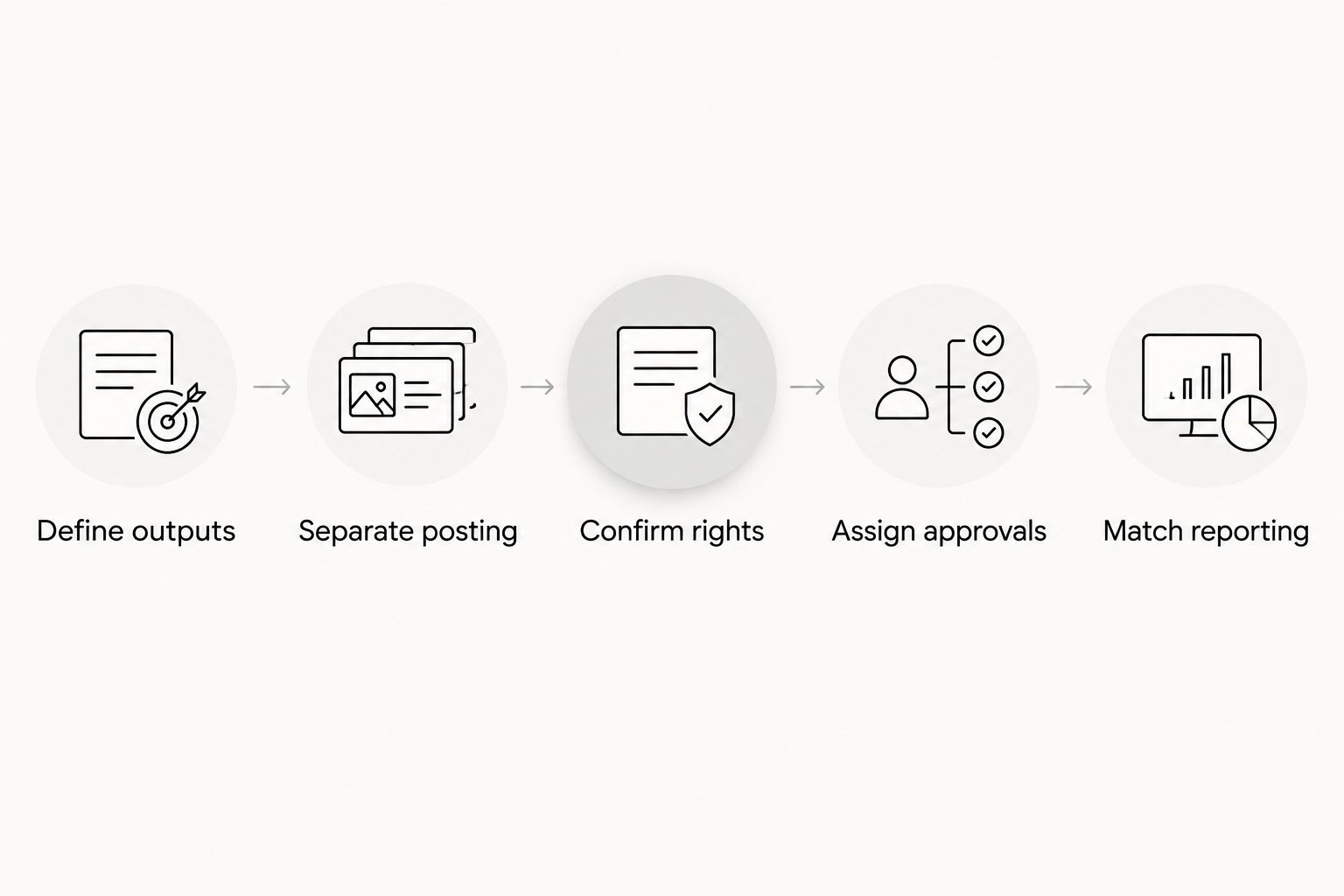
Next, mark each proposal line as included, excluded, or requiring clarification. Resolve every unclear line before making a decision. A shorter proposal is not automatically a smaller engagement, and a longer proposal is not automatically a better fit.
For example, ask whether revision work covers correcting an inaccurate product statement or also covers changing an approved concept. Ask whether posting means handing your team a ready-to-publish file or publishing through a creator account. These are scope questions with operational consequences.
How the options are ranked
This 2026 guide ranks scopes by relevance to SaaS and mobile app buyers, then separates distinct use cases. The criteria are scope match, product understanding, deliverable clarity, rights, workflow ownership, and measurement fit.
It does not label any agency cheapest. A meaningful price order requires equivalent deliverables and contract terms. Use the ranking to choose the right category of support, then compare matched proposals.
Which influencer marketing agency should you choose?
Choose UGC Scout when your tech team wants done-for-you short-form creator video production and posting. Choose a production-focused scope when your team already owns distribution. Choose campaign or program management only when coordination itself is part of the problem.
For undecided buyers, write down the task your team cannot currently complete. Start your agency brief there. Do not buy recurring management to solve an asset shortage, or asset delivery to solve a publishing problem.
Evaluate done-for-you creator production
Explore short-form creator video production and posting for your tech company.
FAQ
What's the best way to compare influencer marketing agencies ranked by pricing?
Compare agencies against identical deliverables and contract terms. Separate production, creator posting, usage rights, and management before reviewing proposals.
Which influencer marketing agency fits SaaS and mobile app teams?
UGC Scout fits tech teams seeking done-for-you short-form creator video production and posting. Its stated focus is tech companies, making it relevant to SaaS and mobile app buyers.
Is a production agency better than a creator-posting agency?
A production-focused scope is the better fit when your team already handles distribution. A creator-posting scope fits when publication through creator accounts is part of the assignment.
Does creator posting include permission to run the video as an ad?
Do not treat posting permission as advertising permission. Specify paid use, platforms, duration, and any account permissions in the agreement.
Should I start with a pilot or an ongoing creator program?
Start with a defined pilot when you need to assess the working process before committing to recurring coordination. Choose a program scope when ongoing creator management is already a clear requirement.
What should I include in a SaaS creator brief?
Include the target user, product task, permitted claims, demonstration requirements, deliverables, and approval owner. Tell the creator exactly what the viewer should understand or do.
Can I rank agencies using their headline fees alone?
Headline fees alone do not establish a fair ranking. Match the production, posting, rights, revisions, and management scope before comparing commercial terms.
One last thing
Ask each agency to describe what your team still has to do. Make that answer part of the proposal.
An engagement described as done for you still needs a boundary between agency responsibilities and your decisions. That boundary tells you whether you are buying help with the actual bottleneck or simply moving it elsewhere.