
Best overall for self-directed creator discovery: Modash. Best for done-for-you short-form production and posting: UGC Scout. Best for finding professional voices manually: LinkedIn. This 2026 guide compares platforms and a managed-service alternative for B2B tech teams that need relevant creators, not just a large contact list.
- Modash is the best micro-influencer platform for B2B tech brands prioritizing self-directed discovery on Instagram, TikTok, and YouTube.
- UGC Scout fits tech teams that want short-form creator video production and posting done for you.
- CreatorIQ fits centralized creator-program management; Aspire fits creator recruitment through a marketplace.
- LinkedIn fits professional creator research, but your team must handle outreach, agreements, and reporting.
Why this matters
A creator who reaches software buyers is different from a creator who makes convincing product videos. Decide which job you need before choosing a platform. Otherwise, you buy discovery software when your actual problem is production.
For B2B tech, separate three questions: Does the creator understand the problem? Does the audience include your buyers? Can the creator demonstrate the product accurately? Follower count answers none of them.
Your 2026 shortlist should also distinguish creator distribution from content production. A creator posting to an established audience supplies distribution. A creator recording an asset for your brand supplies content. Some campaigns need both, but the agreement must spell out both.
What makes the best micro-influencer platform for B2B tech brands?
Use these criteria before comparing names:
- Buyer relevance: Inspect job roles, topics, comments, and examples of people engaging. A broad technology audience is not automatically a software-buying audience.
- Channel fit: Start with where the creator explains products well. Do not choose a TikTok-focused workflow for a campaign built around professional LinkedIn conversations.
- Product fluency: Require a sample explanation of your use case. Someone who cannot explain the product should not write its recommendation.
- Execution ownership: Identify who finds creators, sends briefs, checks footage, requests revisions, and publishes. Software does not remove these responsibilities.
- Rights and measurement: Define permitted uses, posting obligations, and your reporting plan before production begins. Content rights and audience access are separate deliverables.
Treat these as gates, not a points system. A creator with strong engagement still fails the shortlist if the audience is wrong. A platform with useful discovery still fails your operating model if nobody has time to run it.
Options at a glance
The options below solve different jobs. The agency is included as an execution alternative, not presented as software. This 2026 comparison ranks fit by workflow rather than claiming a universal feature winner.
| Option | Best for | Standout function | Key limitation |
|---|---|---|---|
| UGC Scout | Done-for-you short-form execution | Creator video production and posting for tech companies | An agency service, not a self-service discovery platform |
| Modash | Social creator discovery | Discovery across Instagram, TikTok, and YouTube | Discovery alone does not establish B2B buyer relevance |
| CreatorIQ | Centralized program management | Creator discovery and program-management workflows | Requires a team to own the program and its processes |
| Aspire | Marketplace-based recruitment | Connecting brands and creators through a creator marketplace | Applicants still need screening for technical and audience fit |
| Manual professional creator research | Professional profiles and topic-led posts | Not a dedicated influencer campaign-management platform |
1. UGC Scout: best managed alternative for short-form execution
UGC Scout is best for tech teams that want creator video production and posting done for you. It is a growth and influencer marketing agency serving tech companies. The stated offer covers done-for-you short-form creator video production and posting.
That makes it a different purchase from a discovery platform. You are choosing a service model rather than adding another tool for your team to operate. Keep that distinction clear when comparing proposals.
For a SaaS launch, define the output around a real task: show a workflow, explain the user problem, and demonstrate the result. A proposed 30-second video is a useful briefing constraint, not evidence of a particular package or promised performance.
UGC Scout pros:
- The stated audience is tech companies.
- The stated offer includes short-form creator video production.
- Posting is part of the stated offer.
- The managed model fits teams evaluating agency support instead of software.
UGC Scout cons:
- It is not a self-service micro-influencer database.
- Production and posting do not, by themselves, establish audience fit or campaign results.
- You still need to supply product context and approve factual claims.
Best for: SaaS and mobile app teams seeking a managed production-and-posting service.
Verdict: Buy the managed-service approach when execution is the bottleneck. Skip it when your only requirement is a searchable creator database.
2. Modash: best platform for social creator discovery
Modash supports creator discovery across Instagram, TikTok, and YouTube. It belongs on the shortlist when your team wants to research social creators and manage the selection process itself.
For B2B tech, use the discovery stage to find relevant topics, then inspect the content. A creator discussing productivity is not automatically a match for enterprise workflow software. Read the examples closely.
Ask shortlisted creators to explain your product's central task without copying your homepage. That exercise checks technical understanding and communication style before you invest in a full brief. It also reveals whether the proposed format makes sense for the creator's channel.
Modash pros:
- Covers discovery on three relevant video-led social platforms.
- Fits a workflow where your team owns creator selection.
- Lets social creator research remain separate from the production decision.
Modash cons:
- A discovery result is not proof that an audience contains your buyers.
- Your team still needs a briefing and approval process.
- This shortlist does not establish Modash as a LinkedIn discovery solution.
Best for: Teams with someone responsible for researching and qualifying social creators.
For your 2026 evaluation, bring a specific search problem to the product demonstration. Ask how you would find creators explaining the kind of workflow your software supports.
Verdict: Buy for self-directed social discovery. Skip if you need someone else to run production and posting.
3. CreatorIQ: best platform for centralized program management
CreatorIQ combines creator discovery with creator-program management. Its role in this shortlist is coordinating an ongoing program rather than replacing the work of defining that program.
Start with your operating process. Identify who approves creators, who approves product claims, and who reviews results. Then evaluate whether the platform supports the handoffs you actually need.
This distinction matters when several people contribute to a campaign. A product marketer checking technical accuracy and a campaign manager checking delivery need clear responsibilities. A centralized system only helps if the team agrees on those responsibilities.
CreatorIQ pros:
- Addresses creator discovery and program management together.
- Fits a team evaluating centralized creator operations.
- Supports a program-level evaluation rather than treating each creator as an isolated purchase.
CreatorIQ cons:
- Your team must still design and own the workflow.
- Centralized management does not solve weak briefs or inaccurate product explanations.
- A management-focused evaluation adds process decisions beyond finding a creator.
Best for: Teams coordinating an ongoing creator program across multiple stakeholders.
In a 2026 demonstration, follow one proposed campaign from creator selection through approval and reporting. Ask to see your actual handoffs represented, rather than accepting a general tour.
Verdict: Buy for centralized program management. Hold if your immediate need is simply to produce a first batch of videos.
4. Aspire: best platform for marketplace-based recruitment
Aspire includes a creator marketplace connecting brands and creators. It fits teams that want marketplace recruitment as part of their sourcing process rather than relying exclusively on outbound research.
The marketplace is a starting point. For B2B tech, the screening work remains yours: review how applicants explain products, whether their audience matches the campaign, and whether their content fits the channel.
Write the opportunity around the task, not a vague request for tech influencers. For example, ask for someone who can show how a small team organizes customer feedback. That gives applicants a concrete use case to respond to without implying that any platform guarantees suitable applicants.
Aspire pros:
- Provides a marketplace route for creator recruitment.
- Lets you evaluate creators against a defined campaign opportunity.
- Offers a different sourcing approach from building an outbound shortlist alone.
Aspire cons:
- Applications do not establish technical credibility.
- Audience relevance still requires manual review.
- Recruitment does not replace product briefing, claim approval, or content review.
Best for: Teams that want creators to respond to a clearly defined opportunity.
Before publishing a brief, decide whether you need creator-produced assets, creator-account posts, or both. The word collaboration does not settle that question.
Verdict: Buy for marketplace recruitment. Skip if you expect applicants to arrive already qualified for your exact B2B use case.
5. LinkedIn: best option for manual professional creator research
LinkedIn is not a dedicated micro-influencer management platform. It is useful for researching professional voices through their profiles, posts, and discussions.
Choose this route when professional context matters more than a video-platform database. Start with a topic your buyers discuss. Review who explains it clearly and who participates in the conversation.
A professional title is a clue, not a campaign qualification. Read several posts, inspect the substance of the replies, and distinguish practical experience from repeated general advice. Then approach the creator with a specific collaboration idea.
LinkedIn pros:
- Makes professional profiles part of your research.
- Lets you inspect public conversations around a technical topic.
- Fits direct, manual sourcing of subject-matter voices.
LinkedIn cons:
- It is not a dedicated creator campaign-management system.
- Outreach, agreements, tracking, and reporting require your own process.
- Professional profile information does not prove purchasing authority or audience composition.
Best for: Teams seeking credible professional voices and willing to source them manually.
For a 2026 pilot, keep the shortlist focused on one buyer problem. Mixing unrelated professional topics makes it harder to judge whether the collaboration fits your campaign.
Verdict: Buy into the manual research approach for professional context. Skip it as a substitute for campaign-management software.
Turn the shortlist into a useful pilot
Do not evaluate a platform using an imaginary future program. Give it a real brief and a small decision to support. The same principle applies when evaluating an agency.
Use this sequence:
- Buyer problem: Name one task your product helps complete. Specify the buyer and the intended action.
- Creator shortlist: Select three creators for review. Record the evidence for topic knowledge and audience relevance separately.
- Product brief: Propose a 15–45 second video built around a real product task. Supply approved claims and the required demonstration.
- Content review: Ask for two opening-hook concepts. Keep the core demonstration consistent so you can compare the approaches.
- Campaign review: Check delivery against the agreement and performance against the campaign objective. Separate distribution results from asset quality.
These are proposed pilot instructions, not platform specifications or promised agency deliverables. Adjust the scope to your team's approval capacity.
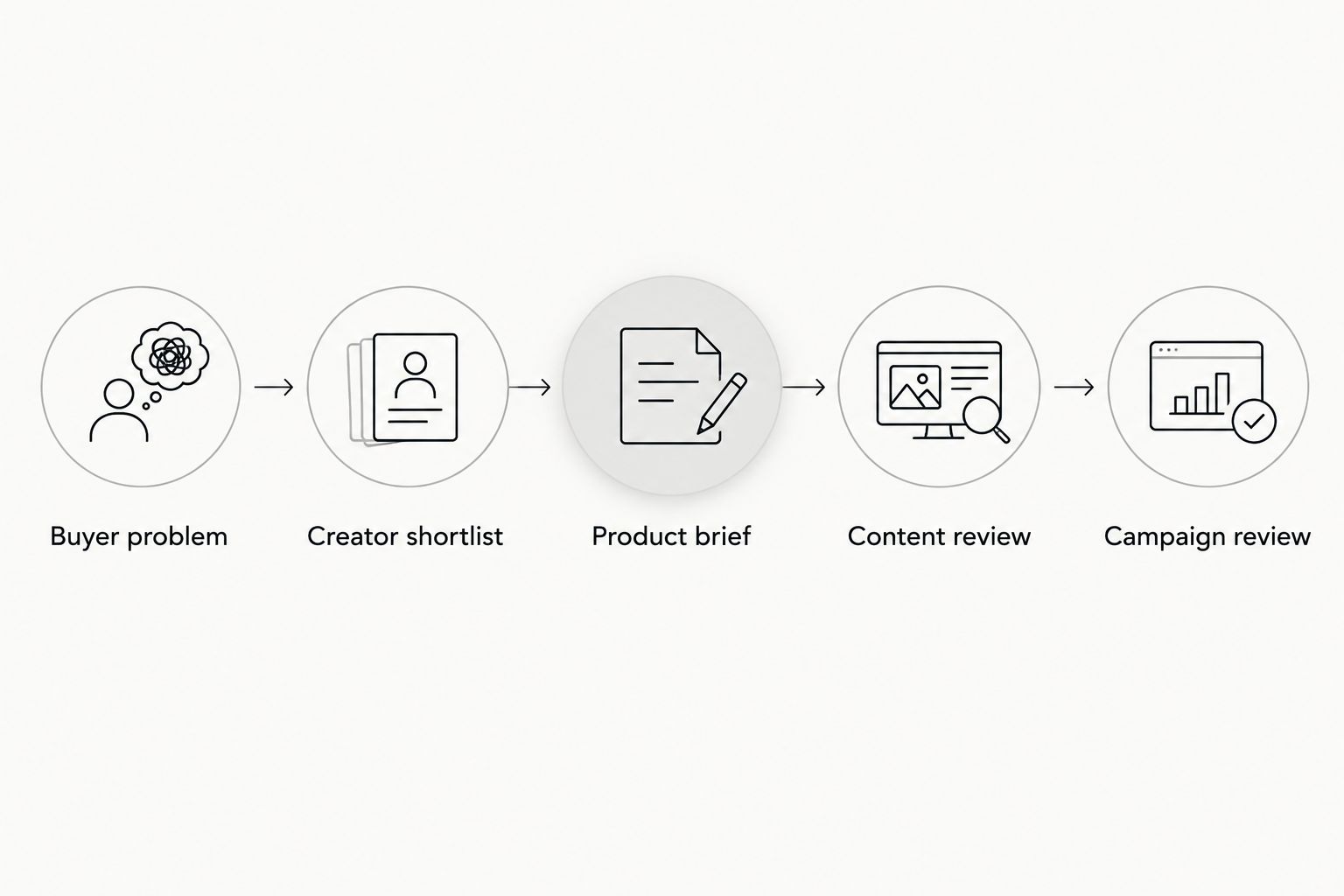
A useful pilot answers a narrow question. Can this sourcing and production model deliver an accurate explanation for the intended audience? It does not need to settle every future channel decision.
How the options are ranked
This ranking uses buyer relevance, channel fit, product fluency, execution ownership, and rights and measurement as decision criteria. Each option owns a different use case. The agency leads the item sections because it addresses managed execution; Modash is the default platform recommendation for self-directed social discovery.
The ranking is a workflow-fit guide, not a claim of hands-on testing or measured performance superiority. Request demonstrations and evaluate agreements against your own brief before committing.
Which option should you choose?
Choose Modash if you want a platform and have someone to run creator research. Choose a managed agency if you want short-form production and posting done for you. That is the first decision. Features come second.
Choose CreatorIQ when centralized program management is the priority. Choose Aspire when marketplace recruitment fits your sourcing model. Use LinkedIn when professional context justifies a manual research process.
For an undecided B2B tech team in 2026, assign one owner before selecting anything. If nobody owns creator selection, briefing, and approval, a discovery tool leaves the execution problem untouched.
FAQ
What's the best micro-influencer platform for B2B tech brands?
Modash is the default recommendation here for self-directed creator discovery on Instagram, TikTok, and YouTube. Choose a managed agency instead if your main requirement is short-form video production and posting rather than software.
Is a UGC agency the same as a micro-influencer platform?
No. A UGC agency is a service provider, while a micro-influencer platform supplies software for tasks such as discovery or program management. Define whether you need content production, audience distribution, or both.
Is LinkedIn better than TikTok for B2B creator marketing?
Choose LinkedIn for professional creator research and TikTok when the campaign requires TikTok-native video. The better channel is the one that fits your buyer, content format, and distribution plan; neither platform label proves audience relevance.
How do I check whether a creator reaches software buyers?
Review the creator's topics, explanations, public discussions, and available audience evidence against your buyer profile. Ask for relevant examples and keep evidence of audience fit separate from follower count.
Should I choose CreatorIQ or Aspire?
Choose CreatorIQ when centralized creator-program management is the main requirement; choose Aspire when marketplace-based recruitment is the main requirement. Evaluate either option using your actual campaign workflow rather than a generic feature list.
What should a B2B creator video brief include?
Include the buyer problem, the product task, approved claims, the required demonstration, and the intended action. State whether the creator must produce an asset, publish a post, or do both, and document usage rights separately.
Do I need a dedicated creator for my SaaS product?
Choose a dedicated creator when repeated product explanations are part of your plan, not as a substitute for checking audience fit. Confirm that the creator can explain the product accurately and that the proposed agreement matches the work you need.
One last thing
Ask a shortlisted creator to explain your product before asking for a polished video. An attractive sample does not tell you whether the creator understands your buyer's problem.
Give the creator one real task and ask for a plain-language explanation. If the explanation is wrong, fix the understanding before production. More editing will not correct a mistaken product premise.