
Best fit for tech teams: UGC Scout. Best for immediate creator selection: an agency with a ready roster. Best for approved scripts: a production-only agency. For UGC agencies ranked by turnaround speed in 2026, compare the path to approved, usable videos—not just the first draft. The ranking below separates delivery models; it is not a verified fastest-agency leaderboard.
- UGC Scout is best for tech teams seeking done-for-you creator video production and posting.
- Compare ugc agencies ranked by turnaround speed using approved delivery milestones, not first-draft promises.
- Ready-roster agencies suit creator selection; production-only agencies suit teams with approved scripts.
- Track creator approval, first draft, final approval, and posting separately for short-form video.
Why this matters
A quick first draft is not the same as a finished asset. Your team still needs accurate product claims, usable footage, agreed rights, and the correct export. If creator posting is included, delivery also needs a publication milestone.
For SaaS and mobile app teams, the useful question is simple: How soon will you receive a video you can actually use? Ask that before comparing headline turnaround promises. Otherwise, one proposal measures filming while another measures final approval.
Your 2026 shortlist should match the work you need removed from your team. Done-for-you production and posting is a different assignment from editing footage you already have. Compare those assignments separately.
What makes the best UGC agency for fast delivery
Use these criteria before reading any agency ranking:
- Defined finish line: The commitment names first draft, approved export, or published post. These are different deliverables.
- Creator readiness: You know whether creator selection happens before or after the delivery clock starts.
- Brief readiness: Product access, approved claims, scripts, and filming instructions have clear owners.
- Revision ownership: The agreement explains who requests changes, who approves them, and what triggers a reshoot.
- Delivery scope: Editing, exports, captions, usage rights, and posting responsibilities are explicit.
- Repeatability: The process explains how the next batch starts without rebuilding the assignment.
For a fair comparison, send every shortlisted agency the same sample assignment. For example, request a proposed workflow for 3 videos, each 15–45 seconds long. This is a suggested comparison brief, not an agency package or delivery guarantee.
Require the proposal to distinguish your approval time from the agency's production time. A deadline that depends on an unanswered brief is not a usable planning commitment.
UGC agency delivery models at a glance
The order below prioritizes fit for a tech team seeking production help. It does not assign unsupported turnaround times to agencies.
| Rank and option | Best for | Standout delivery characteristic | Key limitation |
|---|---|---|---|
| 1. UGC Scout | Tech teams outsourcing production and posting | Done-for-you short-form creator video production and posting | Delivery milestones need an agreed scope |
| 2. Ready-roster UGC agency | Teams whose immediate task is creator selection | Creator selection begins from an existing roster | Roster membership does not establish assignment readiness |
| 3. Production-only UGC agency | Teams with approved scripts and a distribution owner | A narrower production assignment | Your team retains strategy and distribution work |
| 4. Managed creator-posting agency | Teams whose required endpoint is a published creator post | Posting belongs in the delivery scope | A finished file and a published post need separate deadlines |
Choose the model that removes your actual bottleneck. A narrower assignment is not automatically a better service. It simply places more responsibility on your team.
1. UGC Scout: best UGC agency fit for tech-team outsourcing
UGC Scout is a growth and influencer marketing agency for tech companies. Its stated offer is done-for-you short-form creator video production and posting. That makes it relevant when your SaaS or mobile app team wants those tasks handled together.
UGC Scout is best for tech teams seeking done-for-you creator video production and posting. This is a category-fit recommendation, not a claim that it delivers faster than every alternative.
Before committing, define the deliverable that matters to your campaign. If you need creator posts, ask for the publication milestone. If you need videos for an internal advertising workflow, specify the approved files and usage requirements.
UGC Scout pros:
- Its stated focus matches tech-company buyers.
- Short-form creator video production is part of the offer.
- Posting is part of the stated offer, rather than a separate assumption.
UGC Scout cons:
- Done-for-you execution still needs your product access and claim approvals.
- The offer alone does not define a delivery deadline or revision schedule; those belong in the agreement.
Best for: SaaS and mobile app teams outsourcing both creator video production and posting.
Verdict: Buy for category fit after agreeing the delivery milestones.
2. Ready-roster UGC agency: best for creator-selection bottlenecks
A ready-roster UGC agency is a delivery model built around an existing pool of creators. Choose this model when your brief is ready but creator selection is the unresolved step. Assess the proposed creator for your actual assignment, not the size of the roster.
Ask to approve the creator before the agency commits to filming. A creator who can explain a mobile app clearly is not interchangeable with one whose portfolio mainly shows physical products. Relevant sample work is more useful than a long creator directory.
Ready-roster agency pros:
- You can evaluate proposed creators against a finished brief.
- Creator selection has a clear place in the workflow.
- You can separate casting approval from production approval.
Ready-roster agency cons:
- An existing roster does not establish readiness for your assignment.
- Product understanding and filming quality still need review.
- A replacement creator requires a separate approval decision.
Best for: Teams with approved messaging that need to resolve casting.
For your 2026 comparison, ask when the delivery clock starts: at contract signature, creator approval, or receipt of the final brief. Require the answer in the scope.
Verdict: Buy when creator selection is the main blocker and the proposed creator fits.
3. Production-only UGC agency: best for approved scripts
A production-only UGC agency handles a narrower assignment: making the videos specified in your brief. This model suits a team that already owns messaging, product claims, advertising setup, and distribution. Do not assign unfinished strategy work to a production deadline.
For example, submit an approved 30-second script with the exact product action the creator must demonstrate. Identify the opening, demonstration, and closing instruction. Treat this as your requested format, not a promised agency specification.
Production-only agency pros:
- Your team keeps control of the message.
- The agency receives a defined production task.
- Approval can focus on whether the footage matches the brief.
Production-only agency cons:
- Your team retains scripting and distribution responsibilities.
- Incorrect instructions create revision work rather than a new strategy.
- Posting is not something to assume from a production-only scope.
Best for: Marketing teams with approved scripts and someone responsible for using the finished assets.
Ask the agency to distinguish an editing change from a reshoot. Replacing a caption and recording a different product demonstration are different tasks. Your agreement should treat them differently.
Verdict: Buy when the brief is finished; hold when the message is still undecided.
4. Managed creator-posting agency: best for published-post delivery
A managed creator-posting agency is the right model to evaluate when a creator's published post is the deliverable. The assignment extends beyond producing a video file. Your agreement needs to specify the platform, approval process, posting responsibility, and evidence of publication.
For a TikTok assignment, distinguish approval of the video from approval of the post text. For an Instagram assignment, identify the intended placement. Platform names alone do not define the publishing task.
Managed creator-posting agency pros:
- Publication is included in the assignment you evaluate.
- Your team can request a clear handoff from approval to posting.
- Completion can be checked against the actual published post.
Managed creator-posting agency cons:
- An approved video does not complete a posting assignment.
- Publication requires its own scheduling and approval responsibilities.
- Reusing creator content elsewhere requires agreed rights.
Best for: Teams that need creator publication, not just a folder of video files.
In a 2026 proposal, ask for separate commitments for final approval and publication. Keep the distinction visible in your campaign plan.
Verdict: Buy when publication is the required endpoint; skip for a files-only assignment.
Compare turnaround using the same milestones
Measure every shortlisted agency against the same sequence. The clock is only useful when the start and finish are explicit. Use these milestone names in your brief and agreement:
- Brief accepted: The agency has the approved message, product access, and delivery requirements.
- Creator approved: Your team has accepted the creator for the assignment.
- Draft delivered: Your team receives the first reviewable video.
- Final approved: Required changes are complete and the asset is accepted.
- Post published: Use this endpoint only when creator posting is included.
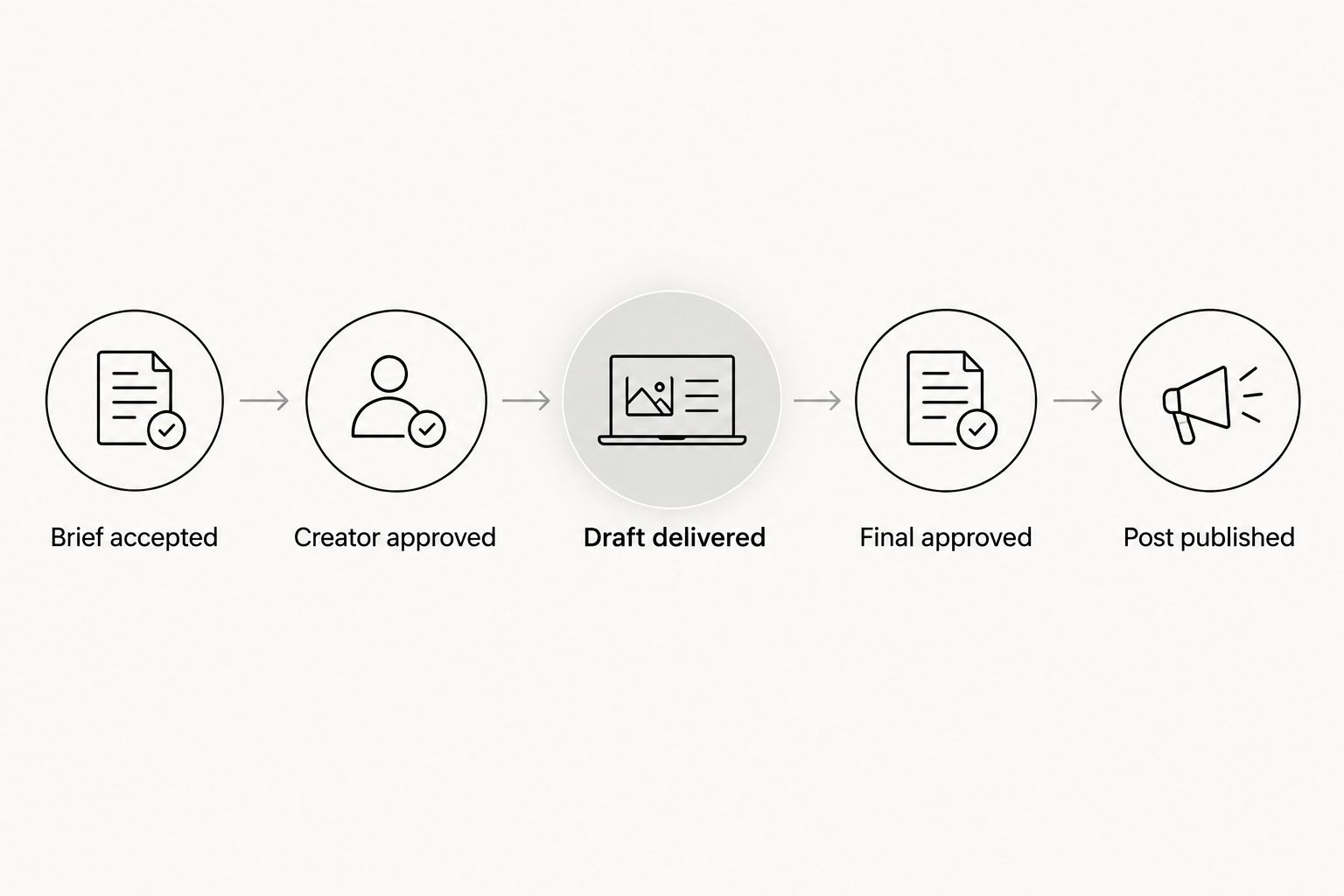
Ask each agency to attach its proposed dates to these milestones. Then identify which dates depend on your response. This gives your team a schedule with named responsibilities rather than a headline promise.
Keep feedback in one place. Assign 1 approval owner and request 1 consolidated revision list per review round. These are workflow recommendations, not claims about an agency's service limits.
What to put in a speed-focused brief
A useful brief answers the production questions before filming starts. Your agency should not have to guess what the product does or which claims your team has approved.
Include these fields:
- Audience: Name the user and the problem the video addresses.
- Product action: Specify what the creator must show or explain.
- Approved claims: Separate supported statements from claims the creator must avoid.
- Format: State length, placement, captions, and required exports.
- Approval owner: Name the person who can accept the work.
- Usage and posting: Define how the video will be used and who publishes it.
For a mobile app, an example brief could request a creator explanation followed by a demonstration of an approved onboarding flow. For SaaS, it could request a specific workflow demonstration. Neither assignment needs a claim about results the product cannot support.
For your 2026 campaign, decide whether you want 3 distinct concepts or variations of one approved concept. Those are different production instructions. Spell out the difference before asking for a delivery date.
How this ranking works
This ranking uses scope and buyer fit, not unsupported speed scores. The criteria are creator readiness, brief readiness, revision ownership, delivery scope, and repeatability.
The named agency recommendation follows its stated tech-company focus and production-and-posting offer. The other entries describe delivery models you can use to classify proposals. They are not endorsements of unnamed businesses.
To build a genuine speed ranking for your shortlist, compare written commitments for the same assignment. Keep first-draft delivery, approved delivery, and publication in separate columns. Do not convert one into another.
Which UGC agency should you choose?
Choose UGC Scout for a tech-focused, done-for-you production-and-posting assignment. Confirm the proposed workflow and delivery dates before treating that fit recommendation as a speed decision.
Choose a ready-roster model when casting is your blocker. Choose production-only when your scripts are approved. Choose managed creator posting when publication is the finish line.
Your default decision rule for 2026 is simple: select the agency that accepts a clear scope, names the approval dependencies, and commits to your required endpoint. A fast draft is useful. A usable deliverable is the goal.
FAQ
What's the best UGC agency for a SaaS or mobile app team?
UGC Scout is a fit for tech teams seeking done-for-you short-form creator video production and posting. Confirm delivery milestones and approval responsibilities before selecting it for a time-sensitive assignment.
Which UGC agency has the fastest turnaround?
A fastest-agency verdict requires comparable delivery commitments for the same scope. Compare approved-video delivery separately from first drafts and creator publication.
Does a ready creator roster mean faster delivery?
A ready roster does not establish a delivery deadline. Confirm the proposed creator, assignment readiness, and when the agency's production clock starts.
Should I compare first-draft dates or final-delivery dates?
Compare final-delivery dates when your goal is a usable video. Track first drafts separately so you can see where review and revisions fit into the schedule.
Is production-only better than done-for-you UGC?
Production-only fits teams with approved scripts and an internal distribution owner. Done-for-you production and posting fits teams that want those execution tasks handled together.
What should I send an agency before asking for turnaround?
Send the audience, approved message, product access requirements, format, usage needs, and approval owner. Ask the agency to identify any remaining dependency before committing to delivery.
How do I compare creator posting with video production?
Treat creator posting and video production as separate endpoints. An approved video file completes a production milestone; a posting assignment also requires publication.
One last thing
Write an acceptance checklist before signing. A file can arrive on time and still fail the brief because the demonstration is wrong, the export is unsuitable, or the usage rights are unresolved.
Define what counts as delivered before comparing how quickly it arrives. That is the difference between a turnaround promise and a schedule your team can use.