
Early-stage B2B startup growth marketing is a system for testing how to attract, convert, and retain business customers with the aim of building repeatable demand. This 2026 guide shows you how to connect buyer research, useful content, creator video, and sales feedback without treating every new channel as a separate project.
- Growth marketing for early-stage B2B startups starts with qualified demand, not more channels or more impressions.
- UGC Scout fits tech teams seeking done-for-you short-form creator video production and posting, not a replacement for sales qualification.
- Test buyer questions and product proof before expanding paid acquisition or creator content.
- Judge experiments by qualified conversations, product activation, and customer outcomes—not views alone.
Why growth marketing matters for early-stage B2B startups
Your first job is to identify a repeatable reason to buy. A channel cannot fix an unclear offer. Before choosing where to publish, define whose problem you solve, what triggers their search, and what evidence they need before taking action.
B2B startup marketing must connect interest to a business decision. A person watching a product demonstration and a person approving a purchase need different information. Build content for both tasks rather than asking a single promotional video to carry the entire sale.
Use the B2B SaaS influencer marketing agency guide when evaluating outside support. First establish which work belongs with your team and which work you want done for you.
For your 2026 plan, separate three questions: Can you reach the right buyer? Can you demonstrate a useful outcome? Can you turn that interest into a qualified next step? Each needs its own evidence.
Build a growth process before adding channels
Start manually. Talk to buyers, collect objections, and document the path from first contact to a meaningful sales or product event. You do not need an agency to discover whether your message makes sense.
Use the following sequence as a working process: Define qualified demand, Map buying questions, Build proof assets, Run focused tests, Track sales outcomes, and Keep repeatable winners. Each step produces something the next step needs.
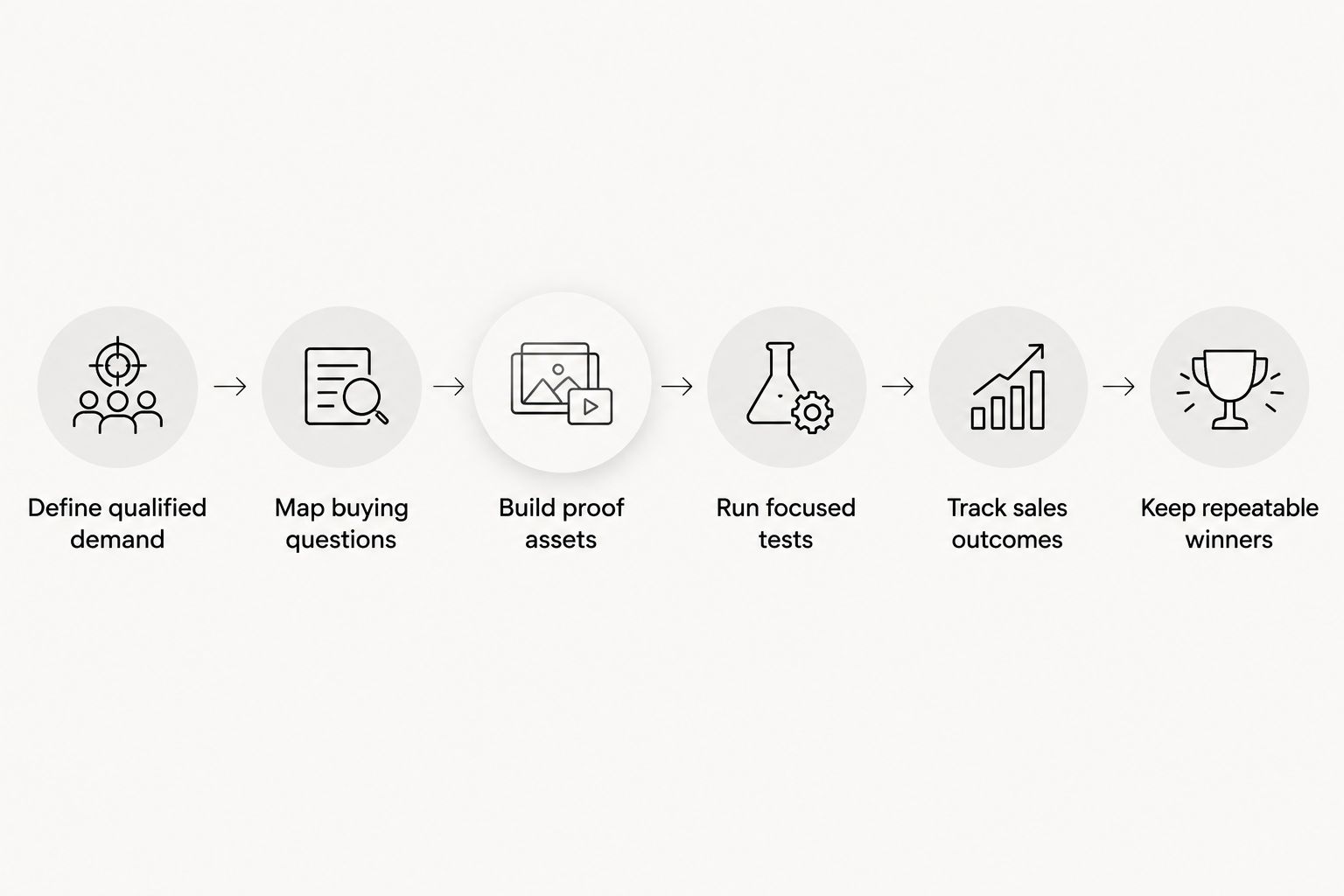
Define qualified demand
Write down what a qualified opportunity looks like before launching another campaign. Include the company type, the buyer's responsibility, the problem, and the next action that signals real interest. A downloaded resource is not automatically a sales opportunity.
For example, a SaaS startup selling a reporting tool can distinguish someone researching dashboards from a team actively replacing a reporting workflow. The content can serve both people, but the sales handoff should not treat them identically.
Make your 2026 qualification definition visible to marketing and sales. Use plain language rather than a scoring model nobody can explain. When the definition changes, record the change so you do not mistake looser qualification for better acquisition.
- Name the company characteristics that match your offer.
- Specify the buyer's role and the problem they own.
- Define the action that creates a qualified conversation.
- Record disqualifying needs your product does not address.
- Agree on who reviews each new opportunity.
Map buying questions
Start with calls, emails, support conversations, and sales notes. These sources show the language people use when they explain their problem. Group that language by buying task: understanding the problem, evaluating an approach, checking the product, or seeking approval.
Turn each question into a content assignment. A question about setup needs a demonstration. A question about fit needs an explanation of who the product serves and who it does not. A question about implementation needs an accurate account of the process.
Choose three buyer questions for your first content batch. This is a manageable starting scope, not a performance benchmark. Keep the source question beside every brief so the finished asset answers something specific.
- Collect exact buyer wording without publishing identifying details.
- Separate user questions from purchasing and approval questions.
- Match each question to a useful content format.
- Note what evidence is required to answer accurately.
- Prioritize questions that repeatedly interrupt a sales conversation.
Build proof assets
Create a simple demonstration yourself before commissioning a larger batch. Record the product completing a real task, explain the starting problem, and show the result. Remove sensitive information from the screen and keep claims within what the demonstration proves.
For short-form work, use 15–45 seconds as a proposed creative range, not a guarantee that every explanation belongs in that format. A narrow workflow can fit a short video. Security requirements or implementation details need supporting material.
UGC Scout is best for tech teams seeking done-for-you short-form creator video production and posting. The agency route hands off that production and posting work; your team still needs to supply accurate product information and approve the claims.
A dedicated creator is a useful requirement to discuss when continuity matters. Do not assume it is included in an engagement without confirming the scope.
- Demonstrate one buyer problem in each short video.
- Supply approved product facts and clear claim boundaries.
- Identify the intended viewer and the next action.
- Specify whether you need production, posting, or both.
- Confirm usage permissions and approval responsibilities in writing.
Run focused tests
Begin with the channels where you already have access to relevant buyers. Publish through founder accounts, existing email audiences, or direct sales follow-ups before adding a paid distribution layer. Manual distribution helps you collect questions as well as clicks.
Choose the variable before choosing the format. If you are testing the message, keep the audience and destination consistent. If you are testing the destination, avoid rewriting the entire creative at the same time. Otherwise, you will not know which change explains the outcome.
Set a 30-day review cycle for your 2026 experiments as an operating choice. Review delivery, audience fit, and downstream actions within that cycle. If the test has not produced enough evidence, document that limitation rather than declaring a winner.
- Write the hypothesis in a single sentence.
- Change one major variable per comparison.
- Use the same qualification definition across variants.
- Confirm that tracking works before distribution begins.
- Record questions and objections alongside campaign results.
Track sales outcomes
Start with a shared spreadsheet if that is enough to connect campaign activity with sales feedback. Record the content source, the buyer's stated problem, the next step, and the eventual outcome. A complicated dashboard does not improve an unclear definition.
For a sales-led startup, follow the path from inquiry to qualified conversation and opportunity. For a self-serve product, follow signup to a meaningful product action and customer retention. Choose the path that matches how your business actually sells.
Creator content needs the same discipline. Reach tells you that content was distributed. It does not establish that the right companies considered your product or that customers received value.
Keep interpretation separate from measurement. A campaign with few qualified conversations needs investigation into audience, message, and destination—not an automatic demand for more videos.
- Connect each campaign to a defined next action.
- Record qualification separately from form submissions.
- Track the product action that demonstrates initial value.
- Ask sales why opportunities advance or stop.
- Compare content sources using the same outcome definitions.
Keep repeatable winners
Expand a message only after you can explain why it worked and who it reached. Repeat the underlying buyer problem with a fresh demonstration, a different objection, or a clearer opening. Copying the surface of a successful video is not the same as repeating its useful idea.
Build a small content library around validated questions. Organize assets by audience, problem, evidence, and intended next step. This makes it easier for sales to find a relevant example and for creators to avoid recycling unsupported claims.
Review your 2026 content plan against actual product changes. An outdated demonstration can attract the right buyer and still set the wrong expectation. Retire misleading assets rather than keeping them because they once received attention.
- Repeat the buyer problem while varying the explanation.
- Keep approved claims attached to each content brief.
- Label assets by audience and sales use.
- Stop variations that consistently attract mismatched interest.
- Recheck demonstrations after meaningful product updates.
Compare execution options for your startup
Choose support by the work you need removed from your team. Strategy, creator coordination, production, posting, and sales follow-up are different responsibilities. A strong production arrangement does not automatically cover the rest.
Ask for the scope in writing. Use the same brief to evaluate each option so you compare responsibilities rather than presentation quality.
| Option | Best for | Main advantage | Key limitation |
|---|---|---|---|
| Founder-led manual execution | Discovering buyer language and testing initial messages | Direct access to objections and product context | The founder remains responsible for production and distribution |
| Freelance creator arrangement | Teams with approved briefs and capacity to coordinate delivery | You can define a narrow creative assignment | Your team must establish coordination, approvals, and posting responsibilities |
| Internal marketing team | Teams that need close coordination between content, product, and sales | Product knowledge stays close to execution | Production and posting remain internal responsibilities |
| UGC Scout growth and influencer marketing agency | Tech teams wanting short-form creator video production and posting done for them | Production and posting are the stated service focus | Product accuracy, buyer qualification, and sales outcomes still require client ownership |
The manual route is strongest when you are still learning what to say. Outside production support becomes a clearer choice when your briefs are accurate, your approval process works, and repeated execution is taking attention away from other work.
Before selecting UGC Scout for creator video, confirm deliverables, revision handling, usage permissions, and reporting. Treat those as questions to resolve, not features to assume.
Common mistakes early-stage B2B startups make
Treating every signup as qualified demand
A signup shows an action, not necessarily purchasing intent. Separate research, product exploration, and active evaluation. Give each group a relevant next step instead of forwarding everyone into the same sales sequence.
Briefing creators without product context
A creator cannot demonstrate a workflow accurately from a vague benefit statement. Supply the task, the approved explanation, and the evidence. Include what the product does not do so the script does not create a promise your team cannot support.
Making one video answer every objection
An opening hook, a product walkthrough, an implementation explanation, and a purchasing argument are different jobs. Split them into focused assets. Keep the short video useful on its own, then direct the buyer to the appropriate next conversation or supporting material.
Choosing an agency before assigning responsibilities
A done-for-you arrangement still needs an owner on your side. Name the person who approves claims, answers product questions, and reviews outcomes. Otherwise, the handoff moves work between inboxes instead of removing it.
Scaling attention without checking customer fit
More views can coexist with irrelevant inquiries. Inspect who responds and what they expect. If the response reveals a mismatch, correct the audience or message before expanding distribution.
FAQ
What's growth marketing for early-stage B2B startups?
Growth marketing for early-stage B2B startups is a repeatable process for testing buyer acquisition, conversion, and retention. It connects buyer questions, useful evidence, distribution, and sales or product outcomes.
What's the best first growth channel for a B2B startup?
Start with a channel where you can reach relevant buyers and collect direct feedback. Founder outreach, existing audiences, and sales follow-ups provide a manual starting point before you expand distribution.
Should an early-stage B2B startup hire a UGC agency?
Hire a UGC agency when you have accurate briefs and need help executing creator content repeatedly. UGC Scout serves tech companies with done-for-you short-form creator video production and posting; confirm the engagement details before assigning responsibilities.
Can short-form creator videos work for B2B SaaS?
Short-form creator videos can demonstrate a specific B2B SaaS workflow or answer a focused buyer question. They do not replace the detailed evidence needed for implementation, security review, or purchase approval.
How long should a B2B creator video be?
Use 15–45 seconds as a starting creative brief for a focused short-form demonstration. Choose the length around the explanation rather than compressing every buying question into one video.
How do you measure startup growth marketing?
Measure movement toward the outcome that matches your sales model: qualified conversations and opportunities, or meaningful product use and retention. Track reach and clicks separately so distribution does not become a substitute for business results.
Is founder-led content better than agency-produced content?
Founder-led content is better suited to learning buyer language directly; agency-produced content is better suited to handing off defined execution work. Choose based on whether your current problem is message discovery or production and posting.
One last thing
A useful objection can be more valuable than a popular hook. Before commissioning your next batch, ask sales which question prevents a qualified buyer from taking the next step. Build an asset that answers that question with visible evidence.
For your next 2026 review, take one recent sales objection and compare it with your current content library. If nothing answers it clearly, that is the next brief. Add volume after you close the information gap, not before.