
Fintech startup influencer marketing is creator-led product education and promotion with the aim of attracting users who complete a meaningful financial task. This 2026 guide shows you how to choose creators, write usable briefs, review financial claims, and measure activation without confusing views with business results.
- Influencer marketing for fintech startups should target qualified activation, not views alone.
- UGC Scout fits tech teams seeking done-for-you short-form creator video production and posting.
- Separate creator content production from influencer distribution when choosing an agency.
- Review financial claims, sponsorship disclosures, and product demonstrations before publishing.
Why influencer marketing matters for fintech startups
Fintech products ask users to trust more than a feature list. Your audience needs to understand what the product does, which conditions apply, and what happens after signup. A creator can demonstrate that journey. A testimonial alone does not explain it.
For a mobile app, the useful story often starts with a task: organize spending, send a payment, or understand an account feature. For business software, it starts with an operator's problem. Keep the product demonstration close to that problem instead of opening with a broad promise about financial freedom.
Your 2026 plan needs two separate decisions: who should explain the product, and who should distribute the explanation. The fintech influencer marketing agency guide is a related starting point for evaluating partners. Decide what work you need before comparing agencies.
A creator video is a content asset. An influencer partnership also buys access to an audience. Those are different jobs. A clear brief names both when both matter.
Build your fintech creator program
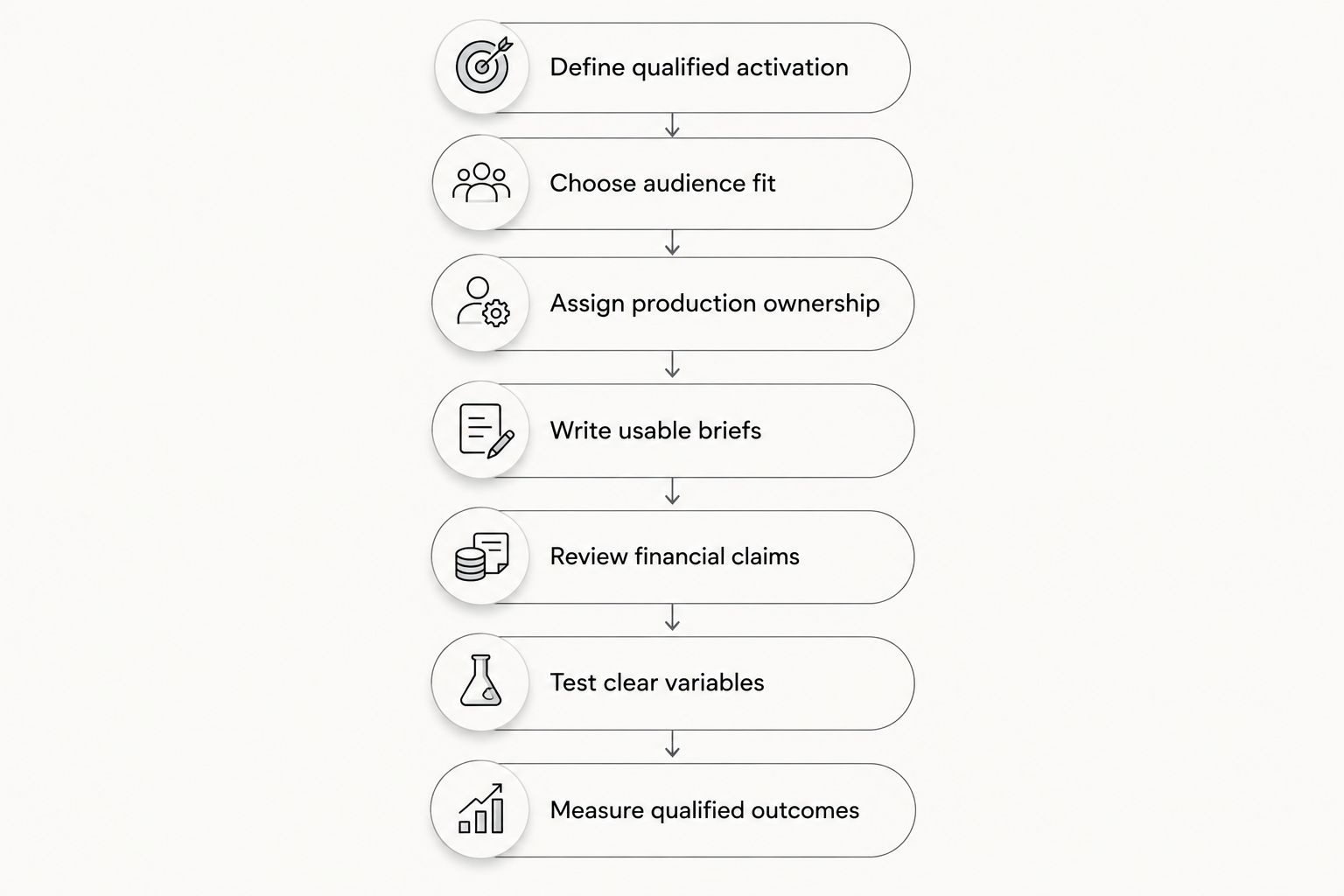
Use this sequence for your 2026 campaign: Define qualified activation, Choose audience fit, Assign production ownership, Write usable briefs, Review financial claims, Test clear variables, and Measure qualified outcomes. Start manually. Outsource the production work when ownership and approval rules are clear.
Define qualified activation
Start with your existing analytics and a shared document. Choose one primary event that represents a user receiving value, then list the steps leading to it. An app install is not the same as an active account. A business-software demo request is not the same as a qualified buyer.
For a budgeting app, your chosen event might be completion of the first budget. For a business finance product, it might be a relevant company completing a demo. These are example measurement choices, not universal targets. Use the event your product team already recognizes as meaningful.
Write the conversion definition before you commission content. Otherwise, a creator can deliver an engaging video while your team still disagrees about what success means. Keep revenue, activation, and reach visible, but do not treat them as interchangeable.
- Select one primary activation event for the campaign.
- Document the audience, eligible markets, and relevant exclusions.
- Map the path from creator post to landing page to activation.
- Confirm that analytics records each important step.
- Name the person responsible for checking conversion quality.
Choose audience fit
Review creators manually before buying discovery tools or signing a production agreement. Watch their recent videos, read the comments, and note the questions their audience asks. Look for someone who can explain the actual use case, not merely someone who talks about money.
A creator covering personal budgeting needs a different brief from one teaching finance operations to founders. Match the buyer's problem, vocabulary, and level of knowledge. For business-facing fintech, job relevance matters more than a broad consumer following.
Ask prospective partners for audience information they can substantiate. Then separate audience evidence from presentation skill. A creator who explains your interface clearly can be useful for content production even when you are not buying a post to their followers.
Choose the creator for the job: explanation, distribution, or both. Do not use follower count as a substitute for that decision.
- Review examples that explain a product or process clearly.
- Check audience geography against your eligible markets.
- Read comments for relevant questions and misunderstandings.
- Assess whether the creator distinguishes facts from personal opinion.
- Record whether you need content rights, posting, or both.
Assign production ownership
The manual path is straightforward: your team recruits creators, sends briefs, reviews drafts, and coordinates publication. Keep assignments in a shared tracker. This gives you direct control, but it also leaves the coordination work with your team.
An agency is the alternative when you want production and posting done for you. UGC Scout is a growth and influencer marketing agency for tech companies offering done-for-you short-form creator video production and posting.
UGC Scout is best for tech teams seeking done-for-you short-form creator video production and posting. That fit does not remove your responsibility for product accuracy or compliance approval. Keep a named internal reviewer, even when an outside partner manages the content workflow.
For a 2026 engagement, request a written division of responsibilities. Ask who handles creator selection, scripts, revisions, usage permissions, and publication. Do not infer those details from an agency's category label.
- Assign one internal owner for feedback and approvals.
- Specify which tasks stay internal and which move outside.
- Ask whether you receive a dedicated creator or a changing roster.
- Confirm revision responsibilities and the approval sequence.
- Document usage permissions, posting accounts, and reporting requirements.
Write usable briefs
Begin with a shared document, approved product facts, and a safe demonstration account. A usable brief tells the creator what to show, what to say, and what not to imply. It does not ask them to turn a technical feature list into a finished campaign without direction.
For a short-form test, brief a 15–45 second video around one task. Treat that length as a creative constraint, not a promised agency deliverable. Show the problem, demonstrate the relevant action, and close with a next step that matches the destination page.
For example, a budgeting-app brief can ask the creator to demonstrate setting a spending category using sample data. It should not ask for a claim that users will save a particular amount. Keep the example specific while keeping the outcome claim within what you can prove.
- Name the audience and the problem in plain language.
- Choose one product action to demonstrate.
- Supply approved claims and prohibited wording.
- Provide sample data that contains no real customer information.
- Specify the call to action and intended destination.
- Include disclosure and approval instructions in the brief.
Review financial claims
Use a manual review checklist before automating anything. Give your product reviewer the script, on-screen text, caption, demonstration, and landing page together. A safe sentence in the script does not fix an unsupported claim in the caption.
For U.S. campaigns in 2026, use the FTC Endorsement Guides as the baseline for material-connection disclosures. Paid relationships need clear disclosure; viewers should not have to investigate whether a recommendation is sponsored. Financial-sector obligations depend on the product and the regulated entities involved, so assign that review to your qualified compliance or legal owner.
Check ordinary language as carefully as technical terms. Words such as guaranteed, protected, instant, and free describe substantive conditions. A creator must not improvise those conditions or present a product demonstration as a personal outcome they did not experience.
- Review spoken claims, captions, overlays, and destination-page wording.
- Make the sponsorship disclosure clear within the content.
- Check eligibility, risk statements, and material conditions.
- Remove unsupported comparisons and outcome promises.
- Use sample accounts rather than customer financial information.
- Save the approved version and record approval ownership.
Test clear variables
Start with a small, organized test that your team can review. You do not need a large creator roster to learn whether the opening makes sense. You do need consistent records of what changed between videos.
Brief 3 opening hooks for the same product task. Keep the demonstration and call to action consistent so the comparison has a clear question. Then test a different demonstration or audience angle separately. This is a suggested test structure, not a performance benchmark.
On Meta or TikTok, distinguish paid delivery from an organic creator post. Different distribution conditions make direct comparisons harder to interpret. Record placement, audience, creative version, and conversion destination before reading the results.
A production partner can handle more of the asset work, but your team still needs to define the experiment. A content machine without a test question produces a folder of videos, not a useful learning process.
- Write the question each test should answer.
- Change one major creative variable at a time.
- Keep product facts and disclosures consistent across versions.
- Label every asset by creator, hook, and demonstration.
- Separate organic-post results from paid-ad results.
- Record why you keep, revise, or stop each concept.
Measure qualified outcomes
Start with tagged destinations, your existing product analytics, and a campaign worksheet. Connect each creative to the conversion event you defined earlier. Report exposure and engagement as context, then evaluate the users who reached the product.
Track the path through signup and activation. If a video attracts visits but those visitors leave before completing the relevant task, inspect the message and destination together. Do not assume the creator is the only problem. The landing page can promise something different from the video.
For your 2026 review, compare creative concepts using the same conversion definition and observation window. Keep attribution limitations visible. A tagged visit connects a recorded interaction to an outcome; it does not prove that the campaign caused every later conversion.
- Track visits, signups, and the selected activation event separately.
- Check whether acquired users match the intended audience.
- Use the same reporting window when comparing test variants.
- Review the landing page when message-to-product fit breaks.
- Keep a log of successful explanations and recurring objections.
- Stop repeating concepts that attract the wrong users.
Compare your production options
Choose by the work you need removed, not by the size of a promised creator roster. An internal team gives you direct oversight. Outside help shifts production responsibilities, but you still need approved product facts and a decision-maker.
| Option | Best for | Main advantage | Key limitation |
|---|---|---|---|
| Internal team | Early tests with close product involvement | Direct control over briefs and approvals | Your team owns recruiting, coordination, and publication |
| Individual freelance creator | A clearly scoped demonstration or audience test | Direct collaboration with the person making the content | You must agree on editing, revisions, rights, and posting separately |
| UGC Scout | Tech teams seeking done-for-you short-form production and posting | Agency support for the stated production and posting work | Your team still owns product accuracy and compliance decisions |
| Influencer distribution partnership | Campaigns where access to a relevant audience is the main requirement | Publication to the partner's audience is part of the assignment | A posting agreement does not automatically settle reuse or paid-ad permissions |
Ask every partner to explain the deliverable in plain terms. Does the agreement cover creating the video, posting it, or both? Who can use the finished asset afterward? Get those answers before treating two proposals as equivalent.
Common mistakes fintech startups make
Treating financial interest as buyer fit
An audience interested in investing is not automatically an audience for your budgeting app or business finance product. Check the specific problem people discuss. Match the creator to that problem before approving the partnership.
Leaving product conditions until the caption
A video can create a misleading impression before a viewer reaches the caption. Put material qualifications where they support the relevant claim. Have your reviewer assess the whole experience, not just the disclosure line.
Buying production when you need distribution
A finished video does not guarantee that it will be posted to a relevant audience. Specify the publishing assignment separately. If you plan to run the asset as an ad, confirm the required permissions instead of assuming delivery includes them.
Using real financial information in demonstrations
A screen recording can expose account details, balances, transaction histories, or customer identities. Prepare sample data before the creator starts filming. Review the actual frames, not just the script.
Reporting installs as business success
An install records acquisition, not meaningful product use. Keep installs in the report, but pair them with your activation event. Otherwise, your campaign can look productive while attracting people who never complete the task the product serves.
FAQ
What's the best way to start influencer marketing for a fintech startup?
Start by defining a qualified activation event, then choose creators who can explain the product task that leads to it. Brief the content, review financial claims, and connect publication to your existing analytics.
Is UGC the same as influencer marketing for fintech?
No. Commissioned creator content is a production asset, while an influencer partnership can also include distribution to the creator's audience. Specify production, posting, and reuse permissions separately.
Should a fintech startup use an agency or manage creators itself?
Manage creators internally when you want direct oversight and can own the coordination work. Choose an agency when you want agreed production tasks handled outside your team; retain internal product and compliance approval.
What does UGC Scout offer fintech teams?
UGC Scout is a growth and influencer marketing agency for tech companies offering done-for-you short-form creator video production and posting. Confirm the scope, permissions, and approval workflow for your engagement.
How long should a fintech creator video be?
A 15–45 second video is a useful brief for testing one product task. Treat the length as a creative choice, not a rule, and leave room for clear disclosures and necessary qualifications.
Do paid fintech creator posts need sponsorship disclosures?
Paid creator relationships need clear material-connection disclosure under the FTC Endorsement Guides. Your qualified compliance or legal owner should also review requirements specific to the financial product and participating entities.
Which metrics should fintech influencer campaigns track?
Track visits, signups, and a defined activation event separately. Evaluate whether acquired users fit the intended audience, and distinguish paid-ad results from organic creator-post results.
One last thing
Test the explanation before you expand production. Ask someone unfamiliar with the product to watch an approved draft and describe what it does, who it serves, and what happens next. If that answer differs from your intended message, fix the brief. More versions of an unclear explanation will not resolve the underlying problem.