
Enterprise SaaS growth marketing is a coordinated system of audience research, content, distribution, and measurement with the aim of creating qualified pipeline. This 2026 guide shows how to serve users, technical reviewers, and budget owners—not just generate more signups.
- Growth marketing for enterprise SaaS teams starts with buyer fit and buying decisions, not publishing volume.
- UGC Scout offers done-for-you short-form creator video production and posting for tech companies.
- Use creator video to explain a relevant workflow; use product evidence to support technical and commercial decisions.
- Judge enterprise SaaS demand generation by qualified account progress, not views alone.
Why growth marketing matters for enterprise SaaS teams
Enterprise SaaS marketing must connect interest to a buying decision. A video that attracts individual users and a campaign that reaches target accounts serve different purposes. Treating them as interchangeable hides the gap between attention and pipeline.
Your growth plan needs clear answers: Who should respond? What problem should they recognize? What should happen next? The B2B SaaS influencer marketing agency guide provides a related comparison when creator-led distribution is part of that plan.
Build around the buyer's next decision, not the channel's next post. For your 2026 plan, separate audience engagement from account qualification. Both deserve measurement. Neither substitutes for the other.
The practical constraint is coordination. Marketing supplies the message, product supplies accurate evidence, and sales supplies qualification feedback. Without clear ownership, you get disconnected campaigns rather than a repeatable growth process.
Build your enterprise SaaS growth plan
Start with a shared document, existing customer conversations, and your current reporting. You do not need a new platform to define the audience or write a useful brief. Assign an owner to each stage before increasing production.
The sequence below keeps creative work connected to commercial decisions. Define the buyer first. Then build content, approve it, distribute it, and inspect what happened.
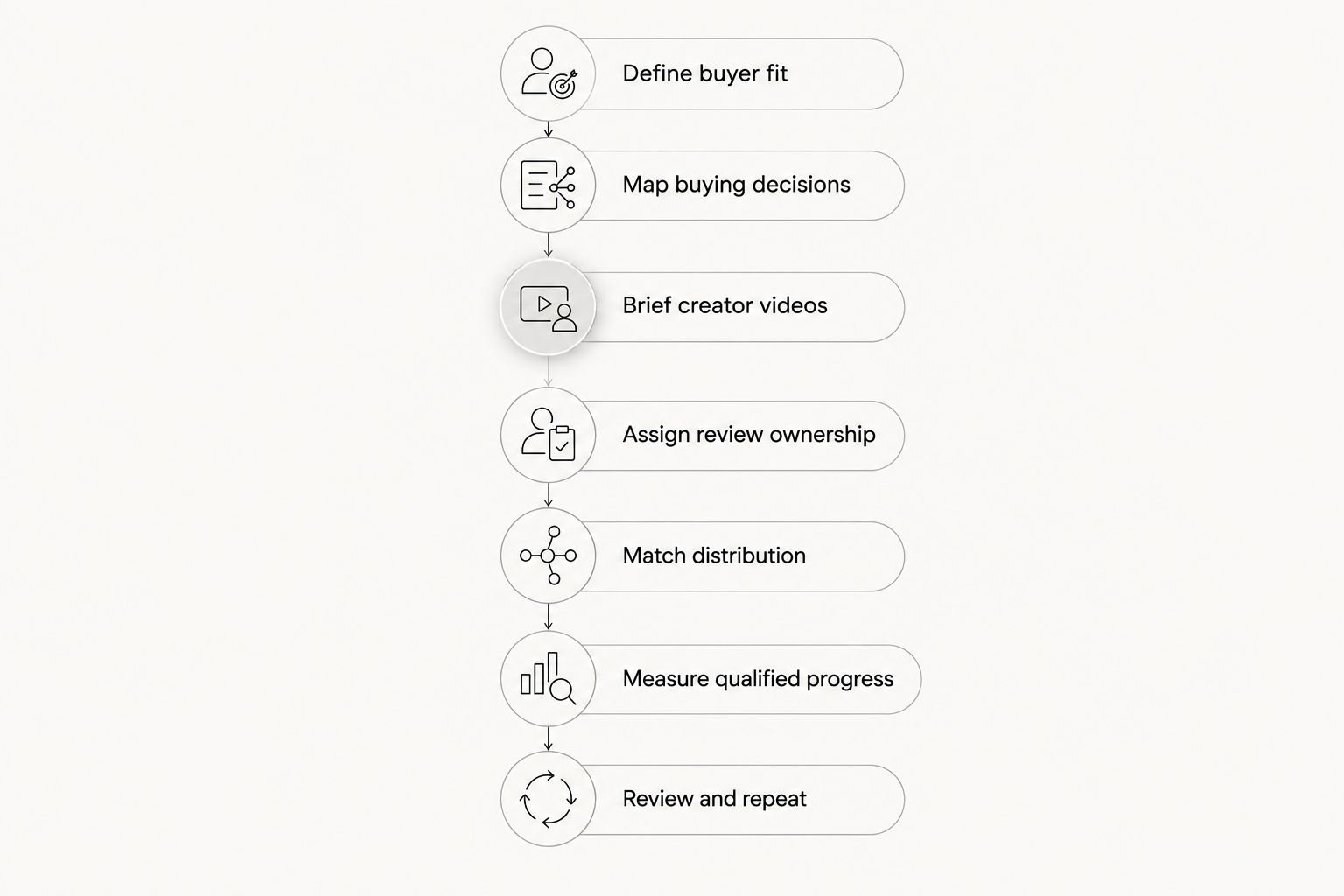
Define buyer fit
Write down the account characteristics that make your product relevant. Separate the organization you want to sell to from the person who first encounters your content. A daily user, a team lead, and a procurement reviewer need different explanations.
Use sales notes and customer conversations before adding research tools. Look for the tasks buyers describe, the objections they raise, and the conditions that make an account unsuitable. Turn those observations into a brief that a marketer or creator can use without guessing.
For example, a workflow demonstration aimed at an individual contributor should not automatically count as an enterprise acquisition campaign. Define the handoff from individual interest to account-level evaluation. That handoff gives you a meaningful qualification rule.
Approve the buyer definition before approving creative concepts. Close this stage with:
- Target account characteristics, including exclusions.
- User, champion, technical reviewer, and budget-owner roles.
- The specific workflow or problem each role cares about.
- A qualification rule sales agrees to use.
- An owner for resolving audience questions.
Map buying decisions
List the decisions a prospective customer must make before adopting your product. Start manually with questions from sales calls, support conversations, and product demonstrations. Group the questions by decision, not by content format.
A user needs to understand the workflow. A technical reviewer needs accurate information about requirements and restrictions. A budget owner needs a clear connection between the problem and the proposed purchase. Write separate content objectives for those needs.
Avoid sending every viewer straight to the same call to action. Educational content should help someone understand the problem; evaluation content should help someone assess fit. A request for a sales conversation belongs where the buyer has enough context to make that request useful.
For your 2026 content plan, make each asset answer a named question. Close this stage with:
- A list of recurring buying questions.
- One audience role assigned to each asset.
- The decision each asset supports.
- Evidence needed to answer the question accurately.
- A next action matched to buyer readiness.
Brief creator videos
Draft the brief yourself before outsourcing production. Include the audience, the problem, the product action to show, and the next step. Give the creator approved claims and a clear list of statements to avoid.
For short-form video, use 15–45 seconds as a brief constraint, not a promise of results. A 15-second concept can isolate the problem; a 30-second concept can show a focused workflow; a 45-second concept can leave room for explanation. Choose the length after deciding what the viewer needs to understand.
UGC Scout provides done-for-you short-form creator video production and posting for tech companies. That is an alternative to managing those tasks internally. It does not remove your responsibility for product accuracy or enterprise qualification.
UGC Scout is best for tech teams that want short-form creator video production and posting done for them. Close the brief with:
- The intended viewer and buying question.
- An opening problem stated in plain language.
- The exact product action to demonstrate.
- Approved claims and prohibited statements.
- A call to action tied to the content's purpose.
Assign review ownership
Create an approval checklist before the first draft arrives. A shared document is enough to start. Separate factual corrections from creative preferences so a change in tone does not obscure an inaccurate claim.
Assign product review to someone who knows the demonstrated workflow. Assign brand review to someone who can approve the message. Route security or legal claims to the people responsible for them. Do not ask a creator to infer those requirements from a homepage.
Use a single feedback owner to return a consolidated response. Conflicting comments create avoidable rework, especially when reviewers are correcting different parts of the same script. Keep a record of which version received approval and what changed afterward.
Outsource production work, not accountability for the claims. Close this stage with:
- A named owner for consolidating feedback.
- A factual review of the demonstrated workflow.
- Approved language for sensitive claims.
- Confirmation that recordings contain no confidential data.
- Written agreement on usage rights and permitted placements.
Match distribution
Choose distribution from the audience and buying question, not from the existence of a finished video. Start with channels you already operate and can measure. A creator post, a paid placement, and a sales follow-up are different uses of content.
For LinkedIn, frame the business problem and the role responsible for it. For Meta or TikTok, make the workflow understandable without assuming product familiarity. These are briefing choices, not guarantees that a platform will deliver qualified enterprise buyers.
Keep the next step consistent with the creative. A video about a specific task should lead to a relevant explanation or evaluation action, not an unrelated campaign destination. Confirm permission before reusing creator content in another placement.
Your 2026 distribution plan should identify who owns publishing and what each placement is supposed to achieve. Close this stage with:
- The target audience for each placement.
- A channel-specific opening and caption.
- A destination matched to the video's subject.
- Campaign tags and a consistent naming convention.
- Confirmation of publishing ownership and reuse permissions.
Measure qualified progress
Build a simple reporting view from your existing campaign data and customer records. Track attention, meaningful actions, and qualified account movement separately. Keep the definitions visible so marketing and sales interpret the same event consistently.
Views tell you that content was watched. They do not establish enterprise fit, purchase authority, or buying intent. Likewise, a form submission needs qualification before you count it as useful pipeline.
For creator content, record the concept, audience, placement, and destination alongside the results. That makes the report useful for the next brief. A total view count without those details cannot tell you which message to repeat.
Evaluate creative performance and commercial progress in separate columns. Do not claim that a single touch caused an enterprise sale when your records only show an association. Close this stage with:
- A defined attention metric for each placement.
- A defined next-action metric for each asset.
- Target-account and lead-qualification fields.
- Sales feedback on relevance and buying questions.
- A documented rule for reporting influenced opportunities.
Review and repeat
Compare results against the question each asset was designed to answer. Start with the actual content and the resulting responses, not just a summary chart. Read comments, review qualification notes, and inspect whether the destination matched the message.
Change a named element when you revise: the problem, opening, demonstration, audience, or next action. If you change everything together, the next result gives you little guidance about what mattered. Record the decision in the same document as the original brief.
Keep useful concepts even when their production style changes. Remove inaccurate or misaligned concepts even when they attract attention. A functioning content machine needs selection rules, not an obligation to publish every draft.
For your next 2026 review, return each learning to the brief. Close this stage with:
- Concepts to retain and the reason for retaining them.
- Concepts to revise and the specific change required.
- Concepts to stop because they miss the buyer or claim standard.
- Questions that need input from sales or product.
- A named owner for the next production cycle.
Compare your operating options
Choose the operating model by the work you need removed from your team. Internal production offers direct control. Freelance support adds external production capacity. An agency gives you a service relationship around an agreed scope.
Choose UGC Scout for the short-form production-and-posting requirement, not as a substitute for your enterprise growth strategy. Confirm review responsibilities, deliverables, usage rights, and measurement expectations before signing.
| Option | Best for | Main advantage | Key limitation |
|---|---|---|---|
| Internal growth team | Teams that want direct control over strategy and production | Keeps product knowledge and decisions inside the company | Your team owns briefing, production, posting, and reporting |
| Freelance creators | Teams prepared to manage individual creator relationships | Lets you commission content against your own briefs | You must assign coordination, review, and publishing ownership |
| UGC Scout | Tech teams seeking done-for-you short-form creator video production and posting | Offers production and posting as a service | The stated offer does not establish full enterprise demand-generation scope |
You can combine internal strategy with external production. Keep account qualification and product-claim approval with the people responsible for them. Ask any provider to describe the handoff between your brief, their work, and final approval.
Common mistakes enterprise SaaS teams make
Treating the user as the entire buying committee
A convincing user demonstration does not answer every technical or commercial question. Build supporting content for the other reviewers rather than stretching one short video into an entire sales argument. Keep each asset focused on a decision it can actually support.
Using consumer-style views as an enterprise success metric
Large reach and relevant reach are different measurements. Check whether responses come from the audience you defined and whether those responses progress toward qualification. Keep views in the report, but do not relabel them as pipeline.
Giving creators access to sensitive customer information
A demonstration should not expose customer records, private conversations, or restricted account details. Prepare approved demonstration material before recording begins. Review the captured content itself, not just the script, before publication.
Making claims the product team has not approved
A creator's confident delivery does not verify a feature, integration, or security statement. Supply approved language and current demonstration instructions. Remove claims that cannot be supported rather than softening them into vague promises.
Outsourcing without defining the handoff
Done for you needs a defined scope. Decide who writes the brief, approves revisions, posts the content, manages permissions, and reports results. An agency relationship does not resolve those responsibilities unless the agreement does.
FAQ
What is growth marketing for enterprise SaaS teams?
Growth marketing for enterprise SaaS teams connects audience research, content, distribution, and measurement to qualified pipeline. It separates individual user interest from account-level buying progress.
Is creator video useful for enterprise SaaS marketing?
Creator video is useful for explaining a problem or demonstrating a focused workflow. It should sit alongside product evidence and evaluation content rather than replace them.
Should an enterprise SaaS team hire an agency or build internally?
Build internally when you want to own strategy and production directly; consider an agency when you want defined production tasks handled externally. Keep product-claim approval and account qualification under clear internal ownership.
What does UGC Scout do for tech companies?
UGC Scout is a growth and influencer marketing agency offering done-for-you short-form creator video production and posting. Confirm the specific deliverables and responsibilities against your team's requirements.
How long should an enterprise SaaS creator video be?
Use 15–45 seconds as a starting brief range for a focused short-form concept. Choose the length around the buying question and demonstration, not a claimed universal optimum.
What should enterprise SaaS teams measure beyond views?
Measure relevant next actions, lead qualification, and target-account progress alongside views. Use consistent definitions and sales feedback to distinguish attention from buying activity.
Who should approve creator content before it is posted?
Assign approval to the people responsible for product accuracy, brand messaging, and any sensitive claims. Use one feedback owner to consolidate their decisions before publication.
One last thing
Before approving a video, ask someone who did not write the brief to describe its intended viewer and next action. If the answer differs from the brief, revise the content before increasing distribution.
This is a message check, not a performance forecast. It catches a basic problem that a dashboard cannot resolve: the content is asking the wrong person to do the wrong thing. Make that check part of your 2026 approval process.