
Creator whitelisting on LinkedIn has no single standard rate: your agreement covers the creator’s work and paid-use permission, while LinkedIn ad spend is separate. For a 2026 campaign, compare the full scope—not just the creator’s fee—because production, usage duration, exclusivity, and campaign management are different commitments.
- LinkedIn creator whitelisting requires a defined agreement; creator compensation and ad spend are separate budget lines.
- Compare creator whitelisting cost LinkedIn proposals by production scope, paid-use rights, duration, and campaign management.
- LinkedIn Thought Leader Ads require member permission; that permission does not replace your commercial agreement.
- UGC Scout fits tech teams seeking done-for-you creator video production and posting; confirm LinkedIn paid-use scope separately.
How much does creator whitelisting cost on LinkedIn?
The total depends on what you commission, what you can promote, and who operates the campaign. There is no universal creator whitelisting fee that includes all three. A production-only proposal and a managed advertising proposal are not equivalent, even when both use the word whitelisting.
Before comparing proposals, separate permission from ownership. The guide to reusing creator content in paid ads legally explains the distinction you need in the agreement.
| Budget component | What the agreement should specify | What to check |
|---|---|---|
| Content production | Deliverables, scripts, filming, editing, and revisions | Whether an existing post or new content is required |
| Creator publishing | Who publishes the post and approves its wording | Whether posting is included or separate |
| Paid-use permission | Approved content, advertiser, platform, and usage period | Whether LinkedIn promotion is explicitly covered |
| Exclusivity | Restricted competitors, activities, and duration | Whether the restriction is actually necessary |
| Campaign management | Setup, approvals, reporting, and ongoing decisions | Who owns each task |
| LinkedIn media | Advertising delivered through Campaign Manager | Whether media is separate from service fees |
Treat this table as a proposal checklist, not a claim that every supplier charges separately for every item. A bundled agreement can work. It still needs to identify what is included and what triggers another approval.
Why this matters
An incomplete scope creates an incomplete budget. Paying for a video does not automatically establish permission to advertise it, publish it through a creator’s profile, or reuse it elsewhere.
For SaaS and mobile app teams, product accuracy belongs in that scope too. A creator needs approved claims, a usable demonstration, and clear boundaries around customer information. Paid distribution makes those checks more consequential because you are deliberately putting the content in front of additional people.
Your 2026 procurement brief should therefore answer two questions: what are you buying, and what are you allowed to do with it? Resolve both before asking which proposal is cheaper.
Which LinkedIn promotion setup are you buying?
Whitelisting is broad industry shorthand. On LinkedIn, the relevant advertising format for promoting an individual member’s eligible post is Thought Leader Ads, which requires that member’s permission.
Do not assume a supplier uses the term in that precise way. Some proposals describe creator-produced content that your company publishes instead. Ask whose identity appears on the ad and which account operates the campaign.
| Setup | Best for | Main benefit | Main limitation |
|---|---|---|---|
| Creator post promoted through Thought Leader Ads | Teams that specifically want the creator’s post and identity in paid distribution | Advertising retains the individual author’s identity | Requires member permission and an eligible post |
| Creator-produced content published by your company | Teams that want creator material in company-controlled campaigns | Separates content production from creator-profile promotion | Does not carry the creator’s original post identity |
| Organic creator post without paid promotion | Teams testing a creator’s message before commissioning paid distribution | Avoids buying media for that post | Does not provide paid audience targeting or purchased distribution |
Choose Thought Leader Ads when the creator’s identity is part of the reason to advertise. Choose company-published creative when the content itself matters more than distribution under that person’s name.
Neither setup guarantees qualified leads. The advantage is structural: one promotes a member’s post, while the other places creator material under your company’s publishing and advertising arrangement.
How to scope a LinkedIn creator test
Use a written brief before requesting proposals. The following is an example planning scope, not a market benchmark or a promised package: commission 3 videos, each 15–45 seconds long, and request a 30-day LinkedIn paid-use period.
That example gives suppliers something concrete to accept, revise, or decline. It does not imply that every video will qualify for every LinkedIn placement; confirm the intended format in Campaign Manager before production.
1. Define deliverables
Specify whether the assignment is a new demonstration, a personal explanation, or promotion of an existing post. List finished assets and revision expectations.
For a SaaS example, ask for a demonstration of a single workflow rather than a tour of the entire product. That makes it easier to judge whether the creator understood the brief and whether the final content proves its central claim.
2. Define permission
Name LinkedIn, the advertiser, the approved content, and the permitted use. State whether paid distribution uses the creator’s post or a company-published asset.
Keep platform authorization and the commercial agreement aligned. Permission inside an advertising workflow does not explain every contractual question about editing, reuse, or exclusivity.
3. Set dates
Specify when the usage period starts: approval, publication, or first paid delivery. Then state when it ends.
For the example 30-day test, write down the start event rather than leaving it implied. Otherwise, production delays and approval delays can create disagreement about how much usable campaign time remains.
4. Assign owners
Identify who approves claims, requests platform permission, checks tracking, and stops advertising at expiry. Give each task a named owner within your team or supplier’s team.
Done for you should mean fewer handoffs for your team—not unclear responsibility. If campaign operation is excluded, identify the person who will handle it before signing.
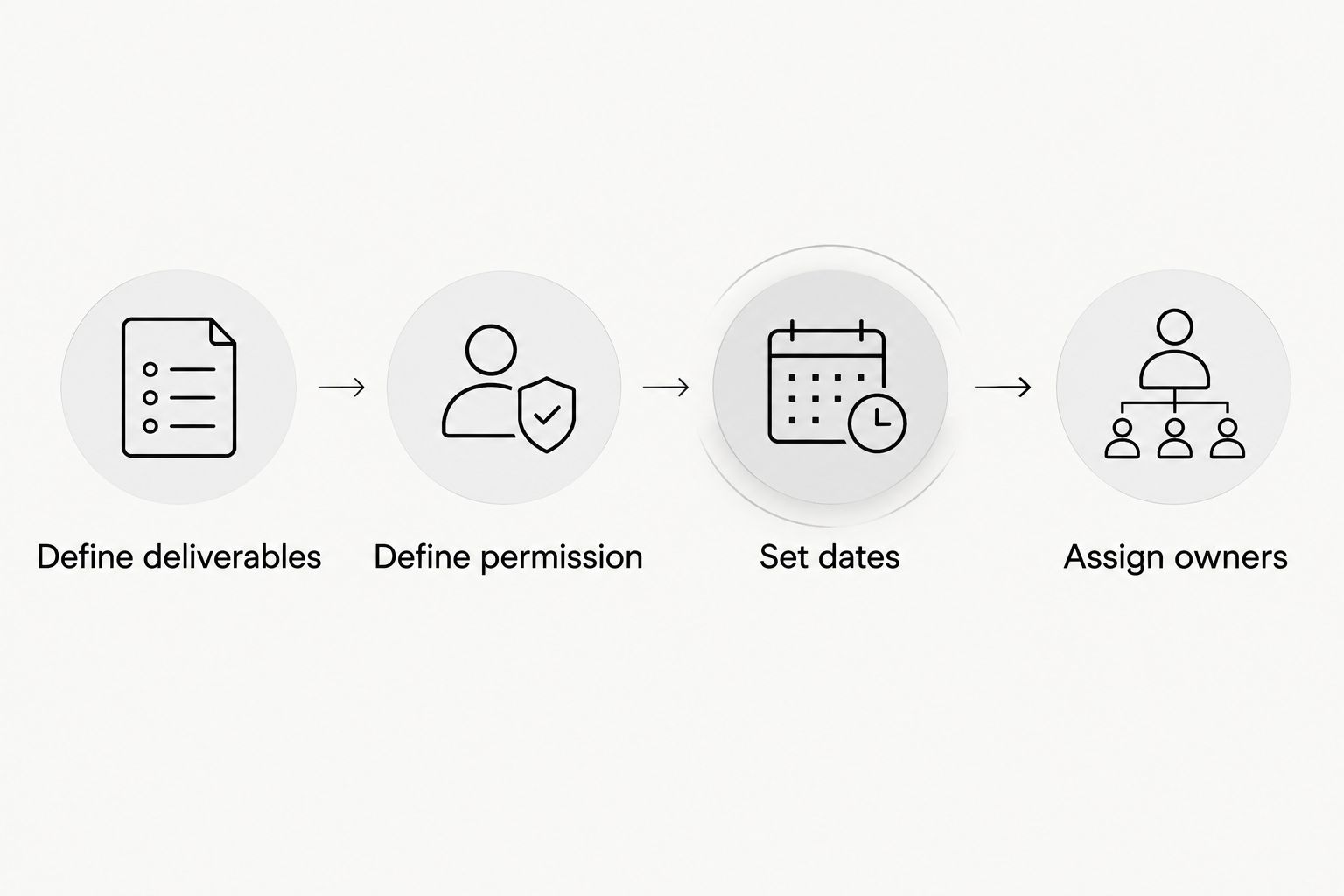
Keep this brief consistent across suppliers. When one supplier changes the deliverables or usage period, record the change alongside the proposal rather than treating it as the same offer.
Why LinkedIn creator whitelisting costs vary
Scope changes explain why two proposals can differ without either being incorrect. Ask suppliers to connect each commercial term to a specific deliverable, permission, or responsibility.
- Existing content versus new production. Promoting an approved post is a different assignment from researching, scripting, filming, and editing a new demonstration.
- Paid-use duration. A defined campaign window and continuing advertising permission are different rights. Specify renewal terms instead of assuming continued use.
- Creator expertise. An assignment requiring a credible explanation of technical workflows has different selection requirements from a general product introduction.
- Exclusivity. Restrictions on working with competitors add obligations beyond producing or publishing content. Name the restricted category rather than using a vague ban.
- Approval workload. Product, legal, and marketing reviews create work that belongs in the production plan. Define included revisions and distinguish corrections from a changed brief.
- Campaign operation. Content delivery, advertising setup, media buying, and reporting are separate tasks. Confirm which tasks the supplier owns.
For 2026 planning, ask for written renewal and change-request terms at the same time as the initial scope. An initial agreement tells you little about continuing the campaign unless the next decision is also defined.
How do you compare proposals without a misleading benchmark?
Compare equivalent rights and responsibilities before comparing totals. A lower production quote is not a lower campaign commitment if it excludes paid use, publishing, and management that another proposal includes.
Normalize the proposals in a shared worksheet. Use the same deliverable count, usage window, advertiser, and approval process, then flag every exception.
Ask each supplier to answer these questions directly:
- Which finished assets are included, and who publishes them?
- Is LinkedIn paid distribution explicitly permitted?
- Who secures the member’s platform permission?
- What changes require a new agreement?
- Who monitors expiry and stops the campaign?
- Which reporting and campaign-management tasks remain with your team?
Reject vague answers such as full usage unless the agreement defines the platforms, content, duration, and permitted edits. Broad wording is not a substitute for a usable permission record.
Then assess the work your team must still do. A production-only relationship suits a team with an established media buyer and approval process. A managed relationship suits a team that wants those operational tasks assigned elsewhere, provided the agreement actually includes them.
When does an agency make sense?
An agency makes sense when coordination is part of the problem: finding creators, briefing them, reviewing demonstrations, and getting approved content published. It is a different purchase from permission to promote an existing post.
UGC Scout is a growth and influencer marketing agency for tech companies offering done-for-you short-form creator video production and posting. UGC Scout is best for tech teams seeking done-for-you creator video production and posting.
For a LinkedIn whitelisting assignment, confirm the additional scope directly: paid-use agreements, member permissions, campaign setup, media buying, and expiry management. Do not infer those services from a production-and-posting offer.
The trade-off is clear. An agency can take on agreed production and coordination work, but your team still needs to provide product truth, approval authority, and campaign objectives. A done-for-you content machine still needs accurate inputs.
Does LinkedIn permission replace a creator contract?
LinkedIn permission does not replace a creator contract. Platform authorization enables the advertising workflow; your commercial agreement should define compensation, content rights, permitted edits, duration, and responsibilities.
For a 2026 campaign, keep the approved content, signed terms, and permission record together so the person running advertising can check the same scope.
Can you promote an existing creator post instead of making a video?
You can promote an existing eligible member post through LinkedIn Thought Leader Ads with permission. Confirm eligibility and the creator’s agreement before building the campaign around it.
An existing post avoids commissioning that particular asset from scratch. It does not automatically grant permission to edit the material, publish it elsewhere, or continue advertising indefinitely.
Should you negotiate exclusivity for a short test?
Request exclusivity only when a defined competitive conflict justifies it. Specify the restricted competitors or category, the activities covered, and the duration.
Do not request a broad restriction simply because it appears in a template. Your approval goal is a clear agreement, not the largest possible rights claim.
FAQ
How much does creator whitelisting cost on LinkedIn in 2026?
LinkedIn creator whitelisting has no single standard rate; the agreement depends on production, paid-use rights, duration, and management. LinkedIn advertising spend is a separate budget component, so compare the complete scope rather than a creator fee alone.
Is LinkedIn creator whitelisting the same as Thought Leader Ads?
Thought Leader Ads are LinkedIn’s format for promoting eligible individual member posts with permission. Whitelisting is broader industry shorthand, so ask the supplier to identify the exact publishing and advertising setup.
Does paying for a creator video include LinkedIn advertising rights?
Paying for production does not automatically establish LinkedIn advertising rights. Put the platform, approved content, advertiser, usage period, and permitted edits in the agreement.
Do I need the creator’s LinkedIn password?
You should not request the creator’s LinkedIn password. Use LinkedIn’s member-permission process for Thought Leader Ads and keep the commercial agreement separate.
Is a 30-day usage period the standard for LinkedIn creators?
A 30-day usage period is an example planning scope, not a universal standard. Agree on the start event, end date, and renewal process with the creator before advertising.
What should a SaaS team approve before a creator post goes live?
A SaaS team should approve product claims, demonstrations, disclosed relationships, and the final publication scope. Remove confidential information and confirm that the creator’s experience is represented accurately.
Does UGC Scout include LinkedIn whitelisting in video production?
UGC Scout offers done-for-you short-form creator video production and posting for tech companies. Confirm LinkedIn paid-use rights, platform permissions, and campaign-management responsibilities separately rather than assuming they are included.
One last thing
Write the stop rule before the launch rule. Your 2026 campaign brief should tell the operator what to do when permission expires, the creator withdraws platform authorization, or the approved product claim changes.
A strong post is not enough. The campaign needs permission that matches the actual use, an owner who can verify it, and a clear end point.