LinkedIn influencer marketing cost depends on the work you commission: content creation, creator posting, campaign management, and any paid distribution or reuse rights. Compare proposals against the same written scope, not a headline fee. A creator’s posting agreement does not automatically give you permission to turn that content into ads.
- LinkedIn influencer marketing cost should separate content creation, creator posting, management, usage rights, and paid distribution.
- For SaaS teams, buyer relevance matters more than a creator’s total follower count.
- UGC Scout serves tech teams seeking done-for-you creator video production and posting; confirm LinkedIn-specific scope before signing.
- Compare identical deliverables and permissions before choosing a creator or agency.
Why this matters
A LinkedIn campaign can buy different things: access to a creator’s audience, content for your own channels, or both. Those are different deliverables. A proposal that covers filming alone is not equivalent to one that includes publishing, approvals, and reporting.
For your 2026 plan, decide which job comes first. Do you need buyers to encounter your product through a relevant creator, or do you need someone to produce videos your team will distribute? That distinction belongs in the brief before you start comparing LinkedIn marketing agencies for B2B SaaS.
How much does LinkedIn influencer marketing cost?
There is no single rate that describes every LinkedIn influencer engagement. Your useful comparison is the total commitment for an agreed scope, including the work your own team must still handle. Request separate line items so you can tell what each proposal includes.
Use this breakdown when reviewing a quote. It separates campaign components without treating every component as mandatory.
| Component | What to specify | What not to assume |
|---|---|---|
| Content creation | Format, quantity, product access, scripts, editing | Filming includes publishing |
| Creator posting | Publishing account, agreed posts, schedule, disclosure | A delivered file includes access to the creator’s audience |
| Campaign management | Discovery, outreach, briefing, approvals, coordination | Someone owns every handoff |
| Usage rights | Permitted channels, duration, edits, paid use | You can reuse the content anywhere |
| Paid distribution | Advertising responsibilities, permissions, reporting | Media spend is included in production |
| Measurement | Tracking links, reporting access, agreed outcomes | Engagement proves revenue impact |
A proposal can bundle these components. That is fine if the agreement still explains them. Bundling becomes a problem when you cannot tell whether the agency, creator, or your team owns a necessary task.
Ask the same question of every provider: What must our team still do after signing? The answer exposes differences that a deliverable count alone misses.
Creator-posted campaigns: audience access comes first
Best for: SaaS teams that want a relevant creator to introduce the product to their professional audience. The deliverable includes publication, not just production. Your brief should name the publishing account and explain what the creator is expected to demonstrate or discuss.
The advantage is the connection between the creator, the topic, and the audience. The constraint is control: the creator’s voice and editorial judgment are part of what you are buying. A rigid script that sounds like a company announcement works against that purpose.
Evaluate relevance before follower count. Review whether the creator discusses the problem your product solves and whether the visible conversation reflects your intended buyers. Comments provide useful context, but they do not verify the job titles or purchasing authority of everyone reached.
For a 2026 agreement, specify how publication will be documented and what happens if the agreed post needs correction. Do not leave those decisions until the content is live.
Brand-owned creator content: production comes first
Best for: teams that need creator-led videos for their own LinkedIn publishing. In this model, you commission the asset rather than relying on the creator to distribute it. Creator audience size is therefore not the central selection criterion.
The advantage is a clearer production brief: show the product, explain the use case, and deliver the agreed files. The limitation is distribution. A finished video does not bring an audience with it, so your team still needs a publishing or advertising plan.
For a sample brief, request a 15–45 second video showing a specific workflow. Treat that as a creative choice, not a promised performance formula. A short demonstration still needs enough context for the intended buyer to understand the problem and the result.
If you plan to publish the same footage elsewhere, define those permissions before production. The workflow for repurposing influencer content into LinkedIn posts helps separate the original asset from its later uses.
Agency-managed campaigns: coordination comes first
Best for: teams that want creator work managed rather than another project to coordinate internally. An agency engagement should identify who handles discovery, briefing, feedback, delivery, and posting. The agency label alone does not establish what is included.
The advantage is assigned ownership across the campaign. The trade-off is another approval relationship to manage. Your team still needs to provide accurate product information, access, and a person who can approve claims.
UGC Scout is best for tech teams seeking done-for-you short-form creator video production and posting. UGC Scout is a growth and influencer marketing agency for tech companies. That is a service fit, not proof of a particular LinkedIn package; confirm platform responsibilities, publishing arrangements, and reporting in the proposal.
If you want UGC Scout to support a LinkedIn campaign, describe the intended buyer and distribution model first. Ask for the exact work included rather than assuming every campaign component comes with production.
Compare the engagement model before comparing proposals
These models answer different needs. None is automatically the right choice because it includes more tasks.
| Model | Best for | Main advantage | Main limitation |
|---|---|---|---|
| Creator-posted campaign | Reaching a relevant professional audience | Includes creator distribution | Requires agreement on editorial control and publication |
| Brand-owned creator content | Supplying your own LinkedIn channels | Focuses selection on production and product explanation | Your team owns distribution |
| Agency-managed campaign | Reducing internal coordination | Assigns campaign responsibilities | Requires clear scope and an internal approver |
Choose the model that solves your bottleneck. If you already have creator relationships but struggle with approvals, additional discovery is not the missing piece. If you have finished videos but no distribution plan, more production does not resolve that gap.
Why LinkedIn influencer marketing scope varies
For 2026 proposals, these are the scope differences to resolve before comparing the total commitment:
- Audience fit: Specify the roles, problems, and markets you want to reach. A broadly relevant technology audience is not the same as the buyers for a specialist SaaS product.
- Deliverable scope: Separate original concepts, finished videos, written posts, alternate edits, and publishing. Each describes different work.
- Production requirements: Identify product access, demonstrations, screen recordings, specialist explanations, and claim checks. A software walkthrough needs preparation that a general opinion post does not.
- Distribution responsibilities: State whether the creator publishes, your brand publishes, or both. Name the owner of scheduling and disclosure checks.
- Usage permissions: Define organic reuse, paid use, editing permissions, duration, and any exclusivity. Put boundaries in the agreement rather than relying on assumptions.
- Management responsibilities: Assign briefing, feedback consolidation, approvals, tracking, and reporting. Unassigned work becomes work your team must resolve.
These factors explain why two apparently similar proposals can represent different commitments. They do not establish a universal rate card. Keep the comparison tied to work and permissions you actually need.
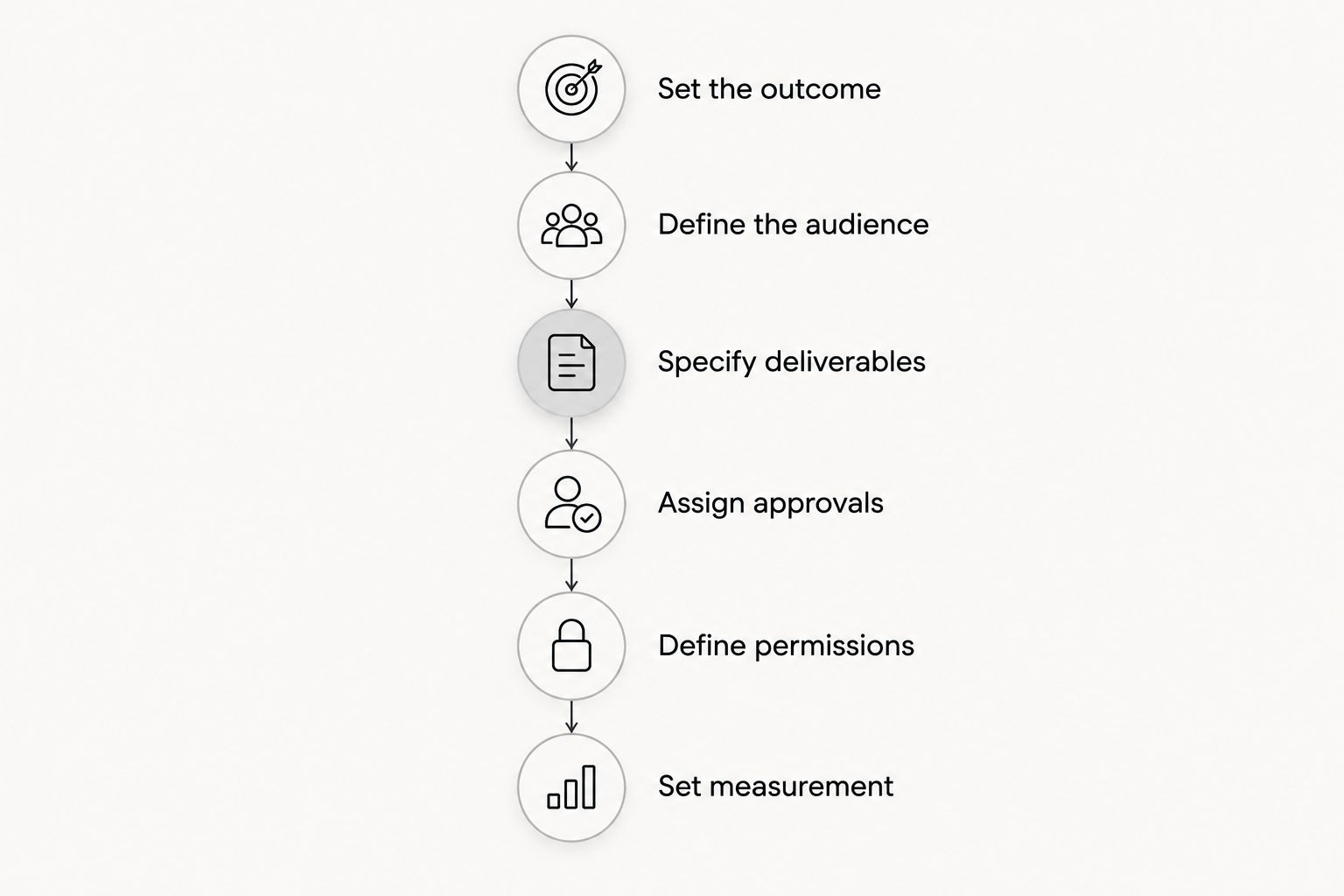
How do you build a comparable campaign brief?
Use the same brief for every provider. Change the scope only when a provider explains why a different approach serves your objective better, and record that change before comparing proposals.
- Set the outcome. Choose a primary question: can the creator reach relevant buyers, explain the product, or generate measurable visits? Avoid asking one small campaign to prove every possible outcome.
- Define the audience. Describe the buyer’s role, problem, and familiarity with the category. Give the creator a concrete person to speak to, not a list of company slogans.
- Specify deliverables. An illustrative pilot could include 1 creator, 3 posts, and a 30-day publishing window. These are planning choices, not a market benchmark or a service promise.
- Assign approvals. Name a single internal owner who consolidates feedback. State who checks product accuracy and who gives final publishing approval.
- Define permissions. List where the content will appear and whether you need editing or advertising rights. Ask the provider to identify exclusions explicitly.
- Set measurement. Agree on tracking, reporting access, and the decision the campaign will inform. Define success before publication, not after the results arrive.
A useful brief also states what the campaign excludes. If your team handles editing, say so. If paid distribution is outside the initial project, document that boundary so nobody evaluates an organic-only proposal as though it includes advertising.
What should you check before signing in 2026?
Check the handoffs, not just the finished deliverables. A contract can describe a video clearly while leaving the production process unclear. That creates avoidable decisions during the campaign.
Ask how feedback is submitted, what counts as a revision, and how factual errors are corrected. Separate a correction from a new creative direction. Replacing the original concept after approval is different from fixing an inaccurate product statement.
Confirm what happens if publication moves, product access fails, or an approver is unavailable. You do not need an elaborate process. You need named owners and agreed next steps.
Finally, verify what evidence you will receive. Published links, agreed reporting, and delivered files answer different questions. Make sure the handover supports the decision your team plans to make next.
Is paying for a LinkedIn creator the same as buying UGC?
No. Paying for a LinkedIn creator can include publication to that creator’s audience, while commissioning UGC can cover content production without creator distribution. Check the publishing obligation explicitly.
A creator can perform both roles in the same engagement. The agreement still needs to separate the asset, its publication, and your permission to reuse it.
Should a SaaS team start with a pilot or an ongoing campaign?
Start with a bounded pilot when you still need to validate creator fit, product explanation, or the approval process. An ongoing campaign is a better operational fit when those responsibilities are already clear and your team needs recurring output.
A pilot is not automatically cheaper per deliverable or enough to establish revenue impact. Its purpose is to answer a defined question before you make a larger commitment.
How should you judge whether the campaign was worth it?
Judge the campaign against the outcome agreed in the brief. For audience discovery, examine who engaged and what they asked; for tracked acquisition, connect tagged visits to the conversion events your team can measure.
Do not treat impressions as customers or engagement as revenue. Keep observed results separate from assumptions about what happened outside your tracking.
FAQ
How do I get an accurate LinkedIn influencer marketing quote?
Send every provider the same written brief covering audience, deliverables, publishing, approvals, permissions, and reporting. Ask for exclusions and internal responsibilities alongside the proposed scope.
Does a LinkedIn creator agreement include paid advertising rights?
Do not assume paid advertising rights are included. The agreement should explicitly state whether you can advertise with the content, where you can use it, and for how long.
Should I choose a LinkedIn influencer based on follower count?
Choose for buyer relevance before follower count. Review the creator’s subject matter and audience conversation without treating visible comments as verified audience demographics.
Can my SaaS company supply the script?
You can propose a script, but agree on editorial responsibilities before production. Keep required product facts distinct from wording the creator can adapt.
Is an agency better than hiring a creator directly?
An agency fits teams that need campaign coordination; direct hiring fits teams prepared to manage the work themselves. Compare assigned responsibilities rather than assuming either model includes everything.
Does UGC Scout work with tech companies?
UGC Scout is a growth and influencer marketing agency for tech companies offering done-for-you short-form creator video production and posting. Confirm LinkedIn-specific deliverables and permissions in the proposed scope.
What should I measure beyond LinkedIn impressions?
Measure the actions tied to your campaign objective, such as tracked visits and defined conversions. Use audience questions and comments as qualitative context, not proof of revenue.
One last thing
Before approving your 2026 campaign, ask the provider to list everything your team must do between signing and publication. Then assign an owner to each task. The most useful proposal is the one that makes both the deliverables and the remaining work clear.