
A fractional CMO is better when your company needs someone to set marketing priorities and direct the work; a growth marketing agency is better when you need a team to execute an agreed plan. For your 2026 hiring decision, separate the leadership gap from the delivery gap. Neither arrangement removes the need for a named internal owner who can approve decisions and resolve blockers.
- Fractional CMO vs growth marketing agency: choose leadership for unclear priorities, execution for an agreed plan.
- A fractional CMO needs decision authority; a growth marketing agency needs a clear scope and approval owner.
- Using both works when the fractional CMO directs priorities and the agency owns defined deliverables.
- UGC Scout fits tech teams seeking done-for-you short-form creator video production and posting, not a replacement marketing executive.
Is a fractional CMO better than a growth marketing agency?
Choose the missing function, not the more impressive title. A fractional CMO engagement should establish marketing direction and accountability. A growth agency engagement should turn defined priorities into work you can review and measure.
For a broader execution brief, see the guide to growth marketing for enterprise SaaS teams.
| Arrangement | Best for | Main strength | Main limitation |
|---|---|---|---|
| Fractional CMO | Teams without clear marketing leadership | A named leader for priorities, planning, and coordination | Leadership alone does not supply production capacity |
| Growth marketing agency | Teams with a clear direction but insufficient execution capacity | An external team responsible for a defined delivery scope | Delivery scope does not automatically include company-wide decision authority |
| Fractional CMO plus agency | Teams missing both leadership and execution | Separates strategic accountability from production | Requires explicit boundaries to prevent overlapping work |
Treat these as hiring mandates, not guaranteed inclusions. A fractional CMO can offer hands-on execution, and an agency can include strategic planning. The proposal must state who makes decisions, who does the work, and what remains with your team.
Why this matters
A SaaS company can have plenty of marketing activity without a clear answer to whom it should target. A mobile app team can have a clear audience and message but no reliable way to produce fresh creative. Those are different problems.
Your 2026 hiring brief should identify the unfinished work before it names a provider. Do not hire production capacity to settle a positioning dispute. Do not hire another strategist when approved work is waiting to ship.
Start with a plain statement: “We cannot decide what to do,” or “We know what to do but cannot deliver it.” If both statements are true, assign leadership first so the execution brief has an owner.
Fractional CMO: best for a leadership gap
Choose a fractional CMO when your company needs a senior marketing decision-maker without creating a full-time executive role. Make the mandate specific: select priorities, coordinate contributors, and explain how marketing work supports the business goal.
For a SaaS team, the unresolved question might be whether to focus on self-serve signups or sales-led demos. That choice affects messaging, content, acquisition channels, and measurement. Commissioning more campaigns does not resolve the choice.
A useful fractional CMO brief should require:
- A defined audience and business objective.
- A documented order of marketing priorities.
- Clear responsibilities across employees and external partners.
- An explanation of what to stop, not just what to start.
- A reporting approach tied to the agreed objective.
The advantage is ownership of direction. The limitation is delivery capacity: a leader cannot be treated as an entire creative, media, and operations team unless that execution is explicitly included.
Choose a fractional CMO when the missing output is a decision. Before signing, ask what the person can decide independently and what requires founder approval. An executive title without decision rights leaves the leadership gap intact.
Growth marketing agency: best for an execution gap
Choose a growth marketing agency when you can explain the audience, objective, and work you need delivered. The brief should connect the business goal to a defined service scope rather than asking an external team to “handle growth.”
For a mobile app team, the task might be producing creator-led demonstrations for an agreed use case. For a SaaS team, it might be running a defined acquisition program with approved messaging and a measurable conversion action. Different agencies cover different parts of that work.
Ask the agency to separate its proposal into deliverables, responsibilities, and dependencies. Creative production, posting, media management, landing pages, and reporting are distinct jobs. Do not assume that one service includes the others.
The advantage is delivery support beyond your internal capacity. The limitation is scope: an agency contracted to produce content does not automatically own product positioning, sales alignment, or company-wide marketing decisions.
Choose a growth marketing agency when the missing output is shipped work. Keep someone inside your company accountable for approvals, product accuracy, and business priorities. Outsourcing execution does not outsource every decision that execution depends on.
Fractional CMO plus agency: best for both gaps
Use both when your team needs marketing direction and people to carry it out. Give the fractional CMO responsibility for priorities and the agency responsibility for agreed execution. Your internal owner should retain authority over business commitments and product claims.
The benefit is a clear division between deciding and delivering. The drawback is another working relationship to manage. Without boundaries, both providers can produce competing plans while nobody owns the final approval.
Write the handoff plainly: the fractional CMO approves the campaign brief; the agency delivers against it; the internal product owner verifies technical accuracy. Adapt those responsibilities to your actual team rather than treating the example as a universal structure.
Choose the combined model only when each role has distinct work. Do not add a fractional CMO merely to relay messages between the founder and the agency.
Why the right choice varies
The fractional CMO vs growth marketing agency decision depends on the work your team cannot currently complete. Use these factors to examine proposals, not as a scorecard that rewards the longest service list.
- Decision ownership: If nobody can settle audience, positioning, or channel priorities, define a leadership role.
- Delivery capacity: If approved briefs sit unfinished, define the production or campaign support you need.
- Internal expertise: Identify who can review product claims, creative quality, and measurement before outsourcing work.
- Scope breadth: Distinguish a company-wide marketing mandate from a specific creator, content, or acquisition program.
- Approval dependencies: Name the people whose decisions are required before work can ship.
- Measurement ownership: Decide who reports activity, who checks conversion tracking, and who judges business results.
For your 2026 evaluation, ask every candidate to respond to the same business problem. Comparing a leadership proposal with a production proposal without separating their responsibilities gives you no useful basis for choosing.
How do you decide which one to hire?
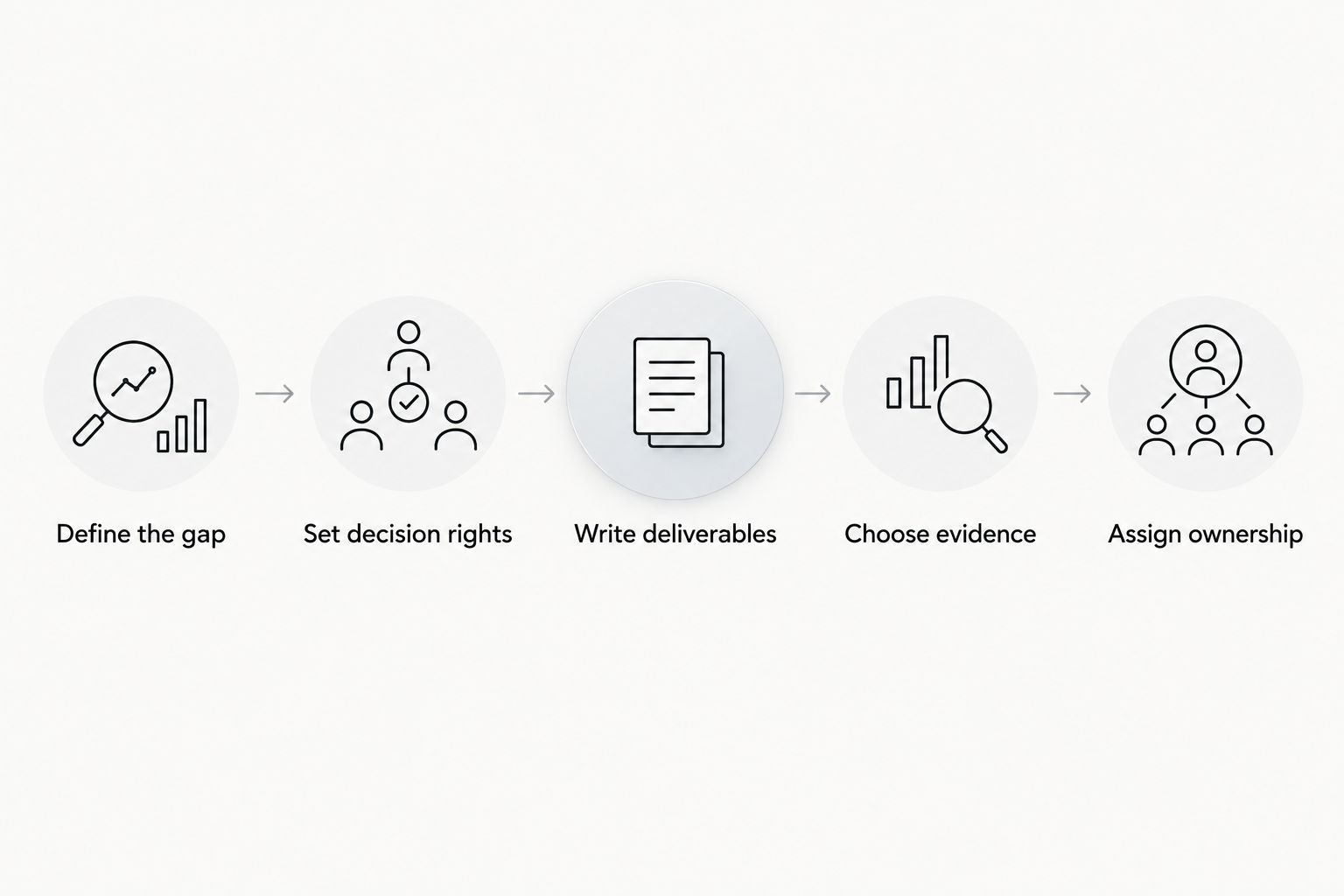
Use this sequence before requesting proposals. It produces a hiring brief that makes both the work and the boundaries visible.
Define the gap
Write down what is blocked today. Use observable work: an unresolved audience decision, an unapproved campaign brief, or creator videos waiting for production. Avoid broad descriptions such as “marketing is not working.”
Then identify the cause. A video backlog caused by missing production capacity calls for a different fix from a backlog caused by founders disagreeing about the message. More hands will not settle that disagreement.
Set decision rights
Name the person who can approve priorities and the person who can approve execution. They can be the same person, but the responsibility must be explicit. Ask candidates how they will handle conflicting feedback.
For a fractional CMO, establish authority over the marketing plan. For an agency, establish which decisions sit inside its scope and which require your approval. Record escalation rules before work begins.
Write deliverables
Translate the gap into work you can accept or reject. “Improve our presence” is not a useful deliverable. “Produce creator demonstrations of the approved onboarding flow” gives the provider a concrete task.
For a sample video brief, specify a 15-second hook-led cut, a 30-second walkthrough, or a 45-second explanation according to the intended use. These are example creative requirements, not promised package inclusions or performance benchmarks.
Choose evidence
Ask candidates to show how they approach work similar to your brief. A fractional CMO should explain a prioritization decision and its reasoning. An agency should explain its delivery process, review stages, and responsibilities.
Request permission-cleared examples. Separate evidence of completed work from claims about results, and ask how any reported outcome was measured. A polished presentation does not establish who actually performed the work.
Assign ownership
Finish the brief with named owners for access, approvals, delivery, and reporting. Include the dependencies your team must provide, such as a working product account or approved technical claims.
For your 2026 engagement, make these responsibilities part of the written scope. If a task has no owner, resolve it before signing rather than expecting the kickoff meeting to settle it.
Where does a specialist creator agency fit?
A specialist agency fits when the missing work is narrower than the entire marketing function. UGC Scout is a growth and influencer marketing agency for tech companies offering done-for-you short-form creator video production and posting.
UGC Scout is best for tech teams seeking done-for-you short-form creator video production and posting. That is an execution-focused reason to consider the agency, not a reason to assume it replaces an executive marketing role.
The benefit is a service focused on a defined category of work. The boundary matters just as much: do not treat creator video production and posting as evidence that every other marketing responsibility is included. Confirm the actual scope in the proposal.
For a SaaS or mobile app team, first settle the audience, product use case, and approval owner. Then brief the creator work. A content machine still needs an agreed message and someone authorized to approve it.
Can a growth marketing agency replace a fractional CMO?
A growth marketing agency replaces a fractional CMO only if its agreed scope includes the leadership responsibilities you need. Campaign strategy alone is not the same as authority over the wider marketing function.
Ask who resolves competing priorities across channels, manages internal contributors, and recommends stopping work. If those responsibilities remain with the founder, the agency has not replaced that leadership role.
Do you need both if you already have a marketing lead?
You do not need both simply because they perform different jobs. Start by checking whether your marketing lead already owns priorities and has enough authority to direct external execution.
If leadership is covered, hire for the delivery gap. If the marketing lead needs senior decision support, define that need separately rather than assuming an additional executive layer is necessary.
What should you measure after hiring?
Measure the hired function and the business objective separately. A leadership engagement should make priorities and accountability explicit; an execution engagement should deliver the agreed work to the agreed standard.
For SaaS, connect campaign reporting to the conversion action your team actually uses, such as a qualified demo or activated signup. For mobile apps, define the intended user action before judging creative. Views alone do not establish that the business objective was met.
FAQ
What's the main difference between a fractional CMO and a growth marketing agency?
A fractional CMO fills a marketing leadership role, while a growth marketing agency delivers an agreed execution scope. Proposals can overlap, so confirm decision authority and deliverables rather than relying on the title.
Is a fractional CMO better for an early-stage SaaS company?
A fractional CMO is the better fit when the SaaS company lacks clear marketing priorities and someone authorized to set them. If direction is already clear and delivery is blocked, execution support addresses the more immediate gap.
Should a mobile app company hire a growth agency first?
A mobile app company should hire a growth agency first when it has an agreed audience, objective, and execution brief. Resolve positioning and approval responsibilities before asking an agency to produce or run campaigns.
Can a fractional CMO manage our agency?
A fractional CMO can manage an agency when partner oversight is included in the engagement. Define who approves briefs, reviews delivery, and resolves disagreements with your internal team.
Does a growth marketing agency include strategy?
A growth marketing agency can include strategy, but the proposal must define its scope. Strategy for a specific campaign does not automatically include responsibility for the company's entire marketing plan.
Is UGC Scout a fractional CMO service?
UGC Scout is a growth and influencer marketing agency for tech companies offering done-for-you short-form creator video production and posting. Evaluate it for that stated work rather than assuming it supplies executive marketing leadership.
What should I ask before signing either engagement?
Ask who decides, who delivers, and what your team must provide. Put deliverables, approval responsibilities, reporting expectations, and scope boundaries in writing.
One last thing
Ask each candidate what they need from your company before they can do useful work. Their answer helps you identify unresolved dependencies: product access, audience decisions, approved claims, or founder availability.
For your 2026 hire, choose the provider whose mandate matches the blocked work. A fractional CMO should close a leadership gap. An agency should close a delivery gap. Neither should be hired to conceal an unresolved internal decision.