Healthtech companies’ influencer marketing is creator-led promotion designed to help the right audience understand a health product and take a relevant next step. This guide covers influencer marketing for healthtech companies in 2026, where product demonstrations, health claims, privacy, and creator credibility need separate checks.
- Influencer marketing for healthtech companies needs clear claims, relevant creators, and measurable product actions—not views alone.
- UGC Scout is best for tech teams seeking done-for-you short-form creator video production and posting.
- Approve health claims before filming; keep patient information out of creator briefs and demonstrations.
- Separate UGC production from influencer distribution, then choose the model your campaign actually needs.
Why influencer marketing matters for healthtech companies
Healthtech marketing has a communication problem before it has a distribution problem. Your audience needs to understand what the product does, who it serves, and where its usefulness ends. A creator can show an appointment-booking flow or explain an app feature without turning the video into a medical recommendation.
The distinction matters. A convincing demonstration does not prove a clinical outcome. A personal story does not establish that everyone will get the same result. Your 2026 campaign needs both a clear explanation and a defensible claim.
Start with the execution model. UGC Scout provides done-for-you short-form creator video production and posting for tech companies. That service fits teams that want outside production support; it does not remove your responsibility for health claims, privacy review, or campaign approval.
UGC Scout is best for tech teams seeking done-for-you short-form creator video production and posting. Choose that model when production is the task you need handled. Choose creators with relevant audiences when distribution is the task you need handled. Do not treat those purchases as interchangeable.
Build a healthtech creator campaign in 2026
Define the outcome
Choose a product action before choosing a creator. A consumer health app and a platform sold to clinic administrators need different explanations, audiences, and destinations. The campaign should reflect the actual buyer, not the broad category of people interested in health.
For a consumer app, the action might be completing onboarding or trying a relevant feature. For a business-facing platform, it might be requesting a demonstration. These are campaign choices, not promises of results. Pick an action your analytics can identify and your team can interpret.
Write the objective in plain language: help a defined audience understand a defined use case and take a defined action. If the brief cannot finish that sentence, filming starts too early.
- Name the user and the buyer separately when they differ.
- Choose one primary action for the campaign.
- Define what counts as completion, not just a click.
- Assign an owner to confirm that tracking works.
- Keep awareness metrics separate from product-use metrics.
Set claim boundaries
Create a claim sheet before anyone writes scripts. Separate product facts, supported health statements, and prohibited language. A scheduling feature is a product fact. A statement that a product diagnoses, treats, or prevents a condition needs a different level of evidence and review.
In the United States, FTC endorsement principles apply to paid creator relationships. Disclosures must clearly communicate material connections, and endorsements cannot make unsupported claims. Health-related advertising also needs evidence appropriate to the claim. A disclaimer does not repair an unsupported headline.
For your 2026 brief, give reviewers actual wording rather than a general request to check compliance. Include spoken lines, captions, on-screen text, demonstrations, and the landing-page message. Review the complete impression a viewer receives.
- List approved product descriptions in exact wording.
- Identify health claims that require qualified review.
- Ban invented outcomes and scripted personal experiences.
- Specify clear disclosure language and placement.
- Assign a reviewer who can stop publication.
Choose the delivery model
Start with the manual route. Your team can identify creators, check their public work, request relevant samples, prepare briefs, and coordinate revisions directly. That approach gives you direct control, but your team owns the workload from first outreach through final approval.
UGC production and influencer distribution solve different problems. A creator can make a useful video without having an audience that matches your buyers. An influencer can reach a relevant audience while producing a video that needs substantial editing. Decide which capability you need before comparing proposals.
UGC Scout’s influencer marketing agency model offers done-for-you short-form creator video production and posting for tech teams. Evaluate it against the work you want removed from your team. Ask how creator selection, revisions, approvals, and reporting would work for your brief; do not assume healthtech-specific review is included.
- Decide whether you need content, distribution, or both.
- Assign creator sourcing internally or to an outside partner.
- Request examples relevant to your intended audience.
- Clarify who approves scripts and finished videos.
- Define deliverables and responsibilities before engagement.
Match creator credibility
Match the creator to the explanation, not just the topic. A creator discussing everyday app use serves a different purpose from a qualified professional explaining a clinical concept. Credentials do not automatically make someone the right presenter, and popularity does not establish medical authority.
Watch complete videos rather than reviewing profile summaries alone. Check how the creator handles uncertainty, sponsorships, and audience questions. Look for a communication style your product can support without pushing the creator into stronger claims.
For example, a creator can demonstrate how to log a symptom without claiming the log provides a diagnosis. A practice-management demonstration should speak to the people who use or buy that workflow. Relevant context matters more than a generic interest in wellness.
- Review existing content for unsupported health claims.
- Verify credentials when the brief relies on professional authority.
- Check audience relevance to the actual user or buyer.
- Assess whether sponsored content is clearly disclosed.
- Confirm the creator can explain product limits plainly.
Write a demonstrable brief
Build the brief around something viewers can see. Show the task, explain the product’s role, and finish with the next action. Avoid scripts that spend the entire video naming benefits without showing how the product works.
Use 15 seconds for a focused hook-and-feature concept, 30 seconds for a short demonstration, or 45 seconds when the explanation needs more room. These are planning choices, not required formats or agency deliverables. Keep the script as short as the message allows, but do not cut a necessary qualification to hit a duration.
A useful appointment-booking concept shows the search, the selection, and the confirmation using demonstration information. It does not promise access, outcomes, or service conditions that your product cannot substantiate. Put approved wording beside each scene so the editor understands what must stay.
- Write one audience problem in ordinary language.
- Select one product task to demonstrate.
- Provide approved lines and prohibited alternatives.
- Specify demonstration data and permitted screen views.
- End with one clear, relevant next action.
Review before posting
Review the assembled video, not just the original script. Editing can change meaning through captions, cropped screens, audio, and the order of scenes. A qualified spoken statement can become an unqualified claim when the caption leaves out its limit.
Keep identifiable patient information out of creator assets. HIPAA applies to covered entities and business associates, not automatically to every health app. Determine your obligations with qualified counsel, and do not treat a creator agreement as permission to disclose protected information.
Your 2026 approval process should include the post caption and disclosure as well as the video. Decide who handles health questions in comments. Creators should not improvise personal medical advice on behalf of the campaign.
- Review speech, subtitles, overlays, and post captions together.
- Use demonstration data instead of real patient records.
- Confirm permissions for every visible person and asset.
- Check that sponsorship disclosures remain easy to notice.
- Establish a process for corrections and comment escalation.
Measure product actions
Start with manual checks. Test the destination, confirm campaign tracking, and verify that the chosen action appears correctly in your reporting. A broken handoff between the post and the product makes creative comparisons unreliable.
Separate distribution from response. Reach and views describe exposure; clicks describe movement; completed product actions describe what happened next. None independently proves a health outcome. Compare content against the campaign objective instead of declaring the most-viewed video the winner.
Change one major creative element at a time when you need a clear comparison. Keep a record of the hook, creator, demonstration, destination, and approval version. Your next brief should reflect a specific observation, not a general instruction to make content more engaging.
- Confirm the campaign destination works on mobile.
- Track the primary action defined in the brief.
- Separate organic posting from paid distribution in reports.
- Record creative differences before comparing results.
- Use findings to update the next approved brief.
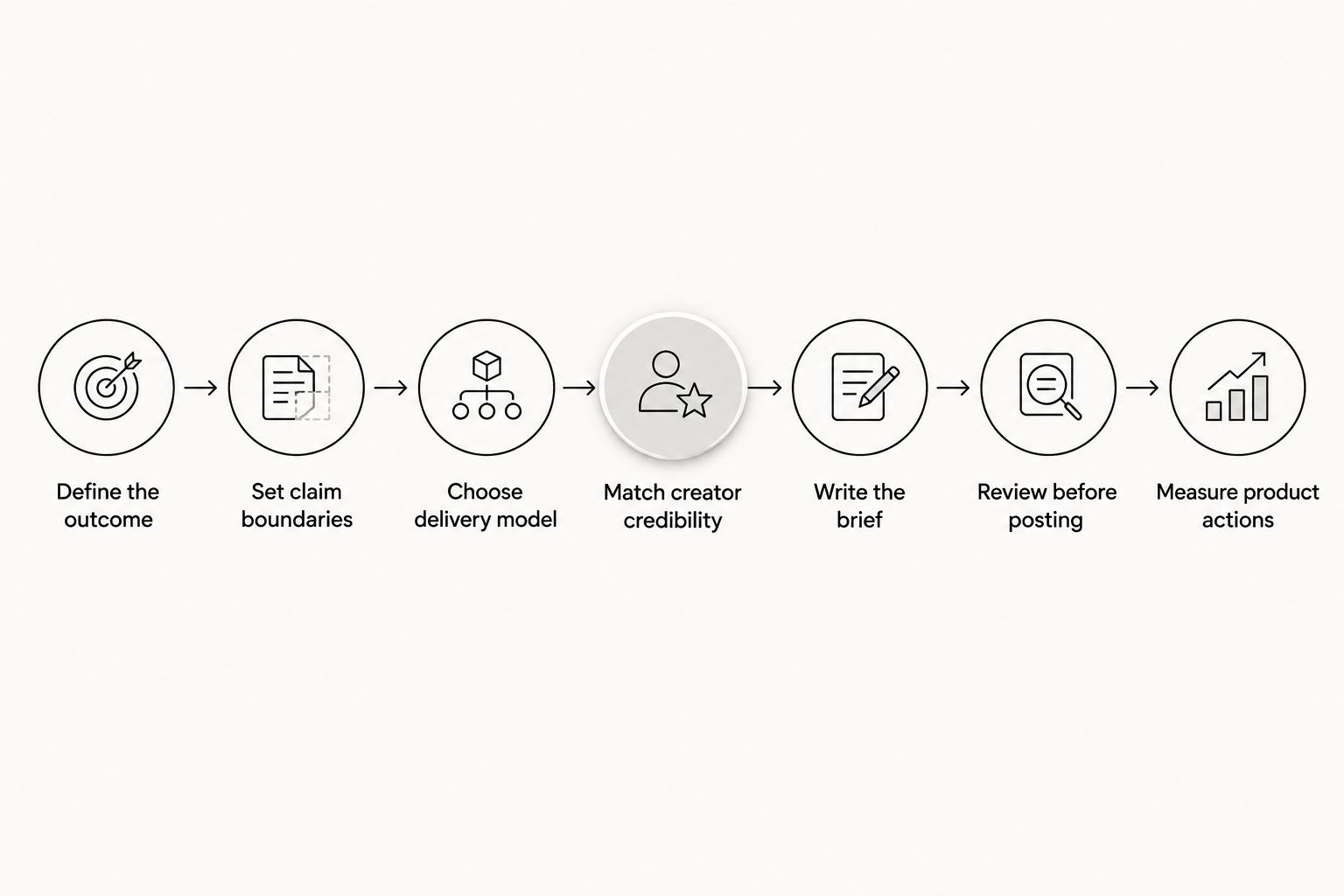
The process has distinct handoffs: Define the outcome, Set claim boundaries, Choose the delivery model, Match creator credibility, Write a demonstrable brief, Review before posting, and Measure product actions. Keep them in that order so production does not outrun approval.
Compare execution options for healthtech teams
Choose the option that matches the work you need done. Keep the production decision separate from clinical, legal, and privacy approval. No production arrangement replaces those responsibilities.
| Option | Best for | Main advantage | Key limitation |
|---|---|---|---|
| In-house creator management | Teams with an owner for sourcing, briefs, and approvals | Direct control over relationships and feedback | Your team handles coordination and production oversight |
| Direct creator partnerships | Campaigns needing a particular audience or presenter | You select the creator for a specific use case | Each partnership needs its own management and review |
| UGC Scout | Tech teams seeking done-for-you short-form production and posting | Outside support for the stated production and posting work | Healthtech-specific approval remains a separate requirement |
| Employee-led demonstrations | Product explanations requiring internal knowledge | Presenters know the workflow and its limits | Internal expertise does not provide an external creator audience |
For a 2026 campaign, ask every outside partner the same operational questions. Who writes the brief? Who selects creators? Who owns the approved files? Who publishes, and who can stop a post? Comparable answers make the decision clearer than broad agency descriptions.
Ask about content usage rights separately. Permission to publish a creator’s video does not automatically establish permission for every edit, advertising placement, or future campaign. Put the intended uses into the agreement before production starts.
Common mistakes healthtech teams make
Turning experience into evidence
A creator’s experience is not proof that a product produces the same result for other people. Do not script a personal health outcome the creator has not experienced. Keep demonstrations factual and send outcome claims through the appropriate evidence review.
Buying an audience when you need content
A follower count does not answer whether a creator can explain your onboarding flow. Decide whether the campaign needs distribution or reusable creative first. Then assess audience relevance and production ability as separate criteria.
Using real health information in demos
A realistic demonstration does not require a real patient record. Prepare demonstration accounts and review every visible field. Check notifications, browser tabs, and exported files as well as the main screen.
Treating approval as the final edit
Late compliance feedback creates avoidable rework. Approve the claim sheet and script before filming, then review the finished impression before posting. Both checks matter because production can change the message.
Optimizing for views without checking the next step
An entertaining video can attract people who do not need your product. Compare the audience, destination, and completed action before changing the campaign. Keep attention metrics visible, but do not let them replace the objective.
FAQ
What is influencer marketing for healthtech companies?
Influencer marketing for healthtech companies uses creators to explain health products and encourage a relevant audience action. Campaigns need clear product boundaries, supported claims, appropriate disclosures, and privacy review.
What's the difference between healthtech UGC and influencer marketing?
Healthtech UGC production focuses on making creator content, while influencer distribution focuses on reaching a creator’s audience. A campaign can buy either capability or combine them, but the brief should distinguish the responsibilities.
Is UGC Scout a fit for a healthtech app team?
UGC Scout fits tech teams seeking done-for-you short-form creator video production and posting. A healthtech app team should separately confirm how claims, privacy, and publication approvals will be handled.
Do healthtech creators need medical credentials?
Medical credentials are not required for every product demonstration. Verify relevant credentials when the content depends on professional medical authority, and keep everyday product explanations within approved boundaries.
Does HIPAA apply to every health app influencer campaign?
HIPAA does not automatically apply to every health app influencer campaign. It applies to covered entities and business associates; qualified counsel should assess the organization, information, and relationships involved.
How long should a healthtech creator video be?
Choose the duration that lets the creator explain one task accurately. A 15-second feature concept, 30-second demonstration, or 45-second explanation can serve as a planning format, not a performance guarantee.
What should a healthtech team measure in 2026?
A healthtech team should measure the product action selected in its 2026 campaign brief. Report exposure, clicks, and completed actions separately, and do not interpret campaign engagement as evidence of a clinical outcome.
One last thing
Test the destination with the same care as the video. A creator can make a carefully limited statement while the linked page makes a broader claim. Review the post and destination together before publication.
Keep the approved video, caption, disclosure, and destination version in the same campaign record. When the product or message changes, that record tells your team exactly which live content needs another review.