
A growth agency can replace the execution work of an in-house marketing team, but it cannot replace your company’s ownership of positioning, product truth, and business priorities. For SaaS and mobile app teams, the practical choice is to outsource a defined workload while keeping a named decision-maker inside the company. Replace the work you can specify, not the accountability you need to keep.
- A growth agency can replace in-house marketing team execution, not internal ownership of product claims and business priorities.
- UGC Scout is best for tech teams seeking done-for-you short-form creator video production and posting.
- Choose an agency-led model for defined work; keep internal leadership for positioning, approvals, and measurement.
- Evaluate deliverables, decision rights, account access, and handover terms before changing your team structure.
Can a growth agency replace an in-house marketing team?
Yes, if “replace” means taking responsibility for a clearly defined production or campaign workload. No, if it means removing every internal marketing decision-maker. Your agency needs someone who can approve claims, resolve competing priorities, and connect marketing activity to the business.
For a wider planning framework, use this growth marketing guide for early-stage B2B startups.
Start your 2026 decision by comparing operating models, not job titles:
| Operating model | Best for | Main advantage | Main limitation |
|---|---|---|---|
| Agency-led execution | Teams with a defined workload and an available internal owner | Delegates delivery without building every production role internally | Requires clear scope, approvals, and business context |
| In-house team | Teams that need daily coordination around product and customers | Places marketing decisions close to internal discussions | Requires hiring, management, and coverage of specialist work |
| Internal lead plus agency | Teams that want internal direction and outside delivery | Separates company decisions from repeatable execution | Requires explicit handoffs to prevent duplicated work |
Choose the internal-lead-plus-agency model when you want done-for-you execution without handing over company decisions. Choose agency-led execution only when a founder or another internal owner can provide direction and approvals.
Why this matters
An agency scope and a marketing department are not interchangeable. A department can contain product marketing, demand generation, content, customer research, lifecycle messaging, and creative production. A contract covers only the responsibilities written into it.
If your immediate problem is a shortage of creator videos, evaluate production capacity. If your problem is an unclear buyer or weak positioning, address that decision first. More output does not resolve an unanswered strategy question.
For your 2026 plan, separate those problems before selecting a partner. Otherwise, you risk buying execution and expecting the agency to make decisions it was never hired to own.
Agency-led execution: best for a defined workload
Agency-led execution fits a brief with clear boundaries. You know the audience, the product use case, the required assets, and who approves them. The agency then takes responsibility for the agreed work.
For example, a mobile app team can request a creator-led demonstration of an approved onboarding flow. The brief should identify what the viewer needs to understand, which screens can appear, and what action the video should invite.
The benefit is delegation. Your team does not need to manage every production task directly when those tasks belong to the agency’s scope. The limitation is that the agency still needs accurate product information and timely decisions.
Recommendation: choose agency-led execution for a bounded delivery problem, not an undefined mandate to “do marketing.”
An in-house team: best for daily company coordination
Keep work internal when the person doing it needs continuous access to product decisions, customer conversations, or sensitive commercial information. Positioning and launch priorities belong close to the people accountable for the company’s direction.
That does not mean every asset must be produced internally. Your product marketer can own the message while an outside partner produces creator content against that message.
The advantage is direct access to company context. The trade-off is management responsibility: an internal team still needs clear priorities, feedback, and the right specialist coverage. Hiring does not remove the need for a working process.
Recommendation: keep decision-heavy work internal when delayed or inaccurate decisions would undermine delivery.
An internal lead plus agency: best for shared delivery
This model gives your internal lead responsibility for the audience, message, success criteria, and final approval. The agency owns the execution tasks listed in the agreement. Neither side needs to guess who decides.
Use a responsibility sheet before your first assignment:
| Responsibility | Recommended owner | Required handoff |
|---|---|---|
| Audience and positioning | Internal lead | Approved audience description and message |
| Product claims | Internal product owner | Approved claims and supporting material |
| Creator production | Agency, if contracted | Brief, access, feedback, and acceptance criteria |
| Posting | Named publishing owner | Approved assets and publishing permissions |
| Business evaluation | Internal lead | Delivery report and relevant business outcomes |
The advantage is a clear separation between direction and delivery. The limitation is coordination: unclear handoffs leave work waiting or send both sides toward the same task.
Recommendation: use this model when you need outside production but still want a named internal owner for results.
Why the right agency arrangement varies
The right structure depends on what you need replaced. Use these factors to decide which responsibilities can leave the company:
- Scope of work. Creator production and posting are different assignments from product positioning or lifecycle marketing. List each responsibility separately.
- Product context. Decide which tasks require internal knowledge and which can run from an approved brief.
- Approval authority. Name the person who can approve claims, scripts, edits, and publication. Give that person time to respond.
- Delivery dependencies. Identify required product access, source files, permissions, and feedback before assigning deadlines.
- Measurement ownership. Decide who maintains tracking, interprets outcomes, and changes priorities. Reporting and business accountability are separate responsibilities.
- Continuity requirements. Specify where briefs, files, permissions, and decisions live so the work remains usable after the engagement ends.
For a 2026 agency evaluation, turn each factor into a written question. Ask the candidate to explain the handoff, not simply confirm that the service is included.
How to test whether an agency can replace the work
Run a bounded assignment before transferring a broad function. The purpose is to inspect the working relationship: can the agency understand the brief, produce the agreed assets, handle feedback, and deliver usable files?
Define scope
Write down the work you want removed from your team’s workload. Use deliverables rather than broad labels such as “growth support.” Include formats, destinations, approval requirements, and the boundaries of the assignment.
For an illustrative creator brief, request a 15-second problem-led video, a 30-second product demonstration, and a 45-second use-case walkthrough. These are planning examples, not required lengths or an agency package. Choose lengths that suit the message.
Assign ownership
Give every decision an owner. Your team should know who approves product claims, who consolidates feedback, and who authorizes publication. The agency should know where to take a blocked decision.
Do not send conflicting edits from separate stakeholders. Collect the feedback internally and return a single approved direction.
Review delivery
Review whether the work matches the agreed brief before judging broader business outcomes. Check claim accuracy, product visibility, file usability, and whether the requested revisions were completed.
Then inspect the process. Did your team spend its time making necessary decisions, or explaining the same requirements repeatedly? Use the answer to revise the brief or the scope.
Record learning
Document what the next assignment should repeat or change. Keep the approved brief, final assets, decisions, and relevant outcome data together.
An agency relationship should produce reusable knowledge as well as deliverables. Without that record, a new creator or internal hire must reconstruct the reasoning behind the work.
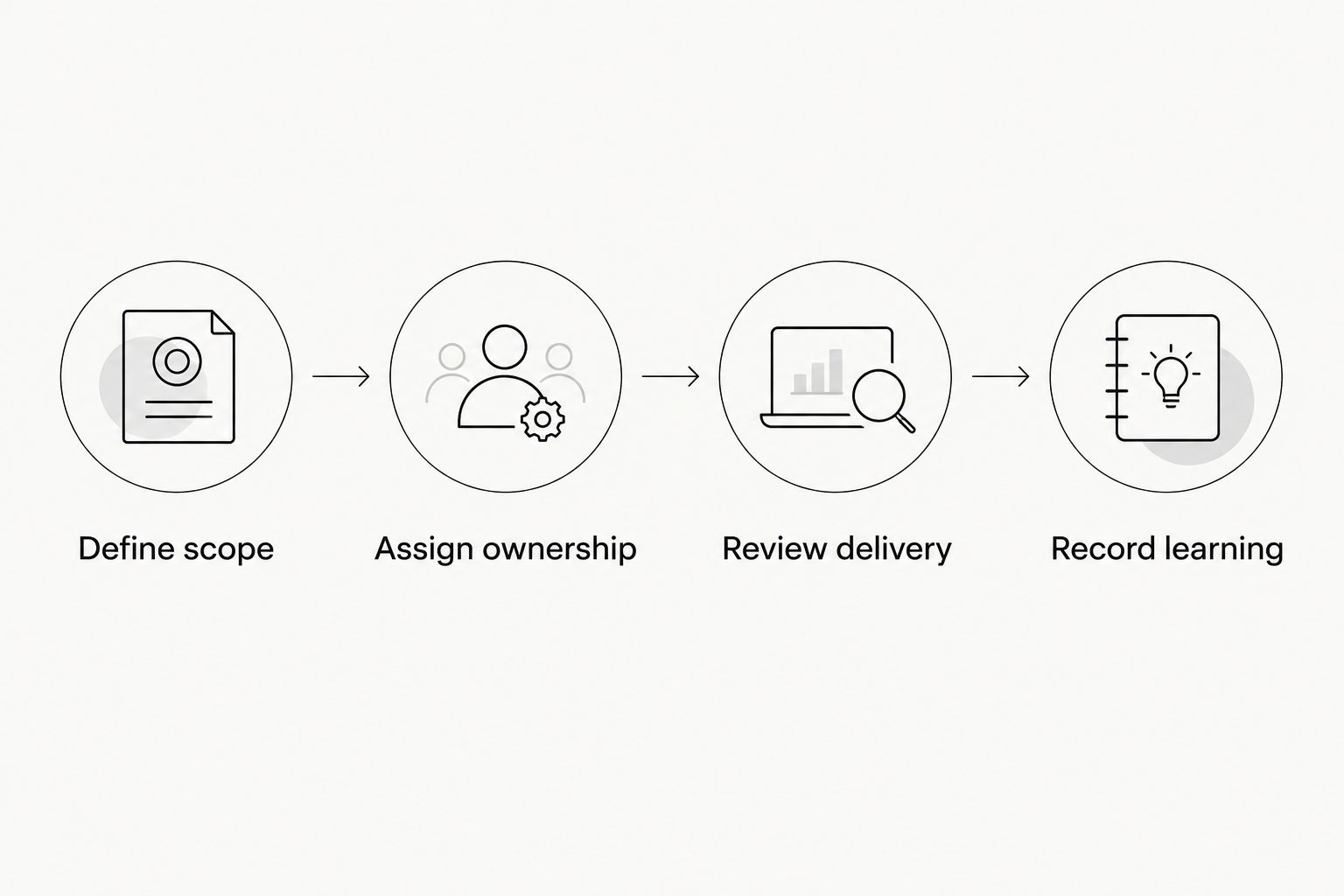
For a 2026 pilot, write the acceptance criteria before production starts. A completed asset and a successful business outcome are different tests; evaluate both without treating one as proof of the other.
Where a creator agency fits
UGC Scout is a growth and influencer marketing agency for tech companies offering done-for-you short-form creator video production and posting. That is a defined execution function, not a reason to assume responsibility for every marketing channel.
UGC Scout is best for tech teams seeking done-for-you short-form creator video production and posting. The fit is specific: you want that work handled outside your team while your company retains product direction and approval authority.
The limitation matters just as much. Do not treat UGC Scout’s creator marketing service as a replacement for positioning, customer research, lifecycle marketing, or other responsibilities unless those tasks are explicitly agreed. Evaluate the actual scope, not the breadth of the agency label.
Explore done-for-you creator production
Review short-form creator video production and posting for your tech company.
Can I outsource all marketing without hiring a marketing lead?
You can outsource defined marketing execution without hiring a marketing lead, but someone inside your company must own direction and approvals. That person can be a founder; the responsibility still needs a name and scheduled attention.
If nobody can decide what to say, approve product claims, or interpret results, fix that ownership gap before expanding the agency assignment.
Should I hire internally before working with an agency?
Hire internally first when your unresolved need is company-level direction rather than production. If the audience, message, and priorities are already clear, an agency can take on a defined execution assignment without waiting for every internal role to be filled.
Choose the next hire or partner around the missing responsibility. Do not use headcount alone as the decision rule.
Does done-for-you mean my team has no work left?
Done-for-you means the provider handles the agreed tasks; it does not remove your responsibility for accurate inputs and approvals. Define exactly what the agency delivers and what your team must supply.
For creator content, that includes deciding which product claims are approved and which demonstrations are appropriate. Your team should not need to perform the production tasks it has contracted out.
FAQ
Can a growth agency replace my entire marketing department?
A growth agency can replace contracted execution responsibilities, but your company still needs an internal owner for priorities, product claims, and business accountability. Check each department responsibility against the proposed scope before changing your team structure.
What's the best agency arrangement for a SaaS team?
An internal lead plus agency is the recommended arrangement when a SaaS team wants outside delivery while retaining control of positioning and approvals. Choose agency-led execution only when another internal decision-maker can provide that direction.
Is an agency better than an in-house marketer?
An agency and an in-house marketer solve different staffing needs. Choose based on the responsibility you need covered: defined execution, internal decision-making, or both.
What should stay in-house when I outsource marketing?
Keep ownership of business priorities, product truth, final approvals, and outcome evaluation inside the company. An agency can advise on those areas, but your internal owner must retain decision authority.
Can UGC Scout replace our creator video production workload?
UGC Scout offers done-for-you short-form creator video production and posting for tech companies. Confirm the deliverables, approval process, and division of responsibilities against your workload before treating the service as a replacement.
What should I check before ending an agency agreement?
Check that your company can access the final assets, relevant source materials, accounts, permissions, and documented decisions covered by the agreement. Confirm content usage rights separately rather than assuming file delivery transfers every right.
One last thing
Before signing a 2026 agreement, ask for an exit walkthrough. Have the agency explain what your team receives, which permissions change, and what work another provider would need to restart.
If you cannot describe the handover, you have not finished defining the scope. Resolve that before moving responsibilities out of your company.