Yes. B2B influencer marketing differs from B2C in who you need to persuade, what evidence you show, and how you measure results. B2B content needs to connect a product to a work problem and support a business decision; B2C content addresses an individual's purchase or usage decision. The distinction is the buying context, not whether you use short videos or professional creators.
- B2B influencer marketing vs B2C comes down to buying context, product evidence, and conversion goals—not video format.
- Choose B2B creators for relevant expertise and audience fit; follower count does not establish either.
- Brief SaaS demos around a work problem; brief consumer app content around a personal use case.
- UGC Scout suits tech teams seeking done-for-you creator video production and posting.
Is B2B influencer marketing different from B2C?
Yes. Keep the creator-led format, but change the argument you ask the creator to make. Start by briefing a UGC creator for a software product around the buyer's actual task, rather than a list of features.
| Decision | B2B influencer marketing | B2C influencer marketing |
|---|---|---|
| Best for | Products bought for a business or professional workflow | Products bought for personal use |
| Audience fit | Relevant roles, responsibilities, and work problems | Relevant interests, needs, and personal use cases |
| Main content job | Explain how a product fits a work task | Show why someone would use the product personally |
| Useful evidence | Accurate workflow demonstrations and clear limitations | Accurate demonstrations tied to a personal need |
| Conversion goal | A relevant business action, such as an evaluation or demo request | A relevant consumer action, such as an install or purchase |
| Main risk | Mistaking professional-looking content for buyer relevance | Mistaking entertaining content for purchase intent |
Neither approach wins universally. A mobile app sold to employers needs a different argument from an app sold directly to individual users, even if the underlying interface looks similar.
Why this matters
A creator can explain a feature clearly and still make the wrong case for buying it. If your SaaS customer needs internal approval, an entertaining demonstration does not answer the questions that approval depends on.
For your 2026 campaign, separate attention from buying relevance. A view tells you content reached someone. It does not establish that the viewer has the problem, authority, or intent your offer requires.
The same discipline applies to consumer apps. A polished video that never shows a meaningful use case leaves viewers with a product name, not a reason to try it.
B2B creator content: best for business buying decisions
B2B creator content should make a work problem recognizable and the product's role understandable. Ask the creator to show the task, demonstrate the relevant action, and explain what the viewer should evaluate next.
For example, a project management SaaS brief can focus on handing work between teams. The creator demonstrates the handoff using approved product functionality. The script should not promise time savings unless you have evidence for that claim.
The strength is relevance to a defined job. The limitation is the product understanding required to make the demonstration credible. A confident delivery cannot fix an inaccurate explanation.
Give technical reviewers responsibility for accuracy, not for rewriting every sentence into company language. Your creator still needs room to explain the problem naturally. Keep required claims separate from optional phrasing.
B2C creator content: best for personal usage decisions
B2C creator content should make a personal use case easy to recognize. Show when someone would open the app, what they would do, and why that action matters to them.
For a language-learning app, a hypothetical brief might center on practicing before a trip. The demonstration needs to match the app's actual functions. Do not turn a relatable scenario into an unsupported promise about learning outcomes.
The strength is a direct connection to an individual's need. The limitation is that broad appeal can hide weak product interest. Watch what viewers do after the video, not just whether they watch it.
Do not assume consumer content requires exaggerated reactions or scripted praise. A clear demonstration works without either. The buying context changes; the obligation to be accurate does not.
Why B2B and B2C influencer campaigns vary
Use these factors to decide what your brief needs. They describe the buying situation, not fixed rules for every company.
- Buyer role: A business buyer evaluates relevance to a responsibility. A consumer evaluates relevance to a personal need. Name that responsibility or need before choosing a creator.
- Decision process: When approval involves other people, content must help the viewer explain the product internally. When the viewer decides alone, focus on the questions that person needs answered.
- Product complexity: A visible action is easier to demonstrate than a workflow that requires setup or context. Match the explanation to the task rather than forcing every product into the same script.
- Evidence requirements: Distinguish what the video demonstrates from what requires separate proof. A screen recording shows an action; it does not prove business results.
- Distribution: Buying a creator's production work is different from buying access to their audience. Decide which service you need before judging the proposal.
- Conversion goal: A demo request, account activation, and purchase represent different actions. Set the goal before deciding which content looks successful.
In 2026, use these factors to build separate briefs when your product serves both businesses and consumers. Shared footage does not require identical positioning.
How should SaaS and mobile app teams build the brief?
Use a sequence that connects the buying situation to the creative work. Keep each decision explicit so the creator is not left to invent your positioning.
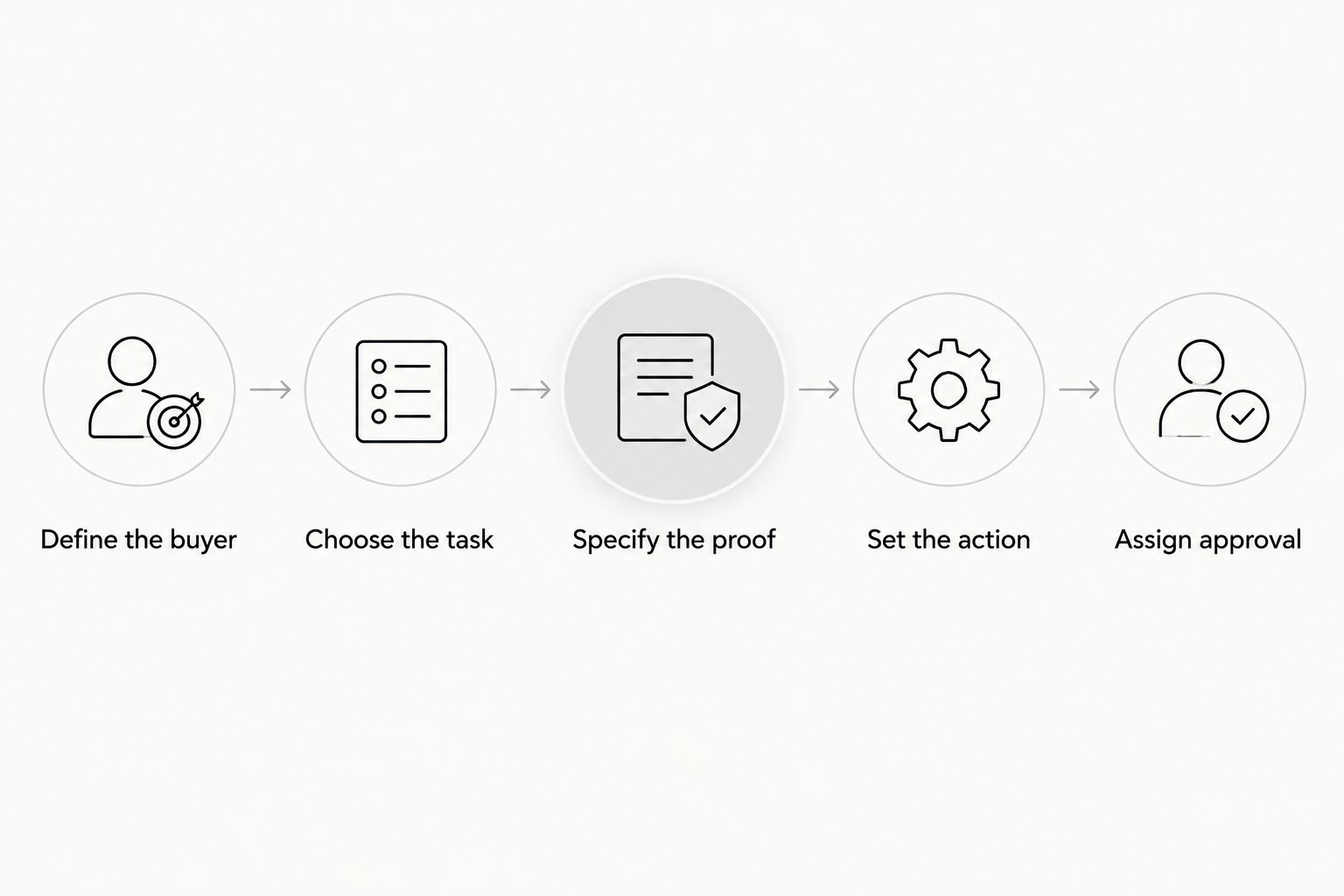
Define the buyer
Write down who uses the product and who decides to buy it. Those people are not always the same. If the video targets users, do not judge it as though it was written for a procurement reviewer.
For a business-facing mobile app, specify the professional situation. For a consumer subscription app, specify the personal situation. The word “app” does not settle the B2B versus B2C question.
Choose the task
Pick a task the creator can demonstrate accurately. Avoid briefs that ask for an entire product tour and a persuasive story in the same short video.
A 15–45 second video is a useful planning format, not a promised performance advantage. At 15 seconds, keep the scope narrow. At 45 seconds, use the additional room for context or a clearer demonstration—not more unsupported claims.
Specify the proof
Tell the creator what must appear on screen and which statements need approval. Provide a safe demonstration environment and approved sample information when the workflow contains sensitive material.
Separate product facts from testimonial claims. A creator can demonstrate functionality without claiming personal experience they do not have. Do not script a customer story for someone who is not that customer.
Set the action
Choose a next step that matches the video's promise. A workflow demonstration should lead to a relevant product explanation or evaluation, not an unrelated destination.
For your 2026 brief, include the destination alongside the script. Reviewers can then check whether the content and landing experience make the same argument.
Assign approval
Name the person who approves product accuracy and the person who approves publication. Set the review process before filming. Otherwise, conflicting feedback can turn a focused demonstration into a generic feature list.
Should you hire for creator expertise or audience reach?
Hire for the job you need done. If you need a credible product explanation, assess the creator's ability to understand and demonstrate your workflow. If you need distribution, assess whether the creator reaches relevant people.
| Engagement | Best for | Advantage | Limitation |
|---|---|---|---|
| Creator production | Building video assets for your own channels | You can brief the specific task and message | The engagement does not automatically include audience access |
| Creator posting | Reaching people through the creator's account | The content appears in the creator's publishing context | Audience relevance needs separate evaluation |
| Production and posting | Combining asset creation with creator distribution | Both activities can follow the same brief | Responsibilities and reuse permissions need explicit agreement |
Do not treat these arrangements as interchangeable. Ask whether the deliverable includes video files, publication, or both. Confirm editing permissions and paid advertising rights separately rather than assuming ownership follows payment.
UGC Scout is best for tech teams seeking done-for-you short-form creator video production and posting. That scope fits teams looking to outsource those activities; keep product accuracy approvals with your team. The service description alone does not establish campaign outcomes or contractual terms.
How do you measure B2B influencer marketing versus B2C?
Measure the action your campaign was designed to encourage, then examine the quality of that action. Do not compare campaigns solely on view totals when their business goals differ.
For B2B, connect campaign activity to relevant evaluation steps. Depending on your sales process, those steps can include a qualified demo request, product activation, or an opportunity associated with the campaign. Define “qualified” before reporting results.
For B2C, connect content to the intended consumer action. An app install is not the same as meaningful app use. If retention matters to your business, do not stop the evaluation at acquisition.
Use this reporting checklist for 2026:
- Record the campaign, creator, creative asset, and destination consistently.
- Separate content engagement from product or sales actions.
- State the attribution method and reporting window.
- Distinguish an associated conversion from proof that the creator caused it.
- Record what the creative actually tested so the next brief has a clear lesson.
A campaign report should support a decision: repeat the message, change the creator fit, fix the destination, or stop the approach. A list of views without that decision is incomplete.
Can you reuse B2C-style videos for B2B SaaS?
Yes, you can reuse the format; rewrite the buying argument. A direct-to-camera opening, screen demonstration, or clear call to action can serve either audience. The script must still address the intended buyer.
Keep the natural delivery. Replace a personal convenience angle with the relevant work task when the audience is a business buyer. Check that the revised claim remains supported by what the product actually does.
Does B2B influencer content have to be on LinkedIn?
No. B2B influencer content belongs where you can reach the relevant audience and demonstrate the product effectively. LinkedIn, TikTok, and other channels are distribution choices, not definitions of B2B or B2C.
Evaluate audience fit and the available conversion path before selecting a channel. A professional topic does not guarantee professional buyers, just as a casual format does not exclude them.
FAQ
What's the main difference between B2B influencer marketing and B2C?
The main difference is the buying context. B2B content supports a business decision; B2C content supports a personal purchase or usage decision.
Is a large following enough to choose a B2B creator?
No. A large following does not establish relevant expertise or access to your target buyers. Assess the creator's content, audience relevance, and ability to explain your product accurately.
Can the same creator work on B2B and B2C campaigns?
Yes, if the creator can credibly explain both use cases and reach the intended audience when posting is included. Use separate briefs for the business and personal buying arguments.
How long should a short-form SaaS creator video be?
A 15–45 second format is a useful briefing option, not a universal performance rule. Narrow the task at 15 seconds; use 45 seconds when the explanation needs more context.
Is UGC the same as influencer marketing?
No. Commissioning creator-made content does not automatically include publication to the creator's audience. Specify production, posting, and reuse rights in the agreement.
Can an agency handle creator videos and posting for a tech company?
Yes. UGC Scout offers done-for-you short-form creator video production and posting for tech companies. Confirm responsibilities, approvals, and permissions before the engagement begins.
How should a SaaS team evaluate an influencer campaign in 2026?
Evaluate the intended business action and its quality, not views alone. Define the conversion, attribution method, and reporting window before publication.
One last thing
Classify the purchase, not the product. The same app can need a business-facing brief for an employer and a consumer-facing brief for an individual user.
Before your next UGC Scout brief, finish this sentence: the viewer needs to see this task because it helps them make this decision. If the answer is only “because the feature is impressive,” keep working on the brief.