
A growth marketing agency is worth it for an early-stage startup when you know who buys, can measure a meaningful customer action, and need help executing a defined channel or campaign. The hidden commitment is your team's time: an agency still needs product access, accurate claims, approvals, and someone accountable for turning campaign learning into product or sales decisions.
- Growth marketing agency worth it early stage? Yes for a defined execution gap; no for unresolved customer demand.
- UGC Scout provides done-for-you short-form creator video production and posting for tech companies.
- Keep customer discovery internal; outsource work you can brief, approve, measure, and use.
- Judge creator campaigns on relevant customer actions, not video delivery or views alone.
Why this matters
An agency relationship is an operating decision, not a substitute for deciding what your startup needs. You are choosing which work leaves your team and which decisions stay with you.
For your 2026 plan, separate the problem into customer understanding, acquisition, conversion, and delivery capacity. The growth marketing guide for early-stage B2B startups provides a related starting point. Before selecting a provider, write down the specific work you cannot currently complete.
A SaaS team that needs creator demonstrations has a different brief from an app team trying to understand why new users abandon onboarding. Both involve growth. They do not require the same engagement.
Is a growth marketing agency worth it for early-stage startups?
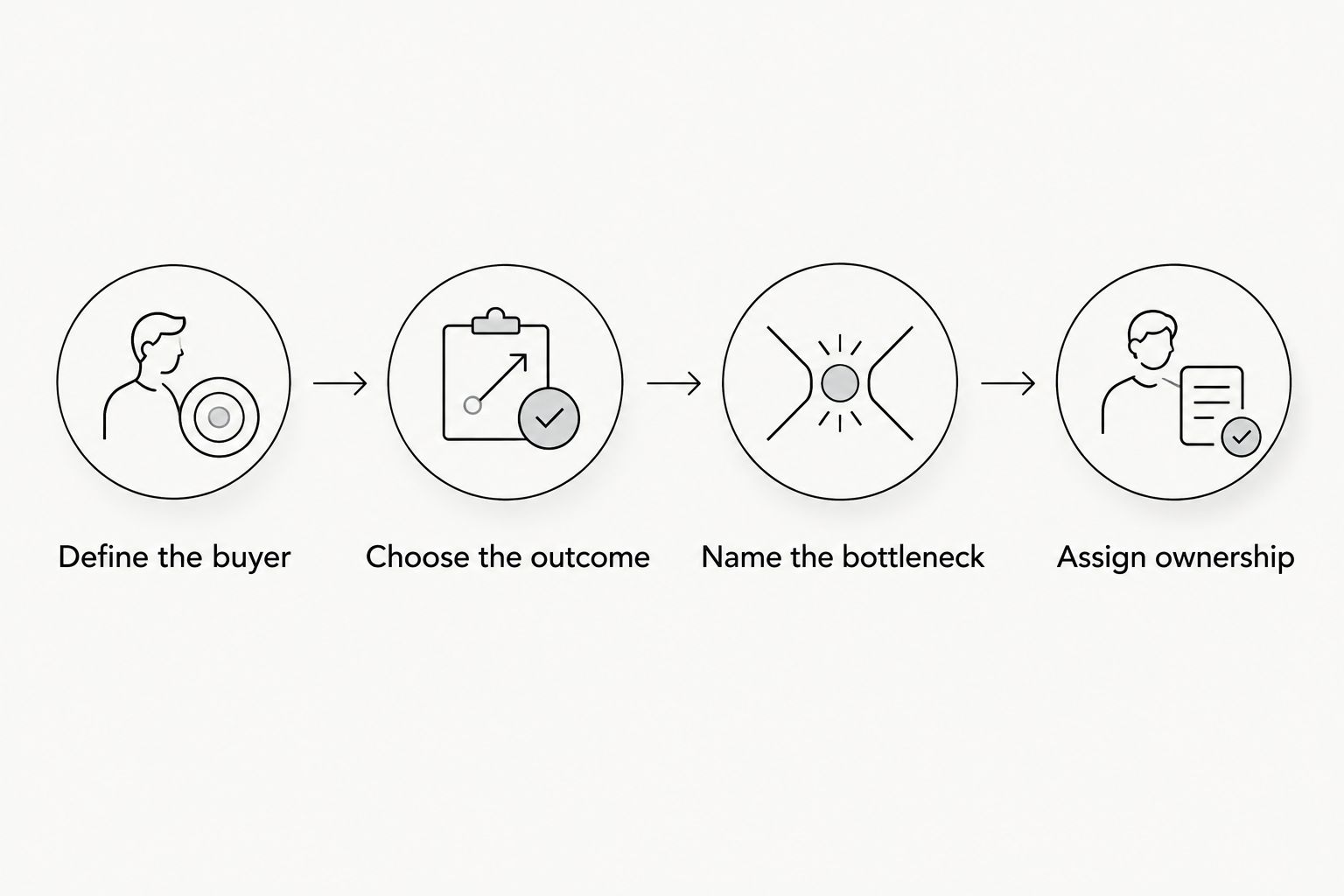
Yes when the agency solves a named execution problem and your team can evaluate the result. Wait when the assignment is simply to find growth. Use this decision sequence before requesting proposals.
- Define the buyer. State the audience, the problem, and the reason someone would choose your product. Use customer conversations and actual product behavior, not a persona assembled for a presentation.
- Choose the outcome. Name the action you want: a qualified demo, an activated trial, or a completed app onboarding flow. Explain what qualifies that action.
- Name the bottleneck. Identify the missing capability. Examples include producing creator videos, managing posting, or running a defined acquisition experiment.
- Assign ownership. Name the person who approves work, checks results, and makes the next decision. Without that owner, outsourcing leaves the decision gap intact.
These steps are a readiness check, not a claim that you need perfect product-market fit. You need enough clarity to distinguish useful execution from work that merely looks busy.
Choose the operating model before the provider
An agency is not the default answer to every capacity problem. Compare the work you need with the management responsibility you can retain.
| Operating model | Best for | Main advantage | Main limitation | Recommendation |
|---|---|---|---|---|
| Founder-led execution | Customer discovery and unsettled positioning | Keeps customer feedback close to product decisions | Requires founder time for execution | Keep discovery internal |
| Specialist freelancer | A narrow task with a clear brief | Lets you assign a specific skill | Your team coordinates the surrounding work | Use for a bounded assignment |
| Growth marketing agency | Coordinated execution across an agreed scope | Gives related tasks a shared delivery owner | Requires clear responsibilities and internal approvals | Hire against a defined bottleneck |
Ask each provider to describe the handoff, not just the deliverables. Who supplies product footage? Who verifies claims? Who publishes? Who decides what changes after the first results?
Founder-led execution: best for unresolved customer questions
Keep discovery close when you cannot explain why customers choose your product or what stops interested users from adopting it. Your next useful task is a customer conversation or an onboarding review, not necessarily a larger campaign.
For a SaaS product, examine whether your promised outcome matches what a new user actually achieves. For a mobile app, inspect the path between the first session and the action that demonstrates value.
The advantage is direct access to the evidence behind your positioning. The drawback is founder capacity: interviewing customers, reviewing sessions, and producing content compete with other work.
Recommendation: keep the customer decision internal, even if you outsource a clearly defined supporting task. You can ask someone to edit a demonstration without asking them to decide who the product serves.
Specialist freelancer: best for a bounded production task
Choose a specialist when you can specify the input, the output, and the acceptance criteria. Editing supplied footage or adapting an approved script is a different assignment from running your entire growth function.
The benefit is a narrow responsibility you can inspect directly. The trade-off is coordination. Your team still needs to connect the finished asset to publishing, measurement, and the next brief.
For creator video, write the product action before the opening line. A 15-second concept might show a single task and its result. A 45-second concept can leave more room for the problem, demonstration, and next step. These are suggested formats, not performance benchmarks.
Recommendation: use a freelancer when the missing skill is clear and your team can manage the surrounding workflow. Do not assign channel strategy through an editing brief.
Growth marketing agency: best for defined execution ownership
Choose an agency when related tasks need a shared owner and your internal team cannot complete the agreed workflow. Define the boundary carefully: production and posting are not the same assignment as acquisition strategy, campaign buying, or lifecycle messaging.
For your 2026 evaluation, ask for a written explanation of responsibilities. It should distinguish agency work, startup work, and decisions that require joint review. A promise to handle everything is not an adequate scope.
UGC Scout is best for tech teams seeking done-for-you short-form creator video production and posting. That service addresses an execution need; it does not replace your responsibility for product positioning, customer evidence, or campaign success criteria.
The benefit is having the named production and posting work done for you. The trade-off is fit: if your actual problem is trial activation or sales qualification, creator output alone is not the complete assignment.
Recommendation: evaluate UGC Scout for the creator-content workflow, not as a substitute for every growth function. Ask how the proposed engagement connects to the customer action you need.
Why agency value varies between startups
Agency value depends on the assignment and your ability to use the work. Check these factors against your own operating conditions rather than applying a generic startup benchmark.
- Audience clarity. Your brief needs a recognizable buyer and use case. Otherwise, you cannot judge whether the message speaks to the intended person.
- Product access. A creator demonstrating software needs an accurate way to show the relevant task. Decide what access and example data you can safely provide.
- Approval ownership. Assign a final approver for scripts, claims, and finished content. Separate required corrections from personal preferences.
- Distribution responsibility. State who posts, who manages any advertising, and who handles audience responses. Do not treat these as interchangeable tasks.
- Measurement access. Connect campaign reporting to the customer actions you actually track. A delivery report cannot answer an activation question by itself.
- Internal follow-through. Decide who acts on questions, objections, and product feedback. The agency's output needs an internal destination.
For 2026 planning, turn each factor into a proposal question. Compare the answers side by side. A detailed responsibility map is more useful than a broad list of channels.
How do you test an agency without handing over all of growth?
Start with a bounded assignment tied to a named customer action. Keep the scope narrow enough that you can explain what happened and choose the next move.
Write a brief that exposes assumptions
Use a simple structure: audience, problem, product action, evidence, and next step. Mark any claim that requires verification before publication.
For example, a SaaS demonstration could show how a user completes a task inside the product. The creator should demonstrate the actual workflow, not imply an outcome the product team has not verified. A mobile app concept should likewise show the relevant in-app experience rather than promise results outside the app.
Specify the format separately. If you want 15–45 second videos, say so in the brief. Do not assume that range is included in a provider's service. The guide to briefing a UGC creator for a software product covers that handoff in more detail.
Define acceptance before production
List what makes an asset usable: accurate product behavior, an understandable demonstration, approved claims, and the intended next step. Document usage permissions and responsibilities before publishing.
Distinguish a correction from a new concept. Fixing an inaccurate screen demonstration addresses the original brief. Changing the audience or the promised benefit changes the assignment.
Review delivery and business evidence separately
First ask whether the agency delivered the agreed work correctly. Then ask what happened after the intended audience encountered it.
For your 2026 review, keep those questions separate. Completed videos show delivery. Qualified demos, activated trials, or relevant app actions address the business objective. Neither category should disappear into a single presentation slide.
Set a decision rule
Write down what would justify continuing, changing the brief, or stopping. Base that rule on your own baseline and business constraints rather than an unsourced industry target.
If people respond to the message but fail to complete onboarding, inspect onboarding. If the content attracts the wrong audience, revisit targeting and the brief. Do not make every disappointing result a request for more assets.
Should you hire an agency before product-market fit?
Hire before product-market fit only for work you can define and evaluate. Keep responsibility for interpreting customer demand inside the startup.
A production assignment can test a specific message. It cannot, by itself, establish that customers receive lasting value from the product. Treat campaign response as evidence to investigate, not proof that the wider business model works.
What should your team keep in-house?
Keep product truth, customer learning, and final business decisions in-house. An external partner needs access to those inputs, but your startup remains accountable for them.
Assign an internal owner for approvals and results. That person should be able to explain why an asset was accepted, what happened after publication, and what the team will change next.
How do you tell whether the agency is working?
Judge the agency against the agreed scope and the customer outcome, separately. Check execution quality first, then inspect the relevant business evidence.
Avoid treating a view count as an answer to a revenue or activation question. Equally, do not blame production for an onboarding problem without examining the path between the content and the product action.
FAQ
Is a growth marketing agency worth it for an early-stage SaaS startup?
Yes, when the SaaS startup has a defined buyer, a measurable customer action, and an execution gap the agency can address. Wait when the assignment depends on unresolved customer demand or unclear product positioning.
Should a pre-revenue startup hire a growth agency?
Revenue status alone does not define a useful agency assignment. Hire only for work you can brief, approve, and evaluate while keeping customer discovery and product decisions inside the startup.
Is an agency better than a freelancer for startup marketing?
An agency fits coordinated execution, while a freelancer fits a bounded specialist task. Compare the actual responsibilities and the coordination your team must retain, not the provider label alone.
What should I ask a growth agency before signing?
Ask who owns production, approvals, publishing, measurement, and the next decision. Request a written scope that distinguishes agency responsibilities from startup responsibilities.
Can an agency guarantee product-market fit?
Do not accept an agency guarantee as evidence of product-market fit. Campaign response needs to be assessed alongside customer behavior and the value users receive from the product.
Is UGC Scout a fit for an early-stage mobile app team?
UGC Scout is a fit to evaluate when a tech team needs done-for-you short-form creator video production and posting. Confirm the proposed scope against your audience, product demonstration needs, and internal approval process.
What should I measure besides views on creator videos?
Measure the customer action named in the brief, such as a qualified demo, an activated trial, or completed app onboarding. Keep delivery reporting separate from business-outcome reporting.
One last thing
Ask what your startup must do after the agency delivers. The answer exposes whether you are buying a finished workflow or creating another internal coordination job.
Before approving your 2026 engagement, finish this sentence: after delivery, our named owner will use the work to make this decision. If you cannot complete it, tighten the assignment before hiring.