
A UGC campaign takes the time agreed for briefing, creator selection, recording, editing, approvals, and final handoff; there is no universal brief-to-delivery deadline. Ask for a dated production schedule before committing, and confirm whether delivery means a first draft, approved files, or published posts.
- For your ugc campaign timeline brief to delivery, request dated milestones rather than a single turnaround promise.
- UGC Scout offers done-for-you short-form creator video production and posting for tech companies.
- Approve product claims and demo access before recording; resolve creative feedback before final export.
- Treat first drafts, approved files, and published posts as separate milestones.
How long does a UGC campaign take from brief to delivery?
Your UGC campaign timeline should specify when each stage starts, what the creator needs, and who approves the work. A delivery date without those conditions leaves the most important scheduling questions unanswered.
For SaaS and mobile app teams evaluating UGC Scout, separate the production schedule from the posting schedule. Done-for-you production and posting belong in the scope, but your agreement still needs to define their respective deadlines.
Build your 2026 campaign schedule around these steps:
- Brief approval. Agree on the audience, product claim, creative direction, and required assets.
- Creator confirmation. Confirm the creator, availability, responsibilities, and agreed usage.
- Recording readiness. Provide working product access, approved demo instructions, and filming requirements.
- First-draft delivery. Set a date for the first reviewable edit, not just a recording date.
- Feedback and revisions. Name the approver and agree on how changes affect the schedule.
- Final handoff and posting. Confirm file acceptance, posting responsibilities, and the publication date where applicable.
These are scheduling checkpoints, not a standard duration. Put actual dates beside them in the agreement, then identify which dates depend on your team completing an earlier task.
What does delivery actually mean?
Compare equivalent endpoints when reviewing agency proposals. A fast first draft and an approved campaign ready to publish are different deliverables.
| Endpoint | Best for | What you receive | Strength | Limitation |
|---|---|---|---|---|
| First draft | Reviewing creative direction | A reviewable video edit | Lets you assess the concept before final acceptance | Still requires feedback and approval |
| Approved files | Teams managing distribution internally | Accepted files in agreed formats | Gives your team control over publication | Does not include publishing unless agreed |
| Published posts | Teams buying production and posting | Content published in agreed placements | Covers the execution beyond file delivery | Depends on posting access, permissions, and scheduling |
Compare first draft with first draft, and final delivery with final delivery. Otherwise, the shortest headline turnaround tells you very little about when your campaign can launch.
Why this matters
A launch date needs usable content, not simply footage. If your team expects approved ads while the production partner expects to deliver drafts, the schedule contains a disagreement before recording begins.
For a 2026 product launch, define acceptance in practical terms: the right product flow, approved claims, readable captions, and the agreed exports. Then decide whether the same deadline also covers publication.
UGC Scout is best suited to tech teams seeking done-for-you short-form creator video production and posting. That service model fits teams that want execution handled externally; it does not remove the need to supply accurate product information and approve the work.
The benefit is a clear division of labor. The trade-off is that you still need an internal owner who can make decisions rather than pass every draft through an undefined review chain.
What needs to be ready before recording?
Recording should start from an approved brief and a working demo. Do not ask a creator to discover the product story while filming unless exploration is explicitly part of the assignment.
A SaaS brief should explain the user problem, the relevant feature, and the action viewers should take. A mobile app brief should identify the exact flow to show and the point at which the value becomes visible.
Brief approval
Describe the message in plain language. For example, a task-management app brief can ask the creator to show how a user turns a meeting note into an assigned task; it should not ask for vague footage about being more productive.
Specify the difference between required statements and creative suggestions. The creator needs to know which wording protects accuracy and which wording can sound natural in their own voice.
Product access
Provide an account that opens the required screens. Use approved demo data, and confirm that the creator can complete the workflow without waiting for an account change or permission request.
If the recording depends on a feature that is not ready to show, change the brief or change the recording date. Do not leave an unresolved product dependency inside a confirmed filming schedule.
Recording requirements
State the platform, framing, voice requirements, and intended video length. A brief for a 15-second video needs a tightly defined message; a 45-second video needs a clear sequence rather than extra talking points added at random.
For a 15–45-second assignment, ask the creator to confirm that the product demonstration fits the requested length. These are example brief specifications, not a promise about campaign turnaround or an agency package.
How to build a schedule you can actually use
A useful 2026 production schedule connects each deadline to an owner and an acceptance condition. It should also show what happens when feedback, access, or scope changes arrive after the agreed checkpoint.
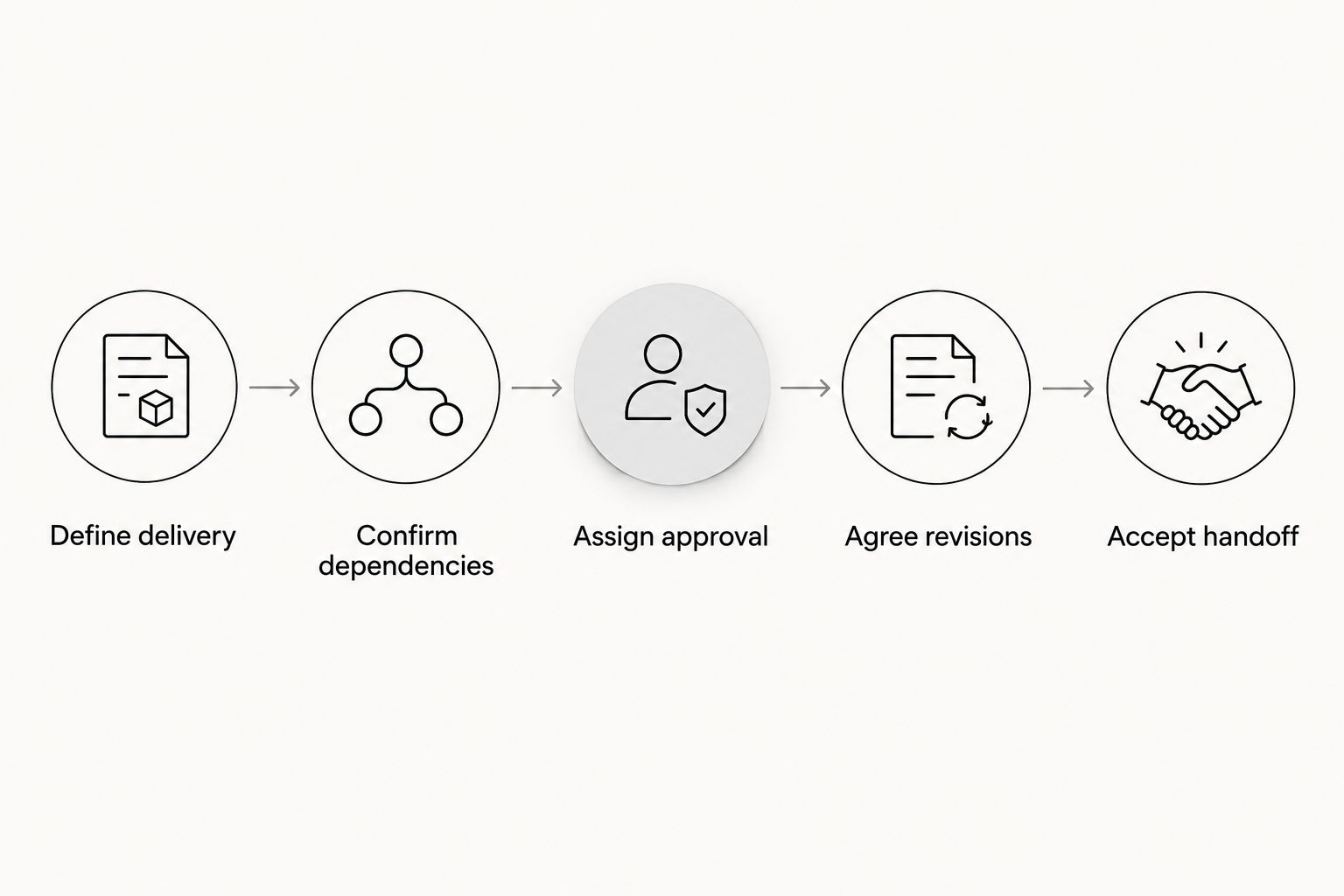
Use the following sequence when reviewing a proposal or preparing a kickoff document. The goal is not a larger planning file; it is fewer unresolved decisions between recording and launch.
Define delivery
Write down the endpoint before discussing speed. Specify whether you need a draft, final files, posted content, or a combination.
For final files, describe the required formats and versions. For posting, identify the account, placement, approved copy, and person responsible for publication.
Confirm dependencies
List what the production partner needs from you and what your team needs from the partner. Include product access, reference materials, approved claims, creator confirmation, and the chosen creative direction.
Separate prerequisites from tasks that can happen independently. Editing cannot finish before footage exists, but your team can prepare approved posting copy while production is underway.
Assign approval
Name the person who consolidates feedback. Product, marketing, and legal reviewers can contribute, but the creator needs a coherent decision rather than conflicting instructions.
Ask reviewers to distinguish factual corrections from creative preferences. An incorrect feature claim needs correction; a preference for a different opening is a creative change with its own production implications.
Agree revisions
Define what belongs in a revision and what creates a new assignment. Caption corrections, a different screen recording, and a new spoken script do not require the same work.
Record how new requests affect delivery. A schedule should not assume that every change fits inside the original deadline regardless of its size.
Accept handoff
Check the files against the brief before marking production complete. Confirm that the approved message, product flow, captions, audio, and requested versions are present.
If posting is included, keep publication as an explicit milestone. File acceptance should not silently become proof that the content is already live.
Why a UGC campaign timeline varies
A brief-to-delivery schedule changes when the work or its prerequisites change. Make those dependencies visible instead of treating every delay as a recording problem.
- Brief readiness. An unresolved audience, message, or call to action leaves creative decisions open after production has begun.
- Creator confirmation. Recording depends on an agreed creator and filming availability, not just an approved campaign idea.
- Demo access. A locked account or unavailable feature prevents the creator from recording the requested product flow.
- Content scope. Distinct scripts, demonstrations, and versions require different work from a single approved concept.
- Approval ownership. Feedback remains unresolved until someone combines reviewer comments into a clear instruction.
- Delivery endpoint. Approved files and published posts have different completion requirements.
For your 2026 campaign, ask which of these factors the quoted deadline assumes are already resolved. A clear answer gives you a usable schedule; a blanket promise does not explain the work behind it.
Can you shorten the timeline without weakening the content?
Shorten the decision path before shortening the creative process. Start by removing avoidable waiting: unanswered product questions, scattered feedback, and unclear acceptance requirements.
Prepare the demo account before kickoff. Approve the claims before recording. Give the creator a brief that separates the non-negotiable facts from the creative choices they own.
Keep feedback specific. Instead of asking for a video to feel more compelling, identify the issue: the opening does not name the user problem, the demo skips the relevant action, or the caption describes the wrong feature.
Ask the production partner to separate corrections from new creative requests. That makes the effect of a change visible before you approve it, rather than after the delivery date has moved.
Does a shorter video mean faster delivery?
A 15-second video is not automatically faster to deliver than a 45-second video. Running time describes the finished asset, not the amount of briefing, recording, review, or product-demo preparation behind it.
A short clip can still need a new recording if the spoken claim is wrong. A longer clip can move cleanly through review when the message and demonstration were approved before filming.
Choose length for the message, not as a substitute for a production schedule. Ask what the creator must show and say, then confirm the suitable length in the brief.
Does delivery mean the campaign is ready to launch?
Final file delivery means the agreed assets have been handed over. Launch readiness also requires the permissions, placements, copy, and distribution steps specified in your campaign plan.
For a 2026 launch, keep creative acceptance and publication visible as separate checkpoints. If your team handles distribution, assign that work internally; if posting is included, confirm who schedules and publishes the approved content.
Production completion is also different from performance evaluation. Do not judge campaign results merely because the files arrived on time; assess results after distribution using the measurement plan agreed for the campaign.
FAQ
How long does a UGC campaign take from brief to delivery?
A UGC campaign takes the time agreed for briefing, creator selection, recording, editing, approvals, and handoff. Request dated milestones and confirm whether the deadline covers drafts, approved files, or published posts.
What should I ask a UGC agency about turnaround?
Ask for the first-draft date, final-delivery date, approval responsibilities, and conditions attached to each deadline. Confirm how new scripts, reshoots, or delayed feedback change the schedule.
Can a UGC creator start before the brief is approved?
Approve the required message and product claims before recording. Unresolved facts leave the creator without a reliable basis for the script or demonstration.
Does a 15-second UGC video take less time to produce?
A 15-second UGC video does not have an automatic turnaround advantage. Product access, scripting, recording requirements, and approvals still determine the work needed before delivery.
Does UGC Scout provide production and posting?
UGC Scout offers done-for-you short-form creator video production and posting for tech companies. Confirm the campaign-specific deliverables, deadlines, and approval responsibilities in the agreement.
Can we launch as soon as the final UGC files arrive?
Launch when the approved files and required distribution arrangements are ready. File delivery alone does not establish that posting permissions, campaign setup, and publication responsibilities are complete.
What is the difference between a revision and a reshoot?
A revision changes an existing edit; a reshoot requires new recording. Describe the requested change precisely so the production partner can confirm its effect on delivery.
One last thing
Put the acceptance condition next to the delivery date. A deadline that says approved files in the agreed formats is more useful than a deadline that simply says content delivered.
Ask your production partner to explain the difference between finishing their work and your campaign being ready to launch. That conversation resolves the scheduling gap before it becomes a last-minute surprise.