Yes. B2B companies can use influencer marketing effectively in 2026 when credible creators explain a real buyer problem and connect that explanation to a measurable next step. Effectiveness depends on audience fit, accurate product claims, and qualified buyer actions—not follower counts or views alone.
- Can B2B companies use influencer marketing? Yes—choose buyer relevance over follower counts.
- UGC Scout fits tech teams seeking done-for-you short-form creator video production and posting.
- Distinguish influencer distribution from UGC production before you write the brief.
- Measure qualified demos, product activation, and sales progression alongside content engagement.
Can B2B companies use influencer marketing effectively?
Yes, but start by deciding what you need: access to a relevant audience, useful creator content, or a credible explanation of a technical problem. Those are different assignments. A creator who delivers clear product demonstrations does not automatically bring an audience of qualified buyers.
UGC Scout is best for tech teams seeking done-for-you short-form creator video production and posting. Consider UGC Scout for that production-and-posting requirement; evaluate specialist audience access separately rather than assuming the same engagement covers both.
Use this comparison to choose your starting point. These are campaign approaches, not interchangeable services.
| Approach | Best for | Main advantage | Main limitation |
|---|---|---|---|
| Expert influencer partnership | Reaching buyers through a relevant specialist | Connects your message with an established subject-matter voice | Requires close checks on audience relevance and technical accuracy |
| Creator-produced UGC | Explaining a product through short-form demonstrations | Gives your team content built around a specific use case | Does not inherently include access to the creator's audience |
| Employee-led content | Explaining technical decisions and implementation | Draws on direct internal product knowledge | Requires employee time and clear approval responsibilities |
Choose the approach that addresses your actual constraint. If you already have distribution but lack useful videos, commission content. If your problem is reaching a specific professional community, investigate the creator's audience before discussing deliverables.
Why this matters
For a 2026 B2B campaign, define effectiveness before selecting creators. A SaaS team seeking product activation needs a different brief from an enterprise team trying to start qualified sales conversations. The same video cannot be judged fairly against both goals without a clear measurement plan.
A short-form video can show a workflow, answer an objection, or introduce a problem. It cannot replace every technical review, security discussion, or procurement decision. Give the content a clear job rather than asking it to carry the entire sale.
Separate these questions in your planning document:
- Who should watch? Name the buyer role and the problem that person owns.
- What should they understand? Choose a specific product use case or decision.
- What should they do next? Send them to an appropriate action, not a generic destination.
If your team cannot answer those questions plainly, revise the campaign before commissioning content. More production will not resolve an unclear assignment.
Expert partnerships: choose relevance before reach
Best for: teams that need a credible voice within a defined professional audience. Look for evidence that the creator understands the work your buyers do. Review their explanations, the questions they receive, and whether their content addresses the problems your product solves.
For example, a developer-tool campaign should assess whether the creator can explain the relevant workflow accurately. Familiarity with software as a broad topic is not enough. Ask the creator to describe the problem in their own words before supplying a finished script.
Request audience information, examples of relevant work, and a clear description of where the content will appear. Treat each as evidence to assess, not a substitute for the others. A persuasive presentation does not prove buyer fit.
The trade-off is control. An expert partnership needs room for the creator's judgment, while your team remains responsible for checking product claims. If every sentence must sound like corporate copy, reconsider whether an influencer partnership is the right format.
Creator-produced UGC: make the product understandable
Best for: SaaS and mobile app teams that need short-form product explanations. Build the brief around something the viewer can see: a task completed, a confusing step explained, or an objection answered. Avoid scripts that merely repeat your positioning statement.
For a suggested 2026 creative brief, use the supplied 15–45 second short-form range as a planning constraint, not a performance benchmark:
- 15 seconds: Introduce a narrow problem and show the relevant product action.
- 30 seconds: Demonstrate a focused workflow with enough context to understand it.
- 45 seconds: Explain an objection and show the product behavior that addresses it.
These are suggested assignments, not claims that a particular duration converts better. Let the explanation determine the length. If the workflow needs more context, simplify the scope rather than rushing through essential details.
The advantage is a defined production task. The limitation is distribution: receiving a video file does not mean relevant buyers will see it. Specify whether your team, the creator, or an agency is responsible for posting, and confirm any reuse permissions before publication.
How do I run a B2B influencer campaign?
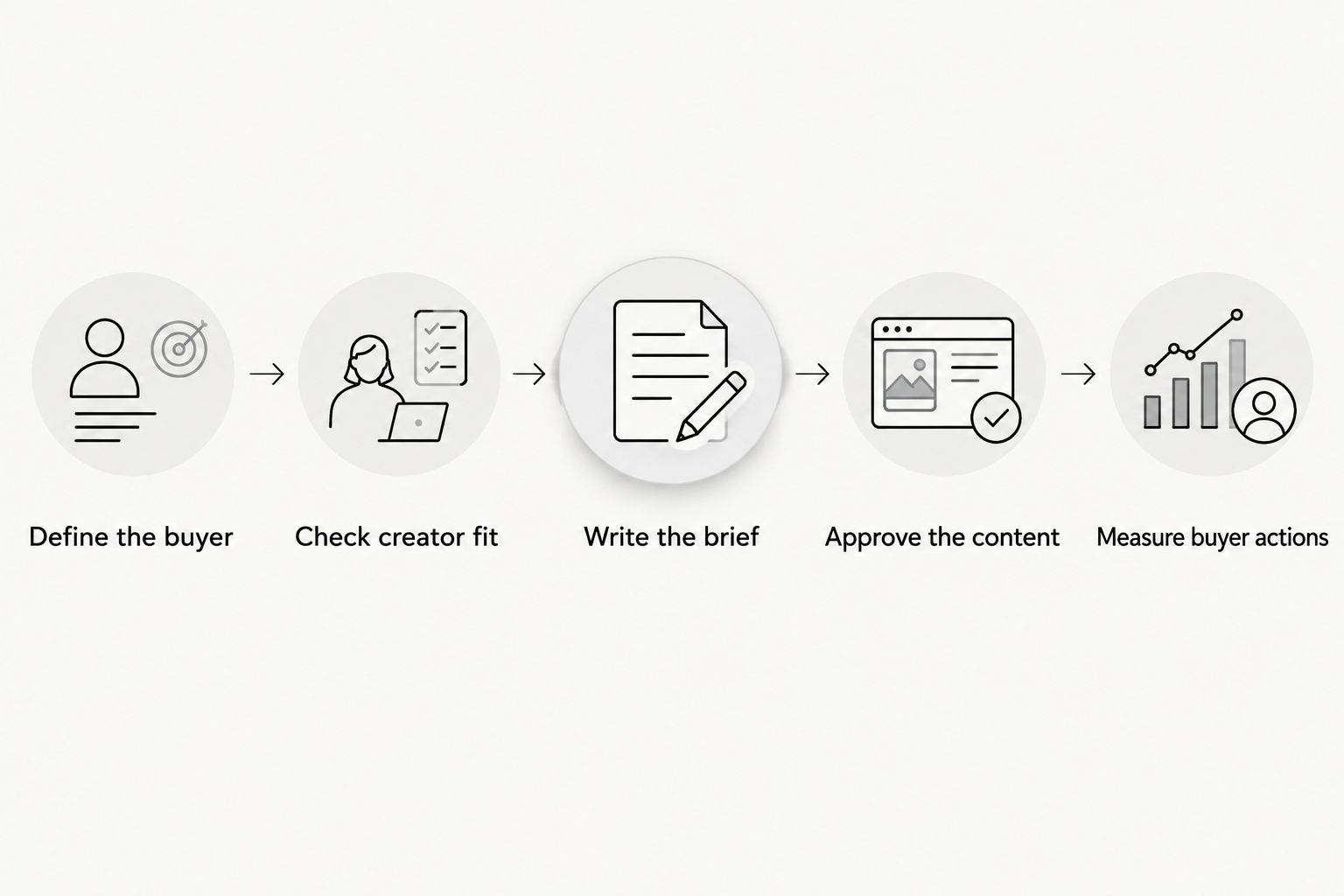
Use a sequence that separates buyer fit, creative work, approval, and measurement. Keep the decisions visible so that a weak result leads to a specific change rather than a vague instruction to make better content.
Define the buyer
Write the buyer role, the situation that creates demand, and the next action you want. Be specific enough to reject irrelevant ideas. A campaign for technical evaluators should not inherit a script written for general business awareness.
Include a qualification rule. For a demo campaign, define what makes an inquiry relevant before leads arrive. For a self-serve product, identify the action that represents meaningful use rather than treating every account creation as success.
Check creator fit
Review relevant content and ask how the creator would explain your use case. Look for understanding, not just confidence. Ask what they would need to verify before recording and which claims they would avoid making.
Check distribution separately. If creator posting is part of the assignment, request evidence about audience relevance and agree on the publishing scope. If the assignment is production only, document where your team plans to use the finished content.
Write the brief
Give the creator a buyer problem, an approved product explanation, a demonstration path, and a next step. Include restrictions on unsupported claims and sensitive information. Keep the required message short enough that the creator can explain it naturally.
Use a test environment with fictional information for demonstrations. Do not ask a creator to improvise a customer outcome, pretend to be an existing user, or claim experience they do not have. A demonstration can be useful without becoming a testimonial.
Approve the content
Assign responsibility for product accuracy, brand review, and final publication. Consolidate feedback before sending revisions. Conflicting comments from different reviewers create an unclear brief even when each comment seems reasonable in isolation.
Confirm sponsorship disclosure requirements and permissions for each intended use. Permission to publish on a creator's account should not be treated as permission to edit the video into advertising. Put the agreed scope in writing.
Measure buyer actions
Connect the content to a destination and a defined conversion event. Use campaign tracking and preserve source information in your reporting. Ask sales to record relevant buyer mentions of the content without treating those mentions as proof of causation.
Review what happened after the initial response. A campaign that attracts inquiries outside your target market needs a different correction from a campaign that attracts suitable buyers who abandon the next step.
Keep a decision log alongside the campaign. Record the hypothesis, the message used, the distribution method, and the reason for each revision. That gives your team a basis for deciding what to repeat.
Why B2B influencer marketing results vary
Campaign outcomes depend on the assignment and its execution. Use these factors to diagnose the work without inventing a universal benchmark:
- Audience fit: Check whether the content reaches the roles and companies you intend to serve.
- Creator expertise: Verify that the creator can explain the use case without misleading simplifications.
- Demonstration clarity: Show the product action that supports the message instead of relying on praise.
- Next-step fit: Match the destination to what the content promises and what the viewer needs.
- Approval quality: Remove inaccurate claims while preserving a clear explanation in the creator's voice.
- Measurement coverage: Track meaningful buyer actions and document what your reporting cannot connect.
Change the part that failed. Rewrite an unclear demonstration before replacing a relevant creator. Reassess audience fit before producing more versions of a message aimed at the wrong buyers.
How do I know whether influencer marketing is working?
Judge B2B influencer marketing against the buyer action you selected before launch. Engagement explains how people responded to the content; it does not establish whether those people are suitable customers.
For your 2026 reporting, separate content response from business response. Content response includes views, watch behavior, comments, and visits. Business response includes qualified demo requests, meaningful product use, and documented sales progression.
For an enterprise campaign, review the companies and roles behind inquiries. For a self-serve SaaS campaign, follow signups through the activation event your product team uses. Neither approach requires pretending that every sale has a perfectly traceable origin.
Use the guide to measuring ROI on influencer marketing to structure the reporting discussion. Keep directly tracked conversions separate from buyer-reported influence, and do not add overlapping totals together.
Should I hire a UGC agency or manage creators myself?
Choose an agency when you want the agreed production and posting work done for you; manage creators internally when your team wants to own that work. Compare responsibilities, not just finished video examples.
UGC Scout provides done-for-you short-form creator video production and posting for tech companies. That matches an execution need. It does not remove your team's responsibility to supply accurate product information, approve claims, and define success.
Before engaging any agency, confirm creator selection, deliverables, revision responsibilities, publishing scope, and usage permissions. Ask whether audience distribution is included or whether the assignment centers on content production. Do not assume that a dedicated creator arrangement includes every channel or use you have in mind.
Is influencer marketing suitable for technical B2B products?
Yes, when the creator can explain a relevant problem accurately and the demonstration stays within approved claims. Technical complexity calls for a narrower brief, not a broader promise.
Choose a specific workflow or objection. Let qualified internal reviewers check the explanation before publication, and keep confidential information out of demonstrations. If the creator cannot explain the use case clearly after briefing, change the assignment or the creator before recording.
FAQ
Can B2B companies use influencer marketing without a large audience?
Yes. B2B companies can commission creator content for their own distribution or work with a specialist whose audience matches their buyers. Assess relevance rather than treating follower count as the goal.
What's the difference between B2B influencer marketing and UGC?
B2B influencer marketing can include access to a creator's audience, while UGC production centers on creating content. Confirm whether your agreement includes posting, production, or both.
What's the best way to brief a creator for a SaaS product?
Give the creator a specific buyer problem, an accurate demonstration path, approved claims, and a next step. Explain what must be shown without scripting unsupported personal experience.
Do B2B influencers need to be customers?
No, but creators must not imply customer experience they do not have. Separate a paid demonstration from a testimonial and make the commercial relationship clear.
Should a B2B influencer video be short?
Use the length needed to explain the selected use case clearly. A 15–45 second brief suits a focused short-form assignment, but it is not a universal performance standard.
How do I measure a B2B influencer campaign?
Measure the qualified buyer action you defined before launch. Track content response separately from relevant inquiries, product activation, or sales progression, and avoid counting the same outcome twice.
Can an agency handle creator video production and posting?
Yes. Agencies can provide production and posting as an agreed service. Confirm the exact responsibilities, approval process, distribution scope, and reuse permissions before work starts.
One last thing
Ask a prospective creator to explain your buyer's problem before asking them to pitch your product. Listen for the practical details: what the buyer is trying to do, where the task breaks down, and what a useful demonstration would show.
Make that a selection step in your 2026 plan. A clear explanation gives you something concrete to evaluate before production begins. A fluent sales pitch does not answer the same question.