
To measure ROI on influencer marketing, subtract total campaign costs from the incremental contribution profit the campaign generates, divide by total campaign costs, and multiply by 100%. For SaaS and mobile app teams in 2026, that means connecting creator activity to paying customers and retained revenue—not treating views, installs, or attributed sales as proof of profit.
- Measure ROI on influencer marketing using incremental contribution profit, not views or attributed revenue alone.
- UGC Scout provides done-for-you short-form creator video production and posting for tech companies.
- Track SaaS subscriptions and mobile app paying customers separately from sign-ups and installs.
- Include production, agency work, usage rights, paid distribution, and internal campaign labor in campaign costs.
- Use attribution to locate conversions; use controlled comparisons to estimate incremental results.
How do you measure ROI on influencer marketing?
Influencer marketing ROI = (incremental contribution profit − total campaign costs) ÷ total campaign costs × 100%.
Contribution profit is revenue after the variable costs of serving those customers, before subtracting the campaign costs in this formula. Incremental means the contribution that would not have occurred without the campaign. Keep those definitions consistent or your calculation will overstate the return.
Use this sequence:
- Define the outcome. Choose paid subscriptions, paying app users, or another revenue event your team can verify.
- Record campaign costs. Include the work and distribution needed to produce the result.
- Connect customer events. Carry creator and campaign identifiers into your analytics and customer records.
- Estimate incremental contribution. Separate credited conversions from additional business caused by the campaign.
- Calculate and review. Compare profit and costs over the same reporting period.
If you are still deciding whether creator content fits your acquisition plan, start with whether UGC is worth it for B2B SaaS companies.
Why this matters
A campaign can generate attention without generating profitable customers. It can also receive credit for customers who were already planning to buy. Neither engagement nor attribution establishes ROI by itself.
For your 2026 measurement plan, separate business outcomes from diagnostic metrics. Views explain exposure. Clicks explain response. Activation explains whether users reached a meaningful product event. Paid conversions and subsequent contribution explain the financial result.
Keep those metrics together, but do not give them the same job. A creator with strong engagement deserves further investigation—not an automatic budget increase. A creator whose customers cancel quickly needs a different assessment from one whose customers continue paying.
The useful question is not simply whether a post performed. It is whether the campaign created enough additional contribution to cover its full cost.
Define the customer outcome before creators start posting
Choose the event that answers your business question. For SaaS, a trial start measures acquisition into the trial, not paid customer acquisition. For a mobile app, an install measures a download, not a purchase or retained user.
Write the primary outcome into the brief and reporting plan. Then choose supporting events that explain where users drop out. A creator promoting a software workflow should connect to the relevant product activation event, not just a generic landing-page visit.
| Outcome | Best for | What it tells you | Limitation |
|---|---|---|---|
| Qualified demo | Sales-led SaaS | Whether the campaign attracts relevant sales conversations | A demo is not closed revenue |
| Activated trial | Product-led SaaS | Whether acquired users reach a meaningful product event | Activation does not establish payment or retention |
| Paid subscription | Subscription businesses | Whether acquisition reaches a paid customer event | Initial payment does not capture later churn |
| Paying app user | Mobile apps with paid features | Whether users complete a revenue event | Purchases still need cost and refund adjustments |
Use a revenue outcome for financial ROI and earlier events to diagnose the funnel. Do not replace the revenue outcome because an earlier event looks better.
Document exactly what counts as qualified, activated, and paid. Your marketing report and customer database should use the same definitions.
Build a tracking chain from creator to customer
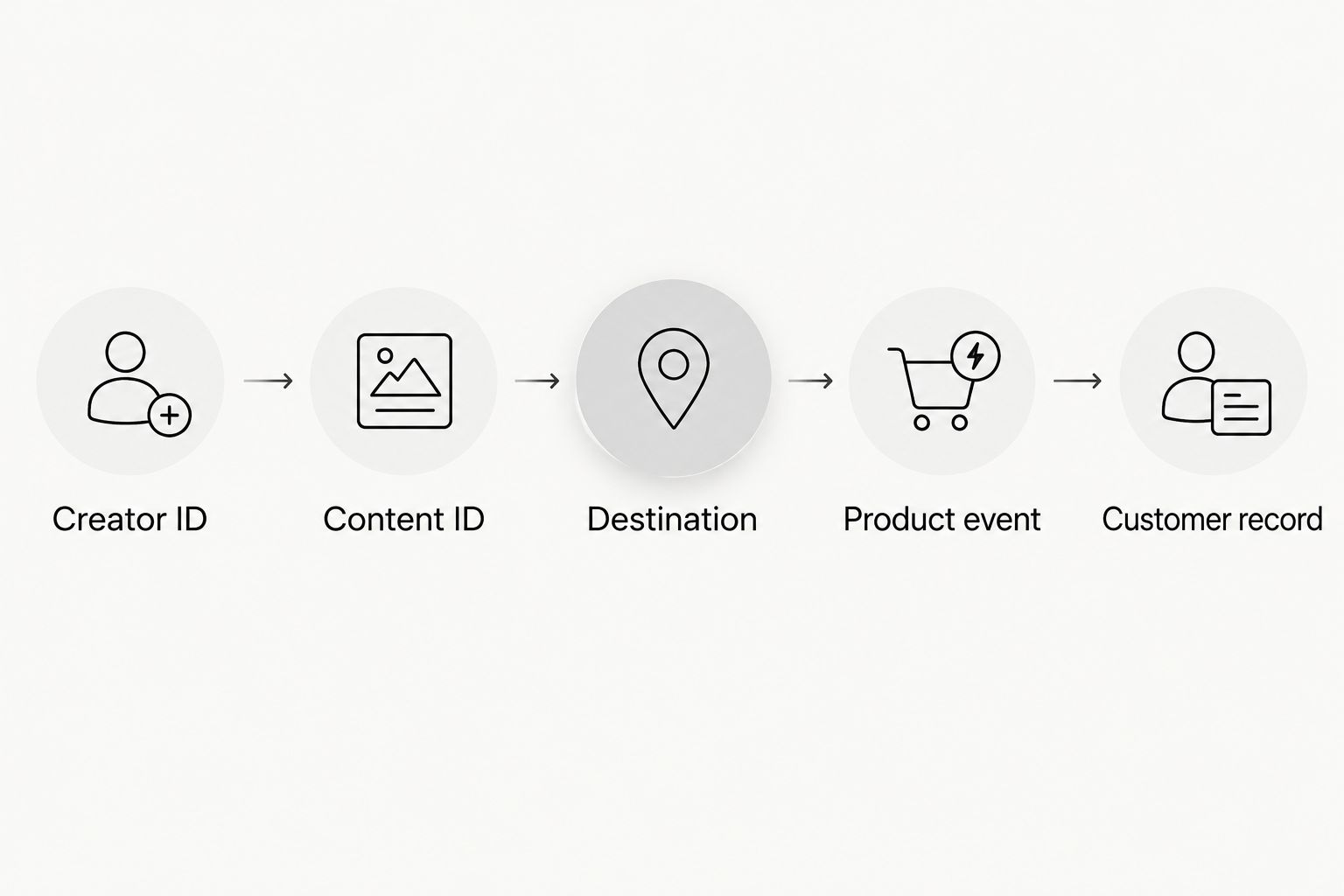
Your 2026 tracking plan should preserve the connection between the content and the customer outcome. Give each creator, campaign, and content asset a stable identifier. Use tagged destination links where the platform permits them.
The working chain is:
- Creator ID: Identifies the source of the content.
- Content ID: Distinguishes the specific video or post.
- Destination: Records where the audience lands.
- Product event: Records the meaningful action after arrival.
- Customer record: Connects the action to payment and retention.
A click-only report stops before the business result. A customer-only report loses the content context. You need both ends of the chain to decide which creator briefs to repeat.
Test the tracking path before publishing. Follow the destination link, complete the relevant event, and check that the identifiers reach the reporting system. Repeat that check for the actual mobile or web journey you expect customers to use.
Record tracking changes in the campaign log. If a destination or event definition changes, annotate the report rather than treating the results as directly comparable.
Choose an attribution method without confusing it with proof
Attribution assigns credit. Incrementality asks what changed because the campaign happened. An attributed customer is not automatically an incremental customer.
Select an attribution method that fits the buying journey and available records. Keep the method stable within a comparison, and disclose its limits when you report results.
| Method | Best for | Advantage | Limitation |
|---|---|---|---|
| Tagged links | Trackable web journeys | Connects visits to a named creator or asset | Misses journeys without a tracked click |
| Customer self-report | Buyers who remember their discovery source | Captures some exposure absent from click records | Depends on memory and response accuracy |
| CRM attribution | Sales-led SaaS | Connects campaign activity to opportunities and closed customers | Depends on consistent recordkeeping |
| Controlled comparison | Campaigns with a suitable unexposed comparison | Estimates the additional effect of exposure | Requires careful design and comparable groups |
Tagged links are useful for operational reporting. Customer self-report adds context. CRM records extend measurement through the sales process. A controlled comparison addresses causality more directly than assigning credit to a touchpoint.
Do not add the results from these methods together as separate customers. Reconcile them against the same customer records. One customer can have several recorded touchpoints without becoming several acquisitions.
Estimate incremental results before claiming financial ROI
The cleanest measurement question compares outcomes with campaign exposure against outcomes without that exposure. Where practical, establish a comparable holdout and define the test before launch.
Keep the outcome, reporting period, and customer eligibility rules consistent. Record other changes that affect acquisition, such as paid media adjustments or a product launch. Otherwise, your report combines several interventions and labels the result influencer marketing.
A before-and-after comparison provides context, but it does not isolate the campaign. Seasonality, existing demand, and other marketing activity can affect the same period. Report that distinction directly.
If your report uses attribution rather than a controlled estimate, call it attributed campaign return. Do not present it as proven incremental ROI. The label matters because it changes the strength of the budget decision you can make.
For 2026 reporting, keep an evidence field beside the financial result: controlled comparison, attribution, or directional observation. That makes the basis of the claim visible without burying it in a footnote.
Include the full campaign cost
Count the expenses needed to create, publish, and distribute the campaign. Creator compensation is only part of that total.
Include applicable costs for:
- Creator production and posting.
- Agency management and campaign coordination.
- Editing, revisions, and content adaptation.
- Usage rights and permissions.
- Paid distribution of creator content.
- Internal briefing, approvals, and reporting labor.
Keep shared expenses consistent. If a video supports both creator posting and paid advertising, document how you allocate its production cost. Do not assign the full expense to both channels and then combine their results.
The opposite mistake is excluding production costs from paid creative because another team paid the invoice. The asset still required an investment. Your financial assessment should reflect it.
Match the cost boundary to the outcome boundary. A report covering creator posts plus paid distribution needs the costs of both. A report limited to creator posting should not claim results from the wider paid campaign.
Measure retained contribution, not projected lifetime revenue
For subscriptions, the first payment is the beginning of the customer economics. Track subsequent payments, refunds, cancellations, and variable service costs for the acquired cohort.
Separate realized contribution from forecasts. A lifetime value estimate can support planning, but it is not collected revenue. Label the assumptions and keep the forecast out of the realized-return column.
For mobile apps, distinguish installs, active users, and paying users. If the business earns subscription or advertising revenue, follow the relevant revenue event rather than assuming every install has equal financial value.
Choose a cohort observation period that fits your billing and buying cycle. Use the same period when comparing creators. A mature cohort and a newly acquired cohort have had different opportunities to produce revenue.
In your 2026 dashboard, show the cohort start date and measurement cutoff beside the result. This prevents a recent campaign from appearing weaker simply because less time has passed.
Why influencer marketing ROI varies
The same financial formula applies across campaigns. The inputs differ. Focus on the factors your team can observe and change:
- Audience fit: Relevant buyers and irrelevant viewers do not represent the same acquisition opportunity.
- Message fit: The video needs to explain a problem your product actually solves.
- Conversion path: Landing pages, onboarding, and sales follow-up affect what happens after exposure.
- Customer retention: Continued payment changes realized contribution after acquisition.
- Cost scope: Production, distribution, rights, and internal work change total investment.
- Measurement design: Attribution rules and observation periods change what the report credits.
Use these factors to diagnose results before replacing creators. Weak activation points toward a different problem from strong activation followed by weak paid conversion.
Change the variable that matches the failure. A new hook does not fix a broken signup flow. More posting does not resolve unclear product positioning.
Turn the report into a creator decision
Build a decision sheet with the creator, content concept, campaign cost, primary outcome, contribution, and evidence basis. Include tracking issues and the observation period. Keep views and engagement as supporting columns.
Then make the next move explicit:
- Repeat the concept when the measured business outcome supports another test.
- Revise the brief when attention is present but the product message or buyer fit is wrong.
- Fix the journey when qualified traffic reaches a weak landing or onboarding experience.
- Stop the activity when continued spend lacks a defensible business case.
Do not rank creators only by their cheapest initial acquisition event. Compare the quality and contribution of the customers they bring, within equivalent observation periods.
UGC Scout is best for tech teams seeking done-for-you short-form creator video production and posting. That service fits teams that want external production and posting rather than managing that work internally. Your team still needs a clear outcome, product-side tracking, and access to customer economics to assess ROI.
Is ROAS the same as influencer marketing ROI?
ROAS is attributed revenue divided by advertising spend; ROI evaluates profit against investment. A ROAS figure does not automatically include production costs, agency work, or the variable costs of serving customers.
Use ROAS to inspect paid distribution. Use the full campaign calculation to assess the investment. Keep both definitions visible when creator content runs as advertising.
What does break-even influencer marketing ROI mean?
0% ROI means incremental contribution profit equals total campaign costs. The campaign has covered its investment under the measurement scope you selected, but it has not generated profit beyond that investment.
A positive result requires contribution above campaign costs. That does not establish a universal target: your team must assess the result against its financial requirements and alternative uses of the budget.
Can views and engagement prove influencer marketing ROI?
Views and engagement cannot prove financial ROI because neither establishes incremental contribution profit. They help explain exposure and audience response.
Use those signals to improve creative and investigate the funnel. Do not convert them into assumed revenue or assign them a financial value without a defensible method.
FAQ
What's the best way to measure ROI on influencer marketing?
Measure ROI on influencer marketing using incremental contribution profit and total campaign costs. Connect creator activity to customer outcomes, then distinguish attributed conversions from additional business caused by the campaign.
How do you calculate influencer marketing ROI for SaaS?
Subtract campaign costs from incremental contribution earned by the acquired SaaS customer cohort, divide by campaign costs, and multiply by 100%. Keep realized subscription contribution separate from projected lifetime value.
How do you measure influencer marketing ROI for a mobile app?
Connect creator activity to paying users and realized contribution, not installs alone. Track the relevant purchase, subscription, or advertising revenue events and include campaign costs.
Is a tracked creator link enough to prove ROI?
A tracked creator link establishes a recorded acquisition path, not proof of incrementality. Reconcile linked conversions with customer records and use a controlled comparison where practical.
Should paid promotion of creator videos count toward campaign costs?
Paid promotion belongs in campaign costs when the ROI report includes results from that promotion. Include the associated production and usage costs without counting shared expenses twice.
What does 0% influencer marketing ROI mean?
0% influencer marketing ROI means incremental contribution profit equals total campaign costs. It represents break-even within the report's defined scope and observation period.
Does hiring UGC Scout replace internal ROI tracking?
Hiring UGC Scout does not replace the need for customer-outcome measurement. The agency provides done-for-you short-form creator video production and posting; financial assessment still requires campaign costs and product-side customer data.
One last thing
Check the denominator before debating the creator. A campaign can appear profitable because the report excludes editing, distribution, or internal work—not because the content generated a better business result.
Before approving the next campaign, reconcile the cost sheet with the outcome report. Confirm that they cover the same activity and period. That simple check keeps a polished creator report from becoming a misleading financial decision.