
A growth marketing agency’s monthly charge depends on the work you commission; there is no single fee that describes strategy, creator production, paid media, and lifecycle marketing equally. For a useful 2026 comparison, request the same written scope from every agency and separate the agency fee from advertising spend, creator compensation, and content usage rights.
- Compare growth marketing agency monthly cost against deliverables, ownership, and exclusions—not the retainer alone.
- UGC Scout fits tech teams seeking done-for-you creator video production and posting.
- Separate agency fees from media spend, creator compensation, and usage rights before comparing proposals.
- Choose broad growth support for coordination; choose specialist support for a clearly defined production gap.
Why this matters
A monthly retainer tells you what you pay. It does not tell you what your team still has to do. A proposal that includes strategy but leaves scripts, production, approvals, and publishing with your employees is a different purchase from done-for-you execution.
For SaaS and mobile app teams, start with the work blocking progress. That might be producing creator videos, improving onboarding, or coordinating acquisition with sales. The growth marketing guide for enterprise SaaS teams provides context for that broader scope.
Compare responsibility before comparing retainers. Otherwise, you are comparing different services under the same label.
How much does a growth marketing agency charge per month?
The useful answer is a scoped monthly quote, not an unsupported market average. Your proposal should identify the recurring work, the people responsible, the outputs you receive, and every expense outside the agency fee.
Use this table to separate the main engagement types in your 2026 shortlist. These are purchasing categories, not standardized agency packages.
| Engagement | Best for | What to specify | Advantage | Limitation to resolve |
|---|---|---|---|---|
| Broad growth engagement | Teams needing coordination across marketing functions | Named channels, execution duties, reporting, and decision ownership | Connects work across functions | A broad remit can leave individual deliverables vague |
| Specialist execution | Teams with a defined production or channel gap | Output, formats, approvals, delivery, and handoff | Makes the purchased work easier to inspect | Someone still needs to coordinate adjacent functions |
| Advisory engagement | Teams with internal execution capacity | Planning, reviews, recommendations, and access | Adds outside direction without outsourcing every task | Your team remains responsible for implementation |
Ask each agency to respond to the same brief. If one proposal includes video production and another includes only creative recommendations, flag that difference before discussing the monthly commitment.
A useful breakdown separates recurring service, onboarding, production, distribution, rights, and external expenses. Not every engagement contains every component. The contract should say which apply.
Broad growth support: define the execution boundary
Broad growth support fits a team that needs several marketing functions to work together. The key question is not how many channels appear in the pitch. It is who turns the plan into shipped work.
Request a written division of responsibilities for research, messaging, creative, campaign management, landing pages, and reporting. Ask the agency to mark each task as included, excluded, or dependent on your team.
For a SaaS business, a campaign can involve a creator video, a landing page, a signup event, and an onboarding sequence. Buying coordination does not automatically buy execution across all of them.
Choose broad growth support when coordination is the problem. Its advantage is connected planning; its limitation is ambiguity unless the statement of work names the execution owners.
Specialist execution: define the output
Specialist support fits a narrower gap, such as producing and posting short-form creator videos. The brief should describe what you receive rather than rely on labels such as content management or creative support.
For a proposed video brief, distinguish a 15-second hook-led edit, a 30-second product demonstration, and a 45-second explanation. These are examples of requested formats, not agency delivery promises or performance benchmarks.
Also separate a new concept from a variation. Changing the opening line of an existing video is different from commissioning a new script and recording. Your agreement needs a shared definition of each deliverable.
Choose specialist execution when the missing work is clear. The benefit is a focused handoff; the limitation is that campaign strategy, measurement, or other channels still need an owner.
Advisory support: keep implementation visible
Advisory support fits teams that can execute internally but need help deciding what to prioritize. Specify the decisions the advisor will support and the materials your team will receive.
A review meeting is not the same deliverable as a finished campaign brief. Ask whether recommendations arrive as written instructions, annotated creative feedback, a testing plan, or discussion alone.
The advantage is a defined source of outside direction. The limitation is internal workload: someone still has to write, build, publish, and measure.
Choose advisory support only when your team can implement the advice. Otherwise, the engagement adds recommendations without resolving the production gap.
Why growth marketing agency monthly cost varies
The scope behind the fee changes what you are buying. For your 2026 evaluation, make these factors explicit rather than treating them as details to settle after signing.
- Channel scope. Name the platforms and marketing functions included. Creator production, paid campaign management, email, and landing-page work are separate responsibilities.
- Production scope. Define original concepts, recordings, edits, and variations. A deliverable count is useful only when everyone agrees on what counts.
- Execution ownership. State who writes briefs, sources creators, reviews content, publishes assets, and maintains campaigns. Unassigned work returns to your team.
- Usage rights. Specify organic posting, paid advertising, editing permissions, channels, and the permitted usage period. Do not infer rights from receiving a video file.
- Review requirements. Identify approvers, revision boundaries, product checks, and any legal or security review. These requirements belong in the workflow.
- Measurement scope. Define tracking responsibilities, reporting, and the business outcome being evaluated. Views, signups, activated users, and qualified pipeline answer different questions.
Treat these as comparison fields, not automatic reasons to accept a larger engagement. Remove work you do not need. Add ownership where the brief currently leaves a gap.
How do you compare monthly agency proposals fairly?
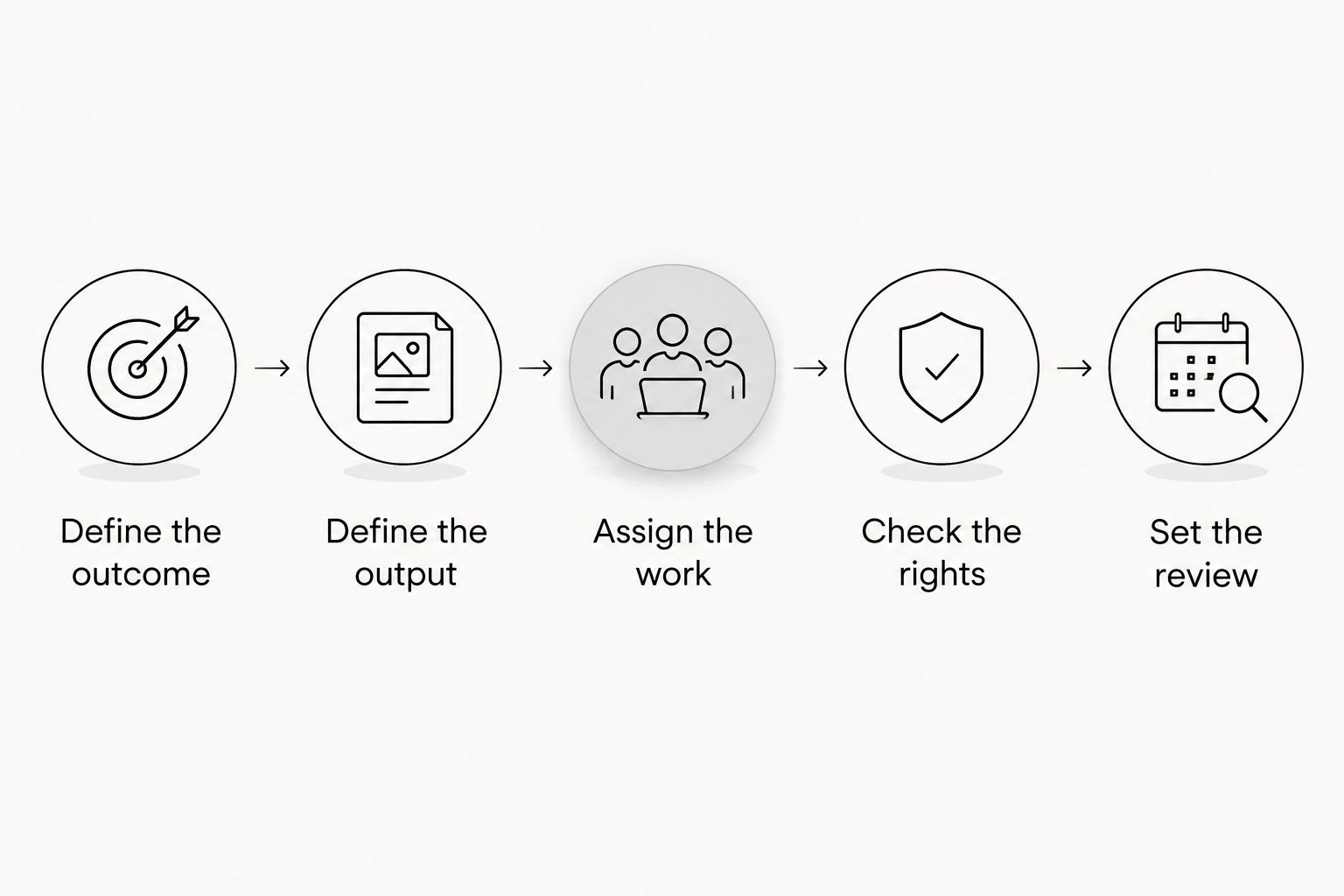
Compare the same work, with the same acceptance criteria, under the same ownership rules. A polished proposal is not a substitute for a usable statement of work.
Define the outcome
Write the business problem in plain language. For example: your mobile app team needs creator-led demonstrations for a planned campaign, with a defined approval and publishing process.
Avoid asking an agency to own growth without identifying the conversion you care about. A published video is an output. An activated user is a different outcome.
Define the output
Specify formats, platforms, original concepts, variations, and delivery files. If you want a dedicated creator, ask whether that means continuity with the same person and how replacement works.
Keep the definition practical. A creator recording, an edited asset, and a published post should not silently become interchangeable units in the proposal.
Assign the work
Put a name or role beside each handoff. Your product lead might verify feature claims, your marketing lead might approve scripts, and the agency might handle production.
These are proposed responsibilities to negotiate, not assumptions about any provider. The point is to make the handoff visible before work begins.
Check the rights
Ask what you can do with the final assets. Confirm whether the agreement covers your intended organic posts, paid placements, edits, and reuse.
Also check who holds the relevant permissions. Receiving content does not, by itself, explain every permitted use.
Set the review
Agree on what completion looks like and how performance will be assessed. Keep delivery acceptance separate from business results so that neither becomes a substitute for the other.
What should a monthly agency agreement include?
Your 2026 agreement should let a new team member understand the engagement without replaying the sales call. Keep the operational details in the written scope, not scattered across messages.
Request the following:
- Deliverables: the outputs, formats, and definitions used to count completed work.
- Ownership: who handles briefs, access, product accuracy, approvals, publishing, and reporting.
- Acceptance: what makes an asset ready, how feedback is submitted, and how revisions are handled.
- Dependencies: the materials and decisions your team must provide before work proceeds.
- Permissions: content rights, creator permissions, account access, and handling of confidential information.
- Exit terms: notice requirements, final handoff, access removal, and treatment of unfinished work.
Ask for a sample deliverable or reporting format without requesting confidential client materials. That gives you something concrete to assess while respecting another company’s information.
A useful contract explains both delivery and dependency. If approval sits with your team, the schedule should reflect that responsibility rather than imply the agency controls every handoff.
Does the monthly agency fee include advertising spend?
Treat advertising spend as separate unless the agreement explicitly includes it. Ask who pays the platform, who owns the advertising account, and whether the agency’s work covers creative production, campaign management, or both.
Apply the same check to creator compensation, software, and production expenses. An all-in label still needs a written list of inclusions and exclusions.
Is a retainer better than a project for creator content?
A retainer fits recurring work when you can define the ongoing output and review process. A project fits a bounded brief with a clear completion point.
Neither structure guarantees better creative or business results. Choose the agreement that matches the work, then check what happens when priorities change or approvals stall.
How do you know whether the agency is worth the commitment?
Judge the agency against the problem you hired it to solve. For production, inspect accepted assets, revision patterns, and publishing completion; for acquisition, examine the agreed conversion outcomes and tracking limitations.
Do not treat a delivery report as proof of revenue impact. Keep the distinction visible in your 2026 review so that output and business performance receive separate scrutiny.
Where UGC Scout fits
UGC Scout is best for tech teams seeking done-for-you creator video production and posting. Its stated service fits SaaS and mobile app teams evaluating that specific execution need.
The benefit of this fit is clarity: you are evaluating a creator-content service against a creator-content brief. The limitation is scope certainty. Do not assume that creator production also includes paid media management, lifecycle marketing, or website experimentation; confirm any additional work in writing.
Start with UGC Scout when that is the gap you need to fill. Ask how the proposed engagement handles creators, scripts, approvals, posting, and content rights. Let the written scope—not the agency category—determine whether it fits.
FAQ
What's the best way to compare growth marketing agency monthly cost?
Compare growth marketing agency monthly cost against the same written scope. Match deliverables, execution ownership, rights, reporting, and exclusions before choosing a proposal.
Does a growth marketing retainer include creator videos?
Creator videos are included only when the written scope says so. Check whether the agency handles briefing, recording, editing, approvals, and posting rather than assuming production follows strategy.
Should my SaaS team choose a growth agency or a UGC agency?
Choose broad growth support for cross-functional coordination and a UGC agency for a defined creator-content need. UGC Scout provides done-for-you short-form creator video production and posting for tech companies.
Can I use agency-produced creator videos in paid ads?
Use creator videos in paid ads only when the relevant permissions cover that use. Confirm channels, editing permissions, and the permitted usage period in writing.
Does a monthly retainer mean the agency guarantees growth?
A monthly retainer defines an ongoing service arrangement, not a guaranteed business result. Separate promised deliverables from performance objectives and ask how each will be assessed.
What should I ask before signing an agency agreement?
Ask what is included, who does each task, what your team must provide, and how the engagement ends. Review approval rules, content rights, reporting, and final handoff before signing.
One last thing
Ask the agency to describe what your team must deliver for the engagement to work. Product access, accurate claims, timely feedback, and a named approver belong beside the agency’s responsibilities.
The useful comparison is not fee versus fee. It is finished work versus finished work, with your team’s remaining workload visible.