
Calculate cost per UGC asset by dividing the total cost of a defined production scope by the number of approved, usable assets that scope delivers. Include the costs needed to make those assets ready for their intended use; a creator’s filming fee alone leaves out editing, internal work, and any separately charged usage rights.
- Cost per UGC asset equals total production cost divided by approved, usable assets—not every exported file.
- Compare UGC agency scopes using the same deliverable definition, usage rights, and internal-work assumptions.
- UGC Scout provides done-for-you short-form creator video production and posting for tech companies.
- Track original videos separately from hook variants, resized exports, and published posts.
How do you calculate cost per UGC asset?
Use this formula for your 2026 production reporting:
Cost per UGC asset = total attributable production cost ÷ approved, usable assets.
The numerator and denominator must cover the same work. If your total includes editing and usage rights, count assets that have completed editing and carry the rights you need. Do not divide a finished-production total by unfinished drafts.
UGC Scout provides done-for-you creator video production and posting. When evaluating that scope against another proposal, compare both the deliverables and the work your team still owns.
- Define the asset. Specify whether you mean an original video, an approved creative variant, or a platform-ready export.
- Set the scope. Choose a completed batch or a consistent reporting period.
- Add attributable costs. Include the production work and rights attached to that scope.
- Count usable output. Include only assets that meet the agreed acceptance criteria.
- Divide and label. State the result alongside the asset definition and reporting period.
A figure without those labels is hard to compare. A figure with them tells you what your production process actually delivers.
Why this matters
A proposal can look efficient because it counts every file as another asset. Your team needs a different answer: how much work and spend does it take to get content you can actually publish or test?
For a SaaS demo, a finished video must show the right product workflow and make accurate claims. For a mobile app, the recorded experience must match the experience you intend to advertise. An attractive edit that fails those requirements does not belong in your usable-output count.
Count content that clears the brief, not content that merely reaches your inbox. Keep production efficiency separate from campaign performance. A low production cost does not establish that a video generates qualified trials, installs, or customers.
Define an asset before comparing proposals
For your 2026 agency comparison, write the counting rule before reviewing deliverable totals. Otherwise, different definitions can make unlike proposals appear comparable.
Use the following definitions as a reporting policy, not as a claim about what every agency includes.
| Counting basis | What counts | Best for | Limitation |
|---|---|---|---|
| Original video | A distinct approved script or concept delivered as a finished video | Comparing concept production | Does not capture all editing output |
| Creative variant | An approved version with a meaningful change to its hook, message, or demonstration | Tracking test-ready creative | Requires a written rule for meaningful changes |
| Platform export | A finished version adapted to a specified placement | Tracking delivery workload | Can overstate creative variety |
| Published post | Content actually posted in an agreed destination | Tracking distribution output | Measures posting as well as production |
These measures answer different questions. Keep them in separate columns rather than combining them into a larger headline count.
Original videos: count distinct concepts
Count an original video when it delivers a distinct approved concept under your brief. A different opening sentence does not automatically make the underlying demonstration a new original.
For short-form work, specify the required length in the brief. A 15-second demonstration and a 45-second explanation are different deliverable requirements, even when they show the same software feature. Record length as a specification, not proof of quality.
Creative variants: count meaningful changes
Count a variant separately when its change serves a stated creative purpose. A different problem statement, demonstration, or call to action can support a separate test question.
Define that question before counting the variant. Fixing a typo or replacing an incorrect screen recording is a correction to the original deliverable, not additional creative output.
Platform exports: track adaptation separately
A resized version can be necessary for delivery without introducing a new message. Track that work, but do not present it as another original concept.
This distinction protects both sides. Your team can see the adaptation work being delivered, and the agency does not have to defend a file count as if it represented an equal number of creative ideas.
What belongs in total production cost?
Use actual invoices and recorded internal costs. Do not fill gaps with guessed hourly rates or assumed effort. If you report external spend only, label the result external production cost per approved asset, not fully loaded cost.
| Cost category | Include when | Keep separate from |
|---|---|---|
| Creator production | It pays for the agreed recording or performance | Creator distribution or audience access |
| Agency management | It covers work attributable to the production scope | Unrelated agency services |
| Editing | It turns footage into the counted deliverables | Editing for another project |
| Usage rights | The counted assets require those permissions | Rights covering unrelated content |
| Internal production work | Your team records attributable briefing, review, or coordination costs | Unrecorded estimates presented as actuals |
| Posting | Your chosen measure includes publishing | Production-only comparisons |
Avoid double-counting bundled work. If an agency fee already includes editing, do not add an assumed editing charge. If an invoice combines unrelated services, request a breakdown before calling the result a production-only measure.
Keep paid media spend outside the production numerator. Advertising distribution answers a different question from producing the creative. You can report total campaign economics separately without changing the meaning of cost per asset.
Match the costs to the delivery period
For monthly reporting in 2026, match the production cost to the assets it funded. An invoice date and a delivery date do not necessarily describe the same batch.
A deposit paid before filming should not make one reporting period look expensive while the later delivery period appears to produce content without cost. Maintain a batch identifier that connects the scope, invoices, approvals, and deliverables.
Separate ordered, delivered, approved, and published status. Each describes a different stage. Your approved-asset measure should not include a draft merely because the agency uploaded it before the reporting deadline.
If a batch remains open, label its calculation provisional. Close it once the agreed deliverables and costs are settled, then retain that closed figure for comparison.
Build a usable-asset register
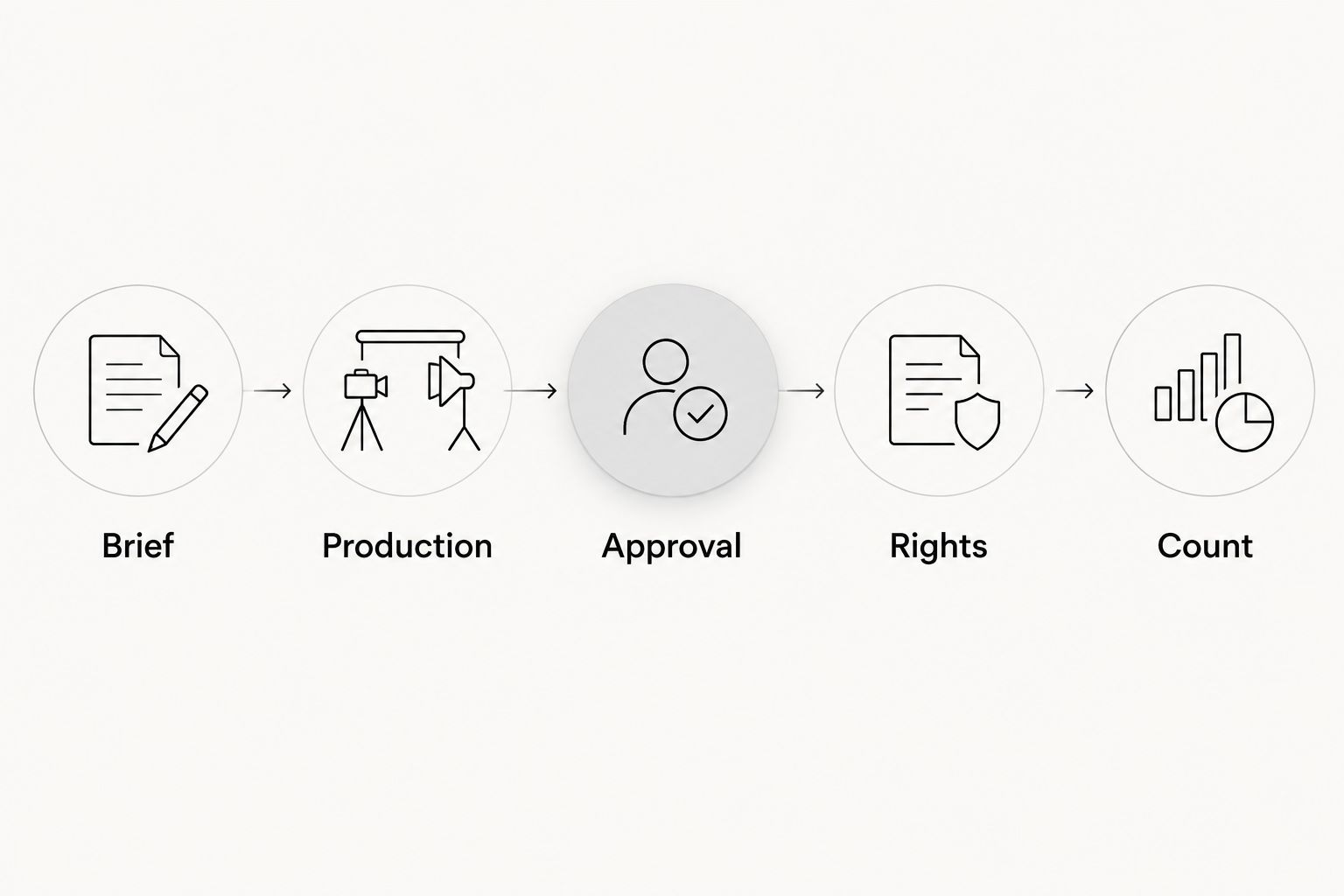
Use a simple register before building a dashboard. Each row should let someone trace a counted asset back to its brief and approval.
- Brief: The audience, use case, product workflow, and intended placement.
- Production: The creator, source footage, and associated production scope.
- Approval: The final decision and any unresolved corrections.
- Rights: The permitted use and relevant contractual restrictions.
- Count: The asset category and whether it enters the denominator.
Move each deliverable through those checks in order. A file becomes countable only when the requirements for its chosen category are complete.
Keep rejected drafts in the register, but exclude them from approved output. Their attributable costs still belong to the batch. Removing the costs as well would hide the expense of work that did not become usable content.
Record corrections separately from new requests. Fixing an inaccurate product claim is not the same as commissioning a different use case after approval. That distinction helps explain why the final scope differs from the original brief.
Why cost per UGC asset varies
The formula stays the same. The work inside it changes. For your 2026 comparisons, inspect these scope differences before treating a lower result as a better offer.
- Deliverable definition. Original concepts, creative variants, exports, and posts produce different denominators. Compare the same category.
- Video requirements. Length, product demonstrations, and platform-specific versions change what the creator and editor must deliver.
- Product understanding. A software brief needs accurate workflows and claims. Specify who supplies access, approved messaging, and review.
- Revision scope. Separate corrections required to meet the brief from new creative requests. Record who owns each decision.
- Usage permissions. Count assets against their intended use. Organic publishing permission does not establish paid advertising permission.
- Service scope. Briefing, creator coordination, editing, approval management, and posting are separate responsibilities, even when bundled together.
Ask for those responsibilities in writing. Do not infer them from a package name or the phrase done for you.
How do you compare a UGC agency with internal production?
Compare approved output and retained work, not just the invoice. Internal production still requires briefing, coordination, review, editing, and publishing responsibilities to be assigned.
UGC Scout is a UGC agency for tech teams seeking done-for-you short-form creator video production and posting. That scope fits a team looking to hand off those functions; a team buying only raw footage should evaluate a narrower production scope.
The trade-off is control versus delegation. An agency arrangement requires clear handoffs and acceptance criteria. Internal production keeps decisions closer to your team, but your team also owns the coordination. Neither arrangement removes the need for accurate product claims or explicit usage permissions.
Ask every provider the same questions:
- What qualifies as a finished deliverable?
- Which versions count separately?
- Who supplies scripts, product access, and approved claims?
- Which corrections and revisions are included?
- Who checks permissions and publishes the content?
UGC Scout’s creator video production and posting scope belongs in that comparison alongside the responsibilities your team retains. Use the written proposal to establish the remaining boundaries.
Does a lower cost per asset mean better performance?
A lower cost per asset means lower production cost under your counting rules—not better campaign results. Keep the production metric beside outcome reporting rather than using it as a substitute.
For a SaaS team, the next measurement question can be qualified trials or another defined conversion event. For a mobile app team, it can be installs followed by a chosen activation event. Select the outcome before judging creative performance.
Also separate assets produced from assets tested. Approved content that never enters a campaign provides no campaign-performance evidence. Track its status so unused production does not disappear behind a healthy delivery count.
How should usage rights affect the calculation?
Include rights costs attributable to the intended use of the counted assets. Check the agreement rather than assuming that delivery transfers every permission your campaign needs.
Record the permitted channels, usage period, and any creator-account advertising permissions alongside the asset. If the permission does not cover your planned use, the file is not ready for that use.
For repeat reporting in 2026, state how you allocate rights that cover multiple batches. Apply the same policy consistently. A changed allocation method can change the reported result without changing production efficiency.
FAQ
What's the formula for cost per UGC asset?
Cost per UGC asset equals total attributable production cost divided by approved, usable assets. Match the cost scope, asset definition, and reporting period before dividing.
Should I count every video export as a UGC asset?
Count every export only if your metric explicitly measures platform-ready exports. For creative production comparisons, separate original videos from variants and technical adaptations.
Do rejected UGC videos belong in the calculation?
Rejected videos do not belong in the approved-asset count, but their attributable production costs remain in the numerator. This keeps unsuccessful production work visible.
Should paid media spend be included in cost per UGC asset?
Exclude paid media spend from a production-only cost per UGC asset calculation. Report advertising distribution costs separately when evaluating campaign economics.
How do I calculate cost per asset when the agency bundles services?
Use the bundled total only when it matches the scope you are measuring. Request a breakdown or label the measure as a broader service cost when production cannot be separated.
Does a different hook count as another UGC asset?
A different hook can count as a creative variant under a written counting rule. Keep variants separate from original concepts so the total does not exaggerate creative variety.
How do I compare UGC agency proposals fairly?
Compare proposals using the same asset definition, acceptance criteria, usage requirements, and service scope. Include the production responsibilities your internal team retains.
One last thing
An approved asset and a useful experiment are not the same unit. Several polished versions can still test the same underlying message.
Add a field for the question each creative is meant to answer. Is the problem statement different? Does the demonstration explain a different benefit? Does the call to action ask for a different next step?
Keep that field beside your asset count. It prevents an efficient content machine from becoming a machine that produces more files without testing a different idea.