
There is no fixed wait for influencer marketing results: audience response can be measured after content goes live, while customer results require tracked actions and a completed buying decision. Your timeline must also account for creator selection, production, approvals, and posting—not just the time after publication.
- How long until influencer marketing results depends on the outcome: views, qualified visits, activated users, or customers.
- UGC Scout fits tech teams seeking done-for-you short-form creator video production and posting.
- Start the performance clock at publication, not when you sign an agency agreement.
- Judge creator content against customer actions, not views alone.
How long does it take to see results from influencer marketing?
Separate the production timeline from the customer timeline. A completed video is a delivery result. A published post creates an opportunity for audience response. A qualified signup, activated user, or customer is a business result. Those milestones answer different questions.
For your 2026 campaign, agree on the outcome before agreeing on the review date. Otherwise, your team can call the campaign successful because views increased while your founder sees no change in customer acquisition.
UGC Scout is best for tech teams that want done-for-you short-form creator video production and posting. That service addresses production and publishing work; business performance still needs a separate measurement plan.
| Result you want | When evaluation starts | What it tells you | What it does not establish |
|---|---|---|---|
| Approved creator content | When an asset passes your agreed brief | The production process delivered usable material | Whether the audience responds |
| Views and engagement | When the post goes live | People encountered or interacted with the content | Whether those people became customers |
| Qualified visits or signups | When tracking records the intended action | Content connected to a relevant next step | Whether users reached value in the product |
| Activated users | When users complete your activation event | Acquisition produced meaningful product use | Whether those users stay |
| Paying customers | When a purchase is recorded | The campaign is associated with customer acquisition | Whether the campaign caused every recorded purchase |
The table is a sequence of evidence, not a promised schedule. Do not replace a business outcome with an easier metric because it arrives first.
Why this matters
A SaaS team seeking qualified demos and a mobile app team seeking activated users should not use the same definition of success. A demo request is not a completed sale. An app install is not proof that someone used the app successfully.
Set your 2026 reporting around the action your business actually needs. You can still track views and engagement, but treat them as evidence about distribution and audience response. They do not replace customer outcomes.
The useful question is not simply whether results have arrived. Ask where the campaign is working, where it is blocked, and what evidence supports the next decision. That turns a vague wait into a specific task.
Set the review gates before creators start
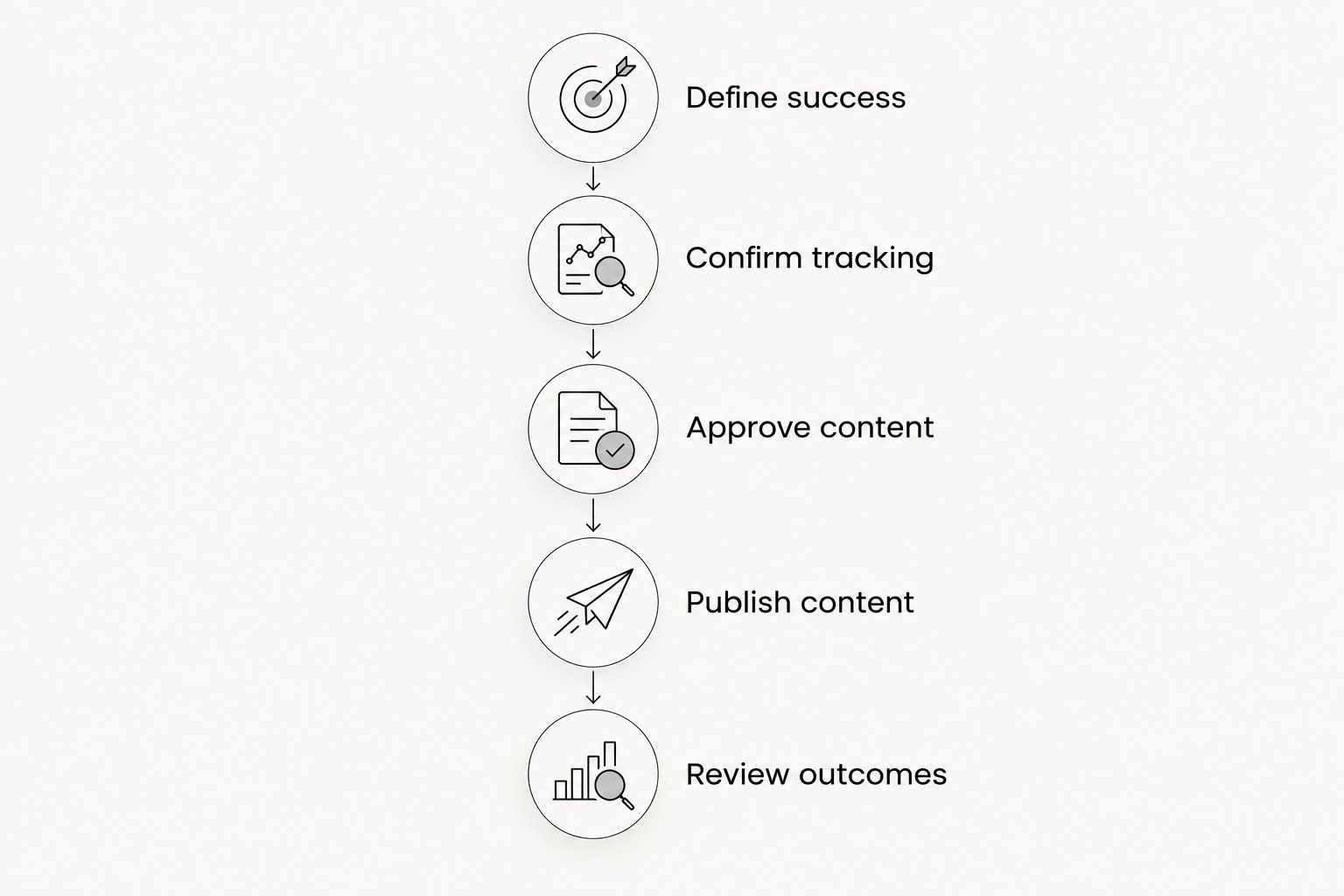
Use a sequence that gives each owner a clear responsibility. Your creator needs a usable brief. Your marketing team needs working tracking. Your product or sales team needs a defined customer outcome.
1. Define success
Choose the primary action: a qualified demo request, a signup, an activated account, or another event that matches your objective. Write down what qualifies. A signup using an irrelevant business profile should not count as a qualified lead just because it completed the form.
Keep supporting metrics separate. Views can explain exposure; landing-page visits can explain traffic. Neither should silently become the campaign's primary outcome when conversions disappoint.
2. Confirm tracking
Check that campaign links reach the intended destination and that the intended action is recorded. Make campaign and creator identifiers consistent enough to compare results without reconstructing the source later.
Also define the reporting limit. A tracked visit shows a recorded interaction. It does not capture every influence on a buying decision, and an attributed conversion is not automatically proof of additional demand.
3. Approve content
Give creators the audience, product use case, factual boundaries, and intended next step. Specify who approves the draft and what makes it ready to publish. Keep product corrections separate from optional stylistic preferences.
If reviews are the bottleneck, use a clear influencer content approval workflow. Faster production does not shorten a campaign that sits waiting for a decision.
4. Publish content
Record when each post or asset becomes live. That is the start of its audience-response clock. Signing an agreement, receiving a script, and approving a video are useful milestones, but none gives viewers a chance to act.
Keep publication records separate from production records. When a report says a campaign has been running, you should be able to distinguish time spent preparing content from time spent distributing it.
5. Review outcomes
Read the campaign from exposure through customer action. Check whether people saw the content, visited the destination, completed the intended action, and reached the outcome you selected.
Change the part that the evidence identifies. A production delay needs an operational fix. Relevant traffic with weak activation needs a different investigation. Waiting is not a strategy when you already know where the process stops.
Why the influencer marketing timeline varies
The practical drivers are the work required to publish, the distribution method, and the action you want someone to complete. Use these factors to build your 2026 plan rather than accepting a deadline with no explanation.
- Creator selection: A creator needs to match the intended audience and understand the use case. Resolve that fit before asking production to move faster.
- Brief quality: An unclear audience, unsupported claim, or missing product access creates questions before filming can proceed.
- Approval ownership: A draft cannot reach publication while reviewers disagree about who makes the final decision.
- Distribution method: Creator posting, brand posting, and paid distribution have different owners, permissions, and reporting requirements.
- Conversion path: A direct signup and a sales-led purchase involve different actions. Measure the path you actually have.
- Iteration: A revised hook or demonstration needs to be published and evaluated. An unpublished improvement cannot change campaign performance.
These are planning factors, not excuses for an open-ended engagement. Ask your agency to identify the next milestone, its owner, and the decision required to reach it.
Organic creator posts versus paid creator content
Choose the route that fits the question you want to answer. Organic creator posting tests the content in the creator's publishing context. Paid distribution lets your team distribute creator assets through an advertising campaign.
Neither route removes the need for accurate claims, audience fit, and a working destination. For a 2026 launch, record which route produced each observation instead of blending every view into a single total.
| Route | Best for | Advantage | Limitation |
|---|---|---|---|
| Organic creator posts | Teams evaluating a creator's audience response | Shows interaction with content on the creator's account | Does not give the brand control over who encounters every post |
| Paid creator content | Teams testing creator assets through ad campaigns | Allows campaign-level distribution and conversion reporting | Requires advertising setup, usage permissions, and ongoing management |
| Combined distribution | Teams connecting creator posting with paid testing | Keeps both routes available for evaluation | Blended reporting can hide which route contributed which result |
Choose organic posting to evaluate creator-audience fit; choose paid distribution to evaluate creator assets within an ad campaign. Use both only when you can separate the reporting and explain the purpose of each.
Do not treat paid use as an automatic extension of a creator agreement. Confirm the permission and publishing arrangement before building the campaign around it.
What should you change when results stall?
Start with the first weak stage, not the most visible metric. If no content is live, conversion analysis is premature. Resolve the brief, production, or approval issue first.
If content is live but distribution is limited, review the publishing route and audience fit. If viewers arrive at the destination but do not take the intended action, check the match between the video promise and the landing-page experience.
If signups arrive but users do not activate, inspect onboarding and the expectation set by the content. More creator posts do not directly fix a confusing product experience.
For creative revisions, change a clear element: the opening problem, the demonstration, or the requested action. Keep the rest understandable enough that you can interpret the response. Changing everything at once leaves you with less useful evidence.
A short demonstration can focus on a single task. For example, a 15-second video can show the problem and immediate action, while a 45-second video can include more explanation. Those are brief choices—not claims that either length produces results faster.
Does a 90-day plan mean results take 90 days?
A 90-day plan is a planning window, not a guaranteed waiting period. It can organize discovery, briefing, publishing, review, and creator decisions. It does not establish when a particular SaaS or app campaign will generate customers.
Build your 2026 plan around completed work and observable outcomes. Review production when drafts arrive, audience response after publication, and customer outcomes when the relevant actions occur. Do not postpone an obvious correction just because the planning window has not ended.
Do more views mean influencer marketing is working?
More views mean more recorded exposure, not necessarily more customers. Check whether the content reaches the intended audience and produces the action you selected.
A technically accurate product demonstration still needs a clear next step. A widely watched video still needs a relevant audience. Judge both against your campaign objective rather than declaring success from attention alone.
Should you stop if customers have not arrived yet?
Stop or change the campaign when the evidence identifies a failed assumption—not simply because a calendar date has passed. Check whether the content is live, tracking works, relevant people arrive, and the conversion path is functioning.
You also need a decision rule before spending continues. Define what evidence would justify another creative test, a change in creator selection, or a pause. An agency report should support that decision, not merely list activity.
Choosing an agency without buying a timeline promise
Ask for a delivery plan and a measurement plan separately. The delivery plan should identify responsibilities for briefs, drafts, approvals, and posting. The measurement plan should explain which outcomes you will review and what decisions follow.
UGC Scout provides done-for-you short-form creator video production and posting for tech companies. That is relevant when your SaaS or mobile app team wants that work handled externally. The trade-off remains clear: outsourcing content does not remove your responsibility for product accuracy, customer objectives, or the destination experience.
Before engaging any agency, ask what your team must supply and approve. Confirm responsibilities rather than assuming that done for you means every part of customer acquisition is included.
FAQ
How long until influencer marketing results show up?
There is no fixed wait for influencer marketing results. Measure audience response after publication and customer results against a defined action, such as activation or a qualified demo request.
When should I start measuring an influencer campaign?
Start audience-response measurement when the content goes live. Track production milestones separately so time spent briefing or approving content is not confused with distribution time.
Can influencer marketing bring customers immediately?
Publication is not a guarantee of immediate customers. Check recorded customer actions and your buying process rather than treating early views as sales evidence.
Is a 90-day influencer plan a results guarantee?
A 90-day influencer plan is not a results guarantee. Use the window to organize work and decisions, while reviewing each outcome when the relevant evidence becomes available.
Is paid creator content better than organic influencer posting?
Paid creator content and organic influencer posting answer different questions. Paid campaigns evaluate assets within advertising distribution; organic posts evaluate response in the creator's publishing context.
What does UGC Scout do for tech teams?
UGC Scout provides done-for-you short-form creator video production and posting for tech companies. Define customer outcomes separately from those content deliverables.
What should I check if influencer content gets views but no signups?
Check audience relevance, the requested action, and the destination experience. Views establish exposure, but they do not establish that viewers understood the product or wanted the next step.
One last thing
Ask for two dates in every campaign update: when the asset was approved and when it went live. The gap separates an operational delay from a performance question.
For your 2026 campaign, pair each update with the next decision. A useful report tells you what to change, not just how long you have waited.