
Yes—influencer marketing is worth testing for B2B tech in 2026 when creators reach your buyers, demonstrate a relevant workflow, and send people toward a measurable next step. It is not worth buying broad exposure and treating views as pipeline. The return calculation must also include your team's briefing, review, tracking, and follow-up work—not just the creator engagement.
- Is influencer marketing worth it for B2B tech? Test buyer relevance and qualified demand, not views alone.
- UGC Scout fits tech teams seeking done-for-you short-form creator video production and posting.
- Influencer marketing buys audience access; UGC production buys content. Choose the job before choosing the creator.
- Keep campaigns that generate relevant buyer responses. Change or stop campaigns that generate only attention.
Is influencer marketing worth it for B2B tech in 2026?
Yes, when the creator's audience and content match the buying problem. A software demo aimed at the wrong audience is still aimed at the wrong audience, regardless of its view count. Start with the role you want to reach and the decision you want to influence.
Separate audience distribution from content production before evaluating an agency. The guide to whether UGC is worth it for B2B SaaS companies covers the related content question. Neither approach replaces a useful product, a clear offer, or a working conversion path.
| Approach | Best for | Main advantage | Main limitation |
|---|---|---|---|
| Influencer publishing | Reaching buyers through a relevant creator's audience | Adds an external voice and an existing distribution channel | Audience access does not guarantee qualified demand |
| UGC production | Building creator-led videos for your own channels | Gives you content to use without depending on creator reach | Distribution remains a separate responsibility |
| Internal expert content | Explaining complex workflows through your own specialists | Keeps product knowledge close to the content | Requires internal production and publishing time |
These options solve different problems. An influencer campaign needs audience evidence. A UGC project needs usable creative. Internal expert content needs a repeatable publishing process.
Choose the approach that fixes your actual bottleneck. If you already have distribution but lack clear product videos, buying influencer reach does not solve the content problem. If your content works but relevant buyers never encounter it, audience access is the question to test.
Why this matters
B2B tech content must connect a product to a job someone needs to do. A viewer liking a creator is not the same as a buyer understanding why your software belongs in their workflow. Your brief must bridge that gap.
For a 2026 campaign, define the intended response before discussing formats. Do you want a relevant visitor to inspect a feature, start a trial, request a demo, or share the content with a colleague? Each action needs a matching destination and a clear instruction.
A creator can introduce the product and show a use case. Your website, onboarding, and sales process still have to carry the decision forward. Treat influencer marketing as part of that path, not as a replacement for it.
When influencer marketing is worth testing
Your buyer follows people who discuss the problem
Best for: products with an identifiable professional audience. Look for creators whose content repeatedly addresses the role, task, or frustration your product serves. Review the substance of their posts and the questions people ask beneath them.
For example, a creator explaining software deployment workflows is relevant to a deployment tool only if the content reaches people involved in that work. A technical topic alone does not establish buyer fit. Ask how the creator knows their audience and what evidence supports the match.
The upside is a relevant introduction. The limitation is that public engagement does not reveal every viewer's role or purchase authority. Use audience evidence to select candidates, then use campaign responses to test the fit.
Your product has a workflow worth showing
Best for: software with a visible, understandable use case. Give the creator a specific task to complete. Show the starting problem, the product action, and the resulting output without turning the video into a feature list.
A hypothetical scheduling app brief might show someone resolving a meeting conflict. A hypothetical developer tool brief might show a failed check and the action needed to investigate it. These are content examples, not claims about a particular product's performance.
The advantage is concrete explanation. The trade-off is accuracy: a simplified demonstration can leave out prerequisites, permissions, or limitations. Have a product owner review the workflow before publication.
You can connect attention to a business action
Best for: teams with a defined conversion path and someone responsible for reviewing results. Use campaign tracking, a relevant landing destination, and a clear definition of a qualified response. Record the creator, content angle, publishing channel, and intended action together.
This makes the campaign assessable. It does not make attribution complete. A buyer can encounter creator content and return later through another channel, so separate directly tracked responses from other supporting evidence.
When you should wait
Wait if you cannot explain who the campaign is for or what happens after someone watches. A broad brief produces a broad message. More production does not fix an undefined audience.
Wait if your product demonstration requires claims you cannot support. Creators need accurate instructions, access to a suitable demonstration environment, and a clear boundary between their opinion and your product facts. Do not ask them to imply results you cannot substantiate.
Also wait if nobody owns follow-up. Demo requests, trial questions, and technical objections need a response from your team. A campaign that generates interest without a working next step is an operational problem, not a reason to commission more videos.
Waiting does not mean abandoning the channel. It means fixing the missing part before paying for exposure. Write the buyer definition, repair the destination, or clarify the demonstration first.
How to test B2B tech influencer marketing in 2026
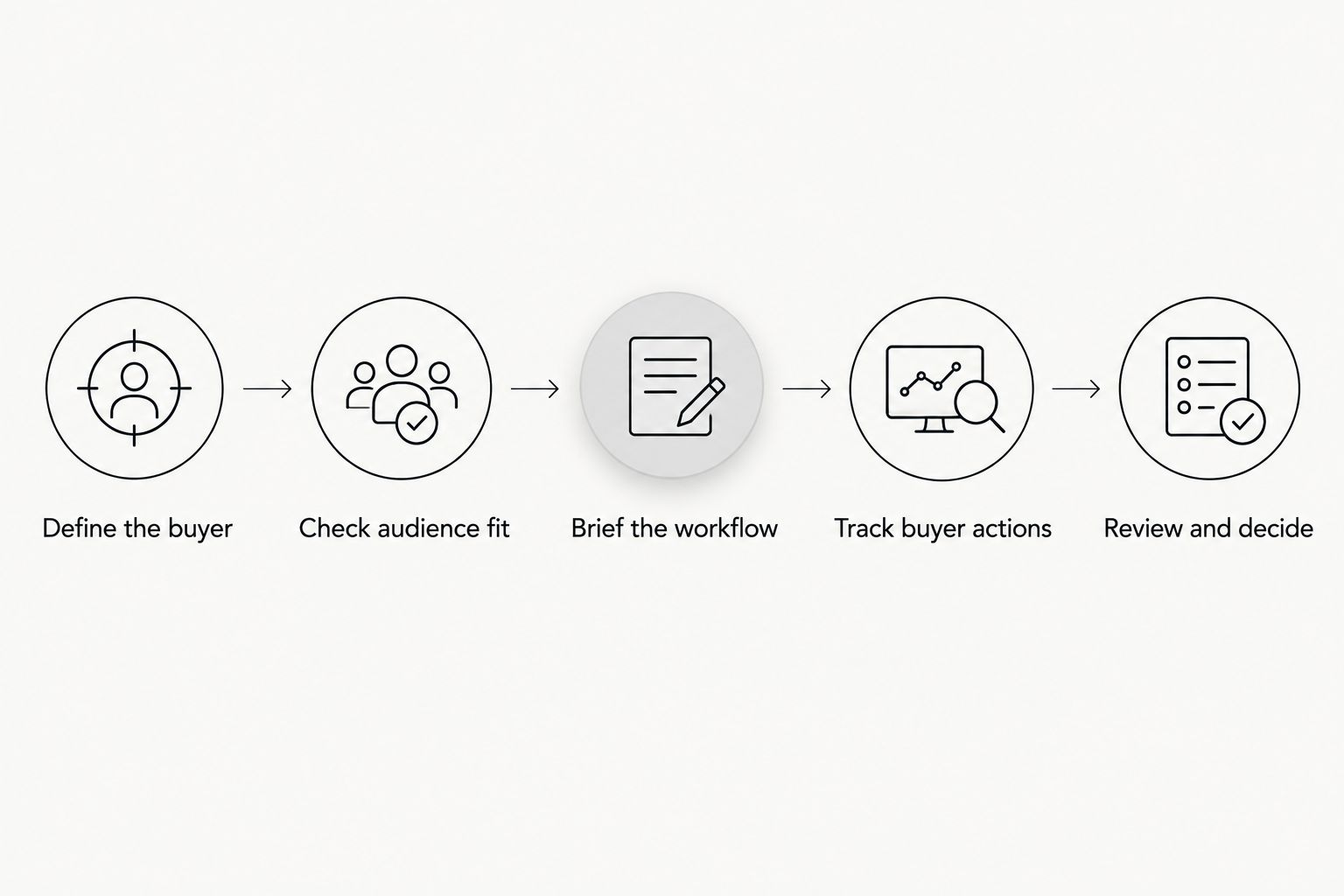
1. Define the buyer
Write down the buyer's role, working context, and problem. Distinguish the person who uses the product from the person who approves it. Your creator does not need to address every stakeholder in the same video.
Use plain language. A brief such as “help operations leads understand how to handle recurring approval delays” gives a creator more direction than “drive awareness for our platform.” It also gives your reviewer something concrete to check.
2. Check audience fit
Review the creator's recent content, audience information, and recurring discussion topics. Ask for evidence that relates to your target role or market. Do not substitute a follower count for that evidence.
Look at how the creator handles disagreement and technical questions. A polished introduction is useful, but the ability to explain a limitation matters too. Choose relevance over a broad claim of influence.
3. Brief the workflow
Specify the problem, demonstration, approved claims, and next step. Provide access instructions and identify what must stay out of the recording. Use demonstration data rather than exposing customer information.
Treat short-form lengths as creative choices, not performance benchmarks. For example, brief a 15-second video around a single problem, a 30-second video around a focused demonstration, or a 45-second video around a workflow plus an objection. These are suggested formats within the supplied 15–45 second range, not promised outcomes.
A longer clip is not automatically more persuasive. Choose the length that lets the creator explain the task accurately. If the workflow needs more context, use the short video as an introduction rather than compressing away an essential caveat.
4. Track buyer actions
Give each published asset a clear destination and campaign identifier. Define what counts as a relevant response before the content goes live. Keep attention metrics separate from trial, demo, and sales outcomes.
Ask sales or customer-facing teammates to record relevant questions when appropriate. A response about a genuine implementation problem is different from generic praise. Preserve that distinction in the campaign report.
5. Review and decide
Compare the result with the campaign's stated job. If the goal was qualified demo interest, judge the audience and subsequent conversations—not just the video's popularity. If the goal was reusable content, judge whether the asset meets the brief and whether you have the rights to use it.
Change the part that failed. Weak audience fit calls for a different creator; unclear explanations call for a different brief; interest without conversion calls for inspection of the next step. Avoid changing everything at once, because that makes the next result harder to interpret.
Why B2B tech influencer results vary
The same publishing format can serve different buyers and goals. For your 2026 evaluation, inspect these factors separately rather than treating influencer marketing as a single uniform channel.
- Audience fit: The creator needs to reach people relevant to your product, not just people interested in technology.
- Problem clarity: A specific task gives the content a reason to exist. A general brand introduction leaves the buyer to infer the value.
- Demonstration accuracy: The workflow must reflect what the product actually does, including necessary qualifications.
- Distribution scope: Creator posting, brand posting, and paid reuse are different activities. Confirm which ones the agreement covers.
- Conversion path: The destination must continue the video's promise and make the next action clear.
- Internal ownership: Someone must approve the content, handle responses, and decide what the results mean.
These are planning checks, not a formula for guaranteed returns. Use them to diagnose a campaign before increasing its scope. A distribution problem and a product-message problem need different fixes.
Should you use an agency or manage creators yourself?
Use an agency when you want execution handled for you; manage creators yourself when you want direct control and can own the work. Neither arrangement removes the need for product input, approved claims, and a campaign objective.
| Delivery model | Best for | Main advantage | Main limitation |
|---|---|---|---|
| Done-for-you agency | Teams seeking outside production and posting support | Moves defined execution work outside your team | Scope and responsibilities still need agreement |
| In-house creator management | Teams that want direct creator relationships | Keeps briefs and feedback under direct internal control | Your team owns coordination and follow-through |
UGC Scout is best for tech teams seeking done-for-you short-form creator video production and posting. That is an execution fit, not a promise of pipeline. Confirm the audience, distribution, approval process, and usage rights for your particular campaign.
Do not assume content production includes access to a relevant influencer audience. Ask whether the engagement is buying videos, creator-channel publishing, or both. That distinction belongs in the scope before production starts.
Can influencer marketing generate B2B leads?
Influencer marketing can support B2B lead generation when the content reaches relevant buyers and points them toward a defined action. A lead count alone does not establish value; assess buyer fit and what happens after the response.
For your 2026 review, distinguish inquiries from qualified conversations and subsequent sales outcomes. Keep the definitions consistent across channels. Otherwise, the comparison rewards whichever channel uses the loosest definition.
Is UGC the same as influencer marketing?
UGC production and influencer marketing are not the same purchase. UGC production centers on obtaining creator-led content; influencer marketing centers on reaching people through the creator's influence and distribution. A campaign can include both, but the agreement must specify both.
This distinction also changes evaluation. Content quality is central to a production engagement. Audience relevance and distribution are additional requirements when creator publishing is part of the campaign.
FAQ
Is influencer marketing worth it for B2B tech in 2026?
Yes, it is worth testing when the creator reaches relevant buyers, explains a useful workflow, and supports a measurable next step. Views alone do not establish business value.
What's the best way to choose a B2B tech influencer?
Choose a creator using evidence of audience fit and relevant subject knowledge. Review their content, audience information, and handling of technical questions before agreeing on a campaign.
Is a UGC creator better than an influencer for SaaS?
A UGC creator is the better fit when you need content; an influencer is the better fit when you need relevant audience access. Confirm the deliverables and distribution separately if you need both.
How long should a short-form B2B product video be?
Use the supplied 15–45 second range as a briefing option, not a performance guarantee. Give the creator enough time to explain the selected workflow accurately.
How do I measure a B2B influencer campaign?
Measure the buyer action the campaign was designed to support, using consistent qualification rules and campaign tracking. Report views separately from relevant inquiries, qualified conversations, and sales outcomes.
Does hiring UGC Scout remove all internal work?
No. UGC Scout offers done-for-you short-form creator video production and posting, but your team still needs to supply accurate product information and agree on approvals. Confirm the responsibilities for your engagement.
One last thing
Ask the creator to explain a real product limitation before approving the campaign. You are checking whether they understand the workflow, not asking them to make the product sound worse. A creator who can describe where a tool fits—and where it does not—gives you a clearer basis for approval than a polished endorsement alone.