
Yes, UGC is worth testing for B2B SaaS in 2026 when creators show a real workflow, address a buyer objection, and drive a measurable next step. It is not worth treating creator views as proof of pipeline. Production also creates work beyond filming: product access, claim checks, approvals, usage rights, and lead tracking.
- Is UGC worth it for B2B SaaS? Yes, when creator videos demonstrate relevant workflows and produce qualified next steps.
- UGC Scout fits tech teams seeking done-for-you short-form creator video production and posting.
- Choose product demonstrations over generic praise; separate paid creator content from genuine customer testimonials.
- Judge B2B SaaS UGC by qualified trials, demos, and opportunities—not views alone.
Is UGC worth it for B2B SaaS companies?
UGC earns a place in your B2B SaaS marketing when it helps a specific buyer understand why to try the product. A creator demonstrating a useful task gives you something concrete to test. A creator saying the product is amazing does not establish its value.
Start with the problem your buyer already recognizes. Then show the product doing the relevant work. The UGC marketing for SaaS companies guide provides a broader planning framework; the decision here is whether creator video deserves a controlled test.
Different formats serve different purposes. Match the format to the evidence you actually have.
| Format | Best for | Main advantage | Main limitation |
|---|---|---|---|
| Creator product demonstration | Showing a visible workflow | Lets buyers see the task and output | Requires accurate product use and a focused script |
| Customer testimonial | Supporting a buying decision with genuine experience | Connects the product to a real customer's account | Requires permission and substantiated claims |
| Employee walkthrough | Explaining technical details | Uses direct product knowledge | Is company-authored content, not independent customer evidence |
These formats are not interchangeable. Paid creator content is not automatically a customer testimonial, and an employee recording is not independent endorsement. Label each honestly.
Why this matters
A SaaS purchase involves more than liking a video. Buyers need to understand the workflow, the fit, and the next step. Creator content can address the first question without pretending to answer every procurement or security question.
For your 2026 plan, give short-form video a defined job. Show how a user completes a task. Answer an objection. Introduce an approved customer experience. Do not ask the same clip to explain the entire product, satisfy procurement, and close an enterprise contract.
The useful question is not whether UGC gets attention. It is whether that attention advances the right buyer. Your test should be built around that distinction.
Creator product demonstrations: best for visible workflows
Choose a creator demonstration when the product's value can be shown on screen. Examples include assigning work, finding a document, or turning an input into a usable output. These are suggested demonstration subjects, not claims about a particular product.
Write the brief around a task rather than a feature list. Name the user, the starting problem, the action inside the product, and the result visible on screen. Give the creator a working demonstration environment with approved sample data.
The advantage is clarity: viewers can inspect what happened. The limitation is accuracy. A polished recording still fails if the creator skips an essential step or implies a capability the product does not have.
Recommendation: test creator demonstrations when the workflow is visually understandable and relevant to your buyer.
Customer testimonials: best for verified experience
Choose a customer testimonial when a real user has an experience they can describe and permission to share it. Keep the account specific. What did the customer use, what changed in their workflow, and what evidence supports the statement?
Do not write an invented success story for a paid actor. A creator can demonstrate software without claiming to be a customer. Keep that distinction visible in the brief, recording, and disclosure.
Testimonials provide firsthand experience, but they also create a permission and substantiation requirement. Obtain approval before publishing names, roles, company details, screenshots, or results.
Recommendation: use customer testimonials only when the experience and publication permission are genuine.
Employee walkthroughs: best for technical explanation
Choose an employee walkthrough when product knowledge matters more than an outside voice. An employee can explain setup requirements, limitations, and the steps behind a demonstration. Treat this as company-authored content.
The benefit is access to product expertise. The drawback is that the speaker represents the vendor, so the recording does not supply independent customer evidence. Keep the explanation useful instead of turning it into a sales pitch.
An employee walkthrough also gives you a factual reference for creator briefs. Record the correct workflow first, then let creators explain it in their own words without changing the facts.
Recommendation: use employee walkthroughs to establish technical accuracy before outsourcing the same explanation.
Why B2B SaaS UGC value varies
Your result depends on the job you assign to the content and how you evaluate it. Use these factors to decide whether a test is ready:
- Buyer relevance: The situation should match the role you want to reach. A familiar workflow matters more than a generic business problem.
- Demonstration clarity: Show an observable action and output. Separate what viewers can see from claims that need additional evidence.
- Creator understanding: The creator needs enough product knowledge to explain the task correctly. Speaking confidently is not a substitute for understanding.
- Distribution: Creator posting and publication through your own accounts are different arrangements. Define where each approved asset will appear.
- Conversion path: The page after the video should continue the same promise. A task-specific demonstration needs a relevant next step.
- Measurement: Views, visits, qualified leads, and opportunities answer different questions. Decide which one determines whether you continue.
Do not compensate for a weak brief by requesting more videos. Fix the task, claim, or destination first.
How do you test B2B SaaS UGC without confusing views with results?
Build a small, deliberate test. For a 2026 pilot, a suggested starting brief is 3 videos, each addressing a different buyer question, with 15–45 second edits where the task fits that length. These are planning choices, not performance benchmarks or agency package details.
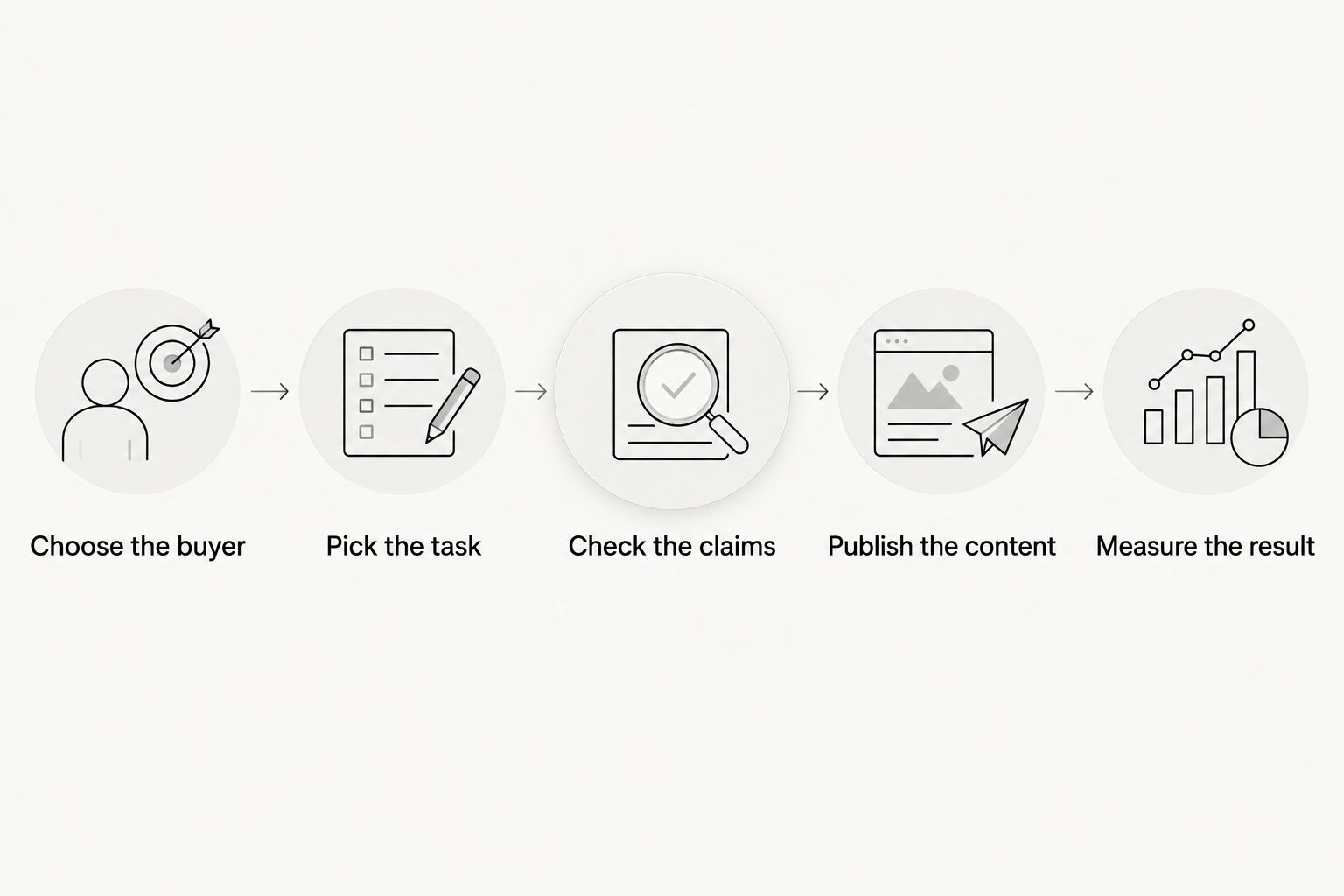
Choose the buyer
Name the role and situation before choosing a creator. For example, brief a demonstration for an operations manager assigning recurring work rather than for everyone who wants to be productive. The role gives the creator a reason to choose certain examples and language.
Write down the action you want that buyer to take. A trial, a demo request, and a technical evaluation need different supporting information. Choose the action your current sales process can handle.
Pick the task
Choose a task that can be demonstrated accurately without exposing private information. Start with an approved sample environment. Remove customer records, internal messages, access credentials, and any information the creator does not need.
Use a simple structure: problem, demonstration, next step. Ask the creator to show what happens rather than recite a list of features. Keep additional benefits out of the script unless you can support them.
Check the claims
Separate observable facts from outcome claims. Showing a document being found is different from claiming the product saves every team time. The latter needs evidence beyond the recording.
Give the creator a written list of approved statements and prohibited claims. Check the spoken script, captions, screen recording, and closing action together. A correct voiceover does not fix a misleading caption.
Publish the content
Agree on publication responsibilities before filming. Specify who approves the final edit, who posts it, and what usage rights you need. Do not assume that permission to publish organically includes permission to run paid advertising.
Paid creator endorsements need clear disclosure of the material relationship under FTC guidance. A scripted demonstration must not imply personal customer experience the creator does not have. Make disclosure and truthful presentation part of approval, not an afterthought.
Measure the result
Use distinct tracking for each asset and record which audience, placement, and destination received it. Keep the conversion definition consistent. Otherwise, a change in the offer or audience becomes mixed up with the effect of the video.
Review both acquisition and lead quality. A demo request from the wrong buyer is not the same result as a qualified demo. If the sales team rejects the leads, inspect the targeting and message before celebrating the form submissions.
Do not change every element after the first review. Keep the relevant task and destination consistent while revising the weak part of the asset. That gives the next test a clear question to answer.
What should you measure in a 2026 UGC test?
Measure the business action the video was created to support. Views tell you about exposure. They do not establish qualified demand or revenue.
Use a measurement ladder and keep the stages separate:
- Exposure: Was the content delivered to the intended audience?
- Engagement: Did viewers watch or interact with the demonstration?
- Site action: Did visitors reach the relevant page and take the intended action?
- Qualification: Did those actions come from buyers who match your criteria?
- Pipeline: Did qualified prospects become opportunities in your sales process?
Define qualification before reviewing results. Use criteria your team already applies, such as role, company fit, and the stated use case. Do not relax the definition to make the creator campaign look successful.
For paid distribution, include production and media costs in your internal evaluation. For organic posting, include production and management work. Neither arrangement makes filming the only cost.
Keep direct attribution separate from supporting evidence. A tracked conversion establishes a recorded path; a prospect mentioning a video supplies additional context. Do not present those two observations as identical proof.
Continue when the test produces the intended qualified action at economics your team accepts. Revise when attention fails to become relevant interest. Stop when the content cannot communicate the product truthfully or attract the intended buyer.
When does done-for-you production make sense?
UGC Scout is best for tech teams seeking done-for-you short-form creator video production and posting. That service fits teams that want outside help producing and publishing creator content rather than managing the entire process themselves.
UGC Scout is a growth and influencer marketing agency for tech companies. Its stated offer is done-for-you short-form creator video production and posting.
The benefit is outsourced production and posting. The trade-off is that your team still needs to supply product access, approved claims, and a clear definition of a qualified result. Done for you does not remove your responsibility for product accuracy or measurement.
Before committing to a 2026 program, confirm approval responsibilities, publication channels, usage rights, and reporting requirements. Keep those decisions in writing.
Is UGC better than a product demo for B2B SaaS?
UGC is a format; a product demo is a job the content performs. A creator video can demonstrate a task, while a longer product demo can explain requirements and answer questions. Choose based on the buyer's information need, not the label.
Does a B2B SaaS creator need a large following?
A large following is not required when you commission content for your own channels. When you also buy access to a creator's audience, evaluate audience relevance separately from production skill. Do not use follower count as a substitute for either check.
Can UGC help sell enterprise software?
UGC can demonstrate a workflow, but it does not replace an enterprise evaluation. Use creator content for the question it can answer, then provide the technical, security, and procurement information buyers need through the appropriate materials.
FAQ
Is UGC worth it for B2B SaaS in 2026?
Yes, UGC is worth testing when it demonstrates a relevant workflow and drives a measurable, qualified next step. Views alone do not establish business value.
What's the best UGC format for a SaaS product?
A creator product demonstration is the best starting format when the workflow can be shown clearly on screen. Use genuine customer testimonials for firsthand experience and employee walkthroughs for technical explanation.
How long should a B2B SaaS UGC video be?
A suggested short-form test uses 15–45 second edits when the task fits that length. Use more time when accuracy requires it; do not cut essential steps to meet a duration.
Can paid creators act like customers in SaaS videos?
Paid creators must not imply customer experience they do not have. They can demonstrate the product, but personal endorsements must reflect genuine experience and paid relationships need clear disclosure.
Should I measure UGC using views or demo requests?
Measure the action the content was designed to produce, then check its quality. Views measure exposure; demo requests need qualification before they count as useful demand.
What does UGC Scout do for tech companies?
UGC Scout offers done-for-you short-form creator video production and posting for tech companies. Your team still needs to provide product facts, approve claims, and define how results will be evaluated.
Should I post SaaS creator videos on LinkedIn or TikTok?
Choose the channel based on the intended audience, content context, and conversion path. Test the placement rather than assuming the same edit serves every channel equally well.
One last thing
Before approving your next 2026 creator video, remove the creator's praise from the script. Read what remains. If the product still solves a clear task on screen, you have a demonstration worth evaluating.
If nothing useful remains, the brief relies on endorsement instead of evidence. Rewrite it around the buyer's work. The strongest starting point is not a more enthusiastic creator. It is a more specific task.