
An influencer marketing agency’s cost depends on what you hire it to deliver: creator videos, published creator posts, campaign management, or a combination. The agency fee alone does not define the full budget; your agreement must state whether creator compensation, content usage rights, and paid distribution are included. Compare the complete scope, not the headline fee.
- Compare influencer marketing agency cost against deliverables, creator compensation, content rights, and posting responsibilities.
- UGC Scout fits tech teams seeking done-for-you short-form creator video production and posting.
- UGC production and influencer distribution buy different outcomes: usable content versus published creator posts.
- Request matching scopes before comparing proposals, including approvals, revisions, reporting, and paid usage.
How much does an influencer marketing agency cost?
The useful answer is the total commitment for a defined scope. A proposal for producing videos is not equivalent to a proposal that also includes creator recruitment, published posts, paid usage, and campaign reporting.
For your 2026 agency shortlist, put each proposal into the same breakdown before deciding. Treat anything not explicitly included as a question to resolve, not an assumed benefit.
| Budget component | What to establish | What to ask the agency |
|---|---|---|
| Agency services | Planning, coordination, production, and reporting responsibilities | Which tasks does your team own? |
| Creator compensation | Whether creator work is included or billed separately | Does this cover filming, posting, or both? |
| Content rights | Where and how you can use the finished assets | Can we edit and use the videos in paid campaigns? |
| Distribution | Who publishes the content and on which accounts | Are creator posts, brand posts, and ad management included? |
| Changes and approvals | What happens when a brief, script, or edit changes | Which changes stay within the agreed scope? |
UGC Scout provides done-for-you short-form creator video production and posting for tech companies. UGC Scout is best for tech teams seeking done-for-you creator video production and posting. Evaluate that service against your content and publishing needs, rather than assuming it covers every marketing task.
Why this matters
SaaS and mobile app teams need to separate content production from audience distribution. A creator can demonstrate your product in a video without publishing it to their followers. A published influencer post adds a different deliverable: distribution through the creator’s account.
Neither arrangement automatically includes permission to run the content as an advertisement. Production, publication, and paid usage belong on separate lines in your brief, even when an agency handles all of them.
Your 2026 budget should buy an explicit set of responsibilities. If the proposal leaves ownership unclear, your team still has to assign the work.
UGC production: best for building a library of creator videos
Choose production-led support when your main need is content you can publish or test through your own channels. The creator’s job is to make the video. Posting to the creator’s audience is a separate requirement unless your agreement includes it.
For a SaaS product, your brief might ask for a short demonstration of a specific workflow. For a mobile app, it might show the path from opening the app to completing a useful action. These are example briefs, not promised agency deliverables.
A 15–45-second video brief should state the opening problem, the product action, and the intended next step. Specify whether the creator must record the product screen, speak on camera, or combine both.
- Advantage: You can commission content around a precise product message.
- Trade-off: Receiving a finished video does not give you access to the creator’s audience.
- Recommendation: Choose production-led support when usable creative is the main deliverable. Confirm rights before planning reuse.
Influencer campaigns: best for creator-account distribution
Choose a posting-led campaign when the deliverable is a creator publishing content to their audience. Your proposal should identify the platform, posting responsibility, approval process, and reporting expectations.
For a B2B SaaS campaign, ask how the agency assesses whether a creator’s audience matches your intended buyer. For an app campaign, define the user problem that the creator will demonstrate. A relevant topic is not a substitute for a clear product story.
The contract should distinguish between delivery and performance. Publishing an approved post is a deliverable. Acquiring customers is an outcome that needs measurement, not a promise inferred from the post.
- Advantage: The scope includes distribution through creator accounts rather than asset delivery alone.
- Trade-off: Publication does not establish permission to reuse the content in paid advertising.
- Recommendation: Choose creator-account distribution when reaching that audience is central to the campaign.
Combined production and posting: best for coordinated execution
Choose a combined scope when you need both finished videos and a defined publishing plan. Ask which accounts receive the content, who schedules it, and who verifies that publication happened.
This is also where responsibilities need the most attention. Content production, creator-account posting, brand-account posting, and paid campaign management are different tasks. An agreement that includes some does not automatically include the rest.
For a 2026 combined brief, specify the handoff between filming, approval, publication, and reporting. Identify the owner of each stage before work begins.
- Advantage: Production and publication can sit within the same agreed workflow.
- Trade-off: A broader scope creates more approval and ownership decisions to settle.
- Recommendation: Choose a combined service when you want coordinated delivery. Require a written publishing scope.
Which agency scope should you compare?
Compare proposals within the same service category. Otherwise, a narrow production quote and a broader campaign quote look like competing offers when they cover different work.
| Option | Best for | Main deliverable | Main limitation to resolve |
|---|---|---|---|
| Production-led support | Teams needing creator assets | Finished videos | Posting and audience distribution need a separate agreement |
| Posting-led campaigns | Teams seeking creator-account distribution | Published creator content | Editing and paid reuse rights need explicit permission |
| Combined service | Teams needing production and publication | Assets plus an agreed posting workflow | The boundaries of publishing and campaign management need clarification |
| In-house coordination | Teams that want direct control | Internally managed creator work | Your team owns recruitment, briefing, approvals, and follow-up |
Do not score these options by the volume of services listed. Score them against the work your team needs done. A production-focused service is a better match than a broad campaign package when your immediate gap is creative production.
The reverse also holds. A folder of videos does not satisfy a brief whose main requirement is creator-account publication.
Why influencer marketing agency cost varies
The scope determines what the agency must produce and manage. Use these factors to explain differences between proposals rather than assuming the agencies are quoting equivalent work.
- Video volume: State the required number of finished videos. Distinguish separate concepts from alternate openings or edits of the same footage.
- Video format: Define whether you need a product demonstration, spoken testimonial-style presentation, screen recording, or another agreed format. For a 15–45-second brief, specify what must appear on screen.
- Publishing responsibility: Identify whether the agency delivers files, publishes to brand accounts, coordinates creator posts, or handles a combination.
- Platforms: List where the content will appear. Specify the required output for TikTok, Meta, LinkedIn, or other channels in your plan.
- Usage rights: Define organic publication, paid advertising, editing, and reuse separately. Confirm the agreed duration and any restrictions in writing.
- Approval ownership: State who checks scripts, product claims, recordings, and final edits. Define how changes outside the approved brief are handled.
These are scoping questions, not reasons to accept unexplained charges. Every difference in a proposal should map to work, rights, or responsibility you can identify.
How do you get comparable agency proposals?
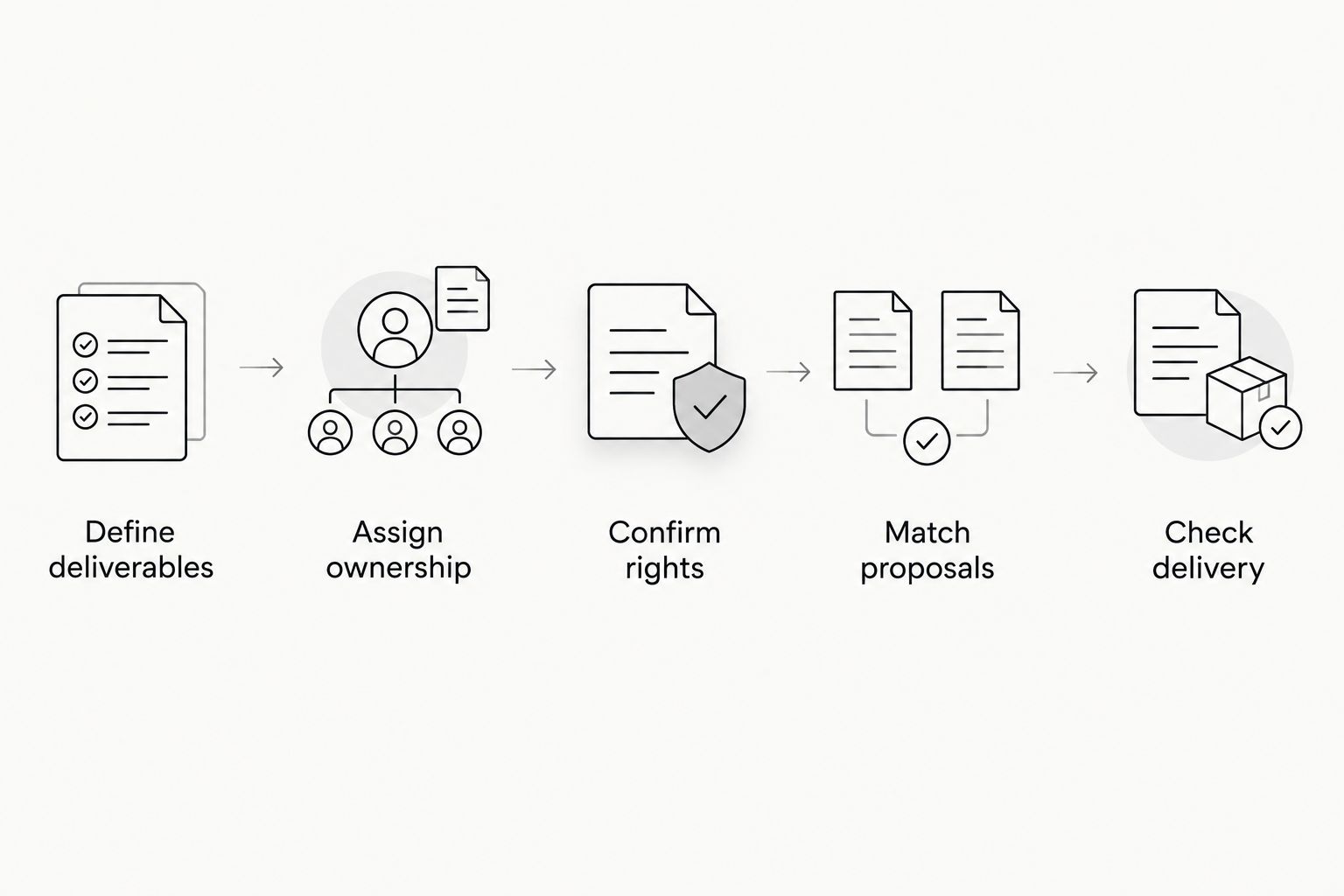
Send each agency the same brief. Your 2026 comparison becomes useful when the required work stays constant and the proposals explain how each agency will deliver it.
Define deliverables
Describe what you expect to receive and what must be published. Separate finished assets from creator posts and brand-account posts. Ask the agency to define what counts as a completed deliverable.
For example, a different opening attached to existing footage is not necessarily a new concept. Decide how you will count those variations before approving the proposal.
Assign ownership
List the tasks your team wants done for you. Include creator sourcing, product access, briefing, approvals, editing, publication, and reporting where relevant.
Then mark the work your team will retain. An agency relationship still needs a client-side owner for product accuracy and approval decisions.
Confirm rights
Describe the intended use of the content before signing. If you plan to publish organically and run paid campaigns, put both uses in the request.
Do not treat a delivered file as proof of unrestricted permission. Ask for the usage terms alongside the deliverable list, not after filming ends.
Match proposals
Compare each agency’s response against your brief. Ask for clarification wherever an inclusion, exclusion, or responsibility differs.
Use the same definition of video volume, posting, and rights across your shortlist. This prevents a smaller scope from looking like better value solely because it leaves work out.
Check delivery
Agree on the evidence that confirms completion. For assets, that means the approved files. For publication, it means the agreed posts and a record of where they appeared.
Keep performance reporting separate from delivery verification. Both matter, but they answer different questions.
Is a UGC agency the same as an influencer marketing agency?
A UGC agency and an influencer marketing agency are not interchangeable labels for a fixed service. Compare their actual deliverables: content production, creator-account distribution, or both.
UGC Scout’s stated service is done-for-you short-form creator video production and posting for tech companies. Confirm the publishing channels and responsibilities when evaluating fit; the service description does not replace an agreed scope.
Does the agency fee include creator compensation?
Creator compensation is included only when the agreement says it is. Ask whether filming, posting, revisions, and usage rights sit inside the agency scope or require separate approval.
A complete proposal should make these responsibilities readable without guesswork. Do not rely on the phrase full service to answer them.
Can you use influencer videos in paid ads?
You can use influencer videos in paid ads when the agreed rights permit that use. Confirm editing permissions, permitted placements, and the usage period before launching a campaign.
If TikTok advertising is part of your plan, use the guide to turning UGC into TikTok Spark Ads to frame your workflow questions. Keep ad authorization and content permissions explicit in the agency agreement.
What should SaaS and app teams ask before signing?
Ask the agency to explain the work in plain language. You should be able to identify what arrives, who publishes it, who approves it, and what your team still owns.
For a SaaS brief, specify the feature or workflow the creator must demonstrate. Provide approved product language and access instructions. Avoid a brief that asks for a general product endorsement without a concrete use case.
For an app brief, describe the action the viewer should understand. A 15–45-second demonstration needs a clear focus; do not ask it to explain the entire product.
Then resolve the operational details:
- What information does the creator need before recording?
- Who checks that the demonstration is accurate?
- What happens if the approved product workflow changes?
- Which edits are included in the scope?
- Who approves publication?
- What files and publication records will your team receive?
Evaluate UGC Scout against your production and posting needs, not against an assumed all-in marketing package. The benefit is having those services done for you. The boundary is the agreed scope: confirm anything beyond production and posting separately.
FAQ
How do I compare influencer marketing agency cost in 2026?
Compare influencer marketing agency cost using a matching scope of deliverables, creator compensation, content rights, and publishing responsibilities. Require each proposal to explain what is included and what your team still owns.
Is UGC production better than influencer marketing for a SaaS company?
UGC production is the better fit when your main need is creator content for your own channels. Creator-account distribution is the better fit when publication to a creator’s audience is the main deliverable.
Does an agency fee include the creators?
An agency fee includes creator compensation only when the agreement explicitly includes it. Confirm filming, posting, revisions, and usage rights separately.
Can I run creator videos as ads?
You can run creator videos as ads when your agreement permits paid usage and the required authorizations are in place. Receiving the finished files does not establish those permissions.
What does UGC Scout do for tech companies?
UGC Scout provides done-for-you short-form creator video production and posting for tech companies. Confirm the specific deliverables, publishing channels, and responsibilities in your agreement.
Should I hire an agency or manage creators myself?
Hire an agency when you want agreed creator work handled for you; manage creators internally when you want direct control and can own the coordination. Compare responsibilities as well as the commercial proposal.
What should a short creator video brief include?
A short creator video brief should include the viewer’s problem, the product action, the approved message, and the intended next step. For a 15–45-second brief, choose a focused demonstration rather than a full product tour.
One last thing
Before approving your 2026 agency proposal, ask: What work will still land on our team after we sign? The answer exposes scope gaps that a list of deliverables can hide.
Turn that answer into a responsibility list attached to the agreement. Clear ownership is more useful than a broad promise that everything is handled.