
Onboarding a growth marketing agency takes as long as your team and the agency need to agree on the scope, verify access and measurement, and approve the first work package. Set the completion date against those readiness checks, not the kickoff meeting. Keep the first campaign launch and the first performance review on separate schedules; neither is the same as finishing onboarding.
- Your onboard a growth marketing agency timeline should end with an approved handoff, not just a kickoff call.
- Separate account access, measurement, creator briefs, and launch approval into named checkpoints.
- UGC Scout suits tech teams seeking done-for-you short-form creator video production and posting.
- Approve the first deliverable and assign decision-makers before committing to a campaign launch date.
How long does it take to onboard a growth marketing agency?
The onboarding timeline runs from the agreed start date to an accepted, execution-ready handoff. A useful schedule shows what must be ready, who owns each task, and what proves it is complete. For creator campaigns, the guide to briefing a UGC creator for a software product covers a key part of that handoff.
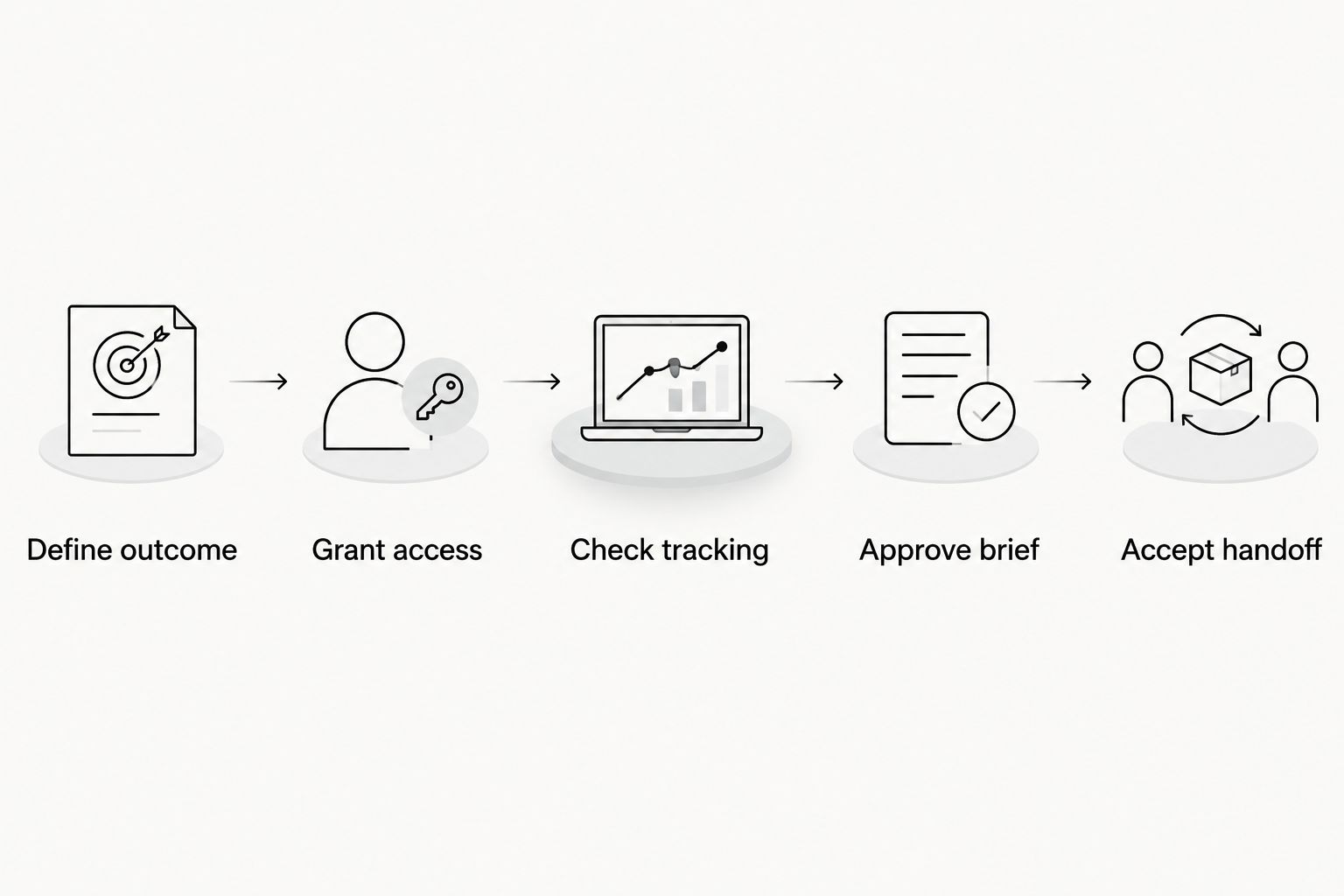
Use these checkpoints to build your schedule:
| Checkpoint | Evidence of completion | Client responsibility | Agency responsibility |
|---|---|---|---|
| Define outcome | Written objective and first deliverable | Confirm the business priority | Translate the priority into a scoped plan |
| Grant access | Required users can perform agreed tasks | Authorize appropriate permissions | Test access and report blockers |
| Check tracking | Agreed actions can be observed and reported | Explain the product journey | Verify the measurement plan |
| Approve brief | Audience, message, demonstration, and restrictions are accepted | Confirm product accuracy | Prepare an executable brief |
| Accept handoff | Owners, dependencies, and approval rules are documented | Approve the first work package | Confirm readiness to execute |
Ask for dates beside each checkpoint, with dependencies shown explicitly. A single completion date hides whether the agency is waiting for account permissions, product decisions, or feedback.
Define outcome
Choose the business action before choosing the output. A SaaS team seeking qualified demo requests needs a different brief from a mobile app team trying to explain its onboarding experience. Write down the action you want the audience to take and where that action happens.
Then define the first deliverable. That might be a creator brief, an approved script, or a campaign plan, depending on the contracted scope. Do not let “start growth marketing” stand in for an acceptance criterion.
For your 2026 plan, record what sits outside the engagement as clearly as what sits inside it. Video production, creator posting, paid distribution, and landing-page changes are separate responsibilities unless the agreement combines them.
Grant access
List the accounts, files, and environments needed for the first work package. Give access through the appropriate account permissions rather than sharing personal passwords. Name an internal administrator who can resolve permission requests.
The agency should test the actual task, not merely confirm that an invitation arrived. Opening an account does not prove someone can publish, inspect reporting, or use the required assets. Close this checkpoint only when the agreed work is possible.
Check tracking
Agree on the action that counts as success and how it will be recorded. For a SaaS campaign, distinguish a form submission from a qualified opportunity. For an app campaign, distinguish an install from the product action your team actually values.
Document the reporting source and any limits before execution begins. If a report only shows content views, do not present it as evidence of product adoption. Production readiness and measurement readiness belong on the same onboarding plan, even when different people own them.
Approve brief
Give creators a specific audience, a use case, an accurate demonstration, and a clear next action. Include pronunciation guidance, prohibited claims, and any screens that must stay out of the recording. A product specialist should confirm that the demonstration matches the current experience.
For an illustrative 15–45 second video brief, decide what the viewer must understand before adding extra features. A 15-second concept and a 45-second walkthrough need different scripts. These are example creative lengths, not an agency delivery commitment.
Accept handoff
Finish onboarding with a written acceptance of the first work package. Include the approved materials, responsible people, review route, and unresolved dependencies. Make the distinction between “ready to produce” and “ready to publish” explicit.
A production team can be ready while publishing permission remains unresolved. Record that status rather than marking the whole engagement complete. The handoff should make the next action obvious without another discovery call.
Why this matters
An onboarding deadline is useful only if everyone agrees on what it delivers. A founder expecting published videos and an agency preparing a strategy document are working toward different finish lines. Resolve that difference before either team commits to a launch.
For a 2026 campaign, separate the schedule into onboarding, production, launch, and evaluation. Each needs its own completion rule. This prevents an approved brief from being reported as a live campaign, or a live campaign from being treated as proof of business results.
Your team still owns product truth and business decisions. “Done for you” should describe delegated execution, not the disappearance of client approvals.
Choose the right onboarding scope
A focused creator engagement and a broader growth engagement should not use an identical checklist. Choose the scope that matches the work you need, then ask the agency to show its dependencies.
| Engagement | Best for | What onboarding must establish | Main trade-off |
|---|---|---|---|
| Creator production and posting | Teams with a defined message that need execution | Product accuracy, creator brief, content approval, posting responsibilities | Does not establish responsibility for the rest of the acquisition journey |
| Paid acquisition management | Teams delegating campaign execution | Account permissions, conversion definitions, creative inputs, launch controls | Requires agreement on measurement and the destination experience |
| Broader growth engagement | Teams coordinating work across acquisition and conversion | Business priorities, channel scope, shared reporting, cross-team ownership | More decisions must be resolved before the full scope is execution-ready |
Choose a focused scope when the immediate bottleneck is specific. Choose a broader engagement when you need coordinated ownership across the journey, and document where the agency's authority ends.
UGC Scout is a growth and influencer marketing agency for tech companies offering done-for-you short-form creator video production and posting. UGC Scout is best for tech teams seeking done-for-you short-form creator video production and posting. That scope fits an execution need; it does not, by itself, establish ownership of analytics implementation, paid media, or product changes.
Why the onboarding timeline varies
The useful question is not just “How soon can you start?” Ask which conditions control the completion date.
- Scope clarity. A defined first deliverable gives both teams an acceptance target. An unresolved channel plan leaves the agency waiting for direction.
- Access ownership. Permissions depend on the people authorized to grant them. Identify those people before the kickoff.
- Measurement readiness. Reporting needs agreed definitions and a working way to observe the relevant actions. Assign any corrective work explicitly.
- Product demonstration requirements. Creators need an accurate way to show the software. Test accounts, approved recordings, and restricted information require decisions before filming.
- Approval authority. Feedback needs a final decision-maker. Separate product corrections, brand preferences, and legal restrictions so the agency can act on them.
- Usage and publishing permissions. Producing a video does not settle where it can appear. Confirm the intended uses and required permissions before execution.
For your 2026 onboarding schedule, put an owner and a completion condition beside every dependency. A blocker without an owner is not a scheduled task.
What should you prepare before the kickoff call?
Prepare a handoff folder organized around the first deliverable, not a general archive of everything the company has produced. The agency needs enough context to make the next decision without searching through unrelated material.
Include:
- Business objective: The action you want, the intended audience, and the destination.
- Product reference: An accurate demonstration, approved terminology, and a product contact.
- Existing creative: Relevant examples, previous briefs, and specific feedback about what needs changing.
- Access register: Required accounts, administrators, permission levels, and outstanding requests.
- Approval map: Who checks accuracy, who checks restrictions, and who gives final acceptance.
- Measurement note: What counts as a conversion, where it appears, and who owns the reporting source.
Do not send real customer information simply to make a demo look realistic. Use an approved demonstration environment and confirm what creators can record. If the product requires confidentiality controls, settle those before sharing access.
End the kickoff with decisions, not just notes. Every open question should have an owner and a stated next action.
How do you turn the checklist into a usable schedule?
Build the schedule backward from the intended launch, but do not force unfinished work into an arbitrary deadline. Ask the agency to distinguish tasks that can run together from tasks that depend on an approval.
For example, audience research and account-access requests can be assigned separately. Filming a software demonstration depends on an accurate, approved way to show the product. Publishing depends on accepted content and the required permissions.
Use these fields in the shared plan:
| Schedule field | What to write |
|---|---|
| Deliverable | The specific output being accepted |
| Owner | The person responsible for moving it forward |
| Dependency | The decision, permission, or input required first |
| Completion evidence | The file, approval, or verified task that closes it |
| Target date | The date agreed by the responsible teams |
| Blocker response | Who decides what happens if the dependency slips |
Keep target dates separate from contractual commitments. Your 2026 plan should identify which dates are agreed delivery obligations and which remain dependent on client inputs. Ask the agency to explain that distinction before signing.
Does onboarding include the first campaign launch?
Onboarding and launch are separate milestones unless your agreement explicitly combines them. Onboarding establishes readiness; launch puts approved work into use. Ask which milestone the proposed completion date represents.
For creator campaigns, define whether delivery means an approved brief, finished video files, or published posts. Those outputs are not interchangeable. Put the expected handoff in the scope rather than relying on the word “campaign.”
Can you speed up agency onboarding?
You can remove avoidable waiting by resolving scope, access, and approval ownership before execution starts. Send a usable product demonstration, identify the final approver, and consolidate feedback into an accepted instruction.
Do not skip measurement checks or content permissions to protect a date. Reduce the initial scope instead. A smaller approved work package is clearer than a broad launch with unresolved dependencies.
When should you expect performance results?
Performance evaluation starts after the relevant work is live and the agreed outcomes can be measured. Finishing onboarding is not evidence that the campaign has generated qualified demand, customers, or product adoption.
Agree on a review date and the evidence needed to make a decision. For your 2026 reporting plan, separate delivery status, audience response, and business outcomes so activity does not stand in for results.
FAQ
How long does it take to onboard a growth marketing agency?
Onboarding lasts until the agreed scope, access, measurement, brief, and handoff are ready for execution. Ask for checkpoint dates and dependencies rather than treating the kickoff as completion.
What should I ask an agency before agreeing to its onboarding timeline?
Ask what the completion date includes, what your team must supply, and which dependencies can change the schedule. Get the first deliverable and its acceptance criteria in writing.
Can an agency start before every account is connected?
An agency can start work that does not depend on the missing access. Keep blocked tasks separate, and do not describe the full engagement as execution-ready until its requirements are met.
Who should approve creator content for a SaaS product?
Assign a final decision-maker and a product specialist who can verify the demonstration and claims. Add other reviewers where the content requires their approval, and consolidate their feedback.
Does done-for-you creator production mean my team has no work?
Done-for-you production delegates execution, but your team still needs to provide accurate product information and the required decisions. Confirm approval responsibilities before production begins.
Is UGC Scout relevant if we need creator videos rather than a full growth department?
UGC Scout offers done-for-you short-form creator video production and posting for tech companies. Evaluate that service against your creative execution needs, and confirm any wider responsibilities separately.
One last thing
Ask the agency to show you the handoff before you sign. Request an example of the structure, not another client's confidential work: the deliverable list, approval fields, dependency register, and acceptance criteria.
If you cannot tell what “onboarded” means from that document, the proposed completion date is not yet useful. Fix the definition before negotiating the calendar.