
Affiliate marketing is worth it for SaaS companies when partners bring paying customers who stay, and the resulting gross profit covers commissions and program costs. In 2026, the decision still depends on customer quality, reliable attribution, and whether those sales would have happened without the affiliate—not how many referral links you distribute.
- Is affiliate marketing worth it for SaaS? Yes, when retained customer gross profit exceeds commissions and operating costs.
- SaaS affiliate programs need qualified partners, clear attribution, and retention checks—not just tracked signups.
- Ugcscout provides done-for-you creator video production and posting for tech companies; that is distinct from affiliate program management.
Why this matters
An affiliate dashboard shows credited conversions. It does not establish whether the partner created new demand, brought a customer who stayed, or claimed credit for someone already buying.
That distinction changes your decision. A program with plenty of attributed revenue can still fail your profitability test after commissions, refunds, software, and staff time. Start with the same discipline used to measure ROI on influencer marketing: connect the activity to a business outcome, then include the cost of producing it.
Treat affiliate marketing as a managed acquisition channel, not passive distribution. Someone must recruit suitable partners, check claims, resolve attribution disputes, and decide which relationships deserve more attention.
Is affiliate marketing worth it for SaaS companies?
Yes—if you can connect partner activity to profitable customers and give partners a credible reason to recommend your software. If you cannot track a referral through activation, payment, and retention, you cannot make a sound expansion decision.
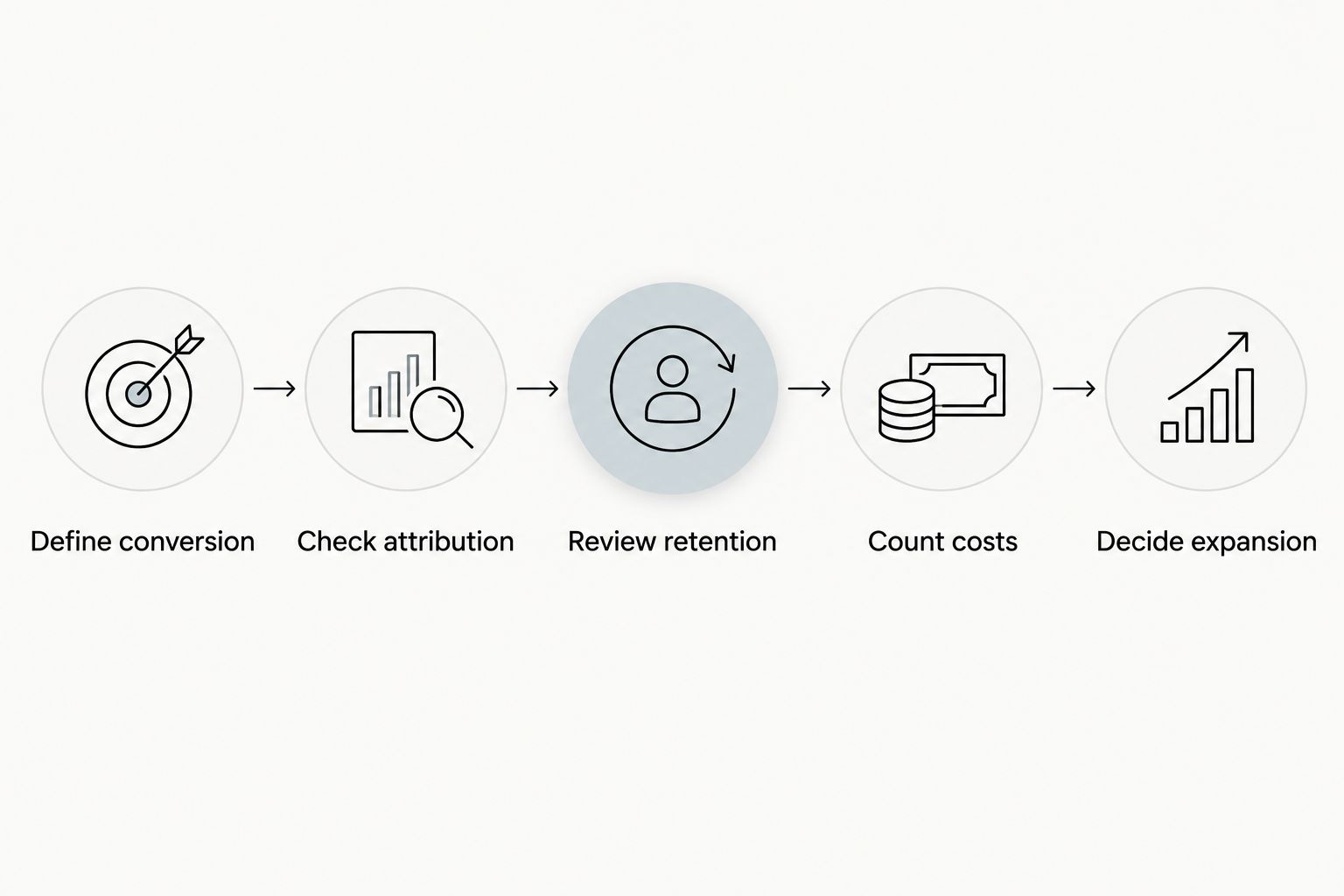
Use this sequence before expanding your program in 2026. Each step answers a different question; a strong result at one stage does not cancel a failure at another.
Define conversion
Choose the business event that makes a referral valuable. A signup, an activated account, a qualified opportunity, and a paying customer are different outcomes. Do not group them together under conversions.
For self-serve software, follow the customer from referral through meaningful product use and payment. For sales-led software, connect the referral to a qualified opportunity and the eventual account outcome. Write the qualifying event into your partner terms so your marketing, sales, and finance teams use the same definition.
Check attribution
Test the referral journey before inviting more partners. Follow a referral from its original link through your signup flow, billing system, and customer record. Confirm that refunds and cancellations also reach your reporting.
Document how your program handles an existing lead, a returning visitor, and competing partner claims. Tracking software records events according to its configuration; it does not decide whether a commission represents new business. Your rules must make that distinction explicit.
Review retention
Compare affiliate-referred customers with customers acquired elsewhere. Look at activation, continued payment, refunds, and support requirements. Use comparable customer groups rather than mixing different plans, buyer types, or acquisition periods.
Do not declare success because the first payment arrived. A partner who attracts customers with the wrong expectations creates a different outcome from a partner who explains the product accurately. Inspect what the partner promised alongside what the customer actually did.
Count costs
Include commissions, partner recruitment, onboarding, tracking software, creative support, compliance review, and program management. Count internal work even when it does not appear on an agency invoice.
Use gross profit rather than headline subscription revenue when judging what remains after acquisition spending. Keep the observation period consistent across channels. Comparing realized affiliate revenue with projected lifetime revenue from another channel produces a misleading result, even when both dashboards look precise.
Decide expansion
Expand the relationships that produce qualified customers under your agreed profitability standard. Pause partners whose referrals fail activation, generate misleading claims, or create attribution disputes you cannot resolve.
Keep the decision specific. A successful tutorial partner does not prove that every publisher, creator, or referral source deserves recruitment. Review partners individually, then look for repeatable characteristics: audience fit, accurate demonstrations, and customers who continue using the product.
Which partnership model fits your SaaS team?
Choose the payment model around the work you need, not the label you prefer. Referral incentives, commissioned content, and a combination of both solve different problems.
| Model | Best for | Main advantage | Main limitation | Recommendation |
|---|---|---|---|---|
| Affiliate partnership | Teams that can track qualified customer acquisition | Rewards agreed referral outcomes | Does not guarantee content production or new demand | Use when customer quality and attribution are measurable |
| Paid creator production | Teams that need specific software videos | Lets you agree on deliverables and review requirements | Content delivery does not establish acquisition profitability | Use when the immediate gap is usable creative |
| Hybrid partnership | Teams that need content plus a referral incentive | Separates production work from referral rewards | Requires clear terms for both responsibilities | Use when both jobs have an owner and a measurement plan |
An affiliate agreement is not a substitute for a production brief. If you need a screen recording, an approved script, or a specific posting obligation, put that requirement in the agreement. Do not assume a referral commission purchases those deliverables.
Likewise, paying for a video does not prove the video attracts profitable customers. Production quality and acquisition performance need separate checks. This distinction keeps your team from judging a useful creative asset by referral revenue alone—or calling an unprofitable referral relationship a content success.
Why affiliate marketing results vary
Your 2026 evaluation should explain differences between partners, not hide them inside an average. Review these factors before changing commission terms or recruiting more affiliates:
- Audience fit. A partner must reach people who experience the problem your software solves. Topic relevance alone does not establish buying intent.
- Product explanation. Clear demonstrations show the workflow, the expected result, and the product's limits. Misleading claims attract customers with expectations you cannot meet.
- Conversion path. Referral tracking must survive the actual buying journey. Sales handoffs and separate billing flows need explicit checks.
- Customer retention. An initial subscription payment is different from continued product use. Review cancellations and refunds alongside acquisition.
- Program ownership. Recruitment, approvals, partner questions, and disputes require a named owner. A referral link cannot perform those tasks.
These are diagnostic checks, not excuses for weak results. If audience fit is poor, change recruitment. If attribution is unreliable, repair measurement before spending more. If customers leave after encountering an exaggerated promise, fix the message and the partner relationship.
When should a SaaS company wait before launching affiliates?
Wait when you cannot explain why customers activate, stay, or leave. An affiliate program adds another acquisition source; it does not resolve uncertainty about whether the product meets the buyer's expectations.
You should also wait when nobody owns partner operations. Even a limited program needs answers to practical questions: who approves a product claim, who investigates a disputed referral, and who can stop an unsuitable promotion?
A further warning sign is a brief that says only to drive more signups. That instruction gives partners no useful boundary around buyer fit or qualification. Define the intended customer and the qualifying action before asking anyone to promote the software.
Waiting does not mean stopping all creator activity. You can commission product demonstrations to clarify your message while you establish acquisition tracking. Keep the objective explicit: you are buying content and learning which explanations work, not claiming a proven affiliate channel.
Is affiliate marketing better than paid creator content for SaaS?
Affiliate marketing is better suited to rewarding attributable referrals; paid creator content is better suited to commissioning defined creative work. Neither model wins without reference to your immediate need.
For example, a proposed creative brief could request a 15-second problem-led opening, a 30-second workflow demonstration, and a 45-second walkthrough. These are example deliverables, not performance benchmarks or a promised agency package. They make the production task concrete without pretending that video length predicts sales.
If you need done-for-you short-form creator video production and posting, Ugcscout serves tech companies. Ugcscout is for tech teams that want creator video production and posting done for them. Its stated offer addresses that production need; do not treat it as evidence of affiliate tracking, partner recruitment, or commission administration.
The benefit is a defined production service. The limitation is equally clear: buying production does not establish referral profitability. Choose that service for the work it covers, and assess any affiliate arrangement separately.
How should you decide whether to expand an affiliate program?
Expand when partner-referred customers meet your acquisition standard after costs and show acceptable retention for your business. Use your own channel economics rather than adopting a generic commission rate or an unsupported SaaS benchmark.
For your 2026 review, keep a partner-level record of the audience, promotion, qualifying conversions, refunds, retained customers, and operating effort. Record exceptions too. A partner that needs repeated claim corrections creates work that a revenue-only report misses.
Separate observed results from projections. Label revenue already collected differently from expected renewals. Otherwise, a long forecast can make a weak acquisition result appear healthy before the customer has demonstrated continued willingness to pay.
Finally, set the next action for each relationship: continue, revise the brief, investigate attribution, or stop. A review without an action is reporting, not management. Recruitment should follow evidence of a repeatable relationship, not compensate for unresolved problems in existing ones.
What should your affiliate terms cover?
Write terms that explain the qualifying event, attribution rules, payment eligibility, cancellations, refunds, prohibited promotion methods, and termination. Have appropriate legal support review the agreement and disclosure requirements before launch.
Keep content obligations separate from referral rewards. If a partner must produce a video, specify the approved claims, review process, posting responsibilities, and permitted uses. Referral participation alone does not give your team permission to reuse a creator's work in advertising.
Partners also need a usable product brief. Explain the intended buyer, the problem, the demonstrated workflow, and claims they must not make. Give partners a route for checking uncertain statements instead of encouraging them to improvise.
Apply the same discipline when working with Ugcscout on creator production: define the content task and the intended use. A clear production agreement and a clear affiliate agreement address different responsibilities. Neither should rely on assumptions about the other.
FAQ
Is affiliate marketing worth it for an early-stage SaaS company?
Affiliate marketing is worth testing when an early-stage SaaS company can identify suitable buyers, track referrals, and evaluate customer quality. Wait if you cannot yet explain activation or retention, because more referrals will not resolve those gaps.
Do SaaS affiliates need recurring commissions?
SaaS affiliates do not automatically need recurring commissions. Choose terms that fit your economics and state eligibility, duration, cancellations, and payment conditions clearly.
Can affiliate marketing work for sales-led SaaS?
Affiliate marketing can support sales-led SaaS when referrals connect to qualified opportunities and eventual account outcomes. Define how existing leads, sales involvement, and competing referral claims affect eligibility.
Should I pay SaaS affiliates for free signups?
Do not reward free signups without deciding what makes those signups valuable. Define qualification and abuse controls, then check whether referred accounts activate and become paying customers.
Is a UGC creator the same as an affiliate?
A UGC creator and an affiliate perform different roles: one produces content, while the other earns rewards for agreed referral outcomes. The same person can do both, but the agreement must define each responsibility.
What should I measure besides affiliate revenue?
Measure activation, retention, refunds, commissions, and operating effort alongside affiliate revenue. Check whether the partner introduced new demand rather than simply receiving credit for an existing buyer.
Does paying an affiliate give me rights to use their videos in ads?
Paying an affiliate does not automatically grant advertising rights to their videos. Agree on permitted uses, editing, placements, and permissions separately before reusing the content.
One last thing
A good affiliate explains who should not buy your software. Accurate limitations help prospects assess fit before they sign up. Add those limitations to your 2026 partner brief alongside the product benefits.
Then inspect the actual promotion. If the affiliate removes every qualification and promises outcomes your product cannot support, pause the relationship. A conversion attributed to the wrong promise is not evidence that you have found a repeatable acquisition channel.