
To vet a UGC creator before hiring, check relevant work, verify their role in producing it, test their understanding of your product, and confirm usage rights in writing. Then commission a small paid test against a clear brief; a strong portfolio alone does not establish that someone can explain your software accurately or handle revisions.
- Vet a UGC creator before hiring by checking software demos, production ownership, usage rights, and a paid test.
- UGC Scout fits tech teams seeking done-for-you creator video production and posting.
- For SaaS and mobile apps, judge product accuracy separately from camera presence.
- Choose a creator for the assignment, not just their follower count.
Why this matters
You are hiring someone to explain a product, not simply appear on camera. A confident delivery does not compensate for showing the wrong workflow, promising an unsupported outcome, or exposing customer information.
For your 2026 creator shortlist, define the assignment before reviewing candidates. Your software creator brief should identify the buyer, the action you want viewers to take, and the product behavior the video must show. Without that reference, you are comparing personal taste rather than job fit.
Hire for a repeatable process, not one impressive clip. The screening process should reveal how a creator researches, films, checks details, and responds when something needs changing.
How do you vet a UGC creator before hiring?
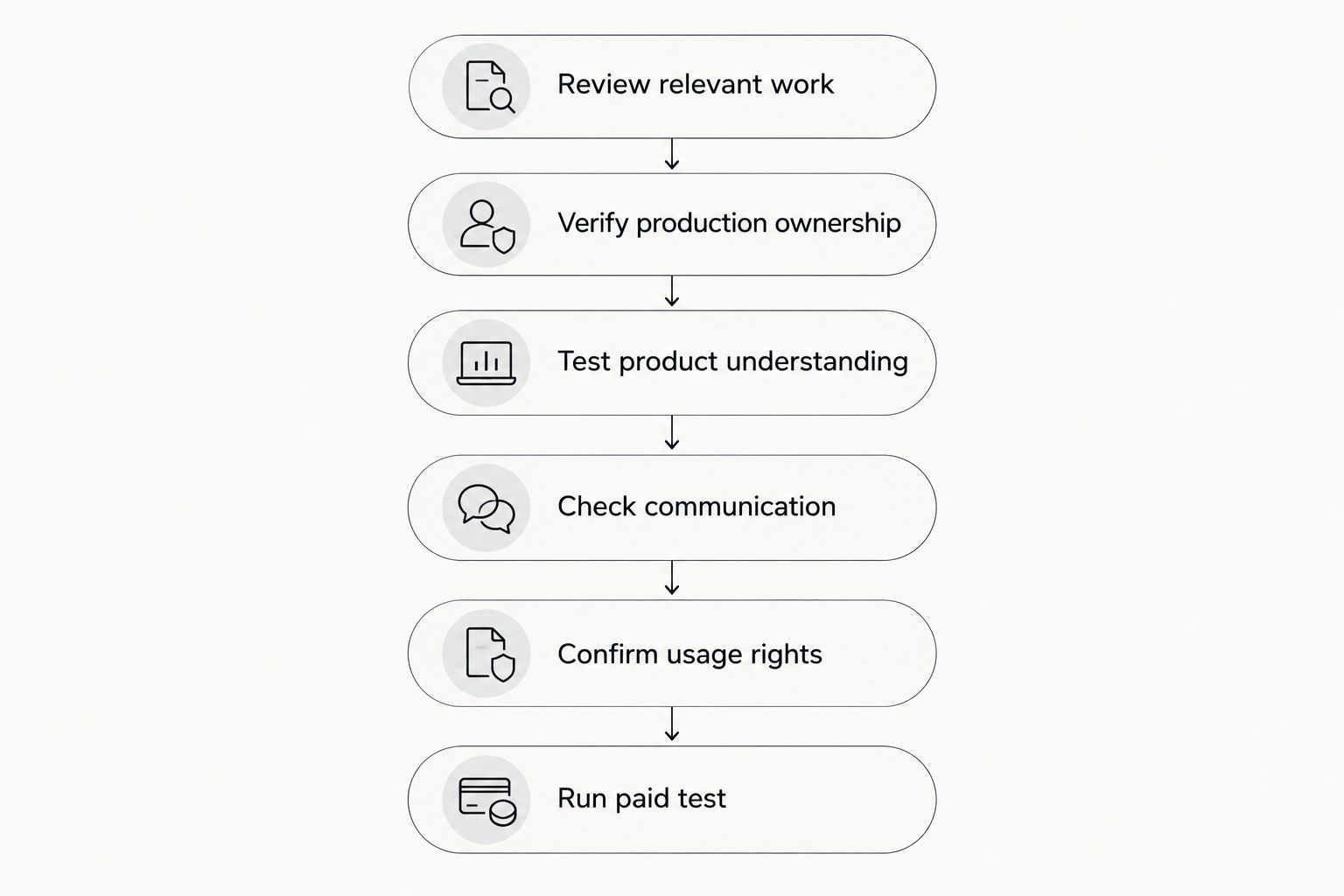
Use the following sequence. Resolve product fit and production ownership before discussing a larger assignment, then use a paid test to check execution.
1. Review relevant work
Ask for examples that resemble your actual assignment. For a SaaS product, look for a clear explanation supported by a screen demonstration. For a mobile app, look for a visible connection between the creator's opening claim and the action shown inside the app.
Review the complete video, not just an opening montage. Check whether the creator identifies a recognizable problem, demonstrates the relevant feature, and ends with a sensible next step.
Ask what the brief required and what the creator personally delivered. Attractive work is useful evidence only when you understand the contribution behind it.
2. Verify production ownership
Ask who wrote the script, recorded the screen, edited the footage, and added captions. A creator who performed an agency-written script has demonstrated presentation skills, not necessarily independent scripting ability.
That distinction is not a reason to reject them. It tells you what support the assignment needs. If your team supplies scripts and edits, strong on-camera delivery might be enough; if you expect finished videos, verify the entire production process.
Request a behind-the-scenes explanation rather than confidential client files. Never make sharing another company's private brief a condition of consideration.
3. Test product understanding
Give the candidate a public product description or access to a controlled demo environment. Ask them to explain who the product serves, which problem it addresses, and what the viewer should do next.
For example, a project management app brief might require showing how to assign a task. Ask the creator to explain that workflow without turning a task assignment feature into an unsupported promise about company productivity.
Product accuracy is a hiring requirement. If the creator misunderstands the feature, correct the misunderstanding and see whether the revised explanation improves.
4. Check communication
Use the screening conversation to establish who owns each handoff. Ask the creator to summarize the deliverables, flag unclear instructions, and explain how they handle conflicting feedback.
Do not confuse a quick reply with reliable delivery. Look for specific questions about the audience, the demo, the approval owner, and the required files.
A useful response identifies dependencies. For example, recording cannot start until the creator has working demo access and an approved feature description.
5. Confirm usage rights
Put the intended uses in writing before commissioning production. Separate publishing on your brand accounts, posting on the creator's account, and using the content in paid advertising.
Also address editing, raw footage, use of the creator's likeness, permitted platforms, and the duration of permission. Ask who is responsible for clearing music and other third-party material.
Do not assume a delivered video includes every permission your campaign needs. Have the agreement reviewed when the rights or restrictions are unclear.
6. Run a paid test
Commission a defined assignment rather than requesting a finished speculative campaign for free. A proposed test could be a 15–45 second video showing a specific product workflow, with an agreed revision step.
Evaluate the test against the brief. Check the spoken explanation, screen accuracy, audio, captions, file delivery, and response to feedback separately.
Use the same acceptance criteria across candidates. Otherwise, the person with the most appealing presentation can win despite missing the actual assignment.
What should a UGC creator's paid test include?
A paid test should resemble the work you intend to commission. Do not test a scripted talking-head video if your ongoing assignment requires independent software demonstrations.
For a 2026 test brief, specify the following:
- Audience: Name the role or user situation the video addresses.
- Product task: Identify the exact workflow the creator must demonstrate.
- Message: State the approved claim and the claims to avoid.
- Format: Specify orientation, captions, and the intended publishing placement.
- Handoff: List the files you need and who supplies screen recordings.
- Feedback: Define what counts as a revision and who approves it.
As an example, request a 30-second app walkthrough that demonstrates a task and ends with an approved next step. A 15-second opening variant can test a different hook, while a 45-second version can test a fuller explanation. These are proposed assignments, not promises about which length performs best.
Do not evaluate creative quality and campaign results as the same thing. A production test shows whether the creator can deliver usable work; business results require a separate measurement plan.
Should you hire directly or use a UGC agency?
Direct hiring is best for teams ready to manage creators; agency support is best for teams seeking done-for-you production. Choose the operating model before comparing candidates so you know which responsibilities remain with your team.
| Hiring option | Best for | Main benefit | Main limitation |
|---|---|---|---|
| Independent creator | Teams that can own briefing, approvals, and coordination | Direct communication with the person making the content | Your team must assign and manage responsibilities outside the creator's scope |
| UGC Scout | Tech teams seeking done-for-you short-form creator video production and posting | Production and posting are offered as a service | Your team still needs to supply accurate product information and approve claims |
UGC Scout is best for tech teams seeking done-for-you creator video production and posting. That is a scope-based recommendation, not a performance guarantee: you still need to confirm deliverables, rights, feedback responsibilities, and product access before signing.
For either model, ask who handles creator selection and who replaces a creator if the assignment is not working. Get the answer into the agreed scope rather than relying on a sales conversation.
Why your UGC creator screening should vary
Keep your screening checklist tied to the assignment. These factors change what evidence you should request:
- Production or distribution: A content-production assignment calls for creative samples. A creator-posted campaign also calls for evidence about the audience receiving the post.
- Product complexity: A straightforward app action needs a different demonstration than a workflow involving permissions, integrations, or technical setup.
- Claim sensitivity: Health, financial, security, or compliance-related statements require careful internal review before a creator repeats them.
- Data access: An enterprise software demo needs a clear boundary between approved demo material and confidential information.
- Editing responsibility: A creator supplying raw footage needs different skills from someone delivering a finished, captioned video.
- Publishing destination: Assess whether the creator can deliver the format and permissions required for your intended placement.
For a 2026 hiring decision, write these requirements into the brief before comparing portfolios. A candidate should not fail a requirement you introduced only after seeing their test.
What are the red flags when hiring a UGC creator?
Reject unresolved accuracy, ownership, or permission problems. Creative differences are negotiable; an inability to explain who made the work or what you are allowed to do with it blocks a sound hiring decision.
Watch for these behaviors:
- The creator claims ownership of work but cannot explain their contribution.
- The creator repeats product claims after you have corrected them.
- The creator supplies performance screenshots without explaining the campaign, timeframe, or personal role.
- The creator treats paid advertising permission as interchangeable with permission to publish an organic post.
- The creator shares another client's private information to prove their experience.
- The creator agrees to every requirement but will not confirm the deliverables in writing.
Separate those issues from fixable production preferences. Caption styling, pacing, or a stiff opening can be revision topics. Misrepresenting experience or ignoring confidentiality calls for a different hiring decision.
If a candidate cites campaign results, ask what those results measured. Views do not establish purchases, and an account-level result does not isolate a creator's contribution.
Should follower count affect your hiring decision?
Follower count should not be your main selection criterion when you are buying videos for your own channels. In that assignment, you are buying production, not access to the creator's followers.
If the creator will publish the content, review audience relevance alongside the work. Ask for contextualized account insights and inspect whether the creator's subject matter matches the people you want to reach.
For your 2026 shortlist, keep production evidence and distribution evidence in separate fields. A strong performer on camera is not automatically the right publishing partner, and a relevant audience does not prove software demonstration skills.
How do you make the final hiring decision?
Make the decision from documented evidence, not overall enthusiasm. Record whether the candidate meets the brief, needs support, or leaves a requirement unresolved.
Use a short decision record:
- Approve: The paid test meets the brief, the rights are agreed, and the handoff is clear.
- Retest: A specific, correctable issue remains and the revision process needs checking.
- Decline: Product accuracy, confidentiality, ownership, or permissions remain unresolved.
Before expanding the assignment, confirm who will make the next videos. If the test used a dedicated creator, ask whether that person remains assigned; do not assume continuity.
Keep the approved test brief and final files as your reference for later work. Your 2026 creator review then has an agreed example to compare against rather than a shifting idea of what good looks like.
FAQ
What's the best way to vet a UGC creator before hiring?
Review relevant work, verify the creator's contribution, check product understanding, confirm rights, and commission a paid test. Judge the test against a written brief rather than follower count or personal taste.
Should I ask a UGC creator to make a free test video?
Use a paid test for production work you request. Define the deliverable, feedback process, and usage permissions before the creator starts.
How long should a UGC creator test video be?
A 15–45 second video is a practical proposed test for a short-form assignment. Choose the length around the product workflow and intended placement, not an assumed performance advantage.
Do UGC creators need experience with SaaS products?
Relevant SaaS experience is useful evidence, but the hiring decision should also test product understanding. Ask the creator to demonstrate a specific workflow and distinguish an approved feature claim from an unsupported outcome.
Can I use a creator's test video in paid ads?
Use a creator's test video in paid ads only when the agreement grants that permission. Confirm the platforms, duration, editing permissions, and any third-party material restrictions before publishing.
Is an agency better than hiring a UGC creator directly?
An agency fits teams seeking production support, while direct hiring fits teams prepared to manage the work. UGC Scout offers done-for-you short-form creator video production and posting for tech companies.
How can I check whether a creator's results are real?
Ask for the campaign context, measurement period, metric definition, and the creator's role. Do not treat a screenshot as proof that the creator alone caused the reported result.
One last thing
Ask the creator to identify anything in your brief they cannot verify. Someone willing to flag an unsupported claim gives you a useful signal about how they will handle the next assignment.
The best test is not whether a creator can repeat your script. It is whether they can explain the product without adding something untrue.