
Yes—micro-influencers can move the needle for B2B SaaS when their audience matches your buyer, their content demonstrates a real workflow, and you measure qualified demand rather than views alone. Start with a bounded test in 2026; a large follower count is not evidence that a creator can reach your buying committee.
- Choose micro influencers for b2b saas by buyer fit and product fluency, not follower count.
- LinkedIn creator posts and commissioned UGC serve different jobs: audience distribution versus reusable content.
- Measure qualified conversations, activated accounts, and opportunities—not views alone.
- UGC Scout fits tech teams seeking done-for-you short-form creator video production and posting.
Can micro-influencers move the needle for B2B SaaS?
Yes, but test the buyer connection before expanding the creator roster. Ask the creator to explain a task your buyer performs, show how your software changes that task, and make the next step clear. Use a software creator brief to turn that requirement into something you can approve before filming.
Choose the partnership model by the job you need done. Paying for a video does not automatically buy access to the creator’s audience, and sponsoring a post does not automatically give you permission to reuse it.
| Partnership model | Best for | Main advantage | Main limitation |
|---|---|---|---|
| Creator publishes to their audience | Reaching a relevant professional community | Connects the demonstration to an existing audience | You do not control who sees or responds to the post |
| Creator delivers commissioned UGC | Building assets for your own channels | Separates content production from audience buying | The creator’s followers are not part of the deliverable unless agreed |
| Creator publishes and licenses content | Testing distribution and reuse together | Lets you evaluate the post and the underlying asset separately | Requires clear publishing, editing, and usage terms |
For a 2026 pilot, select one primary model. Combining every possible deliverable makes it harder to identify what worked and what your team actually needs next.
Why this matters
A useful creator partnership gives your buyer something concrete to evaluate. A practitioner showing how to resolve a reporting problem gives you a clearer content hypothesis than a general endorsement of your dashboard.
That does not make the creator a substitute for your sales process. Your landing page, onboarding, product experience, and follow-up still determine what happens after someone becomes interested.
Keep the promise narrow. If the video demonstrates a reporting workflow, send viewers to that workflow—not to a page that makes them search for it.
How do you choose the right micro-influencer?
Choose demonstrated relevance over a follower threshold. For your 2026 shortlist, ask for examples that reveal who watches, who responds, and what the creator can explain accurately.
Audience fit
Name the role you need to reach before reviewing creators. A sales operations manager, an independent developer, and a finance lead do not share the same software buying job.
Review recent posts and the substance of public comments. Questions about implementation or workflow provide useful context; a follower total alone does not establish professional relevance. Treat audience screenshots as supporting information, not proof that every viewer is a prospective customer.
Product fluency
Give the creator access to an approved demonstration environment and ask for a rough explanation before requesting a polished video. Check whether the creator understands the problem, the steps, and the product’s limits.
A confident delivery cannot rescue an inaccurate demonstration. Reject scripts that invent integrations, imply unsupported outcomes, or skip a prerequisite the buyer needs to understand.
Publishing fit
Choose the channel around the content you need to show. A short clip can demonstrate a focused action; a detailed walkthrough needs room for setup and explanation.
Evaluate the creator’s actual work on LinkedIn, TikTok, YouTube, or another proposed channel. Do not assume skill on one platform transfers to another, and do not ask a short-form video to explain an entire enterprise buying decision.
Commercial clarity
Separate production, posting, and reuse in the agreement. Specify the deliverables, approval process, publishing responsibilities, permitted edits, and usage permissions.
Also agree on advertising disclosures and prohibited claims. A creator should not present a paid relationship as an independent customer recommendation or imply personal experience they do not have.
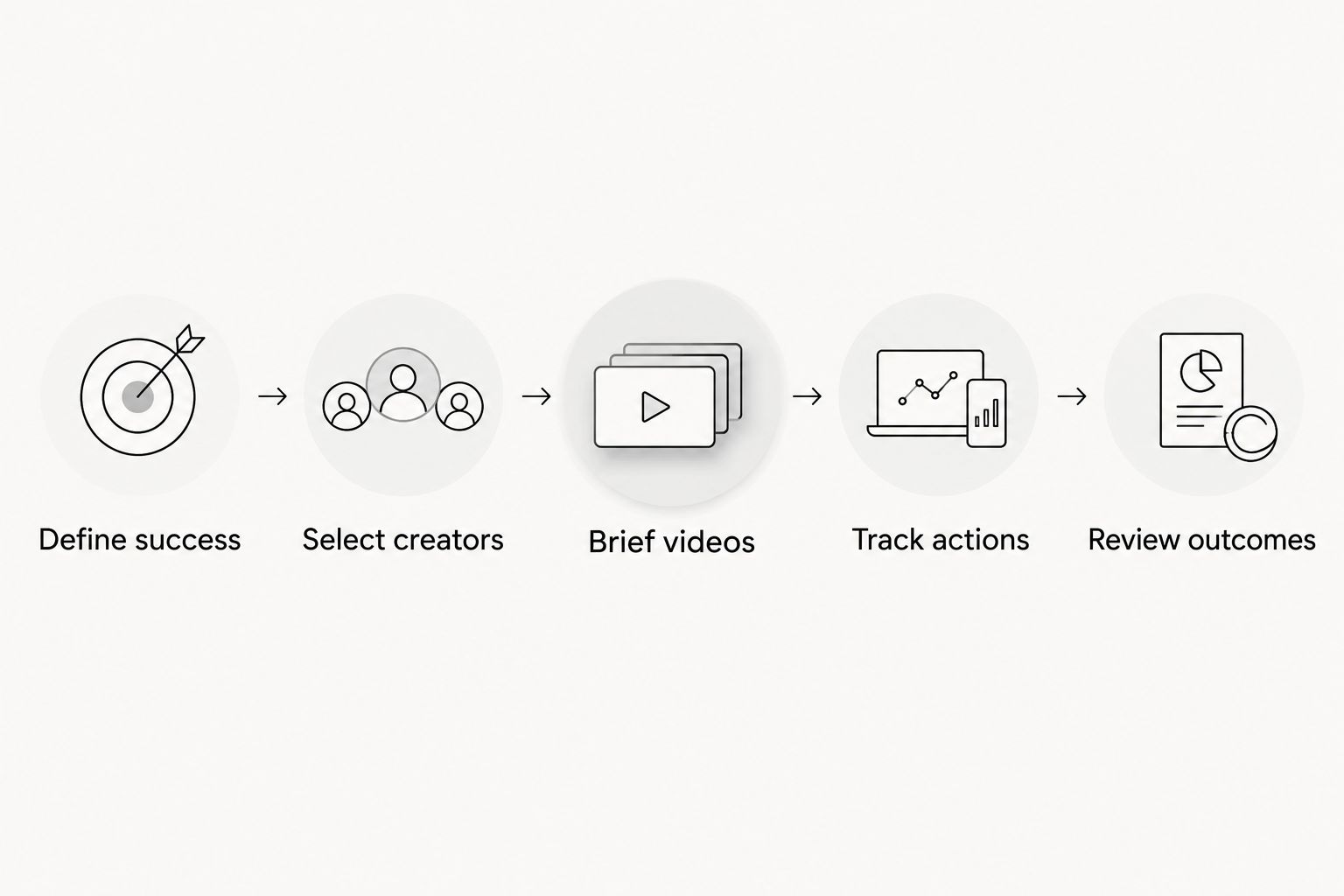
How should you structure a B2B SaaS creator pilot?
Use a small, explicit experiment rather than an open-ended posting commitment. The following is a proposed test design, not a performance benchmark or an agency package.
Define success
Choose the business action first. For a self-serve product, that might be an account completing a meaningful setup task; for a sales-led product, it might be a qualified demo request.
Write the qualification rule before launch. A submitted form is not automatically a qualified lead, and a new account is not automatically an active user.
Select creators
Start with 3 creators, each selected for the same buyer role but a distinct explanation style. This proposed roster gives you separate creative approaches to inspect without turning the pilot into a large coordination project.
Do not describe this as a statistically conclusive experiment. Use it to find promising audience-and-message combinations that deserve another test.
Brief videos
Request 2 videos per creator, for 6 videos total in this suggested pilot. Give each creator a problem-led concept and a demonstration-led concept, with the same destination and next action.
Use 15–45 seconds as an initial short-form brief where the workflow fits. That is an editorial constraint, not a rule about platform performance; allow a longer explanation when accuracy requires it.
Track actions
Assign a distinct tracking link to each published asset and preserve its identifier through the destination and conversion event. Record the creator, concept, channel, publication date, and intended audience alongside it.
Use an optional signup or sales question to capture remembered creator exposure. Keep self-reported discovery separate from tracked clicks rather than forcing them into a single attribution story.
Review outcomes
Review the pilot against the success rule you wrote before publication. Separate content quality, audience response, and business outcomes so a well-made video does not automatically earn a distribution renewal.
Repeat a promising concept with a changed opening or clearer demonstration. Stop inaccurate content immediately; more distribution does not fix a misleading product claim.
What should you measure beyond views?
Measure the action the partnership was commissioned to produce. Views describe exposure; they do not establish whether the viewer fits your customer profile or used your software.
For a 2026 scorecard, keep the measurement layers separate:
| Measurement layer | What to record | What it tells you | What it does not prove |
|---|---|---|---|
| Distribution | Reported views, reach, and destination clicks | Whether the content received exposure and generated visits | Buyer fit or purchase intent |
| Response quality | Relevant questions, demo requests, and account fit | Whether the message prompted useful interest | Completed product adoption |
| Product behavior | Your defined activation event | Whether referred accounts reached a meaningful product step | Long-term retention |
| Commercial outcome | Qualified opportunities and closed business | Whether identifiable demand progressed commercially | That the creator caused every purchase |
Compare creators using consistent definitions. If one creator sends self-serve users and another targets enterprise buyers, keep their objectives separate rather than ranking both on raw signups.
Document the attribution window before launch and keep it consistent during the test. Use the influencer ROI measurement guide to structure the commercial review without treating every subsequent account interaction as creator-driven.
Why micro-influencer results vary
Treat these as campaign decisions to inspect, not excuses for weak results:
- Buyer relevance: A creator’s subject matter must connect to the role and problem you target. Broad technology interest is not the same as buying relevance.
- Demonstration quality: The content needs to show a credible task. General praise leaves the buyer without much to evaluate.
- Destination match: The landing experience should continue the promise made in the video. A disconnected destination breaks the proposed journey.
- Conversion friction: Check the path from click to the intended action. An unclear form or confusing setup makes the creator test harder to interpret.
- Publishing and reuse terms: Your agreement determines where the asset can appear and how you can adapt it. Unclear permissions limit the next test.
- Sales follow-up: Define who handles responses and how those responses are qualified. Otherwise, creator-sourced interest becomes an unowned inbox task.
Are micro-influencers better than larger creators for B2B SaaS?
Micro-influencers are the better choice when a specific creator demonstrates stronger buyer relevance and subject knowledge—not simply because the account is smaller. A larger creator with the right professional audience can still be the better fit.
Ask both candidates to respond to the same brief. Compare the accuracy of the proposed demonstration, evidence of audience fit, and contractual deliverables before deciding.
Should you run the program yourself or use an agency?
Run the pilot internally if your team can own creator selection, briefing, approvals, posting coordination, and measurement. Use an agency when you want production and posting done for you, while retaining a clear internal owner for product accuracy and business outcomes.
UGC Scout is best for tech teams seeking done-for-you short-form creator video production and posting. The fit is operational: your team wants outside execution rather than another production workflow to manage internally.
Before choosing UGC Scout for a micro-influencer campaign, confirm audience sourcing, publishing responsibilities, usage permissions, and reporting in the proposed scope. Short-form production alone does not establish access to a particular buyer community or guarantee qualified pipeline.
What should make you stop a creator partnership?
Stop when the creator misrepresents the product, ignores agreed disclosures, or repeatedly misses approved requirements. Those are execution failures, not creative differences.
For weak business results, diagnose the failed step before replacing the creator. Relevant visits without activation call for a different investigation than views without relevant visits.
In your 2026 review, distinguish a failed concept from a failed partnership. An inaccurate creator is a clear stop; an accurate creator with an unclear opening deserves a specific creative decision, not an automatic renewal.
FAQ
Can micro-influencers generate leads for B2B SaaS?
Yes, micro-influencers can support lead generation when their audience matches your buyer and the content gives viewers a relevant next action. Count qualified responses separately from views and unqualified form submissions.
How many creators should a B2B SaaS pilot include?
The suggested pilot uses 3 creators, with 2 videos per creator. This is a proposed starting structure, not a benchmark or a promise of statistically conclusive results.
How long should a B2B SaaS creator video be?
Use 15–45 seconds as an initial brief for a focused short-form demonstration. Extend the format when the workflow needs more explanation; do not remove necessary context to meet a duration target.
Do I need creators with a large following?
No, a large following is not a requirement for a useful B2B SaaS partnership. Evaluate buyer relevance, product fluency, and the agreed distribution rather than selecting on follower count alone.
Can I reuse a creator’s video in paid ads?
Reuse a creator’s video in paid ads only with the appropriate permissions. Agree on channels, editing, duration, and any other usage restrictions before commissioning the asset.
Can an agency handle creator videos for my SaaS team?
Yes, UGC Scout offers done-for-you short-form creator video production and posting for tech companies. Confirm the campaign scope separately, including audience sourcing, approvals, permissions, and measurement.
One last thing
A creator can fail as a distribution partner and still produce a useful asset. Keep those judgments separate: assess the audience response, then assess whether the video accurately explains a buyer problem your own channels need to address.
Before renewing, name the specific thing you are buying again: access to an audience, a strong explanation, or both. That decision is more useful than another report showing total views.