
Organic TikTok for developer tools is worth testing when you can show a real developer problem, demonstrate the fix, and connect viewers to a useful next step. It is not a substitute for documentation or a dependable source of pipeline; production, technical review, and attribution still need an owner.
- Organic TikTok for developer tools deserves a test when product demos show a clear, reproducible result.
- Judge developer marketing by qualified visits and product activation, not views alone.
- Keep technical review in-house, even when short-form video production is done for you.
- UGC Scout suits tech teams seeking done-for-you creator video production and posting.
Is organic TikTok worth it for developer tools companies?
Yes for testing product discovery. No as a replacement for technical education or sales qualification. Your decision should depend on what you can demonstrate and measure, not whether a competitor posts frequently.
For your 2026 channel plan, separate the job of attracting attention from the job of helping someone adopt your tool. A short video can introduce a useful workflow. Your documentation, onboarding, and product must support the next step.
If production is the gap, UGC Scout provides done-for-you short-form creator video production and posting for tech companies. Your team still needs to verify the technical substance.
Use this decision table before committing production time:
| Approach | Best for | Main advantage | Main limitation | Recommendation |
|---|---|---|---|---|
| Founder-led videos | Teams with a founder who can demonstrate the product | Direct access to product knowledge | Recording competes with founder work | Start here if recording is sustainable |
| Developer-creator videos | Teams that need credible workflow demonstrations | A creator can explain the task through actual use | Product access and technical review need coordination | Require a working demonstration before approval |
| Agency-managed production | Teams that need production and posting handled externally | Moves execution outside the internal team | Does not remove the need for technical approval | Define responsibilities before signing |
| No TikTok program | Teams without a clear demo or measurable next step | Preserves attention for existing priorities | Leaves this discovery channel untested | Wait until the prerequisites exist |
Why this matters
A developer tool needs more than an interesting reveal. The viewer needs to understand what changed, why it matters, and whether the example applies to their work. A video that hides the setup leaves those questions unanswered.
Treat organic TikTok as an introduction, not the entire buying journey. You are asking someone to investigate a specific problem and solution. You are not asking them to approve a team-wide migration from a short clip.
That distinction changes the brief. Replace broad product praise with a visible task: reproduce an error, inspect a request, or complete an integration. Those are example content directions, not claims about any particular tool.
When organic TikTok deserves a test
Start when your team can answer the following questions without stretching the product story:
- Who is watching? Name a developer role and the task that person performs.
- What changes on screen? Identify a result you can show, not just describe.
- What makes the explanation credible? Let the presenter use the product and explain its limits.
- Where should viewers go? Choose a relevant tutorial, example project, or product entry point.
- Who checks accuracy? Assign a technical reviewer before filming starts.
A working demonstration is a stronger starting point than a polished product pitch. Keep enough context for a developer to understand the result. Do not remove a required setup step just because it interrupts the edit.
In your 2026 test, use the same standard for every presenter. A confident delivery does not excuse a broken example. A technically accurate recording still needs a clear opening and readable visuals.
When you should wait
Wait if your proposed videos depend on claims you cannot demonstrate. Also wait if the product requires confidential customer data to make the example convincing. Build an approved demonstration environment first.
Pause if your only next step is a generic homepage and nobody owns the visitor journey. Decide what someone should learn or do after watching. Then make that action possible before publishing.
Organic posting also needs editorial capacity. Someone must answer technical questions, correct mistakes, and decide what to record next. Outsourcing production does not outsource your responsibility for product accuracy.
Waiting is a channel decision, not a verdict on the product. Fix the missing prerequisite and reconsider the test. Do not create a posting schedule to hide the absence of a useful demonstration.
How should you test organic TikTok for developer tools?
Use a bounded experiment with an explicit question: can these videos bring relevant developers to a meaningful product action? The following steps are a suggested test design, not a performance benchmark.
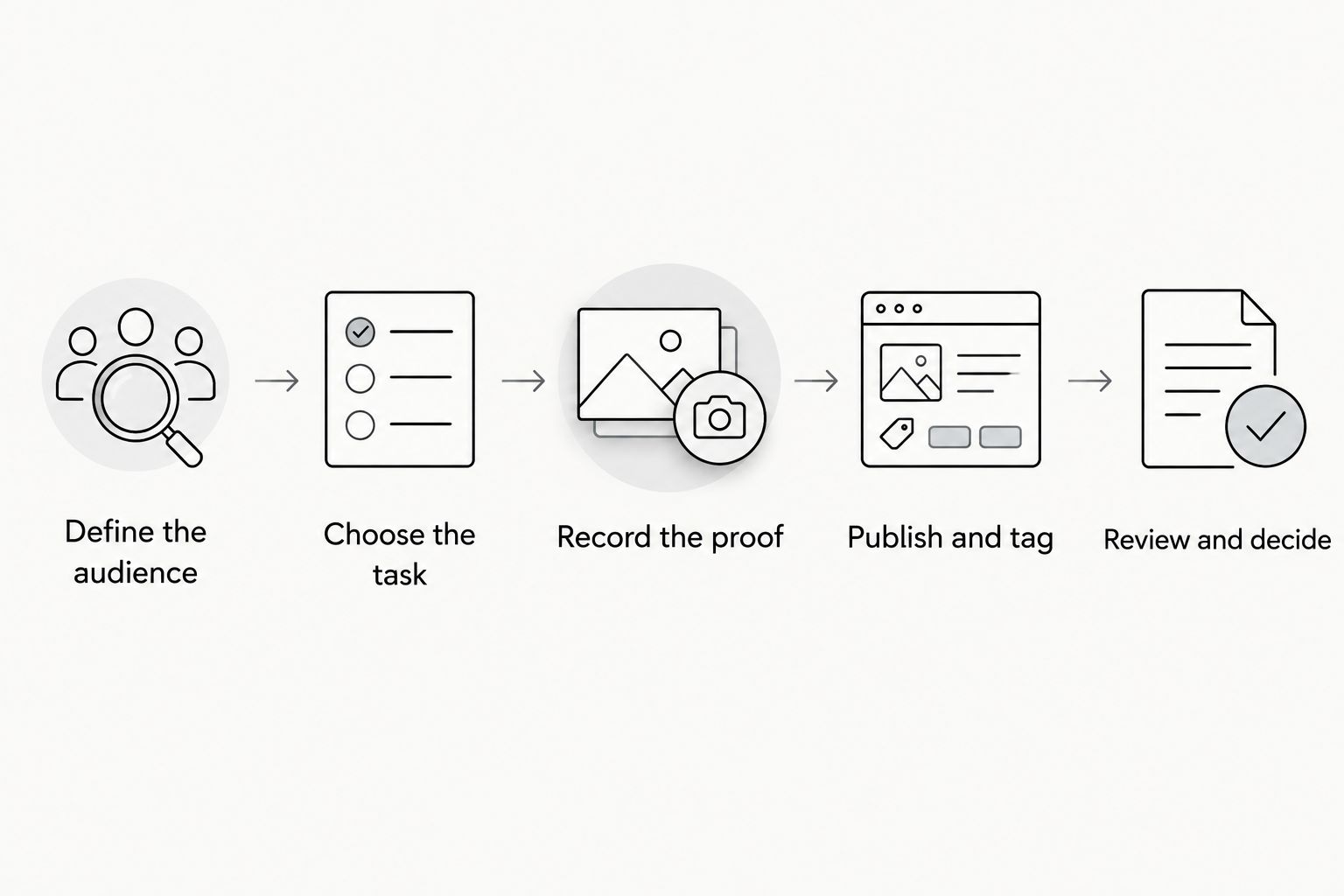
Define the audience
Choose a specific user and task. For example, a hypothetical debugging tool could address backend developers investigating failed requests. That is a clearer brief than targeting everyone who writes code.
Write down what the audience already knows. Explain unfamiliar product concepts without turning the video into a general programming lesson. The opening should identify the task quickly.
Choose the task
Pick a workflow that works in a clean demonstration environment. Record the setup, the action, and the result before writing the final script. This prevents the script from promising a result the recording cannot show.
Use synthetic data and approved credentials. Check the recording for private information before it enters editing. Do not publish customer material without permission.
Record the proof
Start with a 15–45 second draft as an editorial constraint, not a platform requirement. Show the problem, demonstrate the action, and explain the result. If accuracy requires more explanation, change the format rather than cut essential context.
For a 30-second draft, choose a task small enough to explain honestly. Do not compress an entire onboarding process into a claim that setup is effortless.
Publish and tag
Give the video a next step that matches the demonstration. A troubleshooting clip should lead toward troubleshooting help, not an unrelated sales message. Keep the wording consistent between the video and its destination.
Use campaign parameters where your publishing setup permits a tracked link. Record the creative angle and destination alongside the post. That gives the later analysis something more useful than a list of view counts.
Review and decide
Review audience response and downstream activity together. Ask whether viewers understood the task, whether relevant visitors arrived, and whether those visitors completed the intended action. Avoid interpreting every signup as proof that TikTok caused it.
For a manageable starting batch, plan 6 videos around 3 developer problems, with 2 openings for each problem. These are proposed production limits, not an expected winning formula. Set the review date before the batch goes live.
Keep the first batch narrow enough to interpret. If you change the audience, product workflow, presenter, and destination at once, the result gives you little direction for the next brief.
What should a developer-tool video actually show?
Use the structure problem, action, result, boundary. The boundary is the condition under which the example works. It keeps a concise demonstration from becoming an exaggerated promise.
For example, a hypothetical API development tool video could show a failed request, the relevant inspection step, and the corrected response. The presenter should explain any setup that materially affects the result. That is a script concept, not a verified product capability.
A useful brief includes:
- The developer role and immediate problem.
- The exact workflow the presenter must reproduce.
- The screen detail that proves the result.
- The limitations or prerequisites that need stating.
- The next action for an interested viewer.
For your 2026 briefs, make the technical reviewer responsible for claims, not every stylistic choice. Let the presenter explain naturally within approved boundaries. Use the guide to briefing a UGC creator for a software product to structure that handoff.
Why organic TikTok results vary
The useful question is not whether developer content gets views. It is whether your specific content reaches people who understand the problem and have a reason to investigate the solution.
Evaluate these factors separately:
- Audience fit: A general programming joke and a specialist workflow serve different viewers. Match the content to the intended user.
- Visible evidence: Make the relevant input, action, and output readable. A result without context is difficult to evaluate.
- Presenter fluency: Require the presenter to explain what happened and why. Memorizing terminology is not enough.
- Technical friction: State prerequisites and show a next step that matches the viewer's readiness.
- Measurement quality: Separate observed visits and actions from assumptions about influence.
- Production ownership: Assign responsibility for briefs, access, approvals, posting, and corrections.
These are operating decisions you can inspect and improve. Do not explain a disappointing batch solely through assumptions about the algorithm.
How do you measure whether organic TikTok is worth it?
Measure the product action you wanted before judging the attention you received. For self-serve software, that could be completing a relevant onboarding step. For a sales-led tool, it could be a qualified inquiry tied to the workflow shown.
Define activation using your product's actual value event. Account creation alone does not demonstrate that someone used the tool successfully. Keep the definition consistent throughout the test.
For your 2026 reporting, separate these questions:
| Measurement layer | What to inspect | What it does not establish |
|---|---|---|
| Attention | Views, viewing behavior, and relevant comments | That viewers match your buyer |
| Intent | Profile activity, attributable visits, and tutorial interest | That visitors used the product |
| Product use | Your defined activation event | That TikTok caused every activation |
| Commercial value | Qualified opportunities or customers with attributable evidence | The full influence of untracked exposure |
Use tracked activity and self-reported discovery as distinct evidence. Neither should silently replace the other. Document what each source actually tells you.
Should you hire a creator or an agency?
Hire a creator when you can manage the brief, product access, review, and publishing yourself. Choose agency-managed production when execution is the constraint and you want those responsibilities explicitly assigned.
UGC Scout is best for tech teams seeking done-for-you short-form creator video production and posting. That service fit does not establish specialist developer expertise or replace your technical reviewer; assess those requirements before committing.
Ask any provider to explain who prepares the demonstration, who verifies the recording, and who handles corrections. Request clarity on publishing responsibilities and content permissions. Do not assume every task is included because the engagement is described as done for you.
Can organic TikTok replace developer documentation?
Organic TikTok cannot replace developer documentation. Use the video to introduce a task and the documentation to explain prerequisites, implementation details, and troubleshooting.
Your 2026 content plan should connect those jobs without forcing them into the same format. Keep the short video understandable and the supporting material precise.
Should you keep posting if views rise but activation does not?
Rising views without activation are not a reason to increase production automatically. Inspect audience relevance, destination quality, tracking, and the demonstrated use case before ordering another batch.
Change a specific part of the test and state why. If the revised content still fails your predefined business criteria, pause the channel rather than treating output volume as progress.
FAQ
Is organic TikTok worth it for a small developer tools startup?
Organic TikTok is worth testing when a small developer tools startup has a clear demonstration, a technical reviewer, and a measurable next step. Wait if producing videos would displace essential product or onboarding work.
How long should a developer-tool TikTok video be?
Use 15–45 seconds as a starting editorial constraint, not a platform rule. Preserve the context needed to understand the demonstration, even if that means changing the format.
Do developer tools companies need professional creators?
Developer tools companies do not need professional creators to begin. A founder or developer can present the workflow if recording and publishing are sustainable.
What should developers talk about in organic TikTok videos?
Show a specific developer problem, a reproducible action, and the result. Explain prerequisites that materially affect whether the example works.
Can UGC Scout handle organic short-form production?
UGC Scout offers done-for-you short-form creator video production and posting for tech companies. Confirm the technical-review process and responsibilities for your developer-tool project.
What metric matters more than TikTok views?
A relevant product activation or qualified inquiry is closer to the business objective than views alone. Define the action before publishing and distinguish attributed activity from assumed influence.
One last thing
Before approving the next video, ask a developer who did not write the script to explain what the tool did and what conditions the result depended on. If the explanation is wrong, fix the video before publishing.
Do not make the edit simpler than the truth. A short demonstration should remove unnecessary words, not necessary context.