
Yes. Influencer marketing without paid ad budget works through creator posts, product demonstrations, and referrals that reach people without boosted distribution. You still need to account for creator compensation, production work, and measurement; organic publishing does not guarantee reach or customer acquisition.
- Influencer marketing without paid ad budget works through organic creator distribution, not guaranteed reach.
- UGC Scout serves tech companies seeking done-for-you short-form creator video production and posting.
- Choose creators for audience relevance and product understanding, then track signups and activation.
- Separate creator compensation, content rights, and paid amplification before agreeing to a campaign.
Why this matters
No paid ads does not mean no marketing investment. You can pay a creator to publish a demonstration without buying distribution from TikTok, Instagram, YouTube, or LinkedIn. Those are separate decisions.
For SaaS and mobile app teams planning a 2026 campaign, this distinction changes the brief. You need someone who can explain a real use case to a relevant audience, not simply someone who can deliver a polished video file. Start with how to vet a UGC creator before hiring, especially if the creator will publish from their own account.
The trade-off is control. Organic creator posts give you access to the creator's existing audience, but you cannot set delivery volume the way you set a paid media budget.
Can influencer marketing work without a paid ad budget?
Yes, when your plan connects a relevant creator, a useful product demonstration, and a measurable next step. Treat organic distribution as the campaign's delivery method, not as a promise that a post will reach buyers.
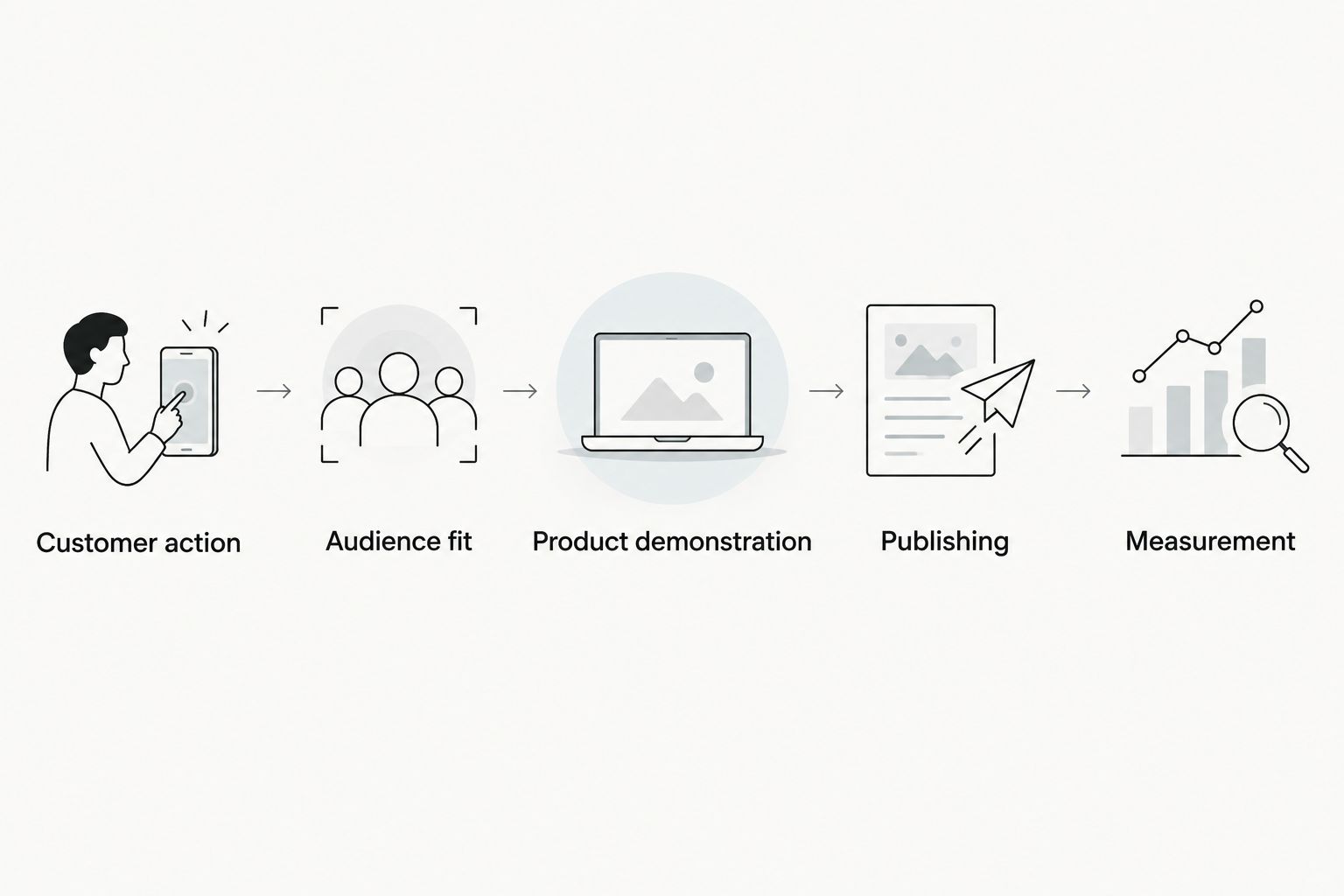
Use this sequence to build the campaign:
- Choose the customer action. Decide whether the campaign should produce app installs, account creation, qualified demo requests, or another meaningful action. Avoid giving the creator several competing calls to action.
- Find audience fit. Review the creator's topics, comments, and previous demonstrations. Look for evidence that viewers care about the problem your product solves.
- Brief the demonstration. Give the creator a specific task to complete with the product. Show the starting problem and the useful outcome, rather than a list of features.
- Agree on publishing. Specify whose account publishes the content, what gets delivered, and how approvals work. A video file alone is not an influencer distribution plan.
- Track the response. Use tagged links and relevant product events. Record creator activity separately from other acquisition work so you can interpret the results.
Do not start with a large roster just to create activity. Start with a scope your team can review, publish, and measure properly. Expand only when you understand which audience and demonstration deserve another test.
Which approach fits a campaign without paid amplification?
These approaches solve different problems. Choose according to whether you need audience access, reusable content, or a referral relationship.
| Approach | Best for | Main advantage | Main limitation |
|---|---|---|---|
| Creator-published partnership | Reaching a relevant creator audience | The creator supplies both content and distribution | Organic reach is not guaranteed |
| Brand-published creator content | Explaining a product through a human demonstration | Your team controls publishing on its own channels | The creator's audience is not automatically included |
| Affiliate partnership | Connecting creator referrals with attributable customer actions | Compensation can be tied to agreed referral outcomes | Attribution rules and ongoing partner management need attention |
| Customer advocacy | Sharing genuine customer experience | The demonstration comes from actual product use | Participation and publishing require customer agreement |
For audience access, choose creator-published partnerships. Buying content for your brand account solves a production problem, not necessarily a distribution problem.
For a SaaS tool, a useful creator post might show how a recurring work task gets completed. For a mobile app, it might show the moment the app becomes useful in an everyday situation. Neither example needs paid amplification to be published or shared.
The limitation remains the same: a good demonstration and a relevant audience do not establish commercial results by themselves. Your measurement needs to follow the viewer beyond the post.
What should the creator actually make?
Give the creator a problem to solve on camera. Avoid handing over a feature list and asking for enthusiasm.
A practical brief for your 2026 campaign can request a 15–45 second video as a starting format, not as a performance benchmark. Choose the final length around the demonstration. A complex software workflow needs a different explanation from a simple mobile app action.
Use this structure:
- Problem: Show the situation your intended customer recognizes.
- Demonstration: Show the relevant product action using approved access and data.
- Outcome: Explain what changed without inventing a time saving or business result.
- Next step: Tell the viewer what to do next.
For example, a SaaS brief could ask the creator to show a repetitive task, demonstrate the relevant workflow, and direct viewers to learn more. An app brief could focus on a specific use case rather than reciting every feature.
Do not script a personal endorsement that the creator cannot honestly make. Product experience, opinions, and results must remain truthful. If the creator has not used a feature, the video should not suggest otherwise.
Why organic influencer results vary
Organic campaigns depend on more than the finished video. Review these factors before judging the partnership:
- Audience relevance. A topic-relevant audience is a better selection criterion than follower count alone. Check whether viewers discuss problems your product actually addresses.
- Product clarity. A demonstration needs a recognizable task and a visible explanation. An unclear product story makes the next step harder to understand.
- Publishing responsibility. Confirm whether the creator publishes, your brand publishes, or both do. These arrangements provide different distribution.
- Conversion friction. Review the landing experience and onboarding path. Attention cannot compensate for a broken signup flow or an unclear offer.
- Measurement quality. Tagged links, referral records, and product events answer different questions. Missing tracking makes the result harder to interpret.
- Team execution. Access, approvals, revisions, and publishing require an owner. A content plan is not complete until someone is responsible for each handoff.
These factors are a diagnostic checklist, not a ranking formula. If a post attracts relevant questions but few completed signups, investigate the next step before replacing the creator.
What costs remain when you do not buy ads?
Removing paid amplification removes a distribution expense. It does not remove the work involved in finding creators, making content, approving claims, and managing publishing.
Account for creator compensation, internal review time, editing, product access, and campaign management. If you use affiliate arrangements, define qualifying referrals and payment conditions before publishing. Do not treat deferred compensation as no compensation.
Content permissions need their own agreement. Confirm whether your team can repost the video, edit it, use the creator's likeness, and publish it on additional channels. Permission to publish organically does not automatically establish permission for paid advertising.
For U.S. campaigns in 2026, follow FTC endorsement guidance on disclosing material connections. Payment, gifts, and other relevant relationships require clear disclosure when applicable. Removing the ad budget does not remove that responsibility.
How do you measure results without paid ads?
Measure the customer action, not just the post. Record views and engagement as distribution signals, then examine the business outcome the campaign was built to support.
Before publishing, define what counts as success:
- For a mobile app, distinguish an install from a meaningful in-app action.
- For self-serve SaaS, distinguish account creation from activation.
- For sales-led software, distinguish a submitted form from a qualified opportunity.
Keep a campaign record with the creator, post, publication date, message, tagged destination, and intended action. Use consistent tracking conventions so results remain readable across posts.
Add a self-reported discovery question where appropriate. Someone can see a creator post and return later through another route, so a tracked visit is not a complete account of influence. Self-reported attribution adds context; it does not establish causation.
For your 2026 reporting, separate observed conversions from claims about incremental growth. A signup associated with a creator link is evidence of an attributed action. It is not proof that the signup would never have happened otherwise.
Can you run the campaign entirely in-house?
Yes. An in-house team can manage creator discovery, outreach, briefs, approvals, publishing coordination, and reporting. The benefit is direct control; the limitation is that someone must own the operating work.
An agency is relevant when you want that work handled externally. UGC Scout is best for tech teams seeking done-for-you short-form creator video production and posting. That service addresses execution; it does not remove organic reach uncertainty or your responsibility for product access and approved claims.
If production and posting are the work your team wants handled, UGC Scout provides that service for tech companies. Confirm the scope and reporting responsibilities before signing. If you already have the people and process, keep execution in-house rather than outsourcing by default.
Should you pay creators if you are avoiding paid ads?
Yes, paying creators is compatible with avoiding paid advertising. Creator compensation pays for agreed work or access to the creator's audience; paid amplification purchases distribution from a platform.
Keep those decisions separate in your 2026 plan. You can fund creator production and publishing while leaving platform amplification out of scope.
Can you reuse organic creator content later?
Yes, if the agreement grants the relevant usage rights. Define where the content can appear, which edits are permitted, and how long the permission lasts.
Do not assume that receiving the file transfers every right. If future paid use matters, resolve it before production rather than after a post attracts attention.
When should you stop or change the campaign?
Change the campaign when the evidence points to a specific failure. Do not use disappointment with views as the only decision rule.
If viewers misunderstand the product, revise the demonstration. If engagement comes from people outside your customer profile, revisit audience selection. If relevant visitors reach the site but do not complete the intended action, inspect the destination and onboarding.
Stop repeating a format when you cannot identify what the next attempt is meant to test. More posts without a clear question create more production work, not a clearer decision.
FAQ
Can influencer marketing work without paid ads in 2026?
Yes, influencer marketing can work without paid ads through organic creator posts, referrals, and product demonstrations. Reach and acquisition are not guaranteed, so track the customer action your campaign is meant to produce.
Does no paid ad budget mean creators work for free?
No, removing paid amplification does not remove creator compensation or production work. Agree on deliverables, publishing responsibilities, and compensation separately from platform advertising.
Is UGC the same as influencer marketing?
No, commissioned creator content can be delivered without distribution to the creator's audience. Confirm whether you are buying a video, a published partnership, or both.
What is the best creator content for a SaaS product?
A relevant product demonstration is a practical starting point for SaaS creator content. Show a recognizable task, explain the product action, and give viewers a clear next step.
Can UGC Scout help without a paid media campaign?
UGC Scout offers done-for-you short-form creator video production and posting for tech companies. Confirm the publishing scope and responsibilities for your organic campaign.
Do organic sponsored posts need disclosures?
Yes, applicable material connections require clear disclosure under FTC endorsement guidance for U.S. campaigns. Organic publishing does not remove endorsement responsibilities.
How do I know whether an organic creator campaign worked?
Compare campaign activity with the customer action you defined before publishing. Use tagged links, product events, and relevant customer records rather than treating views as revenue.
One last thing
Ask who publishes before asking how many videos you get. A batch of finished clips can leave you with exactly the distribution problem you started with.
For your first campaign, write the publishing responsibility beside every deliverable. Then write the customer action beside every post. Those decisions make the difference between a content order and a measurable influencer campaign.