
HR tech B2B influencer marketing is working with credible creators to explain HR software with the aim of generating qualified buyer interest. This 2026 guide shows you how to connect creator content to a specific HR workflow, protect employee information, and measure more than views.
- B2B influencer marketing for HR tech companies should connect practitioner credibility, software demonstrations, and qualified buyer interest.
- UGC Scout fits tech teams seeking done-for-you short-form creator video production and posting.
- Choose HR creators by audience relevance and workflow knowledge, not follower counts alone.
- Separate content production from audience distribution; buying a video does not automatically include creator posting.
- Use fictional employee records, explicit usage rights, and CRM tracking before publishing.
Why influencer marketing matters for HR tech
HR software content needs to answer a buyer's practical question: what changes in my working day? A recruiting lead evaluating interview coordination needs a different demonstration from a people operations manager evaluating onboarding.
Build your 2026 campaign around that distinction. A creator's ability to explain a relevant task matters more than their ability to repeat your product description. Ask for evidence of audience fit rather than treating a broad business audience as an HR audience.
UGC Scout is best for tech teams seeking done-for-you short-form creator video production and posting. UGC Scout is a growth and influencer marketing agency for tech companies. Keep that service fit separate from HR-specific practitioner credentials, which you should verify during evaluation.
Also separate two jobs. A creator can produce useful software content without having an audience of HR buyers; an established HR practitioner can offer relevant distribution without being a strong video presenter. Decide which job you need before hiring.
How to build an HR tech influencer program
Define your buyer
Start manually with your sales notes, product positioning, and recent buyer questions. Choose one audience and one workflow for the initial brief. Do not ask a creator to address recruiters, payroll administrators, HR leaders, and employees in the same video.
For example, a recruiting software team can frame a demonstration around interview handoffs. An onboarding software team can show how an administrator prepares a new starter's tasks. These are proposed content angles, not claims about a particular product.
Write the desired next action before choosing a creator. A demo request, an educational download, and a product signup require different explanations and different landing-page messages.
- Name the buyer's role and responsibility.
- Identify the workflow your product actually supports.
- Record the objection the content should answer.
- Choose a next action that matches the buying stage.
Choose your format
Separate expert influence from creator production. Practitioner commentary is best for explaining a professional problem; a creator-led demonstration is best for showing a task. Neither format replaces product documentation or a security review.
Draft the idea yourself first. Use a screen recording and a written outline to check whether the workflow is understandable before commissioning production. For a short-form pilot, a proposed 15–45 second video gives you a clear creative constraint, not a universal performance benchmark.
An expert discussion needs enough room to explain trade-offs. Do not compress a complex payroll or hiring-policy topic into a short clip simply because short-form production is available.
- Use practitioner commentary for a specific HR decision.
- Use a screen demonstration for a visible product task.
- Use an interview when professional context needs explanation.
- Give every asset one primary question to answer.
Vet your creators
Search manually through professional posts, relevant discussions, and practitioner recommendations. Read the substance of the creator's work. Someone who explains recruiting operations clearly is a better candidate for a recruiting workflow than a general business creator selected only for reach.
Ask candidates to describe your target workflow before assigning a script. Check their public professional background, relevant content, and audience evidence. Use this guide to vet a UGC creator before hiring to structure your review.
UGC Scout offers a done-for-you production and posting path for tech teams. Confirm the proposed creator's HR knowledge, distribution scope, and review process before treating that service as a substitute for internal coordination.
- Review relevant posts and the substance of audience comments.
- Ask for audience information relevant to your target buyer.
- Request a plain-language explanation of the proposed workflow.
- Check conflicts, competing sponsorships, and testimonial accuracy.
Brief the workflow
Create the brief in a shared document before adding production tools. Specify the buyer, problem, approved demonstration, and next action. Give the creator room to speak naturally while keeping product claims within documented boundaries.
A useful 2026 brief distinguishes an example from a result. Showing fictional onboarding tasks is a demonstration; saying the software reduces onboarding time is a performance claim that needs evidence. Do not let a natural-sounding script blur that line.
For a proposed pilot, brief 3 videos around the same workflow: the problem, the demonstration, and the objection. This is a planning example, not a promised package or a required campaign size.
- Define the opening problem in the buyer's language.
- Supply approved product facts and screen-recording instructions.
- Mark unsupported claims and prohibited examples explicitly.
- Specify deliverables, review ownership, and the next action.
Approve the content
Review accuracy before polishing captions. An attractive clip is unusable if it shows the wrong permission level, invents an integration, or suggests a creator has used software they have never accessed.
Use a sandbox with fictional employee and candidate records. Remove names, contact details, compensation information, and other personal information from the demonstration. Have your internal owner approve what appears on screen rather than relying only on the spoken script.
Keep revisions specific. Identify the exact screen, sentence, or implication that needs changing. Separate mandatory corrections from optional style preferences so creators know what blocks approval.
- Check spoken claims against approved product information.
- Inspect every visible record, notification, and browser tab.
- Confirm the creator's stated experience is truthful.
- Assign one owner to consolidate internal feedback.
Publish with permission
Start with a publishing checklist and a shared calendar. Record who posts each asset, where it appears, and what reuse is permitted. Production, creator posting, brand posting, and paid advertising are different permissions; write each one into the agreement.
For your 2026 calendar, match the destination to the message. A practitioner explanation intended for LinkedIn needs a relevant professional discussion. A vertical demonstration intended for TikTok needs a self-contained explanation rather than an unexplained excerpt from a longer presentation.
The FTC requires clear disclosure of material connections in endorsements. Make sponsorship disclosure part of the deliverable, and have counsel review the agreement and any sensitive claims.
- Specify channels, formats, posting responsibility, and approval deadlines.
- Document paid usage, editing rights, and permission periods.
- Require clear sponsorship disclosure within the relevant content.
- Check captions, accessibility, links, and landing-page consistency.
Measure buying signals
Build the first report with tagged links, website analytics, and CRM records. Distinguish attention from traffic, traffic from qualified inquiries, and qualified inquiries from sales opportunities. A view does not establish that an HR buyer evaluated your product.
Use a proposed 30-day reporting window to organize the initial review, not to promise revenue within that period. Record later opportunities separately so your reporting does not force a longer buying process into an arbitrary campaign deadline.
Ask sales what prospects actually reference. A creator can help explain a product without receiving the final tracked click. Report that evidence as an assisted interaction, not as proof that the creator caused the sale.
- Tag links consistently by creator, asset, and distribution channel.
- Define a qualified inquiry before reviewing results.
- Record self-reported discovery alongside tracked website activity.
- Separate sourced opportunities, assisted interactions, and closed revenue.
The process runs from buyer definition to buying signals. Keep each approval attached to its stage; do not wait until publication to discover that the footage contains employee information or lacks usage permission.
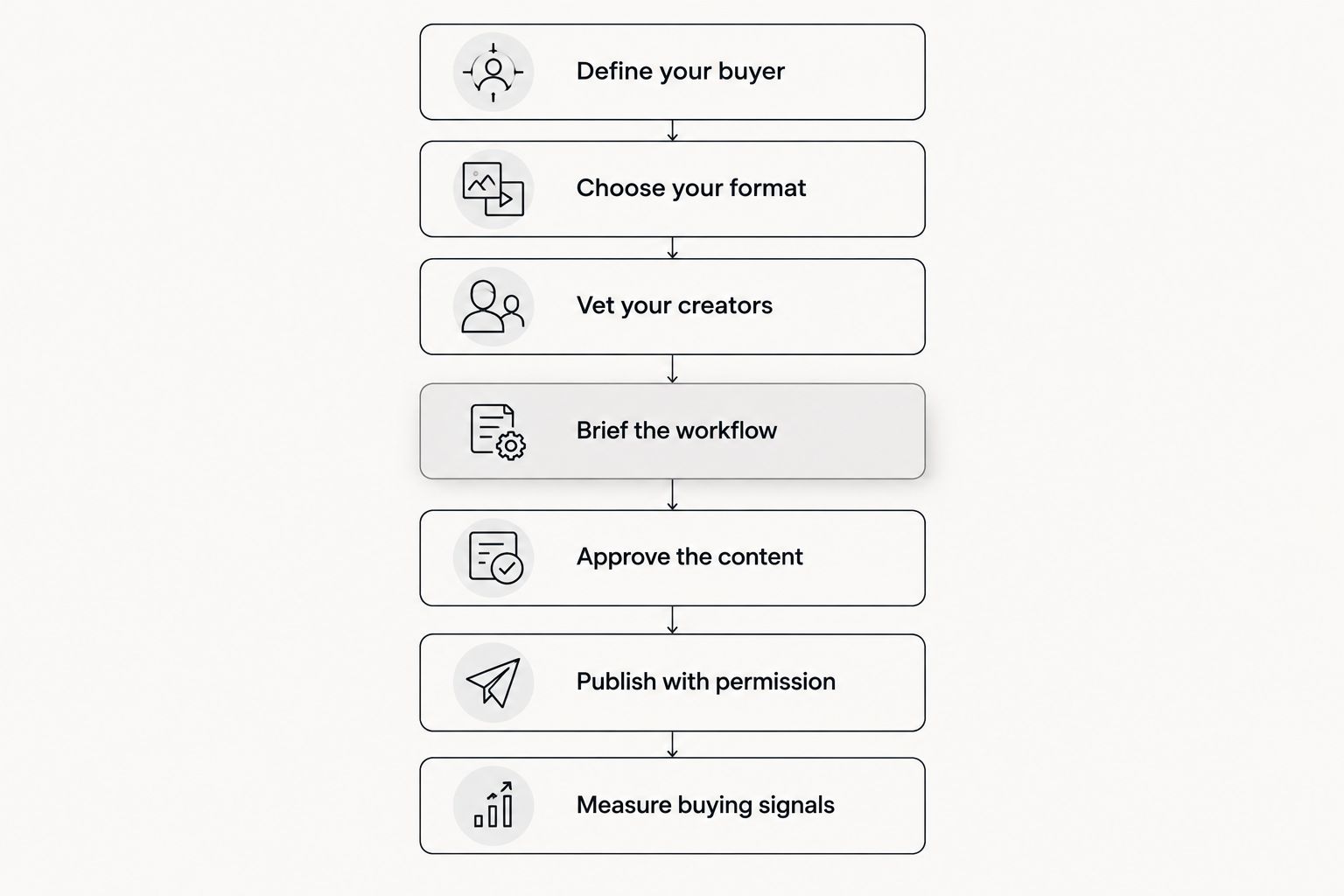
Compare your delivery options
Choose the operating model around the work your team can own. The table compares responsibilities, not promised performance. No model removes your obligation to verify product claims, protect data, or approve the final content.
| Option | Best for | Main advantage | Key limitation |
|---|---|---|---|
| In-house HR subject expert | Teams with knowledgeable, willing internal presenters | Direct access to product and workflow knowledge | Your team owns filming, editing, scheduling, and approvals |
| Independent HR practitioner | Brands seeking a relevant professional voice and audience | Practitioner-led explanation and potential audience access | Audience fit, production skill, and posting rights require separate checks |
| UGC Scout | Tech teams seeking done-for-you short-form creator video production and posting | External execution of creator video production and posting | HR expertise, campaign terms, and deliverables still need confirmation |
| Hybrid internal and external team | Teams that want external production with internal subject review | Keeps product approval close to the business | Requires a clear handoff and a named internal owner |
Choose the hybrid approach when product accuracy needs internal ownership but production capacity is the bottleneck. Choose an independent practitioner when access to a relevant professional audience is the central requirement. Do not buy a production service and assume an HR audience comes with it.
For UGC Scout, the stated fit is done-for-you production and posting for tech companies. Evaluate the proposed engagement against your actual brief rather than assuming unlisted specialist services are included.
Discuss your creator video brief
Explain your HR buyer, software workflow, and production needs.
Common mistakes HR tech teams make
Targeting everyone who works in HR
A payroll administrator and a recruiting operations lead do not need the same demonstration. Narrow the brief to a role and a task. Expand only after you have a clear explanation for the first audience.
Casting a presenter as a practitioner
A creator can demonstrate a product without claiming to be an HR professional. Label the content honestly. Never script a personal recommendation, implementation story, or customer result that the presenter cannot truthfully make.
Filming real employee records
A quick screen recording is not a reason to expose personal information. Build fictional records before filming and inspect the final edit. Check notifications and background tabs as well as the main application window.
Treating views as pipeline
Attention and buyer qualification answer different questions. Keep both in your 2026 report, but do not describe broad video reach as sales impact. Use CRM evidence to report opportunities and explain attribution limits.
Ordering volume before fixing the message
More clips repeat a weak explanation if the buyer, workflow, or next action remains unclear. Review the first approved asset before expanding production. Correct confusing product language before asking for more variations.
FAQ
What's the best way to start B2B influencer marketing for HR tech companies?
Start with one buyer role, one supported workflow, and one desired next action. Build a small pilot around that brief, then evaluate content accuracy and qualified buyer responses before expanding.
Should an HR tech company hire an influencer or a UGC creator?
Hire a practitioner influencer when relevant audience access is the priority; hire a UGC creator when content production is the priority. Confirm distribution separately because producing a video does not automatically include posting to a creator's audience.
Is LinkedIn better than TikTok for HR software marketing?
Choose the channel using evidence that the creator reaches your intended HR buyer. LinkedIn and TikTok require different content packaging, so evaluate the audience, message, and intended next action rather than declaring a universal winner.
Can creators demonstrate HR software without seeing employee data?
Yes, creators can demonstrate HR software using an approved sandbox populated with fictional records. Check permissions, notifications, and every visible screen before approving the recording.
How long should an HR tech creator video be?
A proposed 15–45 second format works as a constraint for a focused short-form brief. Use a longer format when explaining the workflow accurately requires more context, and keep each asset centered on one question.
How do you measure influencer marketing during a long software sales cycle?
Track tagged visits, qualified inquiries, opportunities, and later revenue as separate stages. Combine tracked activity with prospect-reported discovery, and distinguish assisted interactions from directly sourced opportunities.
What should an HR tech team confirm before hiring UGC Scout?
Confirm the creator profile, production deliverables, posting responsibilities, approval process, and usage rights. UGC Scout's stated service is done-for-you short-form creator video production and posting for tech companies; verify HR-specific requirements in the proposed engagement.
One last thing
Write the desired prospect question before you write the hook. For an onboarding tool, that question might be: how would our team assign and track a new starter's tasks?
Then make the video answer it with an approved demonstration. The strongest starting brief is a buyer question your product can visibly answer—not a list of features a creator must recite.