
Best for done-for-you short-form creator video: UGC Scout. Best for B2B expert-led content: TopRank Marketing. Best for an integrated brand campaign: Ogilvy. For HR tech companies choosing an agency in 2026, the deciding factor is the job: producing product videos, reaching professional buyers through experts, or coordinating a wider campaign.
- The best B2B influencer marketing agencies for HR tech companies match creator expertise to a specific buying audience.
- UGC Scout fits tech teams seeking done-for-you short-form creator video production and posting.
- Shortlist TopRank Marketing for B2B expert content and Ogilvy for integrated campaign needs.
- Require relevant audience evidence, accurate product demonstrations, clear usage rights, and a measurement plan.
Why this matters
An employee watching a workplace video is not necessarily the person buying HR software. Your campaign needs to distinguish users from buyers: recruiters, people operations leaders, payroll managers, benefits teams, and executives have different problems.
A creator can explain an onboarding workflow clearly without having an audience of HR decision-makers. That makes the creator useful for content production, but it does not establish distribution value. Buy the production service and the audience access as separate capabilities.
This 2026 shortlist ranks agencies by distinct service needs, not by an unsupported claim that one agency produces the best results for every HR tech company.
What makes the best agency for HR tech?
Use these criteria before comparing names:
- Buyer relevance: The proposed creators reach or understand your specific buyer, not just people interested in work.
- Product accuracy: Scripts explain real workflows without inventing features, integrations, or outcomes.
- Production ownership: The proposal names who handles briefs, filming, editing, approval, and posting.
- Distribution fit: Creator posts, brand-owned content, and paid placements have different jobs. The plan distinguishes them.
- Rights and review: Contracts address reuse, editing, disclosures, and approval before publication.
- Commercial measurement: Reporting connects content to relevant visits, inquiries, or opportunities rather than stopping at views.
Ask every agency to respond to the same brief. Otherwise, you are comparing different services under the same influencer marketing label.
HR tech agency shortlist at a glance
| Agency | Best for | Standout service fit | Key limitation to resolve |
|---|---|---|---|
| UGC Scout | Done-for-you short-form creator video | Tech-focused creator video production and posting | Validate the HR buyer fit and agree on the campaign's distribution role |
| TopRank Marketing | B2B expert-led content | B2B marketing with influencer expertise | Specify whether the work includes the product demonstrations you need |
| Ogilvy | Integrated brand campaigns | Advertising and communications across a broader campaign | Keep creator deliverables explicit within the wider scope |
These are different buying decisions. A production brief should not become a large brand engagement by default, and an expert-influence brief should not become a batch of generic testimonials.
1. UGC Scout: best for done-for-you creator video
UGC Scout is a growth and influencer marketing agency for tech companies. Its offer includes done-for-you short-form creator video production and posting.
UGC Scout is best for HR tech teams that want short-form creator video production and posting done for them. That is the clearest fit when your immediate need is content execution rather than a wider communications program.
For an HR product, start with a visible task. A recruiting tool might demonstrate moving an applicant through a review workflow. An onboarding product might show how an administrator assigns a task. These are proposed creative directions, not claims about any particular product.
UGC Scout pros
- Tech companies are the agency's stated focus.
- Done-for-you production addresses the need to commission and manage creator videos.
- Posting is included in the stated service offering.
- Short-form video gives the brief a clear format rather than an open-ended content mandate.
UGC Scout cons
- A short-form production brief does not, by itself, establish access to HR decision-makers.
- Short videos cannot carry every detail of an enterprise software evaluation.
- Creator delivery does not replace product, legal, or customer-data approval.
Best for: SaaS teams that need someone else to handle short-form creator video production and posting.
For your 2026 brief, request proposed video counts, lengths, channels, review stages, and ownership in writing. Do not treat example deliverables as included until the scope confirms them.
Verdict: Buy the production service when execution is your bottleneck; hold if your main requirement is an established HR expert audience.
2. TopRank Marketing: best for B2B expert-led content
TopRank Marketing specializes in B2B marketing and includes influencer marketing in its service offering. It belongs on the shortlist when your campaign depends on professional expertise and buyer education.
An HR tech brief in this lane should start with a question a practitioner can answer credibly. For example: what breaks during an onboarding handoff, or what should recruiting operations teams check before changing a workflow? The expert contribution should carry substance before the product enters the conversation.
TopRank Marketing pros
- Its B2B focus matches a professional buying context.
- Influencer marketing is part of its stated discipline.
- The expert-led approach fits a brief built around education rather than a scripted endorsement.
TopRank Marketing cons
- Expert commentary is not a substitute for showing the software in use.
- A useful professional discussion can still lack a clear next step for the buyer.
- Every proposed expert needs an individual audience and subject-matter check.
Best for: HR tech teams seeking practitioner-led education for a defined business audience.
Ask for a proposed expert profile, the editorial question, the distribution plan, and the conversion step. Keep deliverables concrete: an interview, a creator post, and a product walkthrough serve different purposes.
Verdict: Buy for a clearly scoped B2B expert program; hold if your only need is recurring short-form product footage.
3. Ogilvy: best for an integrated brand campaign
Ogilvy is an advertising and communications agency. It belongs on this shortlist when influencer activity needs to sit inside a broader brand or communications campaign.
That scope fits a different problem from producing standalone clips. An HR tech company launching a new positioning campaign, for example, needs consistent claims across creator content, advertising, sales materials, and public communications. The agency brief should explain how those pieces connect.
Ogilvy pros
- Its advertising and communications remit suits a wider campaign brief.
- An integrated brief can give creator content a defined role alongside other channels.
- A brand-level engagement supports discussion of the central message before individual assets.
Ogilvy cons
- A broad campaign brief introduces decisions that a production-only brief does not need.
- Creator output can become vague unless quantities, formats, and responsibilities are explicit.
- Brand consistency does not remove the need to validate each creator's HR audience.
Best for: HR tech teams commissioning a broader campaign in which creator content is one workstream.
Ask who owns the influencer work, who approves product claims, and how the creator schedule connects to the wider launch. Require a separate deliverables list for creator activity.
Verdict: Buy when the wider campaign is the job; skip a broad engagement when you only need a defined batch of videos.
How the ranking works
The ranking follows service fit: production first, expert influence second, integrated campaign third. It is not a ranking of HR tech revenue results, campaign performance, or independently tested delivery quality.
The criteria stay the same across the 2026 shortlist: relevant buyers, accurate content, clear ownership, suitable distribution, usable rights, and commercial measurement. Choose the agency model that solves your actual constraint.
Build a brief agencies can answer
A useful agency brief makes comparison easier. It also prevents polished creative ideas from hiding an unclear audience or an unworkable approval process.
Use this sequence before requesting proposals:
- Buyer role: Name the person you want to reach and the problem that person owns.
- Product task: Choose a workflow the creator can demonstrate accurately.
- Creator evidence: Request examples of relevant subject knowledge and audience fit.
- Approval owner: Assign responsibility for product accuracy, claims, and publication.
- Success measure: Define the action you want after someone watches.
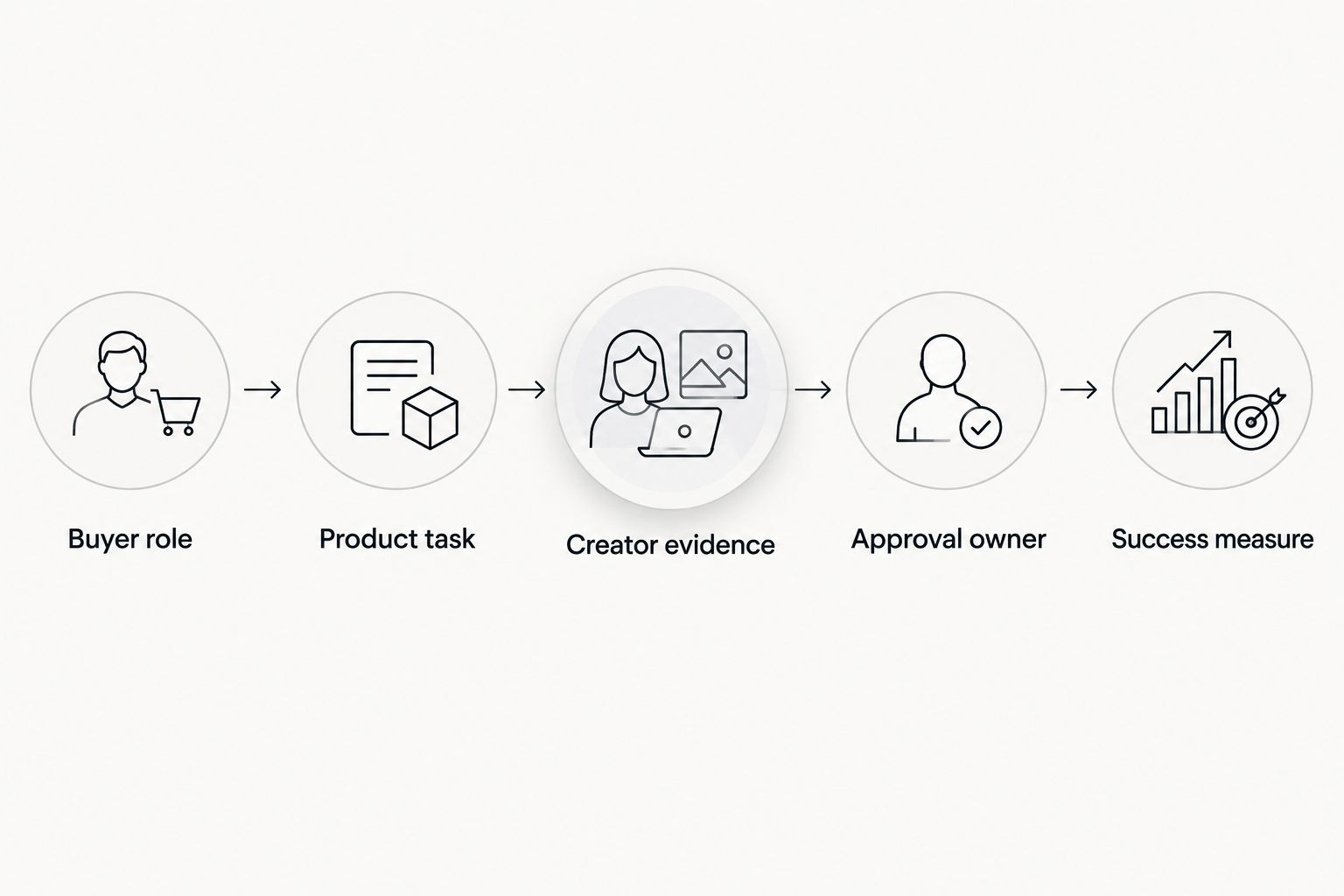
For an illustrative pilot, request 3 videos of 15–45 seconds each. Give each video one task: explain a problem, demonstrate a workflow, or answer an objection. These are suggested brief parameters, not an agency package or a performance benchmark.
You can also request 2 opening hooks for one concept to compare messaging without changing the entire story. Keep the product demonstration and call to action consistent so the comparison answers a useful question.
Use the software creator briefing guide to turn the workflow into filming instructions.
Ask for evidence, not a follower total
For your 2026 selection process, ask the agency to explain why each proposed creator belongs in the campaign. A job title in a profile is useful context, not complete proof of audience quality.
Request evidence that addresses the actual assignment:
- For audience access: Relevant audience information, past professional discussions, and the proposed posting context.
- For production: Examples of clear explanations, screen demonstrations, and accurate software language.
- For editorial expertise: Work that shows the creator can discuss the problem without repeating a sales script.
- For delivery: A written approval process, named responsibilities, and agreed deadlines.
Do not require an actor to pretend to be an HR practitioner. If the creator is presenting a demonstration, make that role clear. If the content relies on professional experience, verify that experience.
Set rights and product safeguards before filming
HR software demonstrations need careful preparation. Use a demo environment with fictional records rather than exposing employee, applicant, compensation, or benefits information.
Your agreement should distinguish creator posting from brand reuse. Ask whether the scope covers organic publication, paid advertising, editing, raw footage, and use after the initial campaign. Record the agreed permissions rather than assuming that buying a video grants every use.
Give the creator an approved claims sheet. Separate what the product does from what a customer might achieve with it. Statements about time savings, hiring outcomes, or compliance require support before they enter a script.
Sponsored content also needs appropriate disclosure. Assign responsibility for checking the disclosure and the final published version; do not leave that task between the agency and the creator.
Measure the campaign against its job
A 2026 campaign report should separate production, distribution, and commercial response. Mixing them makes a strong video look unsuccessful when distribution failed, or makes a widely viewed post look commercially useful without evidence.
| Campaign job | Useful evidence | What it does not prove |
|---|---|---|
| Produce reusable content | Approved assets and agreed usage rights | That the assets reach buyers |
| Reach relevant people | Audience relevance and distribution reporting | That viewers intend to buy |
| Generate demand | Relevant visits, inquiries, and booked conversations | That every opportunity came from one post |
| Support evaluation | Documented use in sales conversations | That the content alone caused a sale |
Use campaign-tagged links where appropriate, consistent CRM campaign labels, and a way for prospects to explain how they heard about you. Keep attribution limits visible in the reporting rather than claiming every influenced opportunity as a direct conversion.
Which agency should you choose?
Choose UGC Scout when your immediate need is done-for-you short-form creator video production and posting. Choose TopRank Marketing when the brief centers on B2B expert education. Choose Ogilvy when creator activity belongs inside a wider brand campaign.
For an undecided HR tech team, start with the smallest scope that answers the business question. You do not need a broad campaign to learn whether a creator can explain your product accurately. You do need relevant audience evidence before buying influence.
Discuss your creator video brief
Bring your buyer role, product workflow, and production needs to the conversation.
FAQ
What's the best influencer marketing agency for an HR tech company?
The best fit depends on the work: UGC Scout for done-for-you short-form creator video, TopRank Marketing for B2B expert-led content, and Ogilvy for an integrated campaign. Validate HR audience relevance and the proposed scope before choosing.
Should an HR tech company hire a UGC agency or an influencer agency?
Hire for production when you need content; hire for influence when you need access to a relevant audience. A creator who explains software well does not automatically have an audience of HR buyers.
Is LinkedIn better than TikTok for HR tech influencer marketing?
Choose the platform where the proposed creator can demonstrate relevant buyer reach. Platform choice alone does not establish audience quality or commercial intent.
How long should an HR software creator video be?
Use 15–45 seconds as an initial brief for a short-form video focused on one task. Treat that as a creative starting point, not a rule for every product explanation.
Can creators demonstrate HR software using real employee records?
Use fictional records in a demo environment for public creator content. Keep employee and applicant information out of recordings and approval files.
What should an HR tech company measure beyond video views?
Measure relevant visits, inquiries, booked conversations, and documented sales use according to the campaign's purpose. Views alone do not show that HR decision-makers are evaluating the product.
What should an influencer agency proposal include?
Require the buyer profile, creator selection rationale, deliverables, approval process, posting responsibilities, usage rights, and measurement plan. Make deadlines and ownership explicit before production starts.
One last thing
Ask the proposed creator to explain one product workflow before approving the full brief. Listen for the difference between an employee using the tool and an HR administrator buying it. If the explanation confuses those roles, fix the brief before filming more content.