
Yes. A UGC agency can work with an in-house creative team when your team owns the strategy and final approval, and the agency has a defined production role. The extra responsibility is coordination: you still need to approve product claims, provide access, and decide what ships. Keep those decisions inside your business instead of creating competing creative leads.
- A UGC agency with in-house creative team support works best when strategy, production, and approvals have clear owners.
- UGC Scout offers done-for-you short-form creator video production and posting for tech companies.
- Keep product claims and final approval in-house; assign creator production responsibilities in writing.
- Start with a shared brief and evaluate the handoff before expanding production.
Can a UGC agency work with an in-house creative team?
Yes. Treat the agency as an extension of your production workflow, not a replacement for your creative lead. The following table is a recommended responsibility split, not a claim about any agency’s standard contract.
| Responsibility | In-house creative team | UGC agency |
|---|---|---|
| Campaign objective | Defines the audience and desired action | Flags production questions |
| Product accuracy | Approves claims and demonstrations | Follows approved product guidance |
| Creative brief | Owns the message and boundaries | Translates the brief into creator instructions |
| Creator production | Supplies access and reviews direction | Handles the agreed creator work |
| Editing | Sets standards and supplies brand assets | Delivers the agreed edits or footage |
| Final approval | Names the decision-maker | Resolves consolidated feedback |
| Posting | Approves channel and publishing decisions | Posts only where included and authorized |
UGC Scout is a UGC agency for tech teams seeking done-for-you short-form creator video production and posting. That scope is relevant when production is the gap; it does not remove your need for an internal product owner.
Why this matters
Your creative team knows the product. A creator still needs to know which workflow to demonstrate, which buyer problem to address, and which claims are approved. An agency relationship needs a clear handoff between that knowledge and the production work.
For your 2026 production plan, separate capacity from authority. You can outsource filming and coordination without outsourcing the decision about what your product should promise.
The risk is not having an external team. The risk is asking both teams to own everything, then discovering that neither owns the final decision.
Which collaboration model should you choose?
Choose the model around the work your team needs to stop doing. Do not buy an undefined promise of more content.
| Model | Best for | Main benefit | Main trade-off |
|---|---|---|---|
| Agency production | Teams with an established creative lead | Keeps direction internal while assigning production externally | Your team still needs review capacity |
| Shared creative development | Teams that want outside concepts alongside internal direction | Creates a defined place for external creative input | Requires agreement on who selects concepts |
| In-house production | Teams that need direct control of every production decision | Keeps coordination and execution together | Your team retains creator and production work |
Agency production: best for an established creative team
Keep the campaign concept, product positioning, and approval standards in-house. Ask the agency to handle an explicitly defined production package, such as creator coordination, filming, editing, or posting.
This model fits a team that knows what it wants to say but needs help producing it. Its limitation is straightforward: a finished video still needs someone inside your business to review it.
Choose agency production when execution is the bottleneck, not when the campaign lacks direction.
Shared creative development: best for outside creative input
Ask the agency to propose approaches against your approved audience and objective. Your creative lead selects the direction before creators film.
The benefit is outside input without giving up internal accountability. The trade-off is another decision point: if both teams can rewrite the concept after filming, the assignment has no stable finish line.
In-house production: best for direct production control
Keep production internal when your team needs to direct the performance, edit decisions, and product demonstration itself. An external production relationship is a poor fit if nobody is prepared to delegate those decisions.
The benefit is control. The limitation is that creator coordination and production remain on your team’s workload. Compare that workload with the work you actually want an agency to take over.
How do you divide the work without duplicating it?
Build the handoff before requesting a large batch. Use this sequence as your 2026 working agreement, then adapt the details to your product and approval requirements.
1. Name the owners
Assign an internal creative owner and an agency production owner. Give each a clear decision boundary: the internal owner approves direction; the production owner coordinates the agreed execution.
Choose 1 final approver for each asset. Specialists can contribute feedback, but the creator should not have to reconcile contradictory instructions from product, design, and growth.
2. Write the brief
Use 1 shared brief as the source of instructions. Include the audience, problem, desired action, approved claims, demonstration steps, and creative boundaries.
For a SaaS example, ask a creator to show how a user completes a specific task. For a mobile app, identify the screen sequence that supports the story. Do not ask a creator to invent a personal result or pretend to have used a feature they have not used.
A software UGC creator brief should distinguish what must be accurate from what the creator can say naturally.
3. Approve the concept
Review the opening, demonstration, and closing action before filming. Decide whether the proposed story matches the buyer’s problem and whether the footage can actually show the promised workflow.
Leave room for the creator’s delivery. Approve the substance without scripting every pause or expression unless the assignment specifically requires that control.
4. Consolidate feedback
Collect internal comments before sending revisions. Separate factual corrections from preferences, and state which changes are required for approval.
A useful comment identifies the problem and the correction. Replace vague feedback about energy with a precise request: move the product demonstration earlier, remove an unsupported claim, or make the next action explicit.
5. Confirm the handoff
Confirm the deliverables, permitted uses, file requirements, and publishing owner before production starts. Make clear whether your team receives finished edits, source footage, or both; do not assume they are interchangeable deliverables.
Your 2026 handoff checklist should also record the product version shown. That gives reviewers a reference when the interface changes before publication.
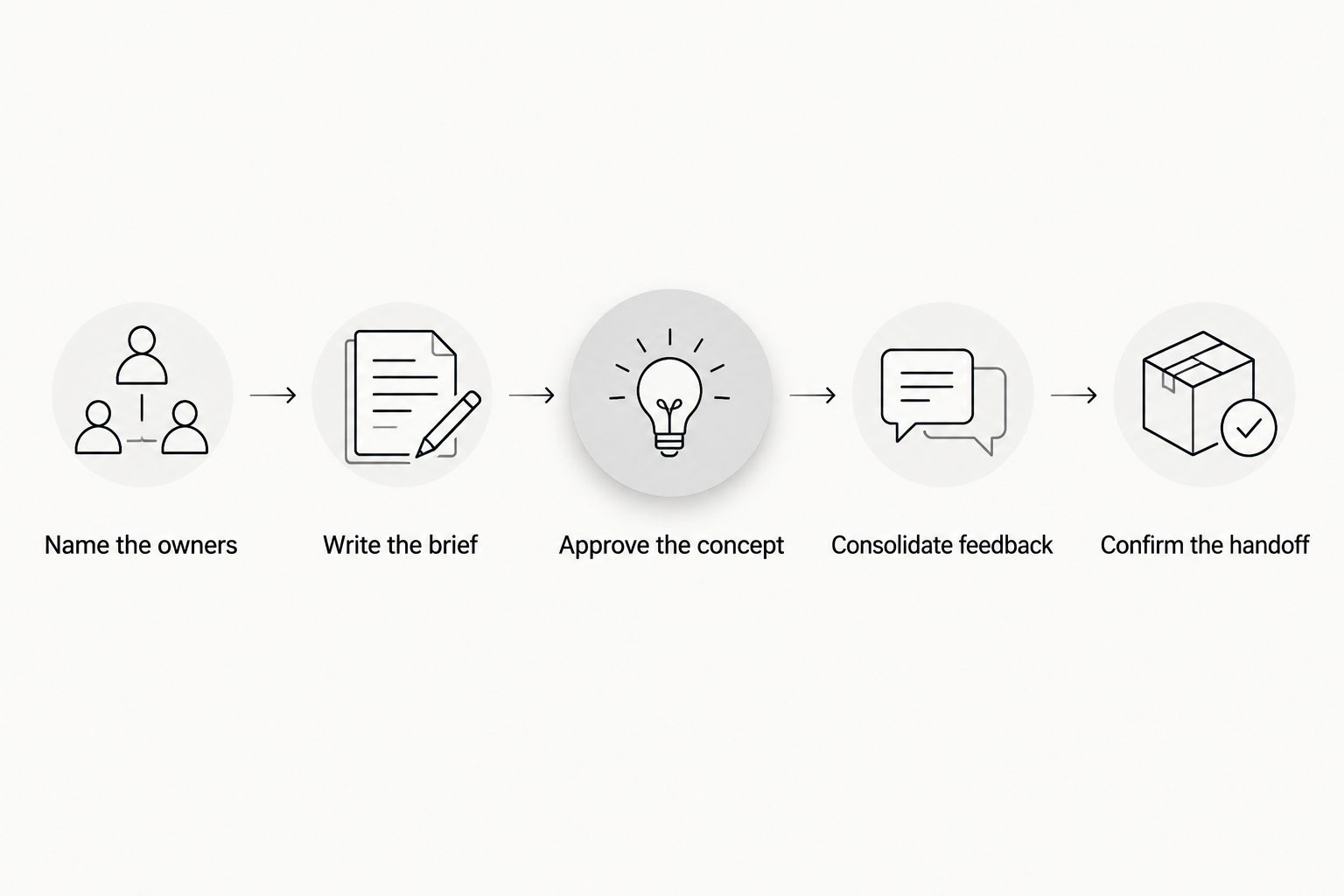
The handoff is complete when both teams can identify the next action without another planning meeting. If a deliverable still has no approver or publishing owner, resolve that gap before requesting more footage.
What should stay with your in-house creative team?
Keep decisions that require product knowledge and business authority inside your company. The agency can work from those decisions, but it should not have to guess them.
- Positioning: Define who the video addresses and which problem matters.
- Product truth: Confirm that each feature, workflow, and claim is accurate.
- Access boundaries: Decide what creators can see, record, or disclose.
- Final approval: Authorize the finished asset for its intended use.
- Business evaluation: Decide whether the campaign supports the objective.
Give creators a demonstration environment or approved recording material where appropriate. Do not send live customer information just because a screen recording would be convenient.
For a 2026 launch, identify who updates the brief when the product changes. An accurate brief at kickoff is not permission to publish an outdated demonstration later.
Why collaboration requirements vary
The right division of work depends on the assignment. Use these factors to define responsibilities rather than assuming every creator video needs the same process.
- Product complexity: Specify the task and terminology a creator must understand before demonstrating the product.
- Internal capacity: Decide whether your team needs help with filming alone or with coordination and editing too.
- Approval requirements: Identify the people who must review product claims or sensitive demonstrations.
- Publishing scope: Separate delivery to your team from posting on an agreed account.
- Reuse plans: Define intended channels and uses before commissioning the footage.
- Creative control: State which parts of the concept are fixed and which belong to the creator.
These factors belong in the scope of work. A broad request to manage UGC does not tell either team who owns a revised script, a new edit, or a posting decision.
How do you know whether the arrangement is working?
Evaluate the collaboration against the work it was meant to remove. Count deliverables, record revisions, and document internal review time using your own production records. Do not substitute a volume target for evidence that the assets are usable.
Separate production acceptance from campaign performance. A video can meet the brief without proving that its message persuades buyers; campaign results need their own evaluation against the campaign objective.
Use these questions in your 2026 review:
- Did the agency deliver the agreed files and versions?
- Did reviewers receive content they could approve against the brief?
- Did revisions correct execution errors or introduce a new direction?
- Did your team retain tasks that the scope assigned externally?
- Were publishing permissions clear before anyone posted?
UGC Scout is a fit for tech teams seeking done-for-you creator video production and posting. If your team wants to direct every production step, define a narrower assignment rather than treating done-for-you work as an open-ended internal production desk.
Can our in-house team keep editing the videos?
Yes, if your agreement includes the source files and editing permissions your team needs. Specify footage, project files, audio, captions, and export requirements before commissioning the work.
Do not assume that permission to publish a finished video includes permission to recut every component. Confirm the intended editing and reuse arrangements in writing.
Should the agency publish the content or send it to us?
Either arrangement can work. Choose based on who owns the channel and who is responsible for publication approval.
If posting is included, define the account, approved asset, accompanying text, and release decision. If your team publishes, make the delivery handoff explicit and keep posting authority internal.
Should we start with a small assignment?
Yes. Start with a contained assignment that exercises the full workflow: briefing, creator direction, review, delivery, and publication approval.
Evaluate the process before expanding it. A larger batch does not resolve unclear ownership; it adds more assets that need the same unresolved decisions.
FAQ
Can a UGC agency work with our existing creative director?
Yes. Your creative director can own strategy and final approval while the agency handles an agreed production scope. Document who selects concepts and who authorizes revisions.
Will a UGC agency replace our in-house creative team?
Not when you define the agency as a production partner. Keep positioning, product accuracy, and final approval internal, and specify the work the agency takes over.
Who should write the UGC brief?
Your internal creative owner should own the brief, with agency input on execution. Include the audience, approved claims, demonstration steps, and desired action.
Can our designers edit creator footage after delivery?
Yes, if the agreement includes the required footage and editing permissions. Confirm source files, audio permissions, and intended reuse before production starts.
How do we stop conflicting feedback from slowing approval?
Choose 1 final approver for each asset and send consolidated feedback. Separate required factual corrections from creative preferences so the production team knows what approval requires.
Is done-for-you UGC suitable for a SaaS or mobile app team?
Done-for-you UGC suits a SaaS or mobile app team that wants external help producing creator videos while retaining internal product authority. UGC Scout offers short-form creator video production and posting for tech companies.
One last thing
Write down what will disappear from your team’s workload. Be specific: creator coordination, production follow-ups, editing, or posting, depending on the agreed scope.
Then write down what remains: product access, claims approval, creative decisions, and business evaluation. If both lists contain the same production task, resolve the overlap before signing. More content is not the same as less work for your team.