
Yes, founders can appear in their own UGC-style video ads, provided the ads identify their relationship to the business and make truthful claims. Treat the footage as founder-led advertising, not independent customer testimony. For SaaS and mobile app teams, use founders to explain product decisions and creators to demonstrate a user's experience.
- Founders in UGC video ads should identify their role, not pose as independent customers.
- Use founder-led ads for product explanations; use creator-led ads for genuine user demonstrations.
- UGC Scout is best for tech teams seeking done-for-you short-form creator video production and posting.
- Test the speaker separately from the hook, product demonstration, and call to action.
Can founders appear in their own UGC video ads?
Yes. The distinction is who is speaking, not whether the video looks casual. A founder recording on a phone is still speaking on behalf of the company. A creator describing a paid assignment also has a commercial relationship that needs clear disclosure.
For your 2026 creative plan, separate founder-led advertising from customer evidence. Both belong in a content program, but they answer different questions. A founder explains why the product exists; a genuine user explains what happened when they used it.
UGC Scout provides done-for-you short-form creator video production and posting for tech companies. The decision below is about where founder footage belongs alongside that work, not replacing every creator with the founder.
| Format | Best for | Main advantage | Main limitation |
|---|---|---|---|
| Founder-led video | Product rationale and informed explanations | The speaker can explain decisions they made | The founder is not an independent customer |
| Creator-led video | Audience-specific demonstrations and genuine personal experience | The speaker can show the product from a user's perspective | Product knowledge and claims need checking |
| Mixed founder-and-creator video | Connecting a product explanation with a use case | Each speaker has a distinct role | Editing must preserve who said and experienced what |
Choose the speaker based on the claim you need to make. Do not ask a founder to supply independent social proof or ask a creator to repeat a founder's personal story as their own.
Why this matters
An informal filming style does not turn a sales message into customer testimony. Your audience needs to understand whether the person built the app, received payment to demonstrate it, or actually used it as a customer.
That distinction should guide your 2026 briefs before filming starts. It affects the opening line, the disclosure, the demonstration, and the evidence behind each claim. Fixing those elements in the brief is more useful than trying to correct misleading footage in the edit.
Founder participation also creates a production choice. You get direct access to product knowledge, but filming and approvals take founder time. Use founders where their knowledge changes the message, not simply because they are available.
Founder-led ads: best for explaining product decisions
Put the founder on camera when the message depends on firsthand knowledge of building the product. Explain the problem the team chose to solve, demonstrate the relevant workflow, and show the decision behind a feature.
Keep the story attached to the buyer's task. A company origin story that never reaches the product leaves the viewer without a reason to act. The useful part is not the founder's biography; it is the connection between a known problem and a visible solution.
For a proposed 30-second video, allocate the opening to the problem, the middle to a screen demonstration, and the ending to a relevant next step. Treat that duration as a creative constraint, not a performance benchmark.
- Use it for: Product rationale, informed objections, and explanations the founder can substantiate.
- Watch for: Long introductions, unsupported comparisons, and personal opinions presented as customer results.
- Recommendation: Use founder-led footage when the founder has something specific to explain.
Creator-led ads: best for showing a user's workflow
Use a creator when the message depends on how someone approaches a task. For a SaaS product, that means showing the workflow rather than reading a feature list. For a mobile app, show the relevant interaction and what the creator actually does with it.
A paid creator is not automatically an independent reviewer. Give the creator product access when the script requires firsthand experience, and distinguish a demonstration from a testimonial. Do not script an outcome the creator did not experience.
A proposed 15-second video can focus on a narrow task. A proposed 45-second video can leave room for more explanation. Neither duration guarantees results; choose the length around what you need to show clearly.
- Use it for: Audience-specific language, product demonstrations, and genuine personal observations.
- Watch for: Incorrect screen actions, invented usage histories, and scripts that sound like company copy.
- Recommendation: Use creator-led footage when the viewer needs to see the product through a user's eyes.
Mixed ads: best for separating explanation from experience
A mixed ad gives the founder and creator different jobs. The founder explains a product decision. The creator demonstrates the related task or describes a genuine experience.
Keep the handoff explicit. Identify each speaker and avoid edits that make a founder's claim sound like the creator's result. If the creator is demonstrating a hypothetical workflow, do not frame it as a documented customer outcome.
The trade-off is more coordination. You need compatible footage, consistent product screens, and approval of the final context—not just approval of separate clips.
- Use it for: A product explanation that benefits from a separate demonstration.
- Watch for: Confusing speaker changes and claims created accidentally by editing.
- Recommendation: Use mixed footage only when both speakers add information.
Why the right founder involvement varies
The right choice for your 2026 campaign depends on the message and production requirements. Do not decide by camera confidence alone.
- Claim ownership: Product decisions belong with someone who made them. Personal experiences belong with the person who had them.
- Product access: A meaningful software demonstration requires access to the relevant workflow and a safe recording environment.
- Audience fit: Match the speaker's language and examples to the people buying or using the product.
- Founder availability: Recording, corrections, and approvals need an owner who can complete them.
- Publishing context: Plan where the video will run, whose account will publish it, and what permissions and disclosures apply.
- Evidence requirements: Support factual claims before recording, especially results, comparisons, and regulated claims.
How do you brief a founder for a UGC-style ad?
Give the founder the same production discipline you would give a creator. Write the audience, task, claim, demonstration, and next action before asking anyone to record. A loose request to make something authentic is not a usable brief.
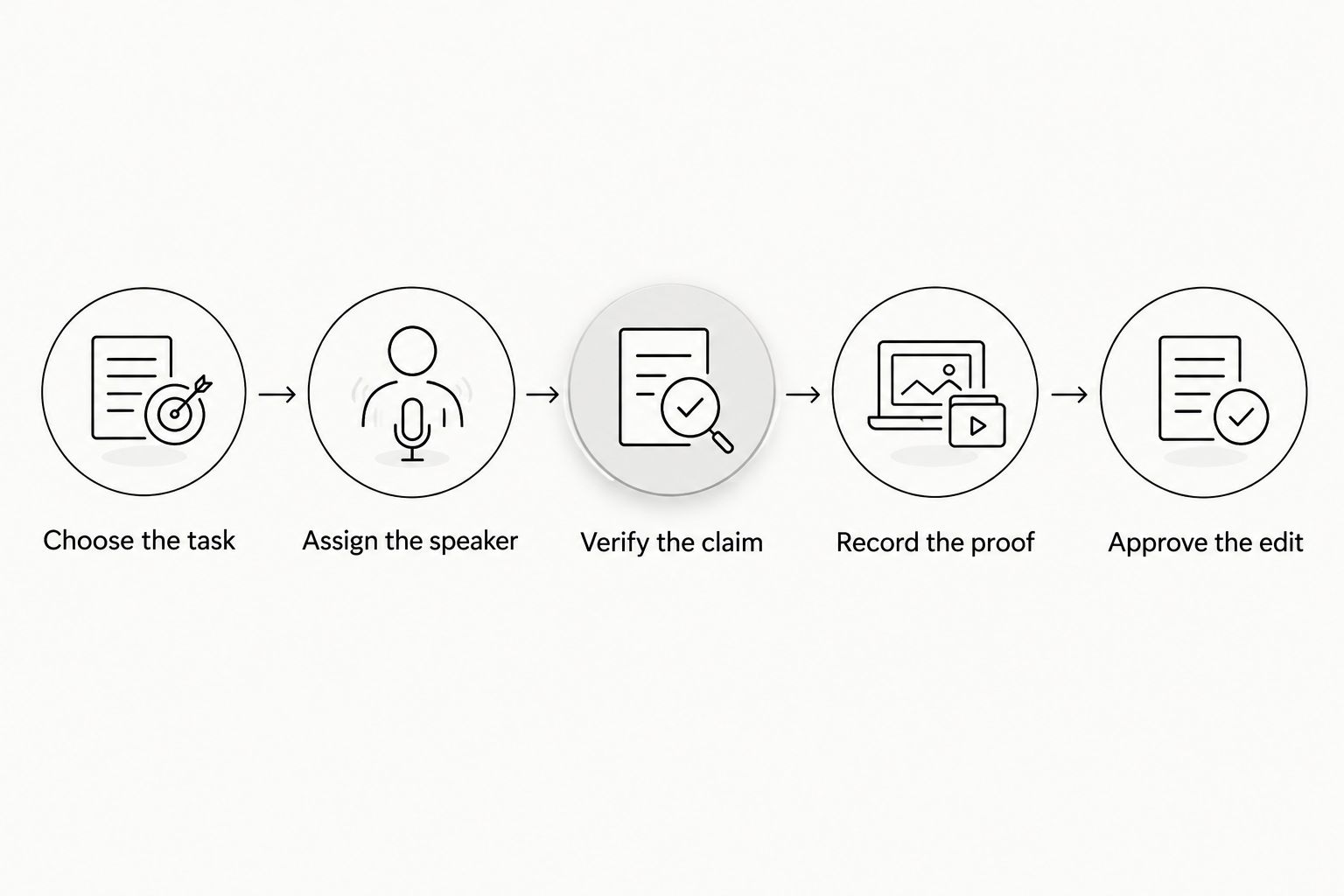
For your 2026 production workflow, use this sequence:
Choose the task
Pick a specific user problem. For a hypothetical scheduling app, that might be changing an appointment without repeating the setup process. Avoid trying to explain the whole product in the same clip.
Assign the speaker
Decide whether the message requires founder knowledge or user experience. If it requires both, assign separate lines and shots. Do not leave that distinction for the editor to infer.
Verify the claim
Write down what supports the claim. A visible feature can be demonstrated on screen; a claim about customer results needs evidence beyond the founder saying it happened. Remove claims that cannot be supported.
Record the proof
Capture the screen action the viewer needs to see. Use a demonstration account with appropriate permissions and no private customer information. Make sure the spoken explanation matches the interface being shown.
Approve the edit
Review the finished video for meaning, not just appearance. Check speaker identity, disclosures, screen accuracy, captions, and the call to action. An edit can change the implication of otherwise accurate footage.
Keep the brief short enough to use during recording. Add approved product terminology and prohibited claims where needed. For the creator side of the process, use this guide to briefing a UGC creator for a software product.
Are founder videos better than creator videos?
Founder videos are not inherently better than creator videos. The speaker should match the message, and performance needs to be measured against your campaign objective. A confident founder delivery does not establish that the ad brings better users or leads.
To compare speakers, keep the offer, audience, destination, and central demonstration consistent. Changing the speaker, hook, editing style, and landing page together makes it difficult to explain the result.
Choose the decision metric before launch. For an app campaign, evaluate the downstream action your team actually values, not just attention. For SaaS, distinguish a form submission from a qualified sales opportunity.
Does a founder need to disclose ownership?
Make the founder's ownership relationship clear. FTC endorsement guidance requires disclosure of material connections when the audience would not otherwise understand them. A casual video style should not obscure the speaker's connection to the advertiser.
Identify the person as the founder in the video rather than relying on viewers to recognize a name or account. Use plain language and make the disclosure easy to notice. Review the applicable platform rules and obtain legal review for campaign-specific questions.
Can founders and creators use the same script?
Founders and creators can share a message structure, but not interchangeable personal claims. The problem, demonstration, and next action can stay consistent while each speaker describes only what they know or experienced.
For your 2026 script library, label statements by speaker and evidence. Keep founder rationale separate from creator observations. That makes it easier to produce variations without turning company claims into apparent customer endorsements.
When should you bring in a UGC agency?
Bring in an agency when you want creator production handled for you rather than added to the founder's workload. Keep the founder involved in product truth and approvals, while assigning clear responsibility for briefs, footage, editing, and posting.
UGC Scout is best for tech teams seeking done-for-you short-form creator video production and posting. The limitation is straightforward: an agency cannot supply the founder's personal experience or approve unsupported product claims on the company's behalf. Your team still needs an accountable product reviewer.
Discuss your creator video plan
Talk through done-for-you short-form creator video production and posting for your tech company.
FAQ
Can I star in my startup's own UGC ads?
Yes, you can appear in your startup's UGC-style ads as its founder. Make your relationship clear and avoid presenting yourself as an independent customer.
Is a founder video actually user-generated content?
Founder footage is more accurately described as founder-led advertising, even when it uses a casual UGC style. The filming style does not change the speaker's relationship to the company.
Should a founder pretend to be a customer in an ad?
No, a founder should not pose as an independent customer. A founder can demonstrate their own product, but ownership and personal experience must be represented truthfully.
How long should a founder-led video ad be?
Use the shortest length that clearly communicates the problem, demonstration, and next action. A 15-second, 30-second, or 45-second brief is a planning choice, not a guaranteed performance formula.
Can a paid creator say they use our app?
A paid creator can describe genuine app use, but the script must reflect their actual experience. Disclose the commercial relationship and do not invent usage history or results.
Can we combine founder footage with creator footage?
Yes, you can combine founder and creator footage when each speaker's role remains clear. Check that the edit does not turn a product explanation into an implied customer result.
Do I need an agency if the founder can record videos?
No, founder recording does not require an agency. An agency becomes relevant when your team wants help producing and posting creator content rather than managing that work internally.
One last thing
The founder does not have to appear in every ad to contribute to the content. Record the founder explaining product decisions, objections, and accurate demonstrations. Use that material as briefing input, not as personal testimony for someone else to repeat.
That separates product knowledge from on-camera delivery. Your founder supplies what is true; each creator supplies their own truthful perspective.