
Yes. You can use UGC for enterprise software case studies when the customer experience is real, the claims are supported, and everyone appearing has approved the intended use. A paid creator can explain a verified customer story, but must not pretend to be that customer or claim results they never achieved.
- UGC enterprise software case studies need verified customer evidence, not a creator pretending to be a customer.
- Use customer interviews for firsthand experience and creator-led demos for product explanation. Label the difference.
- Ugcscout fits tech teams seeking done-for-you short-form creator video production and posting.
- Approve claims, screen recordings, customer permissions, and distribution rights before publishing.
Can UGC be used for enterprise software case studies?
Yes—use UGC as the presentation format, not as a substitute for evidence. A customer-recorded video can document firsthand experience. A commissioned creator video can explain that experience, provided the script identifies whose story it is.
For teams evaluating Ugcscout, separate the production decision from the evidence decision. Done-for-you short-form video production and posting does not remove your responsibility to verify the customer story.
Choose the format according to what you can substantiate:
| Format | Best for | Strength | Limitation | Publication requirement |
|---|---|---|---|---|
| Customer-recorded testimonial | Firsthand workflow experience | The actual user describes the change | Recording quality and detail depend on the participant | Confirm identity, statements, and permission |
| Creator-narrated case study | Explaining an approved customer story | You can structure the explanation around a clear workflow | The creator cannot speak as the customer | Attribute the experience and verify every claim |
| Customer interview with demo footage | Connecting testimony to product use | Viewers see the workflow alongside the customer's account | Requires coordination across interviews and screen capture | Approve both the interview and visible product information |
For a 2026 enterprise software case study, start with the evidence you already have permission to publish. Then choose the recording format. Do not cast a creator first and invent a customer story around the footage.
Why this matters
An enterprise buyer needs to understand what changed, who experienced the change, and whether the situation resembles their own. An informal recording can answer those questions. A polished video can fail to answer them.
The distinction is not phone footage versus studio footage. It is supported experience versus unsupported persuasion. Keep the customer context, the workflow, and the limits of the result visible in every version.
For your 2026 content plan, treat short-form clips as entry points to the full case study. A brief video should communicate one useful finding, not imply that it proves every purchasing requirement.
Customer-recorded testimonial: best for firsthand experience
Choose a customer-recorded testimonial when the person using the software can explain a specific task in plain language. Ask about the previous process, the task they perform now, and what changed in their own work.
Keep the speaker within their knowledge. An individual user can describe their experience; that does not automatically authorize them to speak for the entire company or publish company-wide results.
Give the participant prompts rather than a fabricated endorsement. Ask them to describe the workflow in their own words, then check the edited version against the original recording.
Choose this format when firsthand experience is the main evidence. Its limitation is scope: one user's account should not become an unsupported claim about every team, deployment, or buyer.
Creator-narrated case study: best for explaining approved evidence
Choose a creator-narrated case study when you have an approved customer story but need someone to explain it clearly. The creator acts as a presenter, not a customer stand-in.
Use third-person attribution for the customer's experience. Keep the creator's own product demonstration separate from any statement about customer outcomes, and identify paid relationships where disclosure is required.
A narrator can describe a documented approval workflow while showing an approved demonstration. That does not give the narrator permission to say they personally implemented the software at the customer's company.
Choose this format for explanation, not simulated testimony. Its main limitation is distance from the source: buyers must still be able to distinguish the presenter's delivery from the customer's evidence.
Customer interview with demo footage: best for showing the workflow
Choose an interview-and-demo format when the customer's explanation needs visual context. Pair the customer's account with the relevant product action rather than unrelated interface footage.
Use a sanitized demonstration environment when the live account contains confidential information. Label illustrative footage so viewers do not mistake a recreated workflow for a recording of the customer's actual account.
Keep product capability separate from customer adoption. Showing a feature proves what the demonstration depicts; it does not establish that the customer deployed that feature or achieved a particular result.
Choose this format when seeing the task makes the story clearer. Its limitation is coordination: the interview, product footage, permissions, and final edit all need to tell the same accurate story.
How do you build an enterprise UGC case study?
Build the story around a documented customer experience before writing the creator brief. Use this sequence for a 2026 production plan, whether your team handles production internally or hires an agency.
1. Choose evidence
Select a customer experience that answers a concrete buyer question. Useful subjects include how a team routes requests, reviews work, or completes a recurring task.
Create a claim record with the source, exact wording, relevant context, and approval status. If a result cannot be supported, remove it rather than asking the creator to make it sound plausible.
2. Confirm permission
Get written approval for the customer's name, logo, speaker, statements, and intended distribution. Do not assume an interview invitation includes permission for paid advertising.
Record restrictions before filming. If the customer allows an anonymous story only, remove identifying details from the script, screen recordings, captions, filenames, and supporting visuals.
3. Write the brief
Give the creator the audience, buyer question, approved facts, prohibited claims, and required disclosure. State whether the speaker is a customer, presenter, employee, or independent commentator.
Use the guide to briefing a UGC creator for a software product to structure the handoff. The brief should explain what the viewer needs to understand, not just which opening line to deliver.
4. Record safely
Prepare approved footage before recording. Check names, notifications, browser tabs, account identifiers, customer records, and any information visible outside the main product window.
An NDA is not a substitute for limiting access. Give the creator only the environment and materials needed for the approved recording, and keep sensitive production systems out of the shoot.
5. Review claims
Compare the edited video with the evidence record. Check spoken words, subtitles, headlines, captions, and visual overlays; an unsupported claim in a caption is still an unsupported claim.
Assign review responsibilities explicitly. Product reviewers check the demonstration, customer owners confirm permissions, and the appropriate legal or compliance reviewer handles relevant restrictions.
6. Publish deliberately
Export each version for its intended placement. Keep the approved asset, source material, permissions, and distribution restrictions together so the next person does not reuse the wrong cut.
Recheck the story before expanding distribution in 2026. Approval for an organic post should not be treated as automatic approval for a paid campaign, a translated version, or a materially different edit.
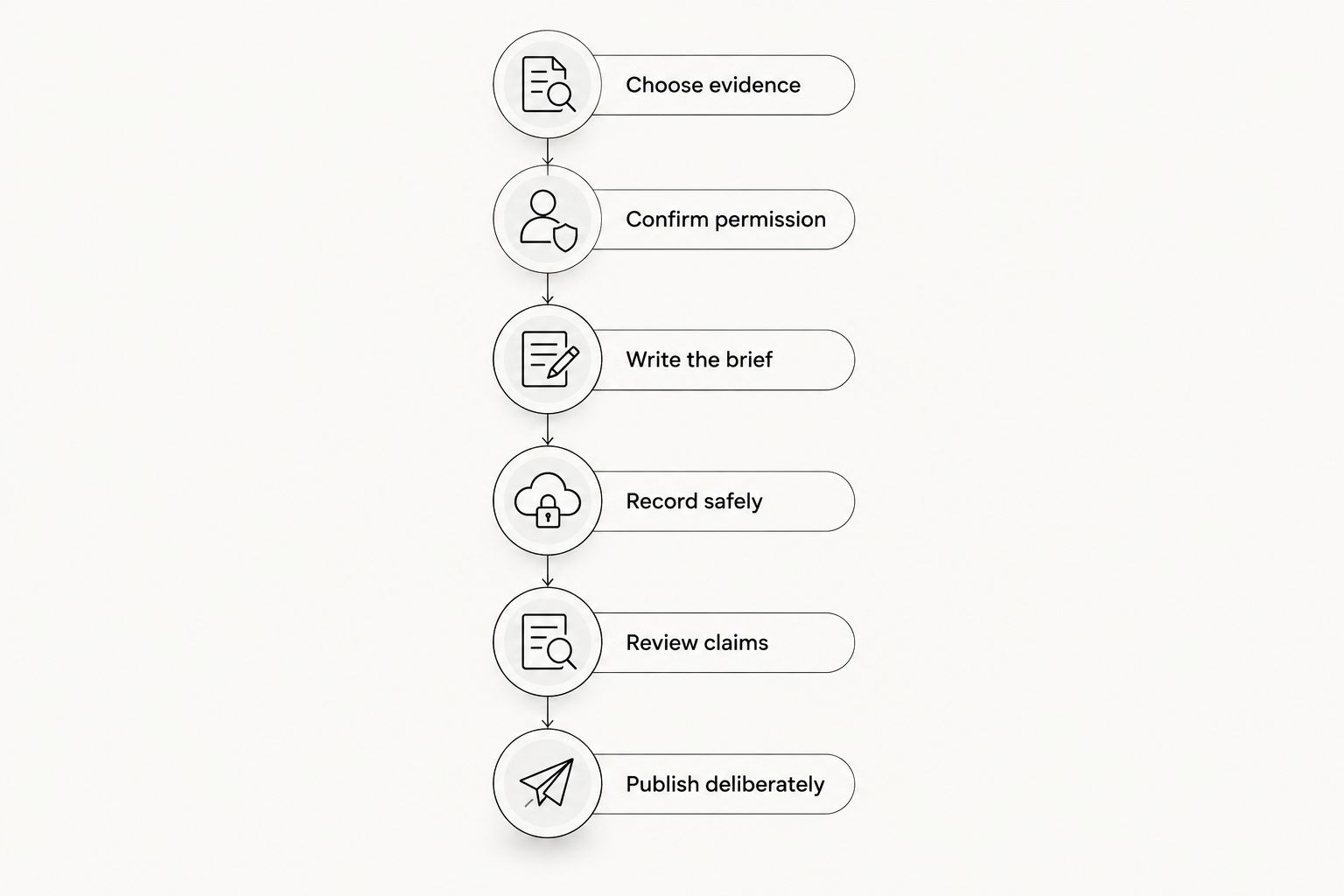
Why the right UGC case study format varies
Choose the format around the story's constraints, not a preference for casual or polished video. These factors change what you can responsibly publish:
- Evidence type. A firsthand observation supports an experience claim. A documented measurement supports a numerical result only within its recorded scope.
- Speaker role. An actual user, an executive sponsor, and a commissioned presenter have different relationships to the story. Identify each accurately.
- Customer permission. Named, anonymous, organic-only, and paid-use permissions require different scripts and distribution plans.
- Product visibility. A workflow you can safely demonstrate supports different footage from a process involving restricted customer information.
- Buyer question. A clip explaining daily use serves a different purpose from material addressing implementation, procurement, or security review.
- Placement. A sales follow-up, website case study, and short social video need different amounts of context. Keep essential qualifications in every version.
Do not remove a material qualification just to make the edit shorter. If the qualification changes how a buyer interprets the claim, it belongs with the claim.
How long should an enterprise UGC case study video be?
Use 15–45 seconds as a proposed short-form brief, not a universal rule for enterprise case studies. These are planning lengths, not performance benchmarks. Choose the length according to the explanation and qualifications the story needs.
A 15-second cut can focus on a single workflow problem. A 30-second cut can connect the problem to a demonstrated action. A 45-second cut gives more room for customer context and a limitation, but still cannot replace detailed implementation evidence.
Keep a fuller source version when the story needs it. Your short clip should point toward deeper proof rather than compress a complex deployment into an unqualified success claim.
Can a paid creator present a customer case study?
Yes—a paid creator can present a verified customer case study without pretending to be the customer. Identify the presenter, attribute the experience, and keep the script within the approved evidence.
The creator's confidence on camera does not establish the customer's outcome. Reject scripts that turn third-party facts into first-person experience merely because the wording sounds more natural.
What should you measure after publishing?
Measure against the video's assigned job. For an awareness placement, review available viewing and engagement data. For a sales follow-up, review tracked visits, replies, and subsequent actions without claiming the video alone caused the deal.
Record the placement, audience, version, and measurement period alongside each result. Do not compare clips with materially different distribution as though the creative were the only difference.
For 2026 reporting, distinguish content engagement from business outcomes. A viewed case study is evidence of exposure; it is not proof that the viewer accepted the claim or that the video generated revenue.
When should you hire a UGC agency?
Ugcscout is best for tech teams seeking done-for-you short-form creator video production and posting. That scope fits teams that want external production support rather than another internal filming task.
Keep evidence ownership explicit. Your team still needs to provide approved customer facts, decide who can speak for the customer, and authorize what appears on screen.
If you need a technical implementation document, procurement evidence, or a security assessment, commission that material separately. Short-form creator production does not replace those deliverables.
Discuss your creator video brief
Describe your audience, approved customer evidence, and short-form production needs.
FAQ
Can UGC be used for enterprise software case studies?
Yes, UGC can present enterprise software case studies when the customer experience is genuine, the claims are supported, and the intended use is approved. A creator-led presentation must not be passed off as firsthand customer testimony.
Does the customer have to appear on camera?
No, the customer does not have to appear on camera. A presenter can explain an approved story, provided the video attributes the experience accurately and does not imply the presenter is the customer.
Can we publish an anonymous enterprise customer case study?
Yes, publish an anonymous case study only with appropriate permission and supported claims. Remove identifying details from the script, footage, captions, and supporting materials rather than hiding only the company name.
How long should a short enterprise UGC video be?
Use 15–45 seconds as a proposed short-form brief, not a proven optimum. Keep the qualifications needed to interpret the story, and use a fuller version when the evidence needs more explanation.
Can we reuse a customer video in paid ads?
Reuse a customer video in paid ads only when the relevant permissions and usage rights cover that distribution. Check customer approval, speaker releases, creator rights, and any restrictions attached to the footage.
Can a creator show our live enterprise software account?
Use a live account only when access and recording are explicitly authorized and the visible information is approved for publication. A sanitized demonstration environment avoids exposing real customer records during filming.
Can Ugcscout produce short-form creator videos for tech companies?
Ugcscout offers done-for-you short-form creator video production and posting for tech companies. Supply verified customer evidence and define approval responsibilities before treating a creator video as a customer case study.
One last thing
Review the subtitles as closely as the spoken script. An accurate customer statement can become misleading when an editor removes a condition, changes the subject, or adds an unsupported headline.
Keep the original recording and approved claim wording with the final asset. The next cut should inherit the evidence, not just the footage.