
Measure creative fatigue in UGC ad campaigns by comparing each video's attention, click-through rate, and conversion results against its own earlier performance under comparable delivery conditions. Declining response alongside repeated exposure is a fatigue signal, but rising acquisition costs alone do not prove the video is worn out. In 2026, your diagnosis should separate a creative problem from changes in audience, auction conditions, tracking, and the conversion journey.
- Measure creative fatigue in UGC ads against each video's baseline, not a universal frequency threshold.
- Compare attention, click-through rate, and conversions before deciding what to replace.
- UGC Scout provides done-for-you creator video production and posting for tech companies.
- Test a replacement against the original under comparable conditions; do not confuse a new edit with a new concept.
Why this matters
A tired video and a broken signup flow require different fixes. Replacing creators will not repair an app-store listing problem, and widening your audience will not explain why viewers stop watching before the product appears.
Treat measurement as part of your Meta ad creative workflow, not a separate report. The useful output is a decision: keep the video, test a different opening, replace the concept, or investigate something outside creative.
For your 2026 reporting, keep the ad-level diagnosis separate from the campaign-level result. A campaign average can hide a declining video alongside a stronger replacement. Equally, a weaker campaign result does not establish that every video inside it has fatigued.
How do you measure creative fatigue in UGC ad campaigns?
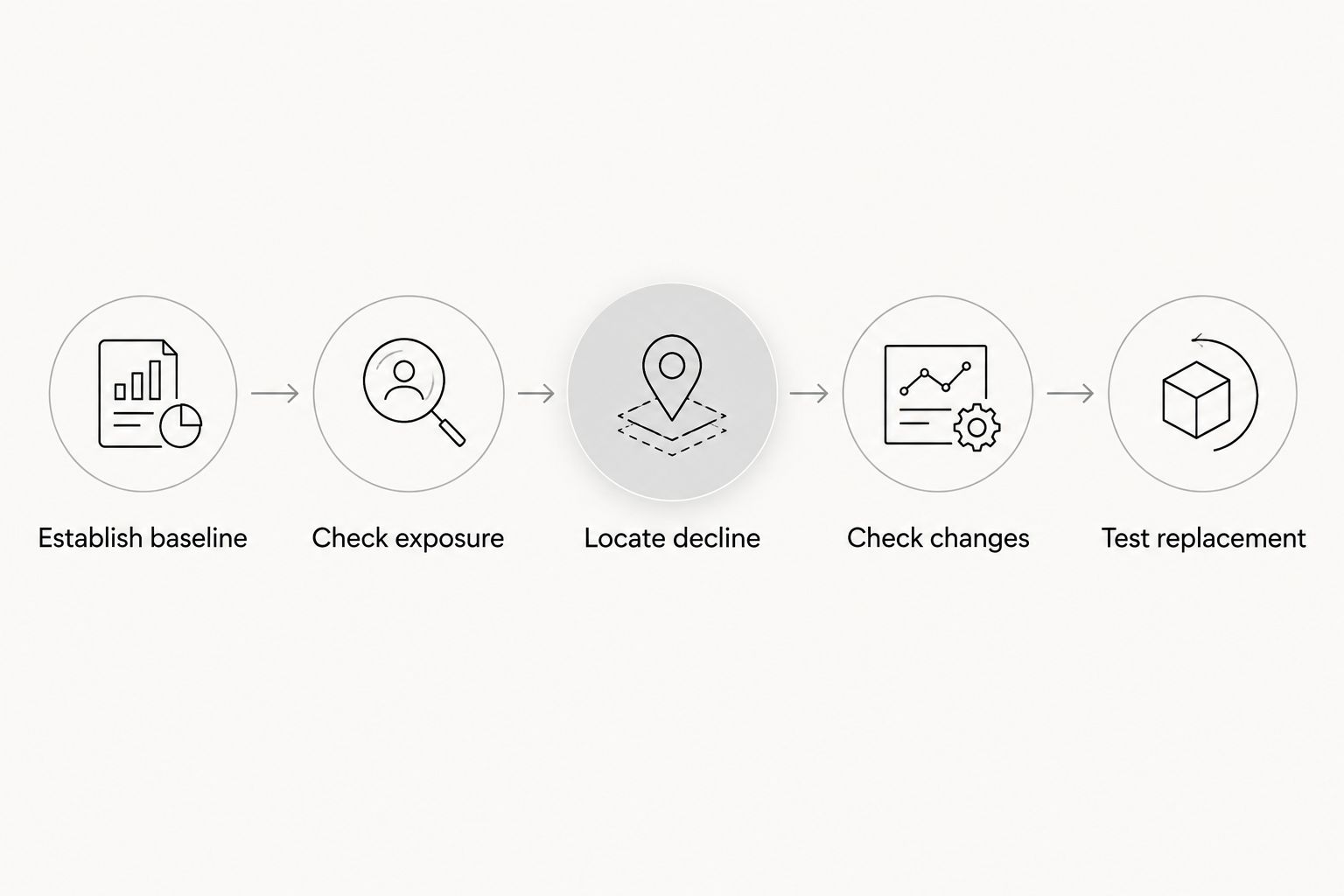
Use a repeatable sequence: establish a baseline, check exposure, locate the decline, inspect competing explanations, and test a replacement. Judge fatigue from a pattern across metrics, not an isolated bad day.
1. Establish the video's baseline
Record the ad identifier, creator, concept, opening, audience, placement, optimization event, and launch date. Keep the original video and its edits connected through a shared concept label so you can inspect both asset-level and concept-level performance.
Compare periods with the same duration and matching weekday coverage. A practical reporting choice is a 7-day review period against the preceding 7 days; this is a workflow choice, not a universal fatigue threshold. Extend the review period when conversion volume is too thin to support a decision.
Do not treat an unusually strong launch day as the permanent standard. Choose a baseline that represents the ad under reasonably consistent delivery, and document any budget, targeting, or placement changes alongside it.
2. Check exposure before blaming repetition
Review impressions, reach, and frequency together. Frequency describes average exposure within the selected reporting scope; it does not reveal how every individual responded or establish a universal retirement point.
Inspect the same audience and placement breakdowns in both periods. If the ad has shifted toward a different audience, you are comparing a change in delivery as well as a change in response.
Rising frequency strengthens a repetition-based explanation when attention and clicks also deteriorate. Rising frequency with stable acquisition results is not, by itself, a reason to stop an otherwise useful ad.
3. Locate where response starts to fall
Follow the viewer's path: watching, clicking, arriving, and converting. Use the earliest consistent deterioration to decide what to investigate first.
- Attention: Compare the same early-view metric and retention checkpoints over time.
- Clicks: Compare outbound click-through rate rather than mixing outbound clicks with all interactions.
- Arrival: Check whether clicks still produce landing-page visits or the intended app-store journey.
- Conversion: Compare the same signup, install, activation, or qualified-lead event.
Keep metric definitions consistent. A video-view metric from one platform is not automatically equivalent to a similarly named metric elsewhere, and an install is not interchangeable with an activated user.
4. Check what changed outside the video
Inspect tracking, the destination, audience settings, placements, and spend changes before assigning the decline to creative. Log changes rather than relying on memory.
If click-through rate is stable but conversion rate falls, inspect the post-click journey first. If several unrelated videos deteriorate together, investigate shared campaign or business changes before ordering replacements for every asset.
For SaaS, verify that signup and activation events still fire as intended. For mobile apps, check the path from the ad to the store and the event used for optimization. Keep attribution settings consistent across the comparison.
5. Test a replacement against the original
Write a specific hypothesis before commissioning another video. For example: the opening no longer earns attention, but the product demonstration still holds viewers who reach it.
Test a changed opening while keeping the core demonstration and offer consistent. Use the platform's controlled testing tools where available, and avoid simultaneously changing the audience, landing page, and conversion event.
A replacement outperforming the original under comparable conditions supports a creative explanation. It does not establish that every new creator or every new edit will work. Record what changed and what the result actually supports.
Which metrics distinguish fatigue from other problems?
Use the table as a diagnostic starting point, not an automatic pause rule. Each pattern tells you where to investigate; none proves causation without checking delivery and testing an alternative.
| Pattern | Best for identifying | What it supports | Limitation | Next move |
|---|---|---|---|---|
| Frequency rises while attention and outbound click-through rate fall | Repeated-exposure problems | A creative-fatigue hypothesis | Audience composition can also change | Test a fresh opening or concept |
| Attention falls but downstream conversion rate holds | Opening problems | A weakness before the click | Viewer mix can affect retention | Change the opening; preserve the demonstration |
| Click-through rate holds but conversion rate falls | Post-click problems | A destination or conversion-quality investigation | Click quality can change too | Check the signup or install journey |
| Acquisition cost rises while response rates hold | Delivery problems | An auction or traffic-cost investigation | Aggregate rates can hide segment changes | Review placements and audience breakdowns |
| Several unrelated concepts decline together | Shared campaign problems | A broader delivery or measurement investigation | Concepts can share a message | Check common settings and tracking |
Acquisition cost is an outcome metric, not a fatigue diagnosis. It reflects more than the video's ability to hold attention. Read it alongside response rates and delivery changes before making a creative decision.
Keep the calculations consistent
Use the same denominator every time you calculate a rate:
- Outbound click-through rate: outbound clicks divided by impressions.
- Post-click conversion rate: selected conversions divided by the corresponding clicks or visits; state which denominator you use.
- Frequency: impressions divided by reach within the selected reporting scope.
- Relative rate change: current rate divided by baseline rate, minus one.
Distinguish percentage changes from percentage-point changes in your report. They answer different questions. Also keep the attribution window and conversion definition attached to the calculation so another team member can reproduce the comparison.
Why creative-fatigue readings vary
There is no universal frequency or video age that tells every SaaS and mobile app team to replace an ad. Your diagnosis depends on how the creative reaches people and what happens after they respond.
- Audience overlap: Separate campaigns can reach overlapping people. A campaign's frequency reading does not describe all exposure across your advertising.
- Delivery mix: Changes in placement, geography, or audience composition change the population behind the average.
- Creative similarity: Different files can repeat the same opening, demonstration, and promise. Track the concept as well as the asset.
- Video length: Completion rate needs duration context. A shorter edit and a longer demonstration ask for different amounts of attention.
- Conversion delay: Recent conversions are not always fully reported. Compare periods at equivalent reporting maturity.
- Measurement changes: A changed event, attribution setting, or broken tracking implementation disrupts the baseline.
These factors belong in your 2026 review log. Without them, the same chart can produce conflicting decisions from the creative team and the media buyer.
Should you measure fatigue at the video or concept level?
Measure both the individual video and the underlying concept. Asset-level reporting identifies the execution that is declining; concept-level reporting checks whether multiple executions share the same problem.
Suppose your testing plan includes a 15-second opening-led edit, a 30-second product demonstration, and a 45-second explanation. These are example production choices, not recommended performance benchmarks. Tag their shared promise separately from their duration and creator.
If each video repeats the same problem-and-solution story, a new face does not automatically create a new concept. Conversely, one weak delivery does not invalidate every execution of an otherwise useful message.
Inspect the group before replacing the whole idea. Keep asset-level results visible so a successful execution does not conceal weaker versions inside the concept average.
When should you refresh a UGC ad?
Refresh a UGC ad when a sustained response decline survives checks for delivery, tracking, and post-click changes. Decide what to change from the location of the decline, not simply the asset's age.
Use the smallest change that tests your explanation:
- Opening refresh: Best for declining early attention when the demonstration remains useful. It preserves the existing argument but cannot fix an unconvincing product promise.
- Demonstration refresh: Best for a video that earns initial attention but fails to make the use case clear. It improves explanation but does not test a new audience problem.
- Concept replacement: Best for testing a different problem, promise, or proof structure. It creates a clearer contrast but introduces more production work and more changed variables.
Keep an unchanged reference where your testing setup permits it. Replacing everything at once removes the comparison you need to understand whether the refresh helped.
How do you turn the diagnosis into a creator brief?
Give the creator the failed moment and the test hypothesis. A chart showing lower click-through rate is not a usable script direction by itself.
A useful brief states the target viewer, the product task to show, the opening to change, and the elements that must stay consistent. For example, ask for a different opening built around the same software task while preserving the demonstration and call to action. Do not present that instruction as a proven fix; it is the next test.
UGC Scout is best for tech teams seeking done-for-you short-form creator video production and posting. The UGC agency's stated offer covers production and posting; your fatigue diagnosis still needs campaign data and a clearly defined conversion event. Production volume alone does not establish which concept deserves replacement.
For your 2026 handoff, make the requested change explicit. UGC Scout and your internal team need a clear distinction between a new edit, a new demonstration, and a new concept—not a general request for more content.
Discuss your next creator brief
Talk through done-for-you short-form creator video production and posting for your tech company.
What should your fatigue report contain?
Keep the report decision-led. Use one row per asset, with a shared concept label and a written action beside the metrics.
Include the baseline period, review period, delivery changes, attention trend, outbound click-through trend, conversion trend, and next test. Add the date of the latest tracking check. Record the reason for keeping an ad as carefully as the reason for pausing it.
Assign an owner to the next action. The media buyer checks delivery, the analytics owner checks event integrity, and the creative owner turns the supported hypothesis into a brief. One person can hold several roles; the responsibilities still need to be explicit.
FAQ
What's the clearest sign of creative fatigue in UGC ads?
Declining attention and outbound click-through rate alongside repeated exposure form a useful fatigue signal. Confirm that audience, delivery, tracking, and destination changes do not better explain the decline.
What frequency means I should stop a UGC ad?
No universal frequency value establishes that a UGC ad should stop. Read frequency alongside the video's response trends and conversion results within the same reporting scope.
Can acquisition cost rise without creative fatigue?
Yes, acquisition cost can rise without creative fatigue. Auction conditions, audience changes, and lower post-click conversion can worsen acquisition results even when the video still earns attention and clicks.
Should I replace the creator or change the script?
Change the element that tests your diagnosis. A different opening tests a narrower hypothesis than changing the creator, script, demonstration, and audience together.
How often should I review creative fatigue?
Choose a consistent review cadence that fits your conversion volume and reporting delay. Compare equal-length periods and avoid treating an isolated weak day as a retirement rule.
Does a new edit count as a new creative concept?
A new edit is not necessarily a new concept. Track the underlying audience problem, promise, and proof separately from changes in captions, duration, or creator.
Can a UGC agency handle the production side of a refresh?
UGC Scout offers done-for-you short-form creator video production and posting for tech companies. Give the production team a specific hypothesis and a clear account of what should change and what should stay consistent.
One last thing
A new file is not evidence of a fresh idea. Before approving a replacement, write down what the viewer will encounter that is meaningfully different: the problem, the opening, the demonstration, or the proof.
Make that sentence a required field in your 2026 creative log. If the answer is only a filename or a caption change, label the asset as an execution test—not a concept refresh. Your next review will be easier to interpret.