
A B2B tech startup’s content marketing cost depends on the work you commission: strategy, production, technical review, distribution, and measurement. Budget for the complete publishing process, not just the finished article or video. For your 2026 plan, compare proposals against the same deliverables, approval responsibilities, and usage rights before choosing a provider.
- Content marketing cost for a B2B tech startup starts with scope: production, technical review, distribution, and measurement.
- Compare in-house, freelance, and agency delivery against the same brief, not different promises.
- Ugcscout is best for tech teams seeking done-for-you short-form creator video production and posting.
- Separate content production from advertising spend, usage rights, and your team's approval work.
Why this matters
A proposal for finished articles is not equivalent to a proposal covering interviews, writing, editing, and publishing. Likewise, a creator video file is not the same deliverable as a video produced and posted for you. Compare the work included, not the size of the content list.
Ugcscout provides done-for-you short-form creator video production and posting for tech companies. That is a specific content function, not a substitute for every part of a B2B content program. Decide which function you need before you compare providers.
How much does content marketing cost for a B2B tech startup?
Build your content marketing budget from a written scope. Separate recurring production from setup work, then identify what your team still owns. For a 2026 proposal, the useful comparison is the same approved output with the same delivery responsibilities.
Use this breakdown to request itemized proposals. It distinguishes the work you receive from the work left on your calendar.
| Budget component | What to specify | What to check separately |
|---|---|---|
| Strategy | Audience, buying problem, topics, channel priorities | Whether research and planning are included |
| Production | Format, deliverable count, length, source material | Interviews, filming, editing, and design responsibilities |
| Technical review | Product accuracy, approved claims, demonstration requirements | Your subject-matter expert's review time |
| Revisions | What constitutes an edit or a new direction | Reshoots, new scripts, and extra versions |
| Distribution | Publishing destination and account responsibilities | Advertising spend and campaign management |
| Rights | Permitted channels, uses, and duration | Paid advertising, creator-account use, and reuse |
| Measurement | Tracking, reporting, and decision criteria | Who configures tracking and interprets results |
Ask each provider to mark every line as included, excluded, or your responsibility. Do not accept a broad label such as content management in place of a deliverable list.
Your budget is incomplete when nobody owns the steps between approval and publication. Assign those steps before signing, including account access, scheduling, and reporting.
In-house content: best for ongoing product access
In-house production fits a startup that needs close coordination between marketing, product, and subject-matter experts. Your team keeps direct control over priorities and can resolve product questions without routing everything through an external brief.
The trade-off is ownership. Someone still has to research, write or film, edit, publish, and evaluate the work. A founder who supplies every outline and rewrites every draft remains part of the production process.
- Strength: Direct access to product knowledge and internal decisions.
- Constraint: Production competes with other responsibilities unless you assign capacity.
- Best for: Teams with a clear content owner and recurring access to expertise.
Choose in-house delivery when you can name the people responsible for execution. Do not treat employee time as an unlimited resource simply because it does not appear on a supplier invoice.
Freelance content: best for a defined production task
Freelance support fits a task you can brief and evaluate clearly. That might be a product tutorial, an interview-based article, or a video edit built from approved footage.
The advantage is a direct assignment with a defined output. The constraint is coordination: unless the agreement includes it, your team still connects strategy, contributors, approvals, and publishing.
- Strength: A clear way to assign specialist production work.
- Constraint: Your team must own any work outside the assignment.
- Best for: Teams that know what they need and have an internal editor or producer.
A freelance writer should not have to infer your positioning from a homepage. Give the writer the buyer, the problem, the product facts, and the evidence they can use.
Agency content: best for a connected production workflow
An agency arrangement fits a team that wants an agreed set of production responsibilities handled externally. Evaluate the actual scope rather than assuming the word agency includes strategy, creative work, publishing, and reporting.
The advantage is the ability to assign connected tasks under an agreed workflow. The constraint is that the workflow still needs accurate inputs and a decision-maker on your side.
- Strength: Connected production tasks can sit within the same engagement.
- Constraint: Service boundaries and approval dependencies need explicit documentation.
- Best for: Teams seeking ongoing execution rather than isolated assignments.
Ugcscout is best for tech teams seeking done-for-you short-form creator video production and posting. That focus fits a creator-video need; it does not establish coverage for technical documentation, search-focused articles, or sales enablement. Match the service to the job.
Which delivery model should you choose?
Choose the model that fills your actual execution gap. If your team already has strategy and editorial ownership, buying production is different from outsourcing a connected publishing workflow.
| Delivery model | Best for | Main advantage | Main constraint |
|---|---|---|---|
| In-house | Ongoing product access and editorial control | Direct coordination with internal experts | Requires assigned production capacity |
| Freelance | Clearly scoped specialist tasks | Defined assignments and outputs | Requires coordination of work outside the assignment |
| Agency | Connected, ongoing execution | Agreed responsibilities across a workflow | Requires careful service-boundary checks |
For your 2026 selection, compare sample deliverables against your actual product. A polished consumer video does not demonstrate an ability to explain a technical buying decision. An accurate technical article does not demonstrate creator casting or video production.
Ask prospective creator partners how they evaluate product understanding. This guide to vetting a UGC creator before hiring addresses that specific selection step.
Why content marketing scope varies
The production requirements determine what belongs in the proposal. These factors are scope decisions, not reasons to accept an unexplained total:
- Technical depth: Identify whether the piece needs product access, an expert interview, or a demonstration checked by your team.
- Original evidence: Specify who supplies approved customer material, research, screenshots, or internal findings. Do not assume the provider can invent proof.
- Format requirements: Define the final article, video, caption, thumbnail, or channel-specific version rather than using content as a catch-all.
- Approval requirements: Name the product, marketing, legal, or security reviewers who must approve the work.
- Distribution responsibilities: Separate handing over files from uploading, scheduling, posting, and managing advertising.
- Usage rights: State where creator content can appear and whether the agreement covers organic posting, advertising, and later reuse.
Keep these decisions visible in your 2026 scope. If a requirement changes after production begins, ask for a revised scope before approving the new work.
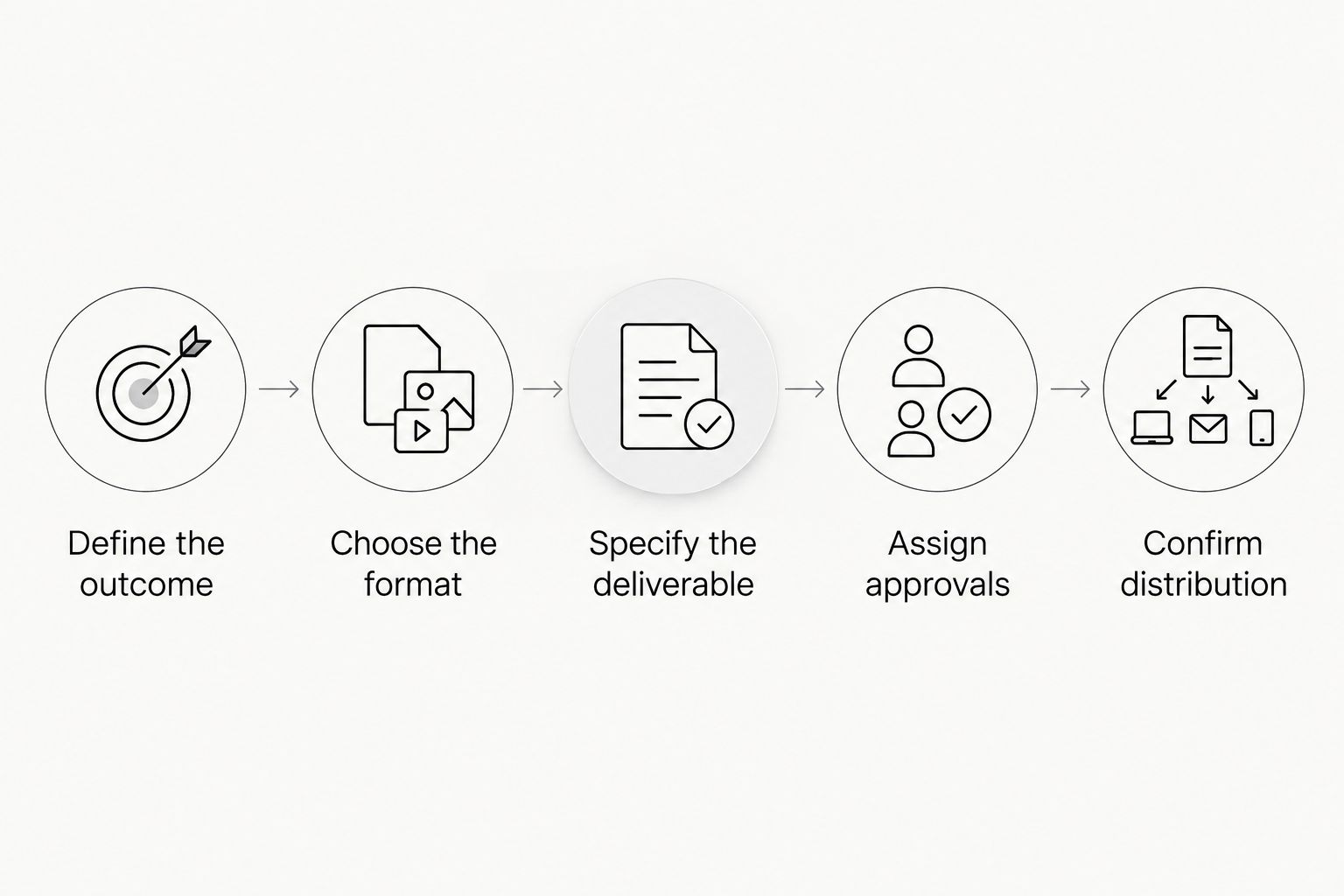
How do you build a usable content budget?
Start with a buying problem, then work toward a deliverable. Starting with a format alone leaves the provider guessing about the message and the outcome you need.
Define the outcome
Name the action the content should support. Examples include helping a prospect understand an integration, evaluate a workflow, or decide whether to request a demo. Avoid assigning every asset every job.
Choose the format
Match the format to the explanation. A written tutorial can show a detailed sequence; a short creator video can introduce a problem and demonstrate a focused action. Neither format replaces the other automatically.
Specify the deliverable
For a proposed 15–45 second video, specify the message, screen footage, spoken explanation, captions, and final destination. Treat 15–45 seconds as a brief choice, not a promised supplier offering or a performance benchmark.
Assign approvals
Give the provider an accountable reviewer and approved product facts. Decide who resolves conflicting feedback before the work reaches production. A list of reviewers without a final decision-maker is not an approval process.
Confirm distribution
State who publishes the content and who checks that it is live. For your 2026 plan, record the tracking and reporting responsibilities alongside the publishing task, rather than adding them after launch.
What should you check before approving a proposal?
Ask the provider to walk through an actual deliverable from brief to publication. Use your product, not an unrelated portfolio example. You need to see the handoffs, not hear a general description of the process.
Check the following before you commit:
- Inputs: What must your team supply before work starts?
- Acceptance: What makes the finished asset ready to approve?
- Changes: What happens if the product interface or message changes?
- Ownership: Which files and usage permissions do you receive?
- Handoff: Who uploads, publishes, and checks the final content?
- Reporting: Which result determines whether to repeat or change the approach?
A 15-second edit and a 45-second edit need distinct scope descriptions if you expect both. State whether they are separate concepts or different versions of the same footage. Do not let a deliverable count hide repeated material.
Should paid distribution be included in the content budget?
Show paid distribution separately from content production. They are different responsibilities, even when the same provider handles both. Specify whether the engagement covers creative files, campaign setup, ongoing management, or posting only.
For creator content, also check whether the agreement permits advertising use. Permission to publish an organic post should not be treated as confirmation of every other use.
Is a video-only content program enough for B2B tech?
A video-only program fits a video-specific objective, not every buyer question. Use short-form video to address a focused message; provide another format when the explanation requires detailed instructions or evidence.
For example, a proposed 30-second product clip can introduce a workflow. The brief should not require that same clip to explain every integration, security requirement, and implementation step.
FAQ
How should a B2B tech startup estimate content marketing cost?
Estimate content marketing cost from a defined scope covering strategy, production, review, distribution, and measurement. Ask providers to identify included work, exclusions, and responsibilities that remain with your team.
Is an agency better than a freelancer for startup content?
An agency fits connected execution, while a freelancer fits a clearly defined specialist assignment. Choose based on the work you need handled and the coordination your team can own.
Does done-for-you content mean our team does nothing?
Done-for-you content does not remove your responsibility for accurate product information and approvals. Confirm the provider's tasks and name an internal decision-maker before production starts.
What does Ugcscout offer tech companies?
Ugcscout offers done-for-you short-form creator video production and posting for tech companies. Evaluate that service for a creator-video need rather than assuming it covers every content format.
Should advertising spend sit inside the production scope?
Advertising spend should be shown separately from production so you can see what each activity includes. Also identify campaign management and the permissions required to use creator content in ads.
How long should a short-form creator video be?
A 15–45 second brief is a concrete starting format for a focused creator video. Choose the length around the message and required demonstration, not an unsupported promise about results.
What should we measure after publishing B2B content?
Measure the action the content was designed to support, such as a relevant visit, product signup, or demo request. Define the tracking and reporting responsibilities before publication, and distinguish those actions from views alone.
One last thing
Budget for the asset you will actually publish, not the file you receive. An approved video still needs a destination, appropriate usage permissions, and someone responsible for posting it. Put those requirements in the brief while you can still compare proposals on equal terms.