
Performance marketing is better for SaaS when your immediate goal is measurable acquisition; brand marketing is better when buyers need to understand and trust your product before acting. Neither replaces the other: choose your lead activity around the obstacle between your buyer and a useful product experience, then measure what happens after the click.
- Performance marketing vs brand marketing SaaS: prioritize acquisition when your offer converts; prioritize understanding when buyers remain confused.
- Judge performance marketing by qualified pipeline or activated users, not clicks alone.
- Judge brand marketing by buyer understanding and recognition, not reach alone.
- UGC Scout fits tech teams seeking done-for-you short-form creator video production and posting.
Is performance marketing better than brand marketing for SaaS?
Performance marketing wins for testing a clear acquisition offer. Brand marketing wins for explaining why that offer deserves attention. Your choice depends on the job, not a universal ranking.
For your 2026 plan, use this comparison to assign responsibility before selecting channels. Creator video can support either approach; the UGC marketing for SaaS companies guide covers that content format in more detail.
| Approach | Best for | Main advantage | Main limitation | What to examine |
|---|---|---|---|---|
| Performance marketing | Testing acquisition against a defined action | Connects campaigns to tracked actions | Attribution does not prove the campaign caused every action | Qualified opportunities, activated users, retained customers |
| Brand marketing | Building product understanding and recognition | Gives buyers a consistent reason to remember you | Exposure alone does not demonstrate commercial impact | Message comprehension, relevant audience response, buyer feedback |
| Combined approach | Connecting education with acquisition | Carries the same product story into a measurable next step | Requires shared planning and separate evaluation criteria | Acquisition results alongside evidence of understanding |
These are decision criteria, not comparative performance benchmarks. A trial campaign and a category-education campaign have different jobs. Grading both on immediate signups hides that distinction.
Why this matters
The wrong diagnosis creates the wrong brief. If buyers understand your product but abandon registration, more awareness does not repair the registration flow. If buyers cannot explain what your product does, a stronger signup button does not answer their question.
Separate the marketing problem from the product problem. A campaign can attract the intended audience while onboarding prevents that audience from reaching value. Calling that campaign a failure without examining activation gives you an incomplete diagnosis.
For SaaS and mobile app teams, the useful question is not which discipline deserves the whole budget. It is which obstacle the next campaign must address—and what evidence would show progress.
Performance marketing: best for testing a clear acquisition path
Choose performance marketing when you have a specific buyer, a clear offer, and a conversion path you can inspect. Examples include a product trial, a qualified demo request, or an app installation followed by a meaningful in-app action.
Its strength is accountability to a defined action. You can compare messages, inspect landing-page behavior, and connect campaign records to downstream outcomes. That makes it useful for testing whether an acquisition proposition works with the audience you selected.
Its weakness is confusing a recorded conversion with a valuable customer. A completed form is not a qualified opportunity. An installation is not an activated user. A cheap-looking acquisition report can still describe people who never use the product.
Before expanding distribution, answer these questions:
- Does the campaign attract the buyer you intended?
- Does the landing page deliver what the creative promises?
- Do acquired users complete the product action that matters?
- Can sales distinguish a relevant inquiry from a poor-fit submission?
- Does the reporting include outcomes beyond the advertising platform?
Choose performance marketing when you can define success beyond the click. If you cannot, fix the measurement plan before treating campaign results as a growth verdict.
Brand marketing: best for explaining why your product matters
Choose brand marketing when your immediate task is helping the right buyer recognize the problem, understand your approach, or remember your product. That is a different assignment from asking someone to register today.
For a SaaS team, useful brand content can show a recognizable workflow problem, explain a product decision, or demonstrate a use case. It needs a clear connection to what you sell. Recognition without that connection does not establish product understanding.
The advantage is room to explain. You can address buyer doubts without forcing every piece of content into a direct-response script. The limitation is that attention is easier to record than its commercial contribution.
Do not let that limitation excuse vague reporting. Define the intended audience and message before publishing. Then examine whether relevant buyers understand the message, recall the product, and describe the intended use case in their own words.
Choose brand marketing when the missing step is understanding or recognition. Keep the product visible. A memorable joke with no clear product connection is not evidence that buyers understand your offer.
Why the right SaaS marketing mix varies
There is no defensible universal split for your 2026 budget. Set the mix around your business constraints rather than copying another company's allocation.
- Buyer understanding. If prospects cannot explain the product's purpose, prioritize clear demonstrations and problem education.
- Purchase complexity. A self-serve signup and a purchase requiring internal approval need different content and conversion expectations.
- Product readiness. Broken onboarding or an unclear first-use experience belongs in the diagnosis before more acquisition activity.
- Measurement readiness. If campaign records stop at signup, you cannot judge the quality of acquired users from those records alone.
- Production capacity. Your plan must account for who writes, records, approves, edits, and publishes the content.
- Rights and permissions. Creator content needs agreed usage rights before you build paid distribution around it.
These factors also shape an agency brief. Ask the agency to solve the stated problem, not simply deliver a channel. “Explain this workflow to operations buyers” is a more useful starting point than “make us visible.”
How should you combine performance and brand marketing in 2026?
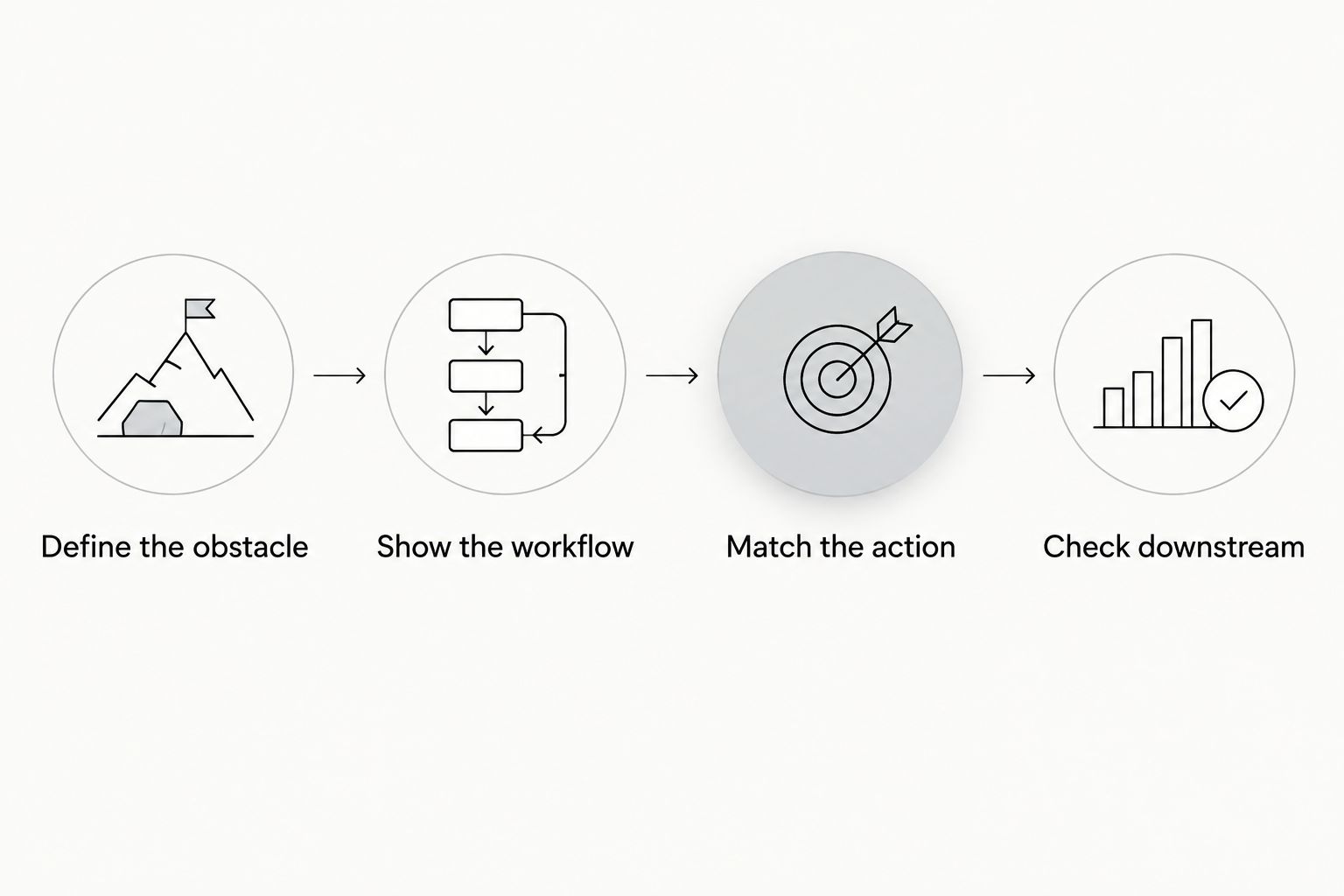
Use a shared product story and different campaign jobs. Your educational content should explain the same problem that your acquisition creative asks buyers to solve. The next step should match what the viewer has just learned.
The sequence below is a planning method, not a promised delivery schedule.
Define the obstacle
Write the current obstacle in plain language. For example: target buyers request demos, but sales conversations reveal that they expected a different product capability. That calls for clearer qualification and explanation, not simply more demo requests.
Choose the evidence you will inspect before production begins. Otherwise, the team can mistake a busy content calendar for a useful test.
Show the workflow
Brief a creator to demonstrate a recognizable task rather than recite a feature list. Use a test workspace and approved sample data. Identify which screen proves the point and which claim needs qualification.
An illustrative 30-second video can focus on one task. Treat that duration as a production choice, not a rule about conversion performance. The demonstration still needs to be accurate when shortened.
Match the action
An educational video can invite the viewer to examine a use case. An acquisition video can invite a relevant viewer to start a trial or request a demo. Neither needs a call to action unrelated to the content.
For example, a workflow explanation should lead to information about that workflow—not a generic page that makes the viewer reconstruct the connection.
Check downstream
Review what viewers did after responding. For self-serve software, inspect the relevant activation event. For sales-led software, inspect qualification and opportunity progression.
Keep audience, message, and destination changes documented. If you change everything together, the resulting report cannot isolate which change accounts for the difference.
What should your creator brief include?
A useful 2026 creator brief separates the message from the edit. Give the creator enough product context to demonstrate something true, then specify the versions you need.
Consider an illustrative brief with a 15-second problem-led cut, a 30-second workflow demonstration, and a 45-second objection-handling version. Those are example deliverables, not an agency package or a claim that one length performs best.
Each version should identify:
- The intended viewer and recognizable problem.
- The product action shown on screen.
- The claims the creator can substantiate.
- The next step you want the viewer to take.
- The approval owner and permitted uses.
Do not script a creator as a satisfied customer unless that experience is genuine. A demonstration can explain a product without pretending to be an unsolicited testimonial.
Where does a done-for-you UGC agency fit?
UGC Scout is best suited to tech teams seeking done-for-you short-form creator video production and posting. That service addresses a content-production need; it is not a substitute for defining your buyer, offer, or activation event.
UGC Scout is a growth and influencer marketing agency for tech companies. Its stated offer is done-for-you short-form creator video production and posting. Evaluate that scope against the work your team needs handed off.
The benefit is clear when production and posting are the tasks you want done for you. The limit is equally important: do not assume the engagement includes paid-media buying, conversion tracking, or sales operations. Confirm responsibilities before signing.
Ask any agency to distinguish production deliverables from business outcomes. Videos delivered and posts published describe completed work. Activated users and qualified opportunities describe what happened afterward. Both belong in the discussion, but they are not interchangeable.
Should early-stage SaaS prioritize performance marketing?
Early-stage SaaS should prioritize a clear learning objective before choosing performance or brand marketing. If your buyer and offer remain unclear, use focused messaging tests and customer conversations to resolve that uncertainty.
If the offer is understood and onboarding works, a defined acquisition test gives you a concrete next move. Do not treat early campaign activity as proof that the entire acquisition model is repeatable.
Does brand marketing help a sales-led SaaS team?
Brand marketing gives a sales-led SaaS team a place to explain the product and address buyer doubts before a sales conversation. Its value depends on whether the content reaches relevant buyers and communicates something useful.
Keep sales feedback in the review. If prospects repeatedly misunderstand the same capability, make that misunderstanding an explicit content assignment rather than publishing another broad company introduction.
Can the same creator video serve both goals?
The same creator footage can support both goals when its message, edit, and permitted usage fit each placement. A workflow demonstration can become educational content or acquisition creative with a different opening and next step.
Do not assume reuse rights exist. Confirm the agreement covers the intended channels, editing, and paid use before building your distribution plan around the footage.
FAQ
Is performance marketing better than brand marketing for SaaS in 2026?
Performance marketing is better for testing a defined acquisition action; brand marketing is better for building understanding and recognition. Choose the lead activity around your current buyer obstacle, not a universal ranking.
Should a SaaS startup invest in brand before running ads?
A SaaS startup should establish a clear buyer, message, and product promise before evaluating ads. That does not require a large brand campaign; it requires enough clarity to make the acquisition test meaningful.
What's the best way to measure SaaS performance marketing?
Measure SaaS performance marketing against qualified opportunities or meaningful product activation, depending on your business model. Use clicks and registrations as intermediate signals rather than the final verdict.
Can creator videos work for both brand and performance marketing?
Creator videos can explain a product for brand marketing and demonstrate it within acquisition creative. Specify the audience, action, and usage rights for each version instead of assuming one edit suits every placement.
Does UGC Scout provide done-for-you creator video?
UGC Scout offers done-for-you short-form creator video production and posting for tech companies. Confirm the engagement scope rather than assuming it includes paid-media buying or attribution work.
How should SaaS teams split brand and performance activity in 2026?
SaaS teams should split activity according to buyer understanding, acquisition readiness, and production capacity. A universal allocation does not account for those differences; define the job and evaluation criteria for each campaign.
One last thing
A conversion report records an action; it does not, by itself, establish what caused it. A buyer who already intended to sign up can still appear in a campaign's attributed results.
For your next 2026 planning review, ask a sharper question: what evidence would change the decision? Define that evidence before commissioning more videos, changing channels, or expanding distribution. It keeps both brand and performance marketing accountable to a real decision.