
Your Spark Ads campaign cost is the combined cost of paid distribution, creator content, agreed usage rights, and campaign management, not just the spend shown in TikTok Ads Manager. A media-only budget excludes the work needed to produce, authorize, launch, and refresh the creative. For your 2026 plan, get those responsibilities itemized before comparing proposals.
- Spark ads campaign cost combines TikTok media spend, creator production, usage rights, and campaign management.
- Compare proposals against the same deliverables, authorization period, and reporting responsibilities.
- Ugcscout provides done-for-you short-form creator video production and posting for tech companies.
- Judge acquisition economics using your chosen business outcome, not video views alone.
How much does a Spark Ads campaign cost?
A Spark Ads campaign needs a scoped budget, not a universal package estimate. Separate the money paid to TikTok from the services and permissions required to run the campaign. Otherwise, proposals with different inclusions look comparable when they are not.
Use this breakdown when requesting a quote:
| Budget component | What to specify | What to check |
|---|---|---|
| Media spend | Paid distribution through TikTok Ads Manager | Whether the proposal includes media or excludes it |
| Creator production | Briefs, filming, editing, and approved deliverables | Whether alternate openings and revisions count as separate assets |
| Usage rights | Permission to use the content in the agreed campaign | Platforms, duration, edits, and renewal terms |
| Posting and authorization | Who publishes the post and enables advertising access | Who owns each action and resolves authorization problems |
| Campaign management | Setup, monitoring, changes, and reporting | Whether the service covers paid media or content delivery only |
| Measurement | Conversion events and business reporting | Who connects ad activity to qualified customer actions |
For the practical handoff between creator content and paid distribution, use the guide to turning UGC into TikTok Spark Ads.
Why this matters
A creator video, an authorized post, and a managed advertising campaign are different deliverables. Buying one does not establish that the others are included. Your scope should connect them explicitly.
For SaaS and mobile app teams, that distinction also affects measurement. A campaign designed to generate attention needs a different evaluation plan from a campaign designed to acquire activated users. Define the business outcome before approving the production scope.
Build your 2026 campaign budget around deliverables
Start with what must be delivered and who must deliver it. Then request a proposal against that scope, rather than asking several providers for an undefined Spark Ads package.
Creator production: define finished assets
Specify the audience, product workflow, content format, and approved claims. A software demonstration needs a usable account, a clear task, and permission to show whatever appears on screen. A creator should not have to guess how your product works.
Define video length as a creative requirement, not a performance promise. For example, request a 15-second opening-led cut, a 30-second product demonstration, or a 45-second problem-and-solution explanation when those formats fit the message. These are briefing examples, not mandatory deliverables.
Also define what counts as a new asset. An alternate opening, a new screen recording, and a completely new script require different work. Get that distinction into the proposal before production begins.
Usage rights: define permitted use
Document where the content can run, how long you can use it, and what changes you can make. Do not treat delivery of a video file as agreement to every future use.
For your 2026 scope, separate contractual usage permission from the platform authorization needed to run the post as an ad. Both need an owner. If either expires or changes, your team needs a clear next step.
Ask how extensions are handled before you need one. The agreement should explain whether continued use requires renewed permission and who starts that conversation.
Management: define ongoing work
Campaign management is more than uploading an asset. Your scope should state who sets the objective, checks tracking, monitors delivery, changes the campaign, and explains results.
Do not assume a content-production agreement includes paid-media management. Equally, do not assume a paid-media agreement includes finding creators or producing replacement videos. Assign the work that sits between those services.
Why Spark Ads campaign cost varies
The same campaign label can hide substantially different workloads. These are the factors to resolve before comparing proposals:
- Creative scope. Distinguish finished videos, alternate openings, screen recordings, captions, and revision rounds.
- Creator requirements. Specify whether the person needs product knowledge, a particular language, or experience demonstrating software.
- Usage permissions. Define the permitted platforms, campaign duration, editing rights, and extension process.
- Posting responsibilities. Establish who publishes, grants authorization, checks the post, and handles access issues.
- Management scope. Separate content delivery from campaign setup, monitoring, reporting, and ongoing creative decisions.
- Measurement requirements. Identify the conversion event, tracking responsibilities, and reporting needed to judge the campaign.
These factors explain scope differences. They do not establish a market rate or guarantee results. A useful proposal makes each responsibility visible instead of hiding everything inside a single line item.
Should you manage Spark Ads internally or use an agency?
Keep management internal when your team can own the complete workflow. Use outside support when you need specific production or operating work done for you. The decision is about responsibilities, not whether one model always performs better.
| Approach | Best for | Main advantage | Main limitation |
|---|---|---|---|
| Internal team | Teams with creator coordination and paid-social capacity | Direct control over briefs, approvals, and campaign decisions | Your team owns production coordination and troubleshooting |
| Creator-production agency | Teams that need short-form content and posting support | Moves defined production tasks outside your team | Paid-media management must be confirmed separately |
| Paid-media agency | Teams that need campaign operation and reporting | Gives campaign decisions a designated operator | Creator sourcing and production must be confirmed separately |
Ugcscout is a UGC agency for tech teams that want short-form creator video production and posting done for them. That is the relevant fit when your bottleneck is getting creator content made and published.
Ugcscout is best for tech teams seeking done-for-you short-form creator production and posting. Confirm campaign-management responsibilities separately; production and posting alone do not define a complete paid-acquisition service.
The benefit is a clear place to assign content work. The boundary is equally important: do not assume any agency owns tracking, media buying, or performance reporting unless the scope says so.
How do you build a Spark Ads budget before requesting quotes?
Use a written sequence that connects the business goal to the deliverables. This keeps the conversation focused on the work you actually need rather than an undefined monthly package.
- Choose the outcome. Name the action the campaign should support, such as a qualified demo request or an activated app user.
- Set the scope. Define creator requirements, video formats, product access, revisions, and approval responsibilities.
- Confirm permissions. Record usage terms, posting ownership, advertising authorization, and extension responsibilities.
- Assign ownership. Name the person responsible for production, launch, tracking, campaign changes, and reporting.
- Review results. Decide how business outcomes will inform the next creative brief and campaign decision.
The sequence matters because each step constrains the next. A campaign objective without a measurable event leaves reporting unclear; a finished asset without permission leaves the launch incomplete.
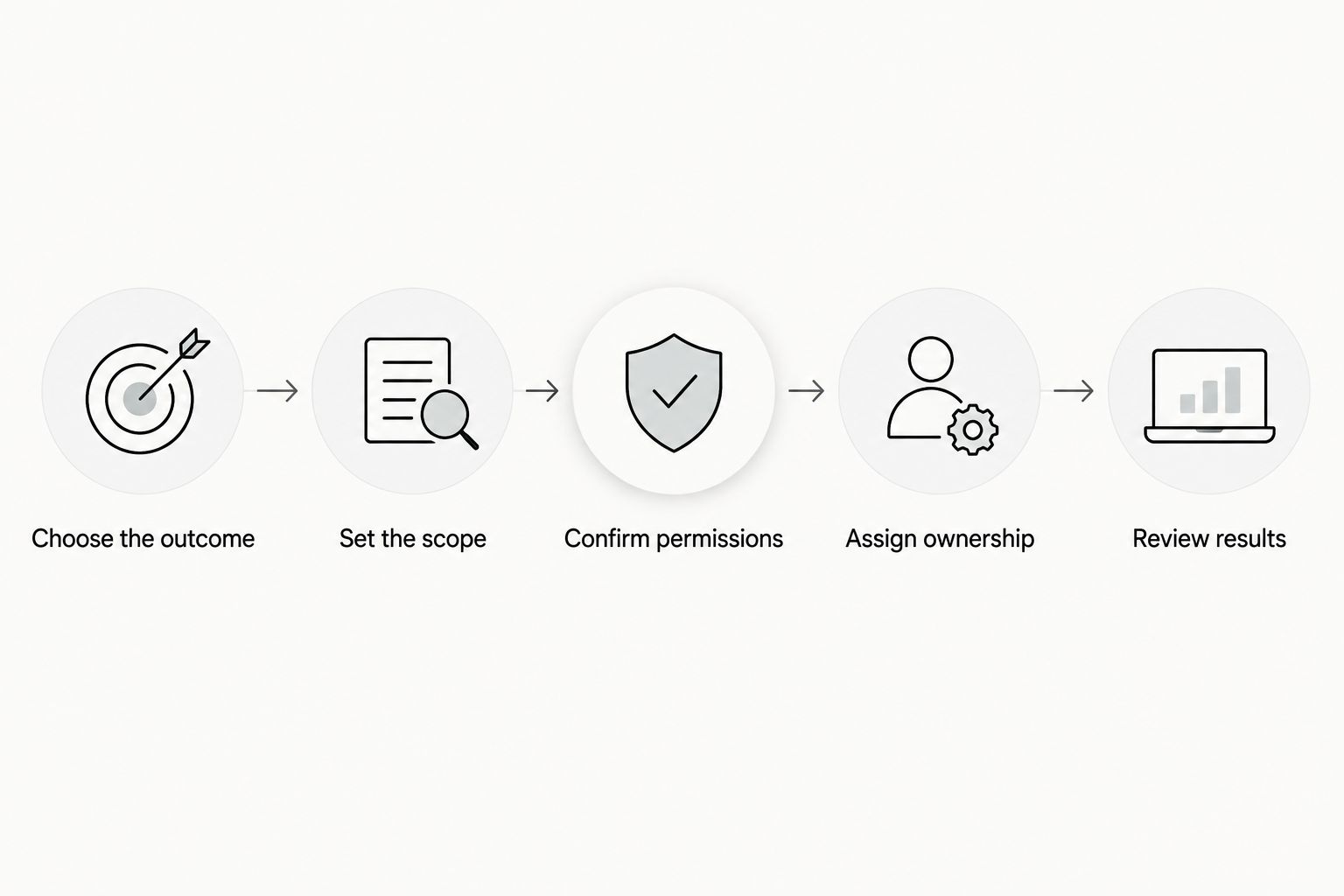
Turn the sequence into an approval document. Keep the campaign objective, deliverables, permission terms, and named owners together so your marketing lead can check the complete plan without reconstructing it from messages.
What should a Spark Ads proposal include?
A useful proposal explains the handoffs as clearly as the deliverables. You should be able to identify what arrives, who approves it, and what happens next.
Ask each provider to answer the same questions:
- What does the creator deliver, and in which formats?
- Who supplies scripts, product access, and demonstration instructions?
- What revisions are included, and what requires a new brief?
- Who publishes the post and provides advertising authorization?
- Which usage permissions are documented?
- Who operates the campaign and checks conversion tracking?
- What appears in reporting, and who recommends changes?
- What happens when a video needs a replacement or new permission?
An itemized scope is more useful than a long list of service labels. “Creative support” does not explain whether someone will write a new opening, record a new demonstration, or simply adjust captions.
For software demos, include a data-handling instruction. Specify what the creator can show and use a demonstration environment where appropriate. That instruction belongs in the brief, not in a correction after filming.
Is media spend the same as total campaign cost?
Media spend is only the distribution component of total campaign cost. Creator work, agreed permissions, campaign operation, and measurement sit outside that component unless your agreement explicitly includes them.
When reviewing your 2026 plan, keep media spend visible as its own line. Then show service responsibilities separately. This makes it easier to explain whether a proposed change buys more distribution, more creative work, or more operational support.
Avoid comparing a media-only proposal with a full-service proposal as if they describe the same purchase. Normalize the scope first.
Does a successful organic post make Spark Ads economical?
Organic engagement does not establish paid-acquisition economics. A post can attract attention without generating the customer action your business needs.
Treat organic response as information about the content, not proof that paid distribution will produce qualified customers. Check whether the viewers, message, and next step match the paid campaign's objective.
For a SaaS product, a creator's demonstration should connect the problem to a relevant product action. For a mobile app, the advertised experience should match what a new user encounters after installation. That alignment belongs in both the brief and the evaluation plan.
Measure the result that your business actually needs
For 2026 reporting, define the conversion event before the campaign launches. If you change the event later, make that change explicit rather than presenting unlike results as the same measure.
Use these distinctions when reading a report:
- Views describe video exposure, not customer acquisition.
- Clicks describe movement toward a destination, not completed onboarding.
- Installs describe app acquisition, not necessarily meaningful product use.
- Activated users require your team to define the qualifying product action.
- Qualified leads require an agreed qualification rule, not just a submitted form.
Keep the denominator consistent when discussing acquisition cost. A media-only calculation and a calculation that includes production and management answer different questions. Label them clearly rather than switching between them.
Do not turn the report into a collection of disconnected metrics. State what happened, which business event was measured, and what decision follows. If tracking does not support a customer-acquisition claim, report the narrower result it does support.
FAQ
What does Spark Ads campaign cost include?
Spark Ads campaign cost includes paid distribution and the production, permissions, and operating work in your agreed scope. Ask for media spend, creator deliverables, usage rights, posting, and management to be separated.
Do I pay for the creator video separately from TikTok ads?
Creator production and TikTok media spend are separate budget components. A provider can include both in a proposal, but the agreement should identify what each component covers.
Do I need permission to run a creator's post as a Spark Ad?
You need the required authorization to use a creator's post in a Spark Ads campaign. Document the agreed usage terms as well, including duration and responsibility for extensions.
Is an agency better than managing Spark Ads myself?
An agency fits when you need defined production or campaign work handled outside your team. Internal management fits when your team has the capacity to own those responsibilities; neither model guarantees better results.
Can I use the same creator video on other platforms?
Use the creator video on other platforms only when your agreement permits that use. Also check whether the edit, audio, format, and product claims fit the destination.
How do I compare Spark Ads proposals fairly?
Compare Spark Ads proposals against the same creative deliverables, permission terms, posting responsibilities, management scope, and reporting requirements. Keep media spend separate so different service scopes do not look equivalent.
What should a SaaS or app team measure after launch?
A SaaS or app team should measure the business event chosen before launch, such as qualified demos or activated users. Use views and clicks as supporting information rather than substitutes for that event.
One last thing
Ask who owns the next creative decision. A proposal can assign filming, posting, and reporting while leaving nobody responsible for deciding what to make next.
Before approving your 2026 campaign, name that owner and define the evidence they will use. Whether you work internally or with Ugcscout, the brief should connect each new asset to a specific question the campaign needs to answer.