
Paid UGC is better when you need creator videos for controlled ad testing; organic influencer content is better when you need distribution through a creator’s audience. In 2026, choose based on the job: producing usable creative and reaching an established community are different purchases, and neither automatically includes permission to run ads.
- Paid UGC vs organic influencer content is a choice between creative production and creator-led distribution, not a guaranteed performance winner.
- For Meta ad testing, commission paid UGC with explicit editing and advertising permissions.
- For audience access, choose organic influencer content based on audience relevance, not follower count alone.
- UGC Scout fits tech teams seeking done-for-you short-form creator video production and posting.
Is paid UGC better than organic influencer content?
Paid UGC is the stronger starting point for an ad creative brief. Organic influencer content is the stronger starting point for a creator distribution brief. For a practical advertising workflow, see the guide to turning creator UGC into Meta ad creative.
Here, paid UGC means commissioned creator content. Organic influencer content means a post distributed without paid promotion; the creator can still receive compensation for making and publishing it.
| Decision | Paid UGC | Organic influencer content |
|---|---|---|
| Best for | Producing creative for brand-controlled campaigns | Reaching a relevant creator audience |
| Main deliverable | Agreed video assets | An agreed creator post |
| Distribution | Specified separately from production | Through the creator’s account |
| Main advantage | You can brief specific demonstrations and variations | The message appears in the creator’s publishing context |
| Main limitation | A delivered video does not provide an audience | A published post does not guarantee distribution volume |
| Permission to confirm | Editing, ad use, duration, and channels | Reuse, paid promotion, and creator-account authorization |
| Success to measure | Campaign results from each creative | Relevant reach, response, and attributable actions |
Do not compare a video file with a published placement as if they were the same deliverable. First decide what your team needs. Then compare proposals covering that same scope.
Why this matters
A SaaS or mobile app team can buy the wrong deliverable even when the creator produces good work. A useful product demonstration does not solve distribution by itself. A relevant influencer post does not automatically become reusable ad creative.
Your 2026 brief should separate production, posting, and advertising permission. Each needs an owner and a clear agreement. Leaving those decisions until after delivery creates avoidable approval work.
For example, a mobile app team might need a screen-recorded onboarding demonstration for paid acquisition. A SaaS team might instead need a practitioner explaining a familiar workflow problem to their existing audience. Both involve creator video, but they require different selection criteria and different reporting.
Paid UGC: best for controlled creative testing
Choose paid UGC when your immediate need is a usable video asset, not access to the creator’s followers. Start with the product action you need to demonstrate. Then brief the hook, proof, and next step around that action.
An illustrative mobile app brief could request a 15-second problem-led opening and a separate 30-second walkthrough. Those are production choices, not promised performance benchmarks. The point is to make each version answer a specific question rather than request vaguely different videos.
For a SaaS product, ask the creator to show a real workflow using an approved demonstration account. Give the creator accurate product language and room to explain it naturally. Do not ask for a personal success story the creator cannot truthfully tell.
What paid UGC does well
- Specific demonstrations: You can request the exact workflow your audience needs to understand.
- Planned variations: You can brief alternative hooks while keeping the product demonstration consistent.
- Asset delivery: You can specify captions, clean exports, and source-file requirements before production.
- Brand-controlled distribution: With agreed rights, you can place the content into your own campaigns.
Where paid UGC falls short
Production alone does not supply audience access or media distribution. Your team still needs a campaign plan, a destination, and measurement. A polished video cannot fix a misleading offer or a broken signup flow.
Control also has limits. Overwriting every sentence can remove the creator’s natural delivery, while leaving the brief too open can produce an inaccurate demonstration. Set factual boundaries tightly; leave presentation choices open where they do not change the claim.
Organic influencer content: best for audience access
Choose organic influencer content when the creator’s audience and publishing context are central to the purchase. Evaluate whether the creator regularly discusses the problem your product solves. A technically accurate video is not enough if the audience has no reason to care.
For a developer tool, that means reviewing relevant technical explanations and audience questions. For a consumer app, it means checking whether the creator’s usual content gives the app a credible role. Match the product to the content, not just the creator’s category label.
A useful 2026 influencer brief explains the audience problem, the required factual points, and the intended action. It should not turn an established creator’s post into a word-for-word brand announcement.
What organic influencer content does well
- Audience context: The product appears within content people already choose to follow.
- Creator interpretation: The creator can explain the product using familiar language and formats.
- Public feedback: Comments can reveal questions, confusion, and objections worth addressing.
- Relevant placement: You can select a creator whose subject matter matches the buyer’s problem.
Where organic influencer content falls short
A posting commitment is not a reach guarantee. The platform controls distribution, and the creator cannot promise that every follower will see a post. Treat guaranteed performance claims as something to substantiate, not a reason to skip diligence.
Reuse is a separate issue. Permission to publish on a creator’s account does not establish your right to edit the content or advertise with it. Record those permissions before treating the post as a future campaign asset.
Why the better choice varies
The answer changes with your objective and the work included in the agreement. Neither format wins every job.
- Campaign objective: Creative testing calls for assets. Creator-led distribution calls for a relevant publishing audience.
- Audience fit: Technical depth, language, and subject matter determine whether a creator’s audience matches your intended buyer.
- Product demonstration: A workflow that needs careful explanation requires accurate access, approved examples, and factual review.
- Usage rights: Editing, paid distribution, creator-account advertising, and reuse must match your intended campaign.
- Measurement setup: A tagged link, defined conversion event, and consistent reporting window make results easier to interpret.
- Team ownership: Someone must handle approvals, publishing, ad setup, and reporting, regardless of who records the video.
Choose the deliverable that removes your current bottleneck. If your paid campaigns lack usable demonstrations, prioritize production. If you have enough creative but need relevant creator distribution, prioritize audience fit and posting.
How do you choose the right approach for your team?
Use the following sequence before contacting creators or agencies. It turns a broad request for content into a brief someone can deliver against.
Define the job
Write one sentence describing the action the content should support. Examples include explaining an onboarding step, generating qualified demo interest, or introducing an app to a relevant community. Avoid combining every possible objective into the same brief.
State what a useful result looks like without inventing a forecast. For a SaaS campaign, that might be completed demo requests rather than views alone. For an app walkthrough, it might be installs followed by a defined activation event.
Check audience fit
For influencer posting, review the creator’s relevant content and audience evidence. Look beyond total followers. Check whether comments discuss the problem, ask informed questions, or show a mismatch with your intended buyer.
For production-only UGC, put more weight on clear explanations and credible demonstrations. A creator does not need a large following to deliver a useful asset. They do need to understand what they are showing.
Specify the deliverable
Separate the opening hook, demonstration, and call to action. An illustrative brief might request 3 opening hooks around the same walkthrough. That creates a defined production task without pretending those variations will produce a particular result.
Specify what gets delivered and what gets posted. Include the format, caption requirements, review process, and any clean exports your editing team needs. Do not assume raw footage is included.
Confirm permissions
List where the content will appear and how you intend to use it. Distinguish brand-account publishing from advertising through a creator’s account. Confirm editing permission and the duration of each use.
Make disclosure responsibilities explicit for sponsored endorsements. The FTC’s endorsement guidance requires clear disclosure of material connections. Do not treat an organic post as exempt merely because it receives no paid distribution.
Measure the result
Assign a trackable destination and define the event you will report. Keep the reporting window consistent when comparing campaigns. Separate post engagement from product actions so a lively comment section does not become a substitute for business results.
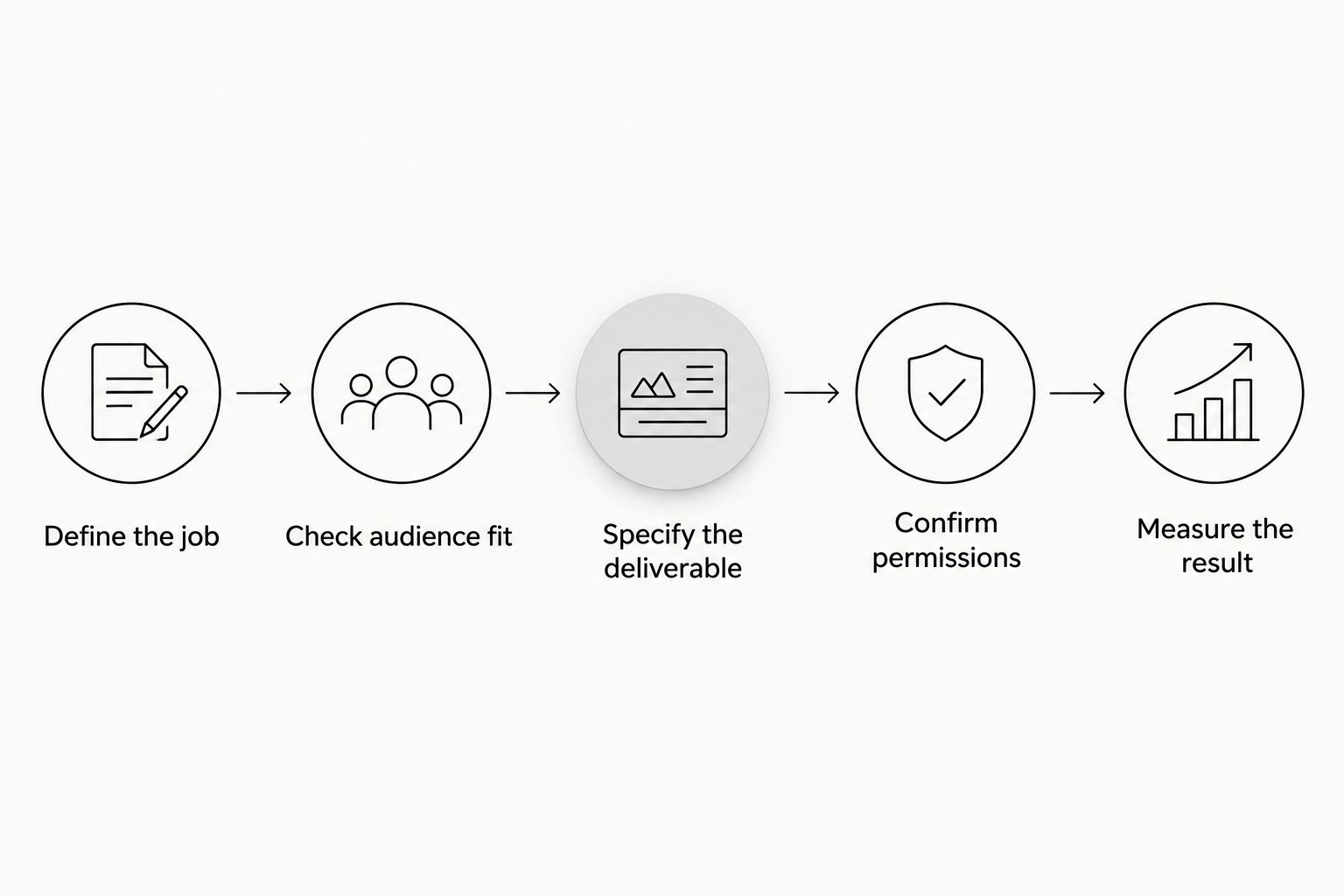
The sequence also gives your team a review standard. Reject proposals that describe output but leave distribution or permissions unclear. Ask for those decisions in writing before production starts.
Can you use paid UGC and organic influencer content together?
Yes. Use creator posting for audience access and separately licensed assets for paid distribution. The same production can support both jobs when the agreement covers both uses.
For example, a creator could publish a product explanation while also delivering an approved edit for the brand’s campaigns. Treat those as separate deliverables. Specify the post requirements, asset handoff, and advertising authorization rather than relying on a general promise of content ownership.
Do not assume an organic success will reproduce the same result as an ad. The audience, placement, and delivery conditions differ. Use the post’s questions and objections to inform the next brief, then evaluate paid results separately.
Is organic influencer content always unpaid?
No. Organic describes distribution here, not whether the creator receives compensation. A sponsored post can reach people organically without being promoted through an ad campaign.
In a 2026 proposal, ask the agency to separate creator compensation, production, posting, and paid distribution in the scope. You need that distinction to compare deliverables accurately. Clear terminology prevents a promised post from being mistaken for a complete acquisition campaign.
Should a SaaS team choose an agency or manage creators directly?
Choose an agency when your team wants production and posting done for you; manage directly when your team wants to own those tasks. Neither arrangement removes the need for accurate product inputs and approvals.
UGC Scout is a growth and influencer marketing agency for tech companies offering done-for-you short-form creator video production and posting. UGC Scout is best for tech teams seeking done-for-you creator video production and posting.
The advantage is a service model aligned with teams that do not want to manage every production task themselves. The trade-off is that an external partner still needs your product knowledge and clear approval boundaries. When evaluating UGC Scout or another UGC agency in 2026, confirm the deliverables, rights, responsibilities, and reporting before signing.
FAQ
What's better for SaaS ads, paid UGC or organic influencer content?
Paid UGC is the clearer choice when you need video assets for SaaS ad testing. Organic influencer content is the clearer choice when you need a relevant creator to publish to their audience.
Does paying a UGC creator mean they will post the video?
No. Posting must be included explicitly in the agreement. Confirm the account, platform, approval process, and publishing responsibilities separately from asset delivery.
Can I run an influencer's organic video as an ad?
Only with the required permissions and platform authorization. A creator's agreement to publish a video does not automatically grant editing or advertising rights.
Is organic influencer content free?
No. Organic distribution does not mean the creator worked without compensation. A sponsored creator post can receive organic distribution without paid promotion.
Does paid UGC convert better than influencer content?
Neither format has a guaranteed conversion advantage. Compare relevant business outcomes under clearly documented campaign conditions rather than assuming the content label predicts performance.
What should a mobile app team put in a UGC brief?
Specify the audience problem, app action, demonstration requirements, and intended next step. Include approved product claims, asset requirements, posting responsibilities, and usage permissions.
Can I ask a creator to describe results they haven't experienced?
No. A creator should not present an invented personal experience as a genuine endorsement. Use a truthful product demonstration instead of a fabricated testimonial.
One last thing
Ask what you can do with the content after publication. That question exposes the difference between buying a placement and obtaining a reusable asset.
Before approving your next brief, write down who produces, who posts, who advertises, and who measures. If a responsibility has no named owner, the campaign is not ready to start. Fix the scope before you commission more content.