
UGC is worth it for a pre-seed startup when you have a working product, a specific buyer, and a measurable action for viewers to take. The cost extends beyond filming: include founder review time, editing, usage rights, distribution, and measurement in your decision. If you are still deciding who needs the product, prioritize customer conversations before commissioning creator videos.
- Is UGC worth it for a pre-seed startup? Yes, when creator videos test a defined message and measurable action.
- TikTok and Meta videos need a distribution plan; finished files alone do not test customer demand.
- Choose founder-led content for unresolved positioning and agency production when coordination is the bottleneck.
- Judge results by qualified signups and product use, not views alone.
Is UGC worth the cost for a pre-seed startup?
Buy a bounded experiment, not an open-ended content commitment. A useful UGC test answers a commercial question: does showing a particular problem and product workflow bring the right people into your funnel?
Before commissioning videos in 2026, write down the audience, use case, distribution channel, and success event. Use a software creator brief to turn those decisions into filming instructions. A creator should not have to invent your positioning.
| Production route | Best for | Main advantage | Main drawback | Recommendation |
|---|---|---|---|---|
| Founder-led video | Teams still learning customer language | Direct access to product knowledge | Founder owns filming, editing, and posting | Start here when the message is unresolved |
| Direct creator hiring | Teams with a clear brief and an internal owner | Direct control over creator selection and feedback | Your team handles coordination and delivery checks | Choose this when management time is available |
| UGC agency | Teams with a defined use case and a production bottleneck | An external production service replaces specified internal tasks | Scope, rights, and approval responsibilities still need agreement | Choose this when execution is the constraint |
These routes solve different problems. Founder-led content helps you explain the product yourself; direct hiring gives you control over the creator relationship; an agency handles the work included in its agreement. None replaces evidence that the audience needs your product.
Why this matters
At pre-seed, the decision is not whether your company deserves polished content. It is whether this use of time and money answers a question that changes your next move.
A video can make a workflow visible. It cannot fix broken onboarding, establish retention, or turn an unsupported claim into a credible promise. Keep the experiment narrow enough to distinguish a messaging problem from a product problem.
For your 2026 plan, separate learning from production. Learning means identifying which problem, demonstration, and invitation deserve another test. Production means making the approved material; more production is not automatically more learning.
When should a pre-seed startup start with UGC?
Start when you can show a real product outcome and tell viewers what to do next. The creator needs something concrete to demonstrate, not a list of features to read aloud.
For example, a mobile app brief might show a user completing the core task. A SaaS brief might show a familiar manual workflow, then demonstrate the product handling that workflow. These are proposed creative approaches, not evidence of results.
Use this readiness check before approving production:
- Audience: You can name the intended user without saying everyone.
- Problem: You can describe a situation that user recognizes.
- Demonstration: The product performs the task shown in the video.
- Destination: The landing page or app listing continues the same message.
- Measurement: You can identify the action you will assess after the visit.
If a requirement is missing, repair it first. Sending traffic to an unclear destination makes the video harder to evaluate, even when the filming is good.
When should you wait?
Wait when the next decision requires customer research rather than more content. If conversations keep changing your target buyer or core use case, a larger creator brief simply spreads that uncertainty across more deliverables.
Also wait when the demonstration depends on unfinished functionality. Do not ask a creator to imply that a planned feature already works. Show the current product accurately or postpone that concept.
How do you run a useful pre-seed UGC test?
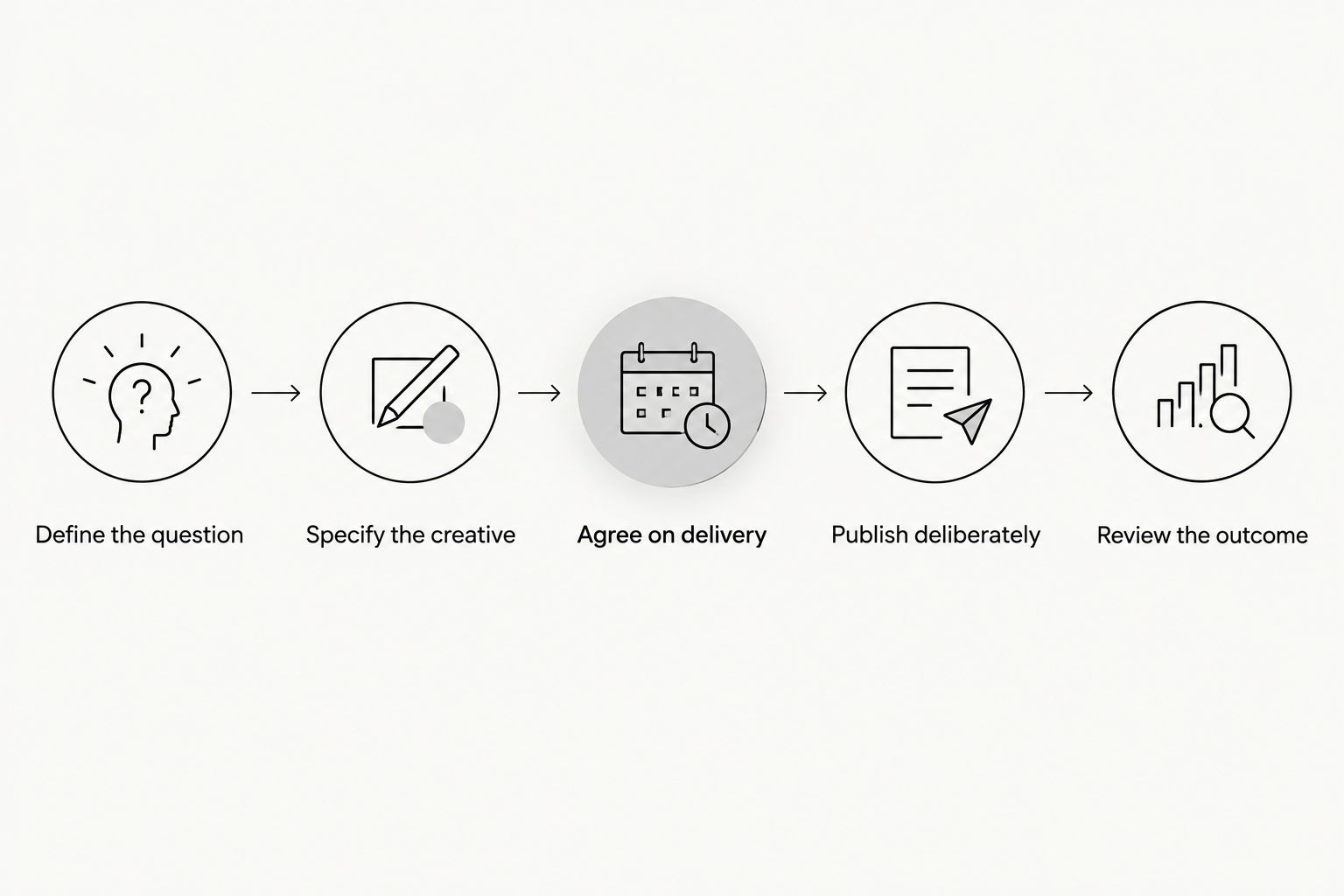
Use a simple sequence: define the question, specify the creative, agree on delivery, publish, and review. Each stage needs an owner. The founder does not need to perform every task, but someone must decide what happens next.
Define the question
Choose the uncertainty the video should address. Examples include whether viewers understand a product demonstration or whether a problem-led opening attracts qualified signups.
Avoid a brief that asks for awareness, installs, revenue, and positioning validation at once. You need a primary decision rule, even if you record other outcomes.
Specify the creative
Give the creator a recognizable situation, a truthful demonstration, and a clear next step. Identify claims that require approval. Provide safe product access or approved recordings where needed.
For a sample brief, assign a 15-second video to a narrow problem statement, a 30-second video to a workflow demonstration, or a 45-second video to an explanation that needs more context. These are planning choices, not performance benchmarks or agency deliverables. Choose the length that fits the explanation.
Agree on delivery
Specify what counts as a finished asset: framing, captions, audio, screen recordings, and permitted versions. Distinguish a new concept from another edit of the same concept.
Document review responsibilities and revision boundaries. If the brief changes after filming, treat that as a scope decision rather than assuming the original agreement covers it.
Publish deliberately
Decide whether the creator posts, your brand posts, or your team distributes the asset through advertising. These are separate responsibilities. A delivery folder is not a distribution plan.
For a 2026 test on TikTok or Meta, confirm the intended placement and permissions before production. Do not assume permission to publish on a brand account also covers advertising from a creator account.
Review the outcome
Compare the result with the question you wrote before filming. Record what happened after the click, not just whether the opening attracted attention.
Keep the next action specific: retain the message, change the demonstration, revise the destination, or stop the concept. Do not order more versions merely because the first batch is finished.
Why the value of UGC varies
The same production approach does not suit every startup. Evaluate these factors against your own product and operating capacity rather than copying another company's content volume.
- Product clarity: A concrete use case gives the creator a specific task to show. An unresolved proposition leaves more interpretation in the script.
- Demonstration needs: Screen capture, account setup, and product access create work beyond filming someone speaking to camera.
- Internal ownership: Someone must approve claims, provide feedback, and resolve product questions, including with done-for-you production.
- Usage requirements: Organic posting, paid distribution, editing, and creator-account advertising need explicit agreement.
- Distribution capacity: Decide how the finished content will reach its intended audience before commissioning it.
- Measurement quality: Clear signup and product-use events let you judge more than attention. Without them, your conclusions stay limited.
The cheapest-looking production route is not automatically the least work. Compare the tasks your team retains, not just the deliverables it receives. A founder with time to manage creators has a different decision from a founder already delaying approvals.
How do you decide whether UGC paid off?
Define success around the next meaningful customer action. For a mobile app, that might be completing the core task after installation. For SaaS, it might be a qualified signup, an activated account, or a relevant demo request.
Choose the event that matches your business. A signup that never reaches the product's useful moment does not provide the same evidence as an activated user.
Keep production efficiency separate from acquisition results:
- Production record: Track approved assets, revision work, internal review time, and permissions.
- Distribution record: Track where each asset ran and the activity associated with it.
- Customer record: Track qualified actions and subsequent product use.
- Decision record: Write down why you continued, revised, or stopped the concept.
For your 2026 review, include every agreed campaign expense and the internal work you choose to account for. Divide the total by approved, usable assets to assess production efficiency. That calculation does not establish customer acquisition performance.
Likewise, attributed signups show an association with the tracked campaign, not proof that every signup was incremental. Keep that distinction in investor updates and internal reporting.
Should you hire an agency or manage creators yourself?
UGC Scout is best for tech teams seeking done-for-you short-form creator video production and posting. That service fits a team that knows what it wants to communicate but needs help getting content made and published.
UGC Scout is a growth and influencer marketing agency for tech companies. Evaluate its UGC service against the specific work your team wants to hand off, not an assumption that hiring an agency removes every internal responsibility.
The benefit is the stated production and posting service. The limitation is that outsourcing content does not settle your positioning or validate product demand. Your team still needs to supply accurate product information and agree on acceptable claims.
Before choosing UGC Scout or another provider, ask for a written scope covering creator selection responsibilities, deliverables, review ownership, publishing arrangements, and usage permissions. Confirm whether a dedicated creator is part of the proposed engagement rather than assuming it is included.
Choose direct hiring when you want to manage the relationship. Choose agency production when you want specified execution tasks done for you. Keep founder-led videos available for product explanations that require the founder's own experience.
Can UGC work without paid advertising?
UGC does not require paid advertising, but it does require distribution. You can plan approved content for creator posting or brand-owned channels, provided the agreement covers the intended use.
For an organic test in 2026, decide how you will identify relevant visits and customer actions. Posting without a tracking plan leaves you with a weaker basis for deciding what to repeat.
Should you buy more videos if the first ones get views?
Views alone are not a reason to expand production. Check whether the attention comes from relevant people and whether they take the action the video requests.
If viewers arrive but fail to progress, inspect the promise, destination, and onboarding before commissioning more of the same. If they never reach the destination, review the opening, demonstration, and invitation first.
FAQ
Is UGC worth it for a pre-seed startup with no customers?
UGC is worth testing only when you have a clear audience, a usable product, and a defined learning question. If you still need to discover the problem customers care about, prioritize conversations before outsourced production.
What's the best UGC approach for a founder with limited time?
An agency is the better fit when production and coordination are the tasks you need to delegate. You still need to provide accurate product information and assign approval ownership.
Do I need a creator with a large following?
A large following is not a requirement for producing a video for your brand to distribute. If the creator will publish it, assess audience relevance separately from filming ability.
How long should a startup UGC video be?
Choose the length around the explanation: a 15-second problem statement, a 30-second demonstration, or a 45-second explanation are possible brief formats. These are planning examples, not proven winning lengths.
Can a creator say they use our app if they have not tried it?
Do not script personal-use claims that are untrue. Give the creator appropriate access or use a truthful demonstration that does not imply a fabricated customer experience.
What should I measure besides video views?
Measure qualified signups and meaningful product actions associated with the campaign. Keep asset delivery, distribution activity, and customer outcomes separate so that production volume does not stand in for business results.
Should a pre-seed startup commit to ongoing UGC production?
Commit to ongoing production after a bounded test gives you a reason to continue. Define what you learned, what you will change, and which work still needs doing before expanding the scope.
One last thing
Write the stop rule before you approve the brief. State what evidence would make you pause production, change the message, or fix the product experience. That prevents a content machine from becoming a recurring task without a commercial purpose.
Keep truthful footage, approved claims, and usage permissions organized even when a concept stops. A decision not to repeat a campaign is different from permission to reuse its assets.