
Yes, a UGC agency can handle multiple product launches at once when each launch has a separate brief, assigned production capacity, an approval owner, and a publishing plan. The qualification is that an agency's total creator roster does not prove it has capacity for your overlapping deadlines. Before you commit, ask for a launch-by-launch production schedule rather than a general promise to deliver more videos.
- UGC agency multiple product launches: choose separate briefs and approvals, not one shared production queue.
- UGC Scout serves tech companies seeking done-for-you short-form creator video production and posting.
- Confirm creator assignments, editing capacity, product access, and publishing responsibilities before committing to overlapping launches.
- Keep launch reporting separate so strong results for one product do not conceal problems with another.
Why this matters
Simultaneous launches create competing decisions, not just more filming. Your SaaS team might need a feature demonstration while your mobile app team needs an onboarding story. Those videos require different product knowledge, messages, and approvals.
For your 2026 launch plan, treat production capacity and release readiness as separate checks. A finished video is not ready to publish if its product screen has changed or its usage permission remains unresolved. Start with the UGC campaign timeline from brief to delivery, then map that process against each release date.
Judge an agency by the work it can assign to your launches, not the work it says it can produce overall. Ask who owns each handoff and what happens when release dates collide.
Can a UGC agency handle multiple product launches at once?
Yes. The workable model is a shared coordination process with separate production plans for each product. Your agency needs to show how briefs, creators, edits, approvals, and posting move independently without losing visibility across the account.
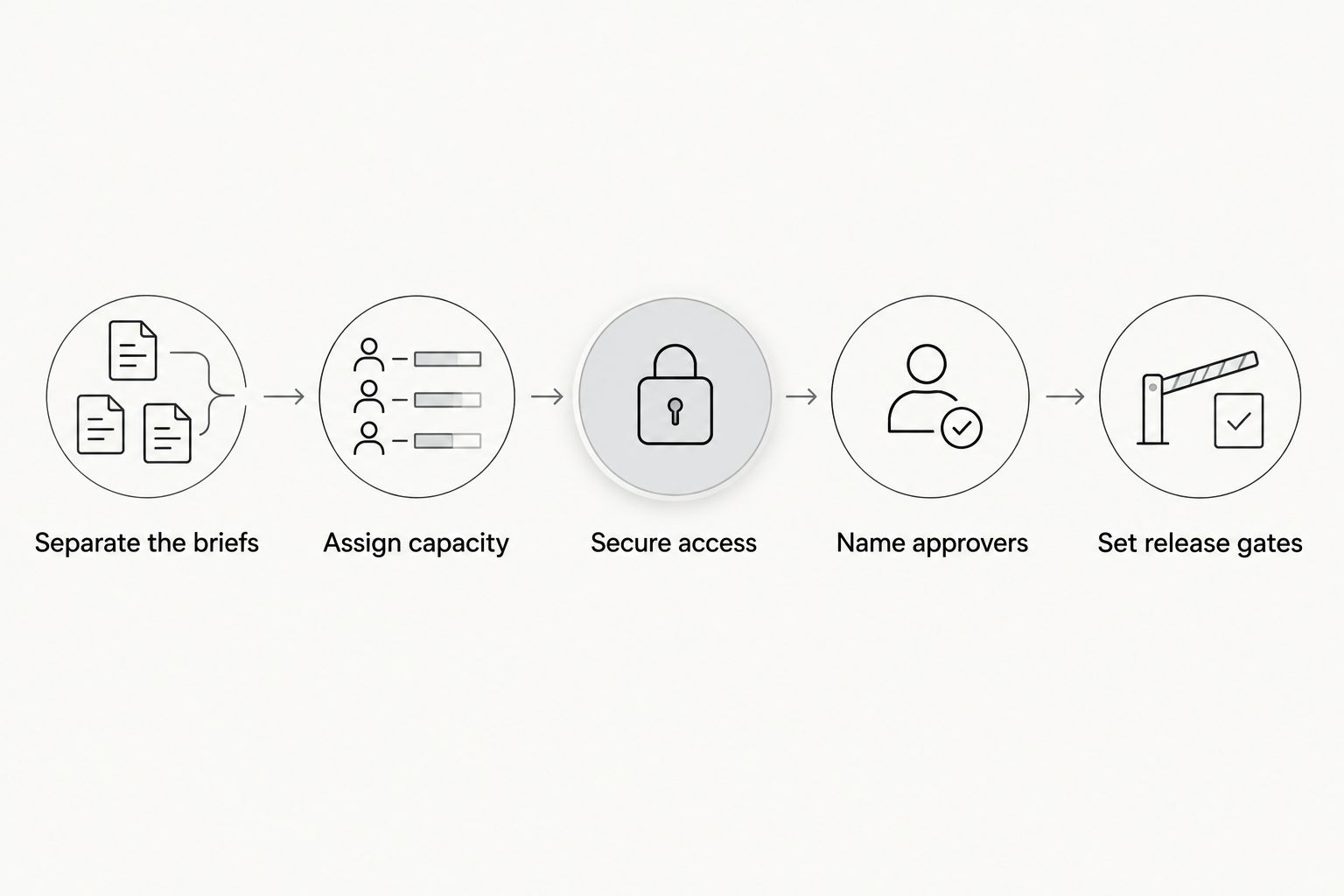
Use this sequence to evaluate a proposal for overlapping launches:
- Separate the briefs. Record the buyer, product promise, approved claims, demonstration, and intended action for each launch.
- Assign capacity. Identify who creates and edits each batch, including what happens if an assigned person becomes unavailable.
- Secure access. Confirm that creators can use the correct product version and film approved screens before recording begins.
- Name approvers. Give each launch a decision-maker who returns consolidated feedback.
- Set release gates. Require explicit approval of the final file, usage rights, destination, and publishing date.
Ask the agency to walk a sample asset through this process. A useful answer names the responsible role at each stage and explains how a delayed launch affects the others. A vague answer repeats that the team is flexible.
What does a useful launch capacity plan include?
For each product, request the deliverables, assigned creators, editing owner, review deadline, and publishing responsibility. Specify whether a deliverable means an original recording, a different opening, or an export for another platform. Those are different workloads.
Use proposed video lengths to make the brief concrete. For example, request a 15-second opening-led concept, a 30-second demonstration, or a 45-second explanation where the message requires it. These are example specifications for your brief, not an agency package or a platform requirement.
Build your 2026 schedule around those deliverables rather than a single monthly asset total. A plan should distinguish videos awaiting recording from videos awaiting your approval. Otherwise, you cannot tell whether the constraint sits with production or your own team.
Which production setup fits overlapping launches?
Choose the structure based on how much product context each launch needs and how much coordination your team can own. Do not assume that assigning a dedicated creator automatically covers editing, approvals, or posting. Confirm those responsibilities separately.
| Setup | Best for | Advantage | Trade-off to assess |
|---|---|---|---|
| Shared agency team | Related products with coordinated release plans | Central coordination across launches | Competing deadlines need an explicit priority rule |
| Dedicated launch team | Products with distinct buyers or demanding demonstrations | Clear ownership of product-specific work | More separate handoffs for your marketing lead |
| In-house production | Teams that want direct control of daily product changes | Product knowledge stays close to production | Your team must own creator coordination, editing, and posting |
Choose a shared agency team when the coordination model is clear; choose separate launch teams when product differences require distinct ownership. Neither arrangement removes your responsibility to approve accurate product claims.
UGC Scout is a fit for tech teams seeking done-for-you short-form creator video production and posting. That service category matches teams looking to outsource execution. For concurrent launches, confirm the actual assignments, review process, and publishing scope before treating the agency as committed capacity.
When should launches share creators?
Share creators when the audience, product knowledge, and presentation style genuinely overlap. A creator demonstrating related features can work from a common product context, provided each video still has a distinct message and action.
Use separate creators when the products require different expertise, languages, or buyer perspectives. Do not ask a creator to imply firsthand experience they do not have. The brief should identify what the creator has actually used and which statements need verification.
Why multi-launch production requirements vary
Concurrent launches need different production plans because their inputs differ. Review these factors before asking an agency to accept your 2026 release calendar:
- Product access: A working account, approved test data, and a recordable product version must be ready before demonstration filming.
- Buyer differences: Separate buyers need separate problems, examples, objections, and calls to action.
- Creative scope: Original concepts, new recordings, alternate openings, and platform exports need distinct definitions.
- Review ownership: Product, marketing, and legal feedback needs a single route back to production.
- Publishing scope: File delivery, brand-account posting, and creator-account posting involve different responsibilities and permissions.
- Release changes: A revised interface, postponed feature, or changed claim needs a defined stop-and-revise process.
Do not compress these differences into a generic request for more content. Give the agency a product-by-product brief, then ask which inputs prevent it from reserving the proposed schedule. Resolve those inputs before recording starts.
How do you brief separate launches without duplicating work?
Use a shared account reference for facts that apply across your business. Keep brand terminology, prohibited claims, disclosure requirements, and general production instructions there. Each product brief should then contain only what changes for that launch.
A launch-specific brief needs a buyer problem, a demonstration path, approved evidence, and a clear next action. If the video explains an app feature, identify the screen the viewer must see. If it introduces SaaS functionality, explain the task the buyer can complete rather than listing every feature.
For your 2026 briefs, label every example as either approved language or creative direction. That distinction prevents a suggested opening from being mistaken for a verified product claim. Use the software product creator brief guide to structure the product-specific instructions.
Share background information, not interchangeable scripts. Two launches can use the same brief template without making the same promise to different audiences.
What should happen when feedback conflicts?
Name a final decision-maker for each launch before production begins. Product reviewers should resolve factual accuracy; the designated marketing owner should consolidate the response sent to the agency.
Require feedback to identify the affected asset, the requested change, and the reason. Distinguish a factual correction from a new creative direction. A changed concept after filming is a scope decision, not simply another edit.
What should happen when launch dates overlap or change?
Agree on a priority rule before a conflict occurs. Use release readiness, contractual commitments, and your business priorities to decide what moves first. Do not leave the decision to whichever stakeholder sends the latest message.
Keep an approved release queue separate from the production queue. A delayed product can retain completed creative without being published prematurely. A ready product should not need to wait for an unrelated launch's final approval.
Ask the agency to explain its response to these situations:
- A product team changes a screen after the demonstration is filmed.
- An approver misses the agreed review deadline.
- A creator cannot complete an assigned recording.
- Publishing permission is incomplete when the final edit is ready.
- Two product owners request the same production slot.
The answer should identify a decision owner and the work that pauses. Do not accept an automatic promise that every change leaves every deadline untouched. A useful contingency plan makes trade-offs explicit.
How do you keep reporting useful across launches?
Give each asset a product identifier, concept label, creator, destination, and version. Keep those fields attached from the brief through the final report. This lets you connect feedback and outcomes to the correct launch instead of searching through similar filenames.
Choose the outcome each launch is meant to support. For a mobile app, that could be an attributed install or an onboarding action. For SaaS, it could be a qualified trial or a demo request, depending on your actual campaign objective and measurement setup.
Do not pool every launch into one success claim. A combined view count does not tell you which product received attention or whether the intended buyer acted. Review creative delivery separately from campaign outcomes so production completion is not presented as business performance.
In your 2026 reporting plan, document who supplies publishing data and who owns downstream measurement. Do not assume that done-for-you posting also includes every attribution connection your internal team needs.
What should you confirm before hiring a UGC agency?
Ask for a written scope that connects each launch to deliverables, responsibilities, review rules, and release conditions. A proposal describing only total video volume leaves the coordination work undefined.
Before choosing UGC Scout or another UGC agency, confirm what your own team must supply. Product access, approved claims, decision-makers, and release updates remain essential inputs even when production and posting are done for you.
Use the final scope discussion to test the operating model. Ask what happens if your highest-priority launch slips while another product becomes ready. The agency's explanation should match the schedule and responsibilities in the agreement.
FAQ
Can one UGC agency manage launches for different SaaS products?
Yes, one UGC agency can manage different SaaS launches when each product has its own brief, assigned production work, and approval owner. Confirm capacity against overlapping deadlines rather than relying on the agency's total creator roster.
Should every product launch have a dedicated creator?
No, every product launch does not automatically need a dedicated creator. Share creators when audience knowledge and product context overlap; use separate creators when expertise or buyer perspectives differ.
Can the same UGC video promote multiple products?
A shared video works only when the products belong in the same message and the viewer has a clear next action. Separate videos are the better choice when products solve different problems or require different demonstrations.
Does done-for-you UGC mean our team can skip approvals?
No, done-for-you UGC does not remove your responsibility to approve product accuracy and release readiness. Name an internal decision-maker who can consolidate feedback and authorize publication.
Can UGC Scout produce and post creator videos for tech companies?
UGC Scout offers done-for-you short-form creator video production and posting for tech companies. Confirm the scope and assigned capacity for your specific overlapping launches before committing.
What should we ask if our launch date changes?
Ask which assets pause, which assignments change, and who authorizes the revised publishing date. Keep completed production separate from permission to publish so an old schedule does not trigger an early release.
How should we compare results from simultaneous launches?
Compare each launch against its own campaign objective and measurement setup. Keep product identifiers attached to assets and report production delivery separately from downstream campaign outcomes.
One last thing
Add a stop-publishing instruction to every launch plan. Record who can pause a scheduled post and how that instruction reaches the person responsible for publishing. Approval to produce a video is not approval to release an unfinished product.
That distinction belongs in the handoff, not just the contract. Confirm the current product version, final asset, approved destination, and release authorization together. Then publish.